

Currently Empty: ر.ق 0,00


IELTS
IELTS Speaking Practice Test: Questions and Answers
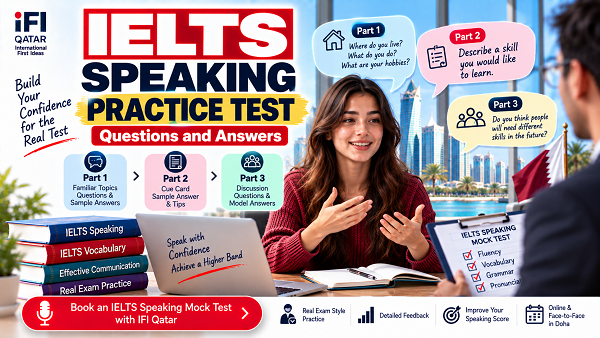
An IELTS Speaking practice test is one of the most effective ways to prepare for the real Speaking exam because it allows you to practise answering questions under conditions that are closer to the actual test.
Reading IELTS Speaking questions is useful, but it is not the same as answering them spontaneously while speaking to another person. A realistic practice test can help you identify problems with fluency, vocabulary, grammar, pronunciation and answer development before test day.
The official IELTS Speaking test lasts 11–14 minutes and consists of three parts. Part 1 covers familiar topics, Part 2 requires a longer individual talk after one minute of preparation, and Part 3 develops into a more general and abstract discussion. Speaking is assessed on four criteria: Fluency and Coherence, Lexical Resource, Grammatical Range and Accuracy, and Pronunciation.
This IELTS Speaking practice test provides realistic practice questions and sample answers for all three parts, along with strategies for developing stronger answers and using a mock Speaking test effectively.
Important: The questions and sample answers in this article are original practice material. They are not leaked IELTS questions and should not be treated as guaranteed questions for a future test.
What Is an IELTS Speaking Practice Test?
An IELTS Speaking practice test is a simulated Speaking session designed to help you practise the format, question types and communication skills required in the real IELTS Speaking test.
A useful practice test should give you the opportunity to:
- Answer Part 1 questions naturally
- Speak for up to two minutes in Part 2
- Discuss broader issues in Part 3
- Develop answers instead of giving one-sentence responses
- Practise speaking without memorising scripts
- Improve fluency and pronunciation
- Use a wider range of vocabulary
- Express opinions and explain reasons
- Respond to unexpected questions
- Identify recurring mistakes
The goal is not simply to answer as many questions as possible.
The real value comes from answering, recording, reviewing and improving your performance.
How Does the IELTS Speaking Test Work?
The IELTS Speaking test is a face-to-face interview with a trained examiner and is recorded. It consists of three parts and normally lasts 11–14 minutes.
| Part | Approximate time | What you do |
|---|---|---|
| Part 1 | 4–5 minutes | Answer questions about familiar topics |
| Part 2 | 3–4 minutes including preparation | Speak about a topic from a task card |
| Part 3 | 4–5 minutes | Discuss broader and more abstract questions |
The Speaking test is the same for IELTS Academic and IELTS General Training.
IELTS Speaking Part 1
Part 1 is an introduction and interview.
The examiner asks questions about familiar subjects such as:
- Home
- Family
- Work
- Studies
- Hobbies
- Food
- Daily routines
- Friends
- Technology
- Free time
The questions are relatively familiar, but you still need to answer naturally and develop your ideas.
IELTS Speaking Part 2
In Part 2, you receive a task card with a topic and points to help you organise your response.
You have one minute to prepare, including making notes, and then speak for up to two minutes.
This part tests your ability to:
- Speak at length
- Organise ideas logically
- Use appropriate vocabulary
- Describe experiences
- Explain ideas
- Maintain a continuous response
IELTS Speaking Part 3
Part 3 is a more general discussion related to the Part 2 topic.
The questions are usually more abstract and may ask you to:
- Give opinions
- Explain causes
- Discuss advantages and disadvantages
- Compare situations
- Predict future developments
- Analyse social issues
- Justify your ideas
Part 3 normally lasts around 4–5 minutes.
How Is IELTS Speaking Scored?
Your Speaking performance is assessed using four criteria, each of which contributes equally to the overall Speaking score.
| Criterion | What you should demonstrate |
|---|---|
| Fluency and Coherence | Speak continuously and organise ideas clearly |
| Lexical Resource | Use appropriate and flexible vocabulary |
| Grammatical Range and Accuracy | Use a range of structures with appropriate accuracy |
| Pronunciation | Speak clearly enough to be understood without undue effort |
The official band descriptors show that higher performance involves greater control, flexibility and development across these areas. For example, Band 7 performance includes speaking at length without noticeable effort or loss of coherence, while Band 8 requires a wider and more flexible vocabulary and generally strong control of grammatical structures.
IELTS Speaking Practice Test Part 1: Questions and Answers
Let’s begin with a Part 1 practice test.
For realistic preparation, try to answer each question before reading the sample answer.
Do not memorise the sample answers.
Instead, use them to understand how an answer can be developed naturally.
Topic 1: Home
Question 1: Where do you live?
Sample Answer:
I live in Doha, Qatar. I’ve been living there for several years, and I really enjoy it because it’s a modern and diverse city. There are plenty of things to do, and I also find it quite convenient for my daily life.
Question 2: What do you like about the place where you live?
Sample Answer:
What I like most is the combination of modern facilities and different cultural influences. There are lots of restaurants, shopping centres and public spaces, so I rarely feel that there’s nothing to do. I also like meeting people from different backgrounds.
Question 3: Is there anything you would like to change about your home?
Sample Answer:
Yes, I’d probably make my home a little more spacious. It’s comfortable at the moment, but I’d like to have a separate study area where I could work or study without distractions.
Question 4: Would you like to live somewhere else in the future?
Sample Answer:
Possibly. I’d like to experience living in another country for a few years, mainly because I think it would be interesting to experience a different culture and lifestyle. However, I wouldn’t necessarily want to move permanently.
Why Is This a Stronger Part 1 Answer?
Notice that the answers are not extremely long.
The speaker:
- Answers the question directly
- Adds a reason
- Gives a relevant detail
- Sometimes gives a personal example
You do not need to give a two-minute speech for every Part 1 question.
Topic 2: Work or Studies
Question 1: Do you work or are you a student?
Sample Answer:
At the moment, I’m working, and most of my responsibilities are related to digital marketing. I particularly enjoy the creative side of my work because I get to solve different problems rather than doing exactly the same thing every day.
Question 2: What do you enjoy about your work or studies?
Sample Answer:
I enjoy learning new things. The field changes quite quickly, so I have to keep updating my knowledge and experimenting with different approaches. I find that challenging, but it’s also what makes the work interesting.
Question 3: What would you like to change about your work or studies?
Sample Answer:
I’d probably like to have a little more flexibility in my schedule. Having greater control over when I work would make it easier to balance professional responsibilities with personal activities.
Question 4: Do you think you will continue doing the same thing in the future?
Sample Answer:
I think I’ll stay in the same general field, but I’d like to take on more responsibility over time. I’d also like to develop some specialised skills that could allow me to work on more complex projects.
Topic 3: Free Time
Question 1: What do you usually do in your free time?
Sample Answer:
I usually try to do something that helps me relax after work. I might watch a film, meet friends or go for a walk. If I have more time, I enjoy taking short trips because they give me a chance to get away from my normal routine.
Question 2: Do you prefer spending your free time alone or with other people?
Sample Answer:
It depends on my mood. If I’ve had a busy week, I usually prefer some quiet time by myself. At weekends, though, I enjoy meeting friends because socialising helps me relax in a different way.
Question 3: Do you think people have enough free time today?
Sample Answer:
Probably not. Many people have demanding jobs and spend a considerable amount of time commuting or dealing with other responsibilities. As a result, they may have very little time left for hobbies or social activities.
Topic 4: Technology
Question 1: How often do you use your phone?
Sample Answer:
I use it throughout the day for both work and personal reasons. I use it to communicate with people, check information, manage my schedule and sometimes relax by watching short videos or listening to music.
Question 2: What do you mainly use your phone for?
Sample Answer:
Communication is probably the main reason. I use messaging apps quite frequently, but I also use my phone for work-related tasks, navigation and online banking. It’s become difficult to imagine managing daily life without it.
Question 3: Has technology changed the way you communicate?
Sample Answer:
Definitely. Communication has become much faster and more convenient. We can contact people almost instantly, even when they’re in another country. However, I think this convenience sometimes means that people have fewer face-to-face conversations.
IELTS Speaking Practice Test Part 2: Cue Card and Sample Answer
Now let’s move to Part 2.
Remember that in the real test you have one minute to prepare before speaking.
IELTS Speaking Part 2 Practice Question
Describe a skill you would like to learn.
You should say:
- What the skill is
- Why you want to learn it
- How you would learn it
- And explain how this skill would be useful to you
How to Prepare in One Minute
Do not write complete sentences.
Instead, create a few keywords:
Skill: photography
Why: creative / useful
Learn: online course / practice
Useful: work / travel / memories
These notes are enough to remind you what to say.
Sample Answer
A skill I’d really like to learn is photography. I’ve always enjoyed taking pictures when I travel, but at the moment I mostly use my phone and rely on automatic settings.
The main reason I’d like to learn photography properly is that I want to become more creative. I think understanding things like lighting, composition and camera settings would allow me to take much better pictures rather than simply pointing the camera at something interesting.
I’d probably start by taking an online course because there are many practical courses available for beginners. After learning the basics, I’d spend time practising outdoors and experimenting with different types of photography. I could also look at photographs taken by experienced photographers and try to understand why certain images are visually effective.
I think this skill would be useful in several ways. First, it would give me a creative hobby that I could enjoy in my free time. More importantly, it would help me capture better memories when travelling. I might even be able to use photography professionally in the future.
So overall, it’s a skill I’d definitely like to develop because it combines creativity, practical knowledge and something I already enjoy doing.
How to Structure Your IELTS Speaking Part 2 Answer
A useful way to organise your response is:
Introduction → Background → Details → Example → Personal reaction → Conclusion
For example:
I’d like to talk about…
Then:
The reason I chose this is…
Then:
One particular thing about it is…
Then:
For example…
Then:
What I particularly like is…
Finally:
Overall, I’d say…
This gives you a logical structure without forcing you to memorise a fixed script.
IELTS Speaking Part 2 Practice Questions
Try answering these cue cards under realistic conditions.
Cue Card 1: A Memorable Trip
Describe a trip that you remember well.
You should say:
- Where you went
- Who you went with
- What you did
- And explain why you remember it.
Cue Card 2: A Useful Piece of Technology
Describe a piece of technology that you use regularly.
You should say:
- What it is
- How you use it
- When you started using it
- And explain why it is useful.
Cue Card 3: A Person Who Influenced You
Describe a person who has had an important influence on you.
You should say:
- Who the person is
- How you know them
- What they did
- And explain how they influenced you.
Cue Card 4: A Place You Enjoy Visiting
Describe a place you enjoy visiting.
You should say:
- Where it is
- How often you visit
- What you do there
- And explain why you like it.
IELTS Speaking Practice Test Part 3: Questions and Answers
Part 3 requires a different approach from Part 1.
Instead of focusing mainly on personal experiences, you should be prepared to discuss broader issues and explain your ideas.
Topic: Technology and Communication
Question 1: How has technology changed communication?
Sample Answer:
Technology has made communication significantly faster and more accessible. People can now communicate instantly across long distances using messaging applications, video calls and social media. This has made international communication much easier, particularly for people who live far away from their families. However, I think there is also a downside because some people may rely too heavily on digital communication and spend less time having face-to-face conversations.
Question 2: Do you think people communicate better now than in the past?
Sample Answer:
In some ways, yes, but I wouldn’t say communication is necessarily better overall. People can exchange information much more quickly today, and technology makes it easier to stay in contact. On the other hand, the quality of communication can sometimes be lower because short messages don’t always convey emotions or meaning accurately. So I think we’ve become more connected, but not necessarily better communicators.
Question 3: How might communication change in the future?
Sample Answer:
I expect communication to become even more immediate and personalised. Artificial intelligence and other technologies may make translation and real-time communication between different languages much easier. At the same time, I think there will probably be a growing interest in authentic face-to-face interaction because people may become tired of spending so much time communicating through screens.
A Useful Structure for IELTS Speaking Part 3 Answers
When you need to answer a difficult Part 3 question, try:
Opinion → Reason → Example → Result
For example:
Opinion: I think remote working will remain popular.
Reason: It gives employees greater flexibility.
Example: Parents may be able to organise their working hours around family responsibilities.
Result: As a result, companies may be able to attract employees who value flexibility.
This structure helps you avoid giving short answers that stop after one sentence.
How to Give Longer IELTS Speaking Answers
Many candidates understand the question but stop speaking too quickly.
For example:
Question:
Do you enjoy travelling?
Weak answer:
Yes, I do. I really enjoy travelling.
The answer is grammatically correct, but it does not give the examiner much evidence of your speaking ability.
A more developed answer could be:
Yes, definitely. I enjoy travelling because it gives me an opportunity to experience different cultures and get away from my normal routine. I particularly enjoy visiting places where I can try local food and explore the area on foot. Even short trips can be quite refreshing.
The objective is not to speak for as long as possible.
The objective is to develop your answer naturally.
How to Improve Fluency in an IELTS Speaking Practice Test
Fluency is not simply speaking quickly.
Official IELTS assessment guidance focuses on continuity, rate, effort, logical sequencing and appropriate use of cohesive devices.
To improve fluency:
Speak in Meaningful Chunks
Instead of thinking about every individual word, organise your speech into ideas.
For example:
One of the main reasons / I enjoy living there / is the convenience.
Avoid Excessive Self-Correction
Correcting every small mistake can interrupt your communication.
If the meaning is already clear, continue speaking.
Practise Without Stopping
Choose a topic and speak for:
- 30 seconds
- 60 seconds
- 90 seconds
- 2 minutes
Record yourself and listen afterwards.
How to Improve IELTS Speaking Vocabulary
You do not need to use complicated vocabulary in every answer.
Instead, focus on:
- Topic-specific vocabulary
- Natural collocations
- Paraphrasing
- Precise word choice
- Vocabulary you can use confidently
For example, instead of repeatedly saying:
very important
you might use:
- essential
- particularly significant
- extremely valuable
- a major factor
But only use these expressions when they accurately communicate your meaning.
The official Speaking criteria assess the range, accuracy and appropriacy of vocabulary, including the ability to paraphrase when necessary.
How to Improve IELTS Speaking Grammar
A strong Speaking performance requires both range and accuracy.
Practise combining:
- Simple sentences
- Compound sentences
- Complex sentences
- Conditional sentences
- Relative clauses
- Comparison structures
- Cause-and-effect structures
For example:
Basic:
I like working online. It is convenient.
More developed:
I like working online because it gives me more flexibility, particularly when I need to manage several responsibilities at the same time.
The goal is not to make every sentence complicated.
It is to demonstrate a natural variety of structures while maintaining control.
How to Improve IELTS Speaking Pronunciation
Good pronunciation does not mean having a particular native accent.
The important objective is clear communication.
Practise:
- Word stress
- Sentence stress
- Intonation
- Individual sounds
- Connected speech
- Pausing
- Clear endings
The official IELTS Speaking criteria assess pronunciation based on how effectively the speaker communicates and how easily they can be understood.
Record yourself regularly and listen for words that are difficult to understand.
Should You Memorise IELTS Speaking Answers?
No.
Memorising complete answers can make your speech sound unnatural and can leave you unprepared when the examiner asks a slightly different question.
Instead, prepare:
- Vocabulary
- Ideas
- Examples
- Useful phrases
- Answer structures
- Topic knowledge
For example, if you prepare the topic technology, you can develop ideas about:
- smartphones
- social media
- artificial intelligence
- communication
- education
- online work
You can then adapt these ideas to different questions.
IELTS Speaking Mock Test vs Practising Questions Alone
Both methods are useful, but they serve different purposes.
| Practice method | Main benefit |
|---|---|
| Answering questions alone | Builds familiarity |
| Recording yourself | Helps identify speaking problems |
| Practising with a partner | Develops interaction |
| Speaking with a teacher | Provides targeted feedback |
| Mock Speaking test | Simulates the exam experience |
A mock test is particularly valuable because you have to respond continuously without stopping to look up vocabulary or prepare the perfect answer.
How to Take an IELTS Speaking Practice Test at Home
You can create a realistic practice session yourself.
Step 1: Prepare a Quiet Space
Remove distractions and sit somewhere where you can speak comfortably.
Step 2: Use a Timer
Follow the approximate structure of the real test.
Step 3: Record Yourself
Use your phone or computer to record the entire session.
Step 4: Do Not Stop the Recording
If you make a mistake, continue.
This gives you a more realistic picture of your fluency.
Step 5: Review Your Performance
Listen to your recording and identify:
- Long pauses
- Repeated words
- Grammar mistakes
- Pronunciation problems
- Very short answers
- Ideas that were not developed
Step 6: Repeat the Test
After practising your weaknesses, record the same type of test again.
Compare your performance.
How to Take a Professional IELTS Speaking Mock Test
Self-practice is useful, but it can be difficult to evaluate yourself objectively.
A structured mock test with a teacher or IELTS mentor can provide feedback on areas that you may not notice yourself.
IFI Qatar currently offers Speaking Partner sessions designed around real-exam-style Speaking practice, with practical feedback. Its current programme includes online and face-to-face options.
A professional Speaking practice session can help you identify:
- Fluency problems
- Weak answer development
- Vocabulary limitations
- Grammar patterns
- Pronunciation issues
- Part 2 organisation
- Part 3 reasoning
- Confidence under pressure
When Should You Take an IELTS Speaking Mock Test?
There is no single perfect time for everyone.
However, a useful preparation sequence is:
First mock test: Establish your current level.
Targeted practice: Work on your biggest weaknesses.
Second mock test: Measure your progress.
Final mock test: Check your readiness before the official exam.
The important point is what you do between mock tests.
Taking several tests without analysing your mistakes is much less useful than taking fewer tests and acting on detailed feedback.
IELTS Speaking Practice Test Self-Assessment
After completing your practice test, score yourself using these questions.
Fluency and Coherence
- Did I speak continuously?
- Did I pause too often?
- Did I repeat the same words?
- Did I develop my ideas logically?
- Could I speak for the required length?
Lexical Resource
- Did I use a reasonable range of vocabulary?
- Did I repeat basic words?
- Could I paraphrase when necessary?
- Did I use words accurately?
Grammar
- Did I use different sentence structures?
- Were my sentences generally accurate?
- Did I make repeated grammar mistakes?
- Could I use complex structures naturally?
Pronunciation
- Was my speech easy to understand?
- Did I stress important words?
- Was my intonation natural enough?
- Were individual sounds causing confusion?
The official IELTS Speaking assessment uses these same four broad criteria.
IELTS Speaking Practice Test: Full Question Set
Use the following questions for a complete practice session.
Part 1 Questions
Home
- Where do you live?
- What do you like about your home?
- Is there anything you would like to change?
- Would you like to move in the future?
Work or Studies
- Do you work or study?
- What do you enjoy about it?
- What is the most difficult part?
- What would you like to do in the future?
Free Time
- What do you usually do in your free time?
- Do you prefer relaxing alone or with friends?
- How often do you meet your friends?
- Do you think people have enough free time?
Part 2 Cue Card
Describe something useful you learned recently.
You should say:
- What you learned
- Where you learned it
- Why you decided to learn it
- And explain how it has helped you.
Part 3 Questions
- Why do people continue learning new skills as adults?
- Is practical knowledge more important than academic knowledge?
- How has technology changed the way people learn?
- Should employers provide training for their employees?
- Do you think people will need different skills in the future?
- What role will artificial intelligence play in education?
How to Use This IELTS Speaking Practice Test Effectively
Do not simply read the questions and compare your answer with the sample answers.
Follow this process:
1. Start the timer.
2. Answer without preparation.
3. Record the entire session.
4. Listen to your recording.
5. Identify three recurring weaknesses.
6. Practise those weaknesses.
7. Take another practice test.
For example, if you discover that you frequently stop because you cannot think of ideas, practise using:
Opinion → Reason → Example → Result
If vocabulary is your problem, create topic-based vocabulary groups.
If pronunciation is your main weakness, record short answers and focus on stress, rhythm and clarity.
IELTS Speaking Practice Test Checklist
Before your next mock Speaking test, make sure you can:
- Answer Part 1 questions naturally
- Develop answers beyond one sentence
- Prepare Part 2 notes quickly
- Speak for up to two minutes
- Organise a Part 2 response logically
- Discuss abstract topics in Part 3
- Give reasons and examples
- Compare different perspectives
- Express opinions clearly
- Paraphrase when you forget a word
- Maintain relatively natural fluency
- Use a range of vocabulary
- Use varied grammatical structures
- Speak clearly enough to be understood
Frequently Asked Questions About IELTS Speaking Practice Tests
What is an IELTS Speaking practice test?
An IELTS Speaking practice test is a simulated Speaking session designed to help candidates practise Parts 1, 2 and 3, improve their communication skills and identify weaknesses before the official IELTS test.
How long is the IELTS Speaking test?
The official IELTS Speaking test lasts approximately 11–14 minutes and consists of three parts.
What happens in IELTS Speaking Part 1?
The examiner asks questions about familiar topics such as your home, work, studies, interests and daily life. Part 1 normally lasts around 4–5 minutes.
How long do I speak in IELTS Speaking Part 2?
You receive one minute to prepare and then speak for up to two minutes about the topic on your task card.
What happens in IELTS Speaking Part 3?
Part 3 is a more general and abstract discussion connected to the Part 2 topic. You may need to explain opinions, analyse issues, compare ideas and speculate about possible developments.
How is IELTS Speaking scored?
Speaking is assessed using four criteria: Fluency and Coherence, Lexical Resource, Grammatical Range and Accuracy, and Pronunciation. These criteria are equally weighted in the Speaking assessment.
Should I memorise IELTS Speaking answers?
No. It is better to prepare ideas, vocabulary and flexible answer structures so that you can respond naturally to different questions.
Can I practise IELTS Speaking by myself?
Yes. Recording yourself, answering questions aloud and reviewing your performance can be very useful. However, practising with another person or completing a professional mock test can give you additional feedback and simulate the interaction more realistically.
How often should I take an IELTS Speaking mock test?
There is no fixed number. A useful approach is to take a baseline test, practise your weaknesses, take another test to measure progress and complete a final mock test before the official exam if appropriate.
Can an IELTS Speaking mock test predict my official score?
A mock test can provide useful information about your current performance, but it cannot guarantee your official IELTS score. The official result is awarded through the actual IELTS assessment.
Book an IELTS Speaking Mock Test in Qatar
Practising IELTS Speaking questions on your own can help you become familiar with common topics, but it does not completely reproduce the pressure and interaction of a real Speaking interview.
A structured IELTS Speaking mock test gives you the opportunity to practise responding in real time, move through all three parts and receive feedback on the areas that matter for your Speaking performance.
IFI Qatar currently offers Speaking Partner sessions in online and face-to-face formats, with real-exam-style practice and practical feedback from mentors.
If you are preparing for IELTS in Doha or elsewhere in Qatar, a mock Speaking session can help you answer an important question:
What do I actually need to improve before my IELTS test?
Instead of simply practising more questions, use your mock-test performance to build a more focused preparation plan.
Ready to practise under realistic Speaking conditions?
Book your IELTS Speaking Mock Test / Speaking Practice with IFI Qatar and get targeted feedback on your performance before test day.
Final Thoughts on IELTS Speaking Practice Tests
An effective IELTS Speaking practice test is more than a list of questions and sample answers.
You need to practise the complete process:
Listen → Think → Answer → Develop → Review → Improve
Use Part 1 to build natural answers about familiar topics. Use Part 2 to practise speaking continuously and organising ideas. Use Part 3 to develop opinions, explain causes and discuss broader issues.
Most importantly, do not measure your preparation only by the number of questions you have answered.
Measure your progress by whether you can speak more naturally, develop ideas more effectively, use vocabulary more flexibly, control your grammar and communicate clearly.
If you want a realistic assessment of your current Speaking performance, an IELTS Speaking mock test can be the next practical step in your preparation.