

Currently Empty: ر.ق 0,00


IELTS
Paraphrasing in Academic English: How to Rewrite Ideas Accurately
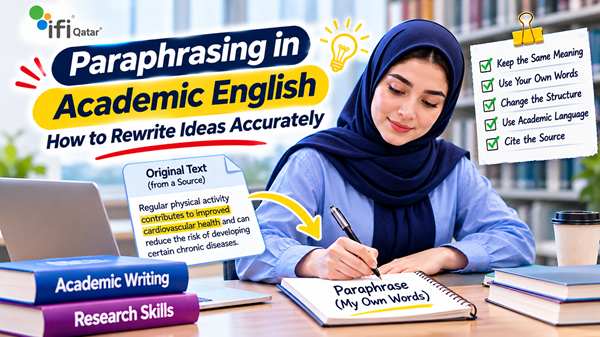
Paraphrasing is one of the most important skills in academic writing. University students regularly need to use information from textbooks, research papers, journal articles and other academic sources. However, using these sources effectively requires more than copying sentences or replacing a few words with synonyms.
You need to understand the original idea, express it in your own language and preserve the author’s intended meaning.
This is where paraphrasing in academic English becomes essential. It allows you to incorporate information from different sources into your assignments while maintaining an independent writing style and following academic integrity standards.
Whether you are preparing a university essay, writing a research report or developing a literature review, effective paraphrasing can make your writing clearer, more professional and better organised.
In this guide, you will learn how to paraphrase academic texts step by step, explore practical examples, understand common mistakes and discover techniques for rewriting ideas accurately without plagiarism.
What Is Paraphrasing in Academic English?
Paraphrasing means expressing information or ideas from an original source using different words and sentence structures while preserving the original meaning.
Unlike summarising, which reduces a longer text to its main points, paraphrasing usually retains the important details of a specific passage.
For example:
Original sentence:
“Regular physical activity contributes to improved cardiovascular health and can reduce the risk of developing certain chronic diseases.”
Paraphrased sentence:
“Taking part in exercise consistently can support heart health and lower the likelihood of experiencing some long-term medical conditions.”
The second sentence communicates the same essential information but uses different vocabulary and sentence construction.
A successful paraphrase should demonstrate that you understand the source and can communicate its ideas independently.
What Makes a Good Academic Paraphrase?
An effective academic paraphrase should have five important characteristics:
- Accuracy: It communicates the original meaning without changing the author’s argument.
- Original expression: It uses your own vocabulary and sentence structures.
- Clarity: It presents the information in a natural and understandable way.
- Appropriate academic tone: It uses language suitable for university assignments and research writing.
- Correct referencing: It acknowledges the original source when required.
Remember that changing the wording does not make someone else’s idea your own. You generally still need to cite the original source.
Why Is Paraphrasing Important in Academic Writing?
Paraphrasing is not simply a technique for avoiding copied sentences. It is a fundamental academic communication skill that supports several aspects of university-level writing.
1. It Helps You Avoid Plagiarism
Plagiarism occurs when someone presents another person’s words, ideas or work as their own without appropriate acknowledgement.
Paraphrasing helps you communicate information from academic sources in your own language. However, it does not remove the responsibility to cite the source.
For example, if you use an author’s research findings in your assignment, you should acknowledge that author even when you have completely rewritten the original passage.
2. It Demonstrates Your Understanding
When you can explain an academic idea without relying on the original sentence structure, you demonstrate that you have understood its meaning.
This is particularly important in university assignments, where lecturers expect students to interpret and communicate information rather than reproduce source material.
3. It Improves Academic Writing Quality
Paraphrasing encourages you to develop:
- More flexible vocabulary.
- Better sentence construction.
- Stronger grammar skills.
- Greater control over academic tone.
- More effective paragraph development.
These skills also improve essay writing, research reports and literature reviews.
4. It Helps You Integrate Multiple Sources
Academic assignments often require information from several different authors.
Paraphrasing allows you to explain their arguments in a consistent writing style and connect related ideas within the same paragraph.
Instead of inserting long quotations, you can integrate relevant information more naturally into your discussion.
5. It Develops Critical Thinking
To paraphrase effectively, you must understand what information is essential and how different ideas are connected.
This process encourages you to analyse the source rather than simply copy its language.
Paraphrasing vs Summarising vs Quoting
These three techniques are frequently used in academic writing, but they have different purposes.
| Technique | Main Purpose | Typical Length | How It Works |
|---|---|---|---|
| Paraphrasing | Restate a specific idea | Similar to or shorter than the original passage | Rewrites the information using different wording and structure |
| Summarising | Present the main ideas of a larger text | Considerably shorter than the original | Selects and condenses the most important information |
| Quoting | Reproduce the author’s exact words | Uses the original wording | Places the copied passage in quotation marks or the required quotation format |
Example: The Same Idea Using Three Techniques
Original text:
“Digital technology has significantly changed the way university students access educational resources. Online platforms provide opportunities for independent study, communication and collaboration beyond traditional classroom environments.”
Paraphrase:
“University students can now access learning materials and communicate with others through digital platforms, making education less dependent on physical classrooms.”
Summary:
“Digital technology has expanded access to university learning.”
Direct quotation:
“Digital technology has significantly changed the way university students access educational resources.”
Each technique is useful in different situations. Choose the one that best supports your writing purpose and follow the required citation rules.
How to Paraphrase Academic Texts: 7 Practical Steps
Effective paraphrasing requires a systematic approach. The following steps can help you rewrite academic information accurately without copying the original wording.
Step 1: Read the Original Text Carefully
Before attempting to rewrite anything, read the complete passage and identify its main message.
Do not begin by replacing individual words with synonyms. First, make sure you understand what the author is communicating.
Ask yourself:
- What is the main argument?
- What information is the author presenting?
- Is the sentence explaining a cause, effect, comparison or result?
- Are there any important conditions or limitations?
- What should remain unchanged in my paraphrase?
For example, consider this sentence:
“Access to reliable educational resources can significantly influence students’ academic performance.”
The central idea is that the availability of dependable learning materials may affect how well students perform academically.
Understanding this relationship is more important than remembering the original words.
Step 2: Identify the Key Information
Not every word in an academic sentence needs to be retained.
Identify the essential information that must remain in your rewritten version.
For example:
Original sentence:
“Researchers have identified several factors that influence students’ motivation, including classroom interaction, teaching methods and access to learning resources.”
Important information:
- Researchers identified several factors.
- The subject is student motivation.
- The factors include classroom interaction.
- Teaching methods and learning resources are also important.
You should preserve these relationships when rewriting the sentence.
Step 3: Put the Original Text Aside
After understanding the passage, look away from the original and try to explain the idea using your own words.
This is one of the most useful paraphrasing techniques because it reduces the temptation to follow the source sentence word for word.
For example, instead of looking at the original sentence and replacing “influence” with “affect”, explain the complete idea as if you were teaching it to another student.
Your first attempt does not need to be perfect. You can improve the grammar and vocabulary during the editing stage.
Step 4: Change the Sentence Structure
One of the most important parts of paraphrasing is changing how the information is organised.
Simply replacing vocabulary is not enough if the sentence structure remains almost identical.
You can use several techniques:
Change the active voice to the passive voice when appropriate.
Original:
“Researchers conducted the experiment to examine the effects of sleep deprivation.”
Paraphrase:
“The effects of sleep deprivation were examined through an experiment conducted by researchers.”
Change the grammatical structure.
Original:
“Because students receive regular feedback, they can identify areas that require improvement.”
Paraphrase:
“Regular feedback helps students recognise which aspects of their work need further development.”
Change the order of information.
Original:
“Students who manage their time effectively are more likely to complete academic tasks before deadlines.”
Paraphrase:
“Completing academic tasks on time becomes easier for students who organise their schedules effectively.”
Do not change sentence structures mechanically. The rewritten version must remain natural and grammatically correct.
Step 5: Use Appropriate Academic Vocabulary
Academic paraphrasing often requires a wider vocabulary.
However, this does not mean using complicated words whenever possible. Your priority should be selecting words that communicate the original meaning accurately.
Consider these examples:
| Original Expression | Possible Alternative |
|---|---|
| Important | Significant, essential, considerable |
| Increase | Rise, grow, expand |
| Reduce | Decrease, lower, minimise |
| Show | Demonstrate, indicate, illustrate |
| Help | Support, assist, facilitate |
| Explain | Describe, clarify, outline |
| Cause | Lead to, result in, contribute to |
| Examine | Investigate, analyse, explore |
| Difficult | Challenging, demanding, complex |
| Use | Apply, employ, utilise |
Be careful: synonyms are not always interchangeable.
For example, “cause” and “contribute to” do not communicate exactly the same relationship. The first can indicate direct causation, while the second may describe one contributing factor among several.
Always consider the context before choosing an alternative expression.
Step 6: Compare Your Version with the Original
After writing your paraphrase, return to the original passage.
Check whether:
- The main idea remains accurate.
- Important details have not disappeared.
- The author’s position has not changed.
- The rewritten sentence uses independent wording and structure.
- The grammar is correct.
- Any necessary citation is included.
If your version changes the original meaning, revise it.
For instance, if the original author says that a particular factor “may improve academic performance”, you should not rewrite it as “guarantees better academic results”.
The strength of the original claim must be preserved.
Step 7: Add the Appropriate Citation
When paraphrasing another author’s ideas, acknowledge the original source according to the referencing system required by your university.
Common referencing styles include:
- APA
- Harvard
- MLA
- Chicago
For example, a simplified APA-style in-text citation might look like this:
“Regular physical activity may support better psychological well-being (Smith, 2024).”
The exact format depends on the source type and the referencing requirements.
Even when you use completely different words, the underlying idea still belongs to the original author.
Academic Paraphrasing Techniques with Examples
Developing a range of paraphrasing techniques helps you avoid repetitive sentence patterns and communicate ideas more naturally.
Here are six useful techniques with practical examples.
1. Using Synonyms Carefully
Replacing selected words with appropriate alternatives can help you create a more original sentence.
Original:
“Online education provides students with flexible learning opportunities.”
Paraphrase:
“Digital learning offers learners more adaptable ways to study.”
The words have changed, but the original message remains the same.
However, avoid replacing every word mechanically. Some terms may have specific academic meanings that should be retained.
2. Changing Sentence Structure
Reorganising a sentence can create a more independent expression.
Original:
“Students improve their writing skills when they receive regular feedback from instructors.”
Paraphrase:
“Regular instructor feedback helps students develop stronger writing abilities.”
The information is presented through a different grammatical structure.
3. Changing the Word Form
You can sometimes change a noun into a verb, an adjective into an adverb or another grammatical form.
Original:
“The analysis of the results revealed several important differences.”
Paraphrase:
“When the researchers analysed the results, they identified several significant differences.”
The noun “analysis” becomes the verb “analysed”, creating a different sentence structure.
4. Combining or Dividing Sentences
Sometimes two short sentences can be combined to create a more natural academic expression.
Original:
“Students need regular practice. Regular practice can improve their academic vocabulary.”
Paraphrase:
“Consistent practice can help students expand their academic vocabulary.”
You can also divide a long sentence into shorter sentences when this improves clarity.
5. Changing the Voice
Changing between active and passive voice can help you present information differently.
Original:
“The research team collected data from 300 university students.”
Paraphrase:
“Data were collected from 300 university students by the research team.”
This technique is useful when the focus of the sentence changes, but it should not be used unnecessarily. Academic writing should prioritise clarity.
6. Changing the Order of Information
You can reorganise the sentence while maintaining the logical relationship between its ideas.
Original:
“Because access to reliable internet is limited in some rural areas, students may experience difficulties participating in online courses.”
Paraphrase:
“Students in some rural communities may find online courses difficult to access when reliable internet connections are unavailable.”
The cause-and-effect relationship remains clear, but the information is presented differently.
Common Paraphrasing Mistakes to Avoid
Many students understand the basic concept of paraphrasing but struggle to apply it correctly.
The following mistakes can reduce writing quality and create academic integrity problems.
| Common Mistake | Why It Is Wrong | Better Approach |
|---|---|---|
| Replacing only a few words | The sentence may remain too close to the source | Change the structure and expression |
| Using complicated synonyms | Can make the sentence unnatural or inaccurate | Choose precise vocabulary |
| Changing the original meaning | Misrepresents the author’s argument | Check the original claim carefully |
| Removing important details | Can weaken or distort the information | Preserve essential relationships |
| Copying the original sentence structure | Does not demonstrate independent expression | Reorganise the sentence naturally |
| Forgetting citations | Fails to acknowledge the source | Follow the required referencing style |
| Adding personal opinions | Changes the author’s original position | Keep the paraphrase objective |
| Overusing passive voice | Makes writing unnecessarily complex | Use the clearest grammatical structure |
What Is Patchwriting?
Patchwriting occurs when a writer follows the structure and wording of a source too closely, making only small changes such as replacing a few words or rearranging phrases.
For example:
Original:
“Access to higher education has increased significantly due to the expansion of digital learning platforms.”
Patchwriting:
“Access to university education has grown considerably because of the development of online learning platforms.”
Although several words have changed, the sentence closely follows the original construction.
A stronger paraphrase would be:
“Digital learning technologies have made university-level education available to a wider group of learners.”
The rewritten version expresses the central idea through a different structure and vocabulary.
Patchwriting is particularly common among students who are still developing their academic English skills. Regular paraphrasing practice can help them become more independent writers.
Useful Academic Expressions for Introducing Paraphrased Ideas
When incorporating information from academic sources, you may need expressions that introduce an author’s argument or research findings.
The following phrases can help you create more professional academic paragraphs.
| Academic Expression | Example |
|---|---|
| According to the author,… | According to the author, effective communication supports student collaboration. |
| The study suggests that… | The study suggests that regular feedback can improve writing performance. |
| The research indicates that… | The research indicates that access to digital resources affects learning opportunities. |
| The author argues that… | The author argues that universities should encourage independent learning. |
| The findings demonstrate that… | The findings demonstrate that teaching methods influence classroom participation. |
| The article highlights… | The article highlights the importance of academic literacy. |
| The research identifies… | The research identifies several barriers to online education. |
| The author emphasises… | The author emphasises the role of critical thinking in higher education. |
| The study examines… | The study examines the relationship between motivation and academic performance. |
| The evidence suggests… | The evidence suggests that further investigation is necessary. |
Choose expressions according to the original source.
For example, “demonstrates” is stronger than “suggests”. Do not use a strong reporting verb if the research provides only preliminary evidence.
How to Paraphrase Different Types of Academic Texts
Not all academic texts require the same approach. The type of information you are rewriting can influence your vocabulary, sentence structure and level of detail.
Paraphrasing Research Findings
When rewriting research findings, preserve the exact meaning of the results.
Pay attention to:
- Statistical relationships.
- The population being studied.
- The conditions of the research.
- The strength of the findings.
- Any limitations mentioned by the authors.
For example:
Original:
“The findings indicate a positive association between regular exercise and improved sleep quality.”
Paraphrase:
“People who exercise regularly may experience better sleep, according to the reported relationship.”
Avoid turning an association into a direct cause-and-effect claim.
Paraphrasing Theoretical Arguments
When working with academic theories, preserve the author’s definitions and central concepts.
Original:
“Social learning theory emphasises the role of observation and interaction in the development of human behaviour.”
Paraphrase:
“According to social learning theory, people develop aspects of their behaviour partly through observing and interacting with others.”
If a technical term is essential, you may need to retain it rather than replace it with an inaccurate synonym.
Paraphrasing Definitions
Some academic definitions contain specialised terminology that should not be changed casually.
Original:
“Critical thinking refers to the ability to evaluate information, analyse arguments and make reasoned judgements.”
Paraphrase:
“Critical thinking involves assessing information, examining arguments and reaching conclusions based on logical reasoning.”
The key concept remains unchanged while the expression is different.
Paraphrasing Literature Review Sources
Literature reviews often require students to discuss findings from multiple researchers.
A useful approach is to identify the relationship between the sources before writing.
For example, one study may highlight the benefits of online education, while another identifies challenges related to student engagement.
Rather than presenting each source as an isolated statement, you can explain how their findings relate to one another, while citing each source appropriately.
Practical Exercises to Improve Your Paraphrasing Skills
Regular practice is one of the most effective ways to develop academic paraphrasing skills.
Try the following exercises to improve your ability to rewrite ideas accurately.
Exercise 1: Rewrite the Sentence
Original:
“Effective time management enables university students to organise their academic responsibilities and reduce unnecessary stress.”
Try rewriting the sentence using different vocabulary and sentence structure.
Example answer:
“University students can manage their study commitments more efficiently and experience less avoidable pressure when they organise their time properly.”
Exercise 2: Change the Sentence Structure
Original:
“Researchers found that regular reading can improve vocabulary development among language learners.”
Try changing the grammatical structure while keeping the original meaning.
Example answer:
“Vocabulary development among language learners can be supported through consistent reading practice, according to the researchers.”
Exercise 3: Paraphrase a Longer Passage
Original passage:
“University students increasingly rely on digital resources to support their academic work. Online libraries, educational platforms and electronic journals provide convenient access to information. However, students need effective research skills to identify reliable sources and distinguish academic publications from inaccurate online content.”
Example answer:
“Digital resources have become important tools for university students by making academic information more accessible. Nevertheless, learners must develop strong research skills to evaluate online materials and recognise trustworthy academic sources.”
Exercise 4: Identify the Weak Paraphrase
Original:
“Communication skills are essential for successful collaboration in professional environments.”
Option A:
“Communication abilities are important for effective teamwork in workplace settings.”
Option B:
“Working with others professionally requires people to exchange information and ideas clearly.”
Both options communicate a similar idea, but Option B changes the sentence structure more substantially.
The best choice depends on the surrounding paragraph and the specific meaning you need to preserve.
How to Improve Your Academic Paraphrasing Skills
Paraphrasing becomes easier when you develop the language skills that support it.
The following practices can help you become a more confident academic writer.
Read Academic Materials Regularly
Read journal articles, research summaries and university-level texts.
Pay attention to how authors introduce arguments, explain evidence and connect ideas.
Develop Academic Vocabulary
Build a vocabulary notebook containing:
- Reporting verbs.
- Academic transition expressions.
- Common word families.
- Subject-specific terminology.
- Alternative expressions for frequently used words.
Learn vocabulary in context rather than memorising isolated synonym lists.
Practise Sentence Transformation
Take short academic sentences and rewrite them using different grammatical structures.
Practise active and passive voice, clause combinations, noun phrases and different sentence openings.
Review Your Own Writing
After completing a paraphrase, compare it with the original.
Look for repeated wording, grammatical errors, missing details and changes in meaning.
Get Feedback on Your Writing
Feedback can help you identify problems that are difficult to recognise independently.
An experienced English instructor can help you improve vocabulary choices, sentence construction, academic tone and overall accuracy.
Frequently Asked Questions About Paraphrasing in Academic English
What is paraphrasing in academic English?
Paraphrasing in academic English means expressing information from an original source using different words and sentence structures while maintaining the author’s intended meaning. It allows students to incorporate research and academic ideas into their assignments using their own language.
How can I paraphrase without changing the original meaning?
First, understand the complete passage. Identify its essential ideas and relationships, then explain them using your own sentence structures. Finally, compare your version with the original to ensure that no important information or meaning has changed.
Is changing words enough to paraphrase a sentence?
No. Replacing a few words with synonyms is usually insufficient. Effective paraphrasing requires you to understand the idea and express it through an independently constructed sentence, using appropriate vocabulary and grammar.
Do I need to cite a source when paraphrasing?
Yes. Paraphrased ideas generally require citations because they originate from another author’s work. The citation format depends on your university’s referencing requirements.
What is the difference between paraphrasing and summarising?
Paraphrasing restates a specific passage while retaining most of its important information. Summarising condenses a longer text into a shorter explanation of its central ideas.
Can paraphrasing help improve academic writing?
Yes. It develops vocabulary, grammar, sentence construction and reading comprehension. It also helps students integrate research sources more effectively into essays, reports and literature reviews.
How can I avoid patchwriting?
Avoid following the original sentence structure too closely. Read the passage, understand its meaning, put it aside and explain the idea independently. Check your final version against the original and make sure you have acknowledged the source.
Should I use academic vocabulary when paraphrasing?
Use vocabulary appropriate to the subject and academic context. However, complicated words are not always better. Choose precise expressions that communicate the original meaning clearly and naturally.
Can paraphrasing tools replace academic writing practice?
Paraphrasing tools may provide alternative wording, but they cannot replace your responsibility to understand the source, verify accuracy and acknowledge original authors. Developing independent paraphrasing skills is more valuable for long-term academic success.
Improve Your Academic Writing Skills with IFI Qatar
Effective paraphrasing is an essential part of successful academic communication. It helps you work with research materials, develop well-supported arguments and produce university assignments that demonstrate independent understanding.
However, becoming a confident academic writer requires more than learning a list of synonyms. You need to develop strong reading comprehension, grammar, vocabulary, sentence construction and the ability to communicate complex ideas clearly.
At IFI Qatar, learners can strengthen their English language abilities through structured learning opportunities designed to support their communication and academic development.
Developing your Academic English and writing skills can help you:
- Express academic ideas more accurately.
- Use formal vocabulary appropriately.
- Build clear and well-structured paragraphs.
- Paraphrase information more confidently.
- Improve grammar and sentence variety.
- Communicate research findings effectively.
Ready to develop stronger academic writing skills?
Explore English language learning opportunities at IFI Qatar and take the next step towards more confident, accurate and effective academic communication.