

Currently Empty: ر.ق 0,00


IELTS
How to Check Whether Your IELTS Score Meets an Institution’s Requirements
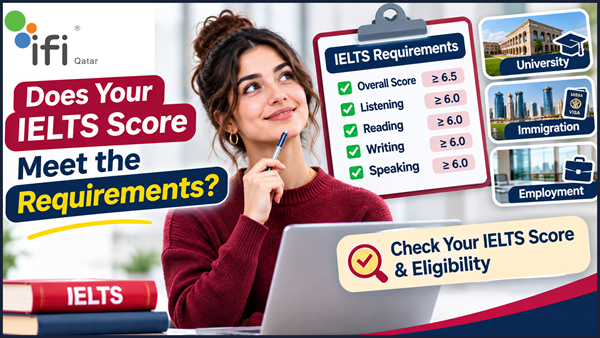
Receiving your IELTS result is an important step, but achieving a particular band score does not automatically mean you meet every institution’s English language requirements.
A university may require an overall IELTS score of 6.5 while also asking for at least 6.0 in each skill. An employer may set different minimum scores for professional roles, while an immigration authority may require a specific test type and minimum performance in individual components.
This means you need to check more than the overall band score on your Test Report Form (TRF).
If you are planning to study, work or apply for a visa, understanding the exact IELTS score requirements before submitting your application can help you avoid unnecessary delays, additional expenses and rejected applications.
This guide explains how to check IELTS score requirements, compare your results with an institution’s conditions, understand individual skill requirements and identify what to do if your score does not meet the required standard.
What Are IELTS Score Requirements?
IELTS score requirements are the minimum English language proficiency standards established by an organisation that accepts IELTS results.
These requirements indicate the level of English a candidate must demonstrate to qualify for a particular programme, job, professional registration or immigration route.
An organisation may specify:
- A minimum overall IELTS band score.
- A minimum score in Listening.
- A minimum score in Reading.
- A minimum score in Writing.
- A minimum score in Speaking.
- An accepted IELTS test type.
- A maximum age for the test result.
- Specific rules for computer-delivered, paper-based or other test formats.
- Additional conditions for submitting or verifying results.
The exact requirements depend on the organisation and the purpose of your application.
For example, a university may accept IELTS Academic with an overall score of 6.5 and no component below 6.0. Another university may require 7.0 overall with at least 6.5 in every skill.
The important point is that IELTS does not establish one universal minimum score for all universities, employers or immigration authorities. Each organisation determines its own requirements.
How to Check Whether Your IELTS Score Meets an Institution’s Requirements
The most reliable way to check your IELTS eligibility is to compare your official results with the exact requirements published by the organisation receiving your application.
Follow these steps before submitting your IELTS score.
Step 1: Identify the Exact Programme or Application
Start by identifying the specific programme, position or application route for which you need IELTS.
Do not rely on a general English language requirement if your intended programme has its own conditions.
For example, a university may have different IELTS requirements for:
- Undergraduate programmes.
- Master’s programmes.
- Doctoral programmes.
- Medicine and healthcare.
- Law and professional studies.
- Foundation programmes.
- English language preparation courses.
Similarly, an employer may require different English proficiency levels depending on the responsibilities of a particular position.
What to check: Find the exact programme name, department, course level or application category before reviewing the IELTS requirements.
Step 2: Find the Official IELTS Requirement
Visit the official website of the institution or organisation receiving your application.
Look for sections such as:
- English Language Requirements.
- Entry Requirements.
- International Student Admissions.
- Language Proficiency.
- IELTS Requirements.
- Admission Criteria.
- Visa or Immigration Requirements.
If the information is unclear, contact the admissions office or relevant authority directly.
Avoid relying exclusively on third-party websites, old admission guides, discussion forums or general IELTS score charts.
Requirements can change between academic years and application cycles.
Step 3: Check the Minimum Overall Band Score
Your IELTS Test Report Form displays an overall band score calculated from your four individual skill scores.
Suppose an institution requires an overall IELTS score of 6.5.
If your result is 7.0 overall, you may appear to meet this condition.
However, you should not assume that you qualify yet.
The organisation may also require minimum scores in each of the four skills.
Important: An overall score that meets or exceeds the published minimum does not automatically satisfy separate component requirements.
Step 4: Check the Minimum Score for Each Skill
This is one of the most important parts of an IELTS score requirements check.
Your Test Report Form provides individual scores for:
- Listening.
- Reading.
- Writing.
- Speaking.
An institution may require a minimum overall score and a separate minimum for every component.
Consider the following example:
Institution’s IELTS requirement:
- Overall: 6.5
- Listening: 6.0
- Reading: 6.0
- Writing: 6.0
- Speaking: 6.0
Candidate’s IELTS result:
| IELTS Component | Required Score | Candidate’s Score | Status |
|---|---|---|---|
| Overall | 6.5 | 7.0 | Meets requirement |
| Listening | 6.0 | 7.5 | Meets requirement |
| Reading | 6.0 | 7.0 | Meets requirement |
| Writing | 6.0 | 5.5 | Below requirement |
| Speaking | 6.0 | 7.0 | Meets requirement |
Although the candidate has achieved an overall score of 7.0, the Writing score is below the required minimum.
The candidate therefore does not meet the full IELTS requirement under these example conditions.
This is why checking each component separately is essential.
Step 5: Confirm the Accepted IELTS Test Type
Not every organisation accepts every IELTS test type.
Depending on your application, the organisation may require:
- IELTS Academic.
- IELTS General Training.
- IELTS for UKVI.
- IELTS for UKVI Life Skills.
- Another specifically approved test format.
For example, universities commonly require IELTS Academic for degree-level admission, but the exact policy depends on the institution and programme.
Some immigration routes require a specific approved test, such as IELTS for UKVI, rather than standard IELTS.
Never assume that achieving the required band score in one IELTS format means that another format will automatically be accepted.
Check the exact test name stated in the official requirements.
Step 6: Check the Validity Period of Your IELTS Result
IELTS recommends that organisations consider test results valid for two years after the test date.
However, accepting organisations can establish their own policies, including whether they accept older results under particular conditions.
When checking validity, confirm:
- Your original test date.
- The application deadline.
- The programme start date.
- The institution’s result validity policy.
- Whether any additional evidence is required for an older result.
For example, a candidate applying in 2026 with an IELTS result from 2023 should not assume that the result will be accepted.
Even if an organisation has a different policy, you should obtain confirmation before submitting an older Test Report Form.
Step 7: Check How Your IELTS Result Must Be Submitted
Meeting the score requirement is only part of the process.
You must also make sure the organisation can verify your result through its accepted submission method.
Some institutions request electronic IELTS results directly from the test provider, while others may ask applicants to provide their Test Report Form details or follow a specific online submission procedure.
Check:
- Whether electronic score delivery is required.
- Whether a Test Report Form number is needed.
- Whether the institution accepts uploaded documents.
- Whether the result must be verified directly.
- Whether the organisation requires a particular submission deadline.
A result that cannot be verified through the organisation’s accepted process may not be considered complete.
How to Compare Your IELTS Overall and Individual Band Scores
Understanding the relationship between your overall IELTS band score and individual component scores can help you identify whether you meet an institution’s requirements.
What Is the IELTS Overall Band Score?
Your overall IELTS band score represents your performance across Listening, Reading, Writing and Speaking.
It is calculated by taking the average of the four component scores and rounding it to the nearest whole or half band according to IELTS scoring rules.
For example:
| Component | Band Score |
|---|---|
| Listening | 7.0 |
| Reading | 6.5 |
| Writing | 6.0 |
| Speaking | 7.0 |
| Average | 6.625 |
| Overall IELTS Band | 6.5 |
The overall band score is not simply the highest component score or the result of one particularly strong skill.
It reflects the average performance across all four components.
Why Can You Meet the Overall Requirement but Fail the Component Requirement?
Some institutions establish minimum scores for individual skills because they need candidates to demonstrate balanced English proficiency.
For example, a university programme may involve extensive academic writing, presentations and reading.
An overall IELTS score of 7.0 may look sufficient, but if the programme requires at least 6.5 in Writing and your Writing score is 6.0, you may not meet its published conditions.
This distinction is particularly important for:
- Academic programmes.
- Healthcare and professional registration.
- Teaching positions.
- Communication-intensive jobs.
- Immigration routes with separate component thresholds.
Always compare your four individual scores with the institution’s minimum requirements.
IELTS Score Requirements: Example of a Detailed Eligibility Check
The following examples show how different institutions can apply different IELTS conditions.
These are illustrative examples, not universal admission requirements.
| Example | Overall Requirement | Individual Requirement | Candidate’s Result | Outcome |
|---|---|---|---|---|
| Institution A | 6.5 | No component below 6.0 | Overall 7.0, lowest skill 6.0 | Meets the stated score conditions |
| Institution B | 7.0 | No component below 6.5 | Overall 7.5, Writing 6.0 | Does not meet all conditions |
| Institution C | 6.0 | No component below 5.5 | Overall 6.0, lowest skill 5.5 | Meets the stated score conditions |
| Institution D | 7.0 | Writing at least 7.0 | Overall 7.5, Writing 6.5 | Does not meet all conditions |
Notice that a higher overall score does not necessarily compensate for a lower component score.
The only reliable way to determine eligibility is to compare every requirement with your official IELTS result.
IELTS Score Requirements for Different Types of Applications
IELTS requirements can vary significantly depending on the purpose of your application.
Understanding these differences will help you identify which rules apply to your situation.
IELTS Score Requirements for University Admission
Universities establish IELTS requirements based on the academic level, programme content and language demands of the course.
A university may set:
- One overall score for undergraduate admission.
- A higher score for postgraduate programmes.
- Separate minimum scores for individual skills.
- Additional requirements for medicine, law or other specialised programmes.
- Different conditions for foundation or pre-sessional English courses.
For example, a programme involving academic research and extensive written assignments may place particular importance on Writing performance.
Do not assume that the general university requirement applies to every department.
Check the specific programme’s admission page.
IELTS Score Requirements for Immigration
Immigration authorities may use English language requirements to assess an applicant’s ability to communicate in an English-speaking environment.
These requirements may be expressed through:
- IELTS band scores.
- Minimum scores in individual components.
- CEFR levels.
- Approved test types.
- Specific test-centre or security requirements.
For some immigration routes, achieving a particular overall IELTS band is not enough.
You may need to meet a minimum score in every required skill.
For example, UK visa routes can have different English language conditions depending on the visa category and application circumstances.
Always check the current government guidance for your exact route rather than relying on a general IELTS score chart.
IELTS Score Requirements for Employment
Employers may use IELTS results as evidence of English language proficiency for certain positions.
The required score depends on the job responsibilities and the organisation’s recruitment policy.
For example:
- Healthcare roles may require strong communication skills.
- Teaching positions may require high proficiency in all four skills.
- International business roles may prioritise professional communication.
- Customer-facing positions may place particular importance on Speaking.
Some employers do not require IELTS at all, while others specify their own accepted English language qualifications.
Check the vacancy description or contact the employer before booking an examination.
IELTS Score Requirements for Professional Registration
Certain professional organisations require English language evidence before granting registration or licensing.
This may apply to healthcare professionals, teachers and other regulated occupations.
Professional bodies may establish:
- A minimum overall score.
- Minimum scores in Listening, Reading, Writing and Speaking.
- Rules about test dates.
- Accepted IELTS test formats.
- Specific conditions for combining results, where permitted.
Do not assume that the IELTS requirement for a university degree is the same as the requirement for professional registration.
The relevant regulatory organisation is the authoritative source for your application.
IELTS Score Requirements in Qatar: What Should You Check?
Candidates applying to universities, professional organisations or international institutions from Qatar should pay particular attention to the requirements of the organisation receiving their results.
The fact that you take IELTS in Qatar does not automatically mean that every organisation will apply the same score rules.
For example, Qatar University publishes IELTS-related information for its applicants and identifies accepted test formats and score policies.
Its Testing Center information states that an IELTS Academic overall band of 5.5 can exempt applicants from Foundation Programme English courses. This should not be interpreted as a universal admission requirement for every Qatar University programme.
The university also specifies which IELTS test formats it accepts and provides additional information about score validity.
This illustrates why candidates should check the exact programme and intended use of their IELTS result rather than relying on a general score requirement.
Before applying to an institution in Qatar, check:
- The minimum overall IELTS score.
- The minimum score for each skill.
- Whether Academic or General Training is accepted.
- Whether computer-delivered and paper-based results are accepted.
- Whether UKVI or another specific format is required.
- The result validity period.
- The accepted method for submitting your IELTS result.
If you are applying to an international institution while living in Qatar, remember that the receiving organisation’s requirements take priority over the policies of the test centre where you completed IELTS.
What Should You Do If Your IELTS Score Does Not Meet the Requirement?
If your IELTS result falls below the required standard, you still have several possible options.
The best choice depends on how large the score difference is, which component is below the minimum and how much time you have before your application deadline.
Option 1: Retake the Full IELTS Test
A full IELTS retake may be appropriate if:
- Several components are below the required scores.
- Your overall band is below the minimum.
- You need more time to improve your English.
- You want to improve your performance across all four skills.
Before booking another examination, identify why your previous result was below your target.
For example, if your Writing score is significantly lower than your other components, spending time improving Writing may be more effective than repeating the same preparation routine.
Option 2: Consider IELTS One Skill Retake
IELTS One Skill Retake allows eligible candidates to retake one component of an IELTS test instead of completing all four skills again.
However, there are important conditions.
According to IELTS, eligibility generally requires:
- An original full IELTS on Computer test.
- Completion at a test centre offering One Skill Retake.
- Taking the retake within 60 days of the original test.
- No more than one One Skill Retake for the original test.
It is available for eligible Academic and General Training candidates.
Important: Not every university, employer or immigration authority accepts IELTS One Skill Retake.
Before choosing this option, confirm directly with the organisation receiving your result that it accepts the updated score.
Do not assume that a One Skill Retake result will automatically satisfy every application requirement.
Option 3: Request an Enquiry on Results
If you believe your IELTS result does not accurately reflect your performance, you may consider an Enquiry on Results (EOR).
This is an official IELTS process in which you request a review of your result.
It may be worth considering if:
- You performed substantially better in practice.
- Your result is unexpectedly different from your usual performance.
- You believe a particular component may not accurately reflect your ability.
An EOR is not a guaranteed way to increase your band score.
The result may remain unchanged, and the process follows the applicable IELTS rules and deadlines.
Check the relevant test provider’s current EOR policy before submitting a request.
Option 4: Ask Whether the Institution Offers an Alternative
Some organisations may offer alternative routes for demonstrating English proficiency.
Depending on the institution, these could include:
- An approved alternative English language test.
- A pre-sessional English course.
- A conditional admission pathway.
- An internal English assessment.
- Other accepted qualifications.
These options are not available everywhere.
Contact the institution directly to confirm whether an alternative is permitted for your programme.
How to Identify Which IELTS Skill Needs Improvement
If your result does not meet the required standard, the next step is to identify the specific component causing the problem.
Consider the following example:
| IELTS Component | Your Score | Required Score | Difference |
|---|---|---|---|
| Listening | 7.0 | 6.5 | +0.5 |
| Reading | 6.5 | 6.5 | Meets requirement |
| Writing | 5.5 | 6.5 | -1.0 |
| Speaking | 7.0 | 6.5 | +0.5 |
| Overall | 6.5 | 6.5 | Meets requirement |
In this situation, Writing is the main area that needs attention.
The candidate already meets the overall requirement, but the Writing score is one full band below the required component minimum.
A focused Writing assessment may therefore be more useful than repeating all four skills without a clear improvement plan.
Why a Skill-by-Skill Assessment Matters
A general IELTS score does not explain exactly why you lost marks.
A more detailed assessment can help identify:
Listening: Difficulty recognising paraphrasing, following speakers or identifying specific information.
Reading: Problems with time management, understanding complex passages or distinguishing between True, False and Not Given.
Writing: Weak task response, unclear organisation, limited vocabulary or grammatical errors.
Speaking: Problems with fluency, pronunciation, vocabulary or developing answers.
Understanding the cause of a low score makes it easier to create a targeted preparation plan.
IELTS Score Requirements Check: Candidate Checklist
Before submitting your application, use this checklist to make sure you have reviewed all the important conditions.
-
I have identified the exact institution and programme.
-
I have checked the latest official English language requirements.
-
My overall IELTS score meets the required minimum.
-
My Listening score meets the required minimum.
-
My Reading score meets the required minimum.
-
My Writing score meets the required minimum.
-
My Speaking score meets the required minimum.
-
I have confirmed the accepted IELTS test type.
-
My IELTS result is within the accepted validity period.
-
I understand how the institution wants my result submitted.
-
I have checked whether any additional language conditions apply.
-
I have confirmed that any One Skill Retake result will be accepted, if relevant.
If you cannot confidently tick every applicable item, contact the institution before submitting your application.
When Should You Get Professional Advice About Your IELTS Score?
Sometimes the published requirements are straightforward. In other cases, interpreting them can be more complicated.
You may benefit from a score-related consultation if:
- Your overall band meets the requirement but one component does not.
- Your university has different requirements for different programmes.
- You are unsure whether Academic or General Training is accepted.
- Your IELTS result is approaching the end of its validity period.
- You are considering One Skill Retake.
- You have received an unexpected band score.
- You need to decide between a full retake and a focused assessment.
- You have limited time before an application deadline.
A professional review can help you organise the available information, understand your score gaps and identify the most appropriate next step.
However, only the organisation receiving your application can make the final decision about whether your IELTS result satisfies its admission, employment or immigration conditions.
Frequently Asked Questions About IELTS Score Requirements
How do I check whether my IELTS score meets a university’s requirements?
Visit the university’s official admissions website and find the English language requirements for your specific programme. Compare your overall IELTS band and all four individual component scores with the published minimums. Also confirm the accepted test type and result validity period.
Is the IELTS overall score more important than individual band scores?
Both can be important. Some institutions only specify an overall minimum, while others require minimum scores in Listening, Reading, Writing and Speaking. If separate component requirements are published, you must meet those conditions as well.
Can I get admission if my overall IELTS score is high but my Writing score is low?
It depends on the university’s policy. If the programme requires a minimum Writing score and your result is below that threshold, you may not meet the English language requirement even if your overall band is higher than the required score.
Do all universities require IELTS 6.5?
No. IELTS requirements vary by institution, programme, academic level and application cycle. Some programmes require lower scores, while others may require 7.0 or higher. Always check the exact programme requirements.
How long is an IELTS result valid?
IELTS recommends that organisations consider results valid for two years from the test date. However, accepting organisations can decide whether to accept older results under their own policies. Confirm the validity rules directly with the institution.
Can I use IELTS General Training for university admission?
It depends on the institution and programme. Many degree programmes require IELTS Academic, while some organisations accept other formats for particular purposes. Never assume General Training is accepted for academic admission without checking the official requirements.
What happens if my IELTS score is 6.5 but the university requires 7.0?
You may need to retake IELTS, consider an eligible One Skill Retake if only one component is below the required level and the institution accepts it, or explore an approved alternative pathway. Contact the university to understand which options are available.
Can I combine two IELTS results to meet an institution’s requirements?
Some organisations may accept specific arrangements involving multiple test results, while others require one complete test result. Do not assume that scores from separate examinations can be combined. Check the receiving organisation’s policy.
Does IELTS One Skill Retake count for university admission?
Some universities accept IELTS One Skill Retake, but acceptance is not universal. Check directly with your intended institution before booking the retake.
How can I improve only one IELTS component?
Start by identifying the specific weaknesses affecting your performance. A focused assessment of Writing, Speaking, Reading or Listening can help you understand which skills need improvement and develop a more targeted preparation plan.
Can an IELTS mock test tell me whether I meet a university’s score requirements?
A mock test can estimate your current performance and help you identify areas that need improvement. However, it cannot replace an official IELTS result or confirm admission eligibility. The university makes the final decision based on its published requirements and accepted results.
Where can I get help checking my IELTS score requirements in Qatar?
You can seek guidance from an IELTS preparation and assessment provider in Qatar to understand your score profile, identify skill gaps and explore appropriate preparation options. For final eligibility decisions, always confirm the requirements directly with the receiving institution or authority.
Check Your IELTS Score Before Your Next Application
An IELTS result should always be evaluated against the exact requirements of the organisation receiving it.
A high overall band may look impressive, but individual component scores, test type, result validity and submission rules can all affect whether your result is accepted.
Before applying, take the time to compare your Test Report Form with the official requirements. If one skill is below the required level, identify the reason and choose a suitable improvement strategy rather than booking another examination without a clear plan.
At IFI Qatar, you can seek guidance on understanding your IELTS performance, identifying weaknesses across the four skills and determining which areas may need further assessment or preparation.
Not sure whether your IELTS score meets your target institution’s requirements? Contact IFI Qatar to discuss your score profile and explore the most suitable next step.
Make an informed decision about your IELTS result before submitting your application.