

Currently Empty: ر.ق 0,00


IELTS
General English or IELTS Preparation: Which Course Should You Take First?
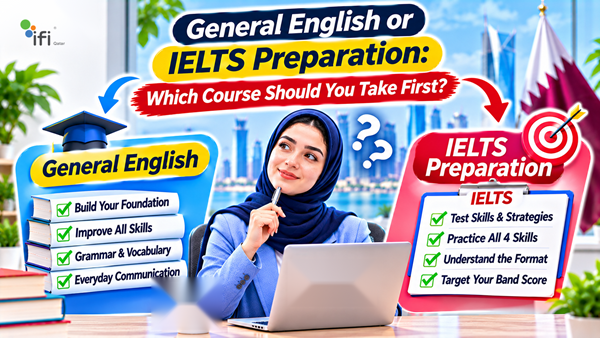
If you are planning to take the IELTS test, choosing the right course is one of the first decisions you need to make. You may be wondering whether to enrol in a General English programme to strengthen your language skills or start an IELTS preparation course immediately.
Both options can help you move towards your goal, but they serve different purposes.
General English focuses on developing your overall ability to communicate in English. IELTS preparation, on the other hand, combines language development with examination-specific skills, question types, strategies and assessment requirements.
Choosing the wrong starting point can make learning more difficult than necessary. If your English foundation is not strong enough, intensive IELTS practice may feel overwhelming. However, if you already have a suitable level of English, spending too much time on basic language lessons may not be the most efficient approach.
So, should you take General English or IELTS preparation first?
The answer depends on your current English level, your target score, your weaknesses and how confidently you can use English in different situations.
This guide compares both options and explains how to decide which course is more suitable for your needs.
1. General English vs IELTS Preparation: What Is the Difference?
Before choosing a course, you need to understand what each programme is designed to achieve.
Although both courses develop English language skills, their learning objectives and classroom activities are different.
What Is a General English Course?
A General English course is designed to improve your overall language proficiency.
It helps you develop the knowledge and communication skills needed to understand and use English in everyday, academic and professional situations.
Depending on the course level, lessons may cover:
- Grammar and sentence construction.
- Everyday and topic-based vocabulary.
- Listening comprehension.
- Speaking and pronunciation.
- Reading comprehension.
- Writing skills.
- Everyday conversations.
- Expressing opinions and explaining ideas.
General English is particularly useful if you need to strengthen your language foundation before working towards a specific examination.
For example, if you frequently make grammar mistakes, struggle to understand spoken English or find it difficult to construct complete sentences, a General English course may be a more suitable starting point.
What Is an IELTS Preparation Course?
An IELTS preparation course is designed to help learners develop the skills required for the IELTS examination.
It focuses on the four IELTS components:
- Listening
- Reading
- Writing
- Speaking
In addition to developing these skills, learners become familiar with the examination format, task requirements and assessment criteria.
Depending on the programme, IELTS preparation may include:
- IELTS Listening question types.
- Reading strategies and time management.
- Academic or General Training Writing tasks.
- IELTS Speaking practice.
- Understanding the IELTS assessment criteria.
- Practice tests and mock examinations.
- Identifying weaknesses in test performance.
- Developing examination strategies.
An IELTS course is most useful when you already have enough general English knowledge to understand the learning materials and benefit from examination-focused practice.
General English vs IELTS Preparation: Quick Comparison
| Comparison Factor | General English | IELTS Preparation |
|---|---|---|
| Main objective | Improve overall English proficiency | Prepare for the IELTS examination |
| Grammar | Builds and strengthens general grammar knowledge | Applies grammar accurately in test tasks |
| Vocabulary | Develops everyday and broader topic-based vocabulary | Focuses on vocabulary useful for IELTS tasks and topics |
| Listening | Improves general listening comprehension | Practises IELTS Listening tasks and question types |
| Reading | Develops general reading ability | Focuses on IELTS Reading passages and strategies |
| Speaking | Builds communication and speaking confidence | Practises IELTS Speaking Parts 1, 2 and 3 |
| Writing | Develops sentence, paragraph and general writing skills | Focuses on IELTS Writing Task 1 and Task 2 requirements |
| Assessment | May include general language assessments | Uses IELTS-style practice and performance evaluation |
| Best suited for | Learners who need to strengthen their English foundation | Learners who are ready for examination-focused preparation |
The main difference is that General English develops your language foundation, while IELTS preparation helps you apply your English skills in a specific examination environment.
2. When Should You Choose General English Before IELTS?
Not every learner is ready to begin intensive IELTS preparation immediately.
If you have difficulty using English in everyday situations, strengthening your foundation first may help you make better progress later.
Consider taking General English before IELTS if several of the following situations describe you.
You Struggle with Basic English Grammar
Grammar is important in both IELTS Writing and Speaking.
If you frequently make mistakes with verb tenses, sentence structure, articles, prepositions or subject–verb agreement, you may need additional grammar development.
For example:
Incorrect: “People is using technology every day.”
Correct: “People are using technology every day.”
Understanding and applying these basic structures can help you communicate more accurately before moving towards complex IELTS tasks.
Your Vocabulary Is Too Limited
If you regularly struggle to find the right words when speaking or writing, you may benefit from a broader vocabulary foundation.
You should be comfortable discussing familiar topics such as:
- Education.
- Work.
- Family.
- Health.
- Technology.
- Travel.
- Environment.
- Daily activities.
You should also gradually develop your ability to understand less familiar words through context.
A General English course can help you build vocabulary systematically rather than relying on memorised IELTS word lists.
You Find Everyday English Conversations Difficult
IELTS Speaking requires you to understand questions and communicate your ideas clearly.
If you struggle to respond to simple questions, explain personal experiences or maintain a conversation, you may need more general speaking practice.
For example, before attempting longer IELTS Speaking responses, you should feel reasonably comfortable discussing your work, studies, interests and everyday experiences.
You Have Difficulty Understanding Spoken English
If you cannot follow relatively simple conversations, interviews or short recordings, intensive IELTS Listening practice may be challenging.
You should first develop your ability to:
- Understand the main idea.
- Recognise familiar vocabulary.
- Follow basic conversations.
- Identify important details.
- Understand different speakers.
Once these skills become more comfortable, you can gradually introduce IELTS Listening question types.
You Cannot Write Clear English Paragraphs
IELTS Writing requires you to organise ideas, develop arguments and communicate information accurately.
If you struggle to write complete sentences or organise a basic paragraph, it may be better to strengthen your general writing skills first.
Start by learning how to:
- Construct accurate sentences.
- Organise ideas into paragraphs.
- Explain opinions.
- Provide relevant examples.
- Connect ideas logically.
These are important foundations for IELTS Writing.
3. When Are You Ready to Start an IELTS Preparation Course?
You may not need a separate General English course if you already have a reasonably strong language foundation.
If you can communicate independently and understand a range of English materials, you may be ready to focus on IELTS preparation.
Consider starting an IELTS course if you can do most of the following.
You Understand Everyday English
You can follow normal conversations about familiar subjects without translating every sentence.
You may not understand every expression, but you can generally identify the main ideas and important details.
You Can Read English Texts with Reasonable Comprehension
You can understand the main arguments in general articles and identify supporting information.
You may still find academic texts challenging, but you can read paragraphs without constantly stopping to translate individual words.
You Can Express Your Opinions in English
You can explain your thoughts, give reasons and provide examples.
You may make occasional grammar mistakes, but you can communicate your message clearly.
You Can Write Organised Paragraphs
You understand basic sentence structure and can develop a paragraph around a central idea.
You may need to improve your academic writing, but you are not struggling with basic written communication.
You Understand Common English Grammar Structures
You can use common verb tenses, sentence structures and linking expressions with reasonable accuracy.
You may need more advanced grammar development, but basic language mistakes do not prevent you from communicating.
If these descriptions match your current abilities, you may be ready to move towards IELTS-specific learning.
4. Which Course Should You Take Based on Your English Level?
Your current proficiency is one of the most useful indicators when deciding between General English and IELTS preparation.
The following guide provides a practical starting point.
| Current English Level | Recommended Starting Point | Main Learning Priorities |
|---|---|---|
| A1 – Beginner | General English | Basic vocabulary, grammar and everyday communication |
| A2 – Elementary | General English | Sentence construction, listening and simple conversations |
| B1 – Intermediate | General English with gradual IELTS familiarisation | Grammar accuracy, vocabulary, reading and extended speaking |
| B2 – Upper Intermediate | IELTS preparation may be suitable | Test format, task requirements and examination strategies |
| C1 – Advanced | Focused IELTS preparation | Performance improvement, assessment criteria and task-specific practice |
These are general recommendations rather than strict entry requirements.
Two learners at the same CEFR level may have very different strengths. One may be confident in speaking but struggle with writing, while another may read comfortably but have difficulty understanding spoken English.
That is why a skills-based assessment is more useful than choosing a course based on level alone.
What If You Are at B1?
B1 learners often fall between the two learning pathways.
You may understand everyday English and communicate independently in familiar situations, but still struggle with complex vocabulary, extended discussions or detailed writing.
In this situation, you may benefit from continuing General English while becoming familiar with the IELTS examination.
You do not necessarily need to postpone every form of IELTS practice. The important thing is to balance test familiarisation with language development.
What If You Are at B2?
At B2, many learners have developed enough independence to begin more focused IELTS preparation.
However, your individual skills still matter.
For example, if your reading and listening are strong but your writing is weak, you may need additional writing development alongside IELTS practice.
The objective is to avoid spending unnecessary time on material you already understand while addressing the areas that limit your performance.
5. Should You Take General English and IELTS Preparation at the Same Time?
In some situations, combining both learning approaches can be useful.
You do not always have to finish one complete course before beginning any IELTS-related activity.
If your English foundation is developing but you already understand basic communication, a combination of general language learning and introductory IELTS practice may help you progress.
How Can You Combine Both Approaches?
You can divide your learning activities according to their purpose.
| General English Practice | IELTS Preparation Practice |
|---|---|
| Review grammar structures | Apply grammar in IELTS Writing |
| Learn topic-based vocabulary | Use appropriate vocabulary in Speaking and Writing |
| Listen to everyday conversations | Practise IELTS Listening question types |
| Read general English articles | Practise IELTS Reading passages |
| Discuss familiar subjects | Practise IELTS Speaking questions |
| Write organised paragraphs | Develop IELTS Writing responses |
For example, if you are learning vocabulary related to education in your General English lessons, you can later use those expressions when discussing education-related IELTS Speaking or Writing topics.
This creates a connection between general language development and examination preparation.
Who Can Benefit from a Combined Approach?
Combining both approaches may be useful for learners who:
- Have an intermediate English foundation.
- Understand everyday communication.
- Need to improve specific language skills.
- Want to become familiar with the IELTS format.
- Can manage regular practice outside lessons.
However, if your basic English skills are still weak, focusing on General English first may be more manageable.
6. General English or IELTS Preparation: Which Course Is Better for Your Goal?
Your reason for learning English should influence your course selection.
Not everyone who studies English needs IELTS, and not everyone preparing for IELTS needs to start with General English.
If You Want to Study Abroad
If your goal is to apply to an international university, you may eventually need to demonstrate your English proficiency through an accepted test.
In this case, IELTS preparation may be relevant, but your first step should depend on your current level and the institution’s requirements.
If your English foundation is not strong enough, General English can help you develop the necessary skills before beginning examination-focused study.
If You Need IELTS for Immigration
If you need IELTS for an immigration application, check the exact language test and score requirements for your intended immigration pathway.
Different programmes may have different requirements, and not every application uses the same IELTS test type or score threshold.
Once you understand the requirement, choose your learning pathway based on your current proficiency.
If You Want to Improve Everyday Communication
If your goal is to communicate more confidently at work, while travelling or in social situations, General English is usually the more relevant option.
You may not need IELTS preparation unless you have a separate examination-related objective.
If You Need English for Professional Development
General English can help you strengthen your overall communication skills.
If your work involves international clients, meetings or presentations, you may eventually benefit from Business English or another specialised programme.
IELTS preparation is only necessary if you also need to take the examination.
If You Need a Specific IELTS Band Score
If you have a clear IELTS target, your learning plan should be based on the difference between your current performance and your target.
For example, a learner who already communicates comfortably but struggles with IELTS Writing may need targeted preparation rather than a complete return to basic English lessons.
However, if the difficulty comes from weak grammar or limited vocabulary, additional foundation work may still be necessary.
7. What Should You Consider Before Choosing an English Course?
Once you understand which learning pathway is more suitable, compare the actual courses available.
A course should match your level, learning objectives and practical requirements.
Check the Course Level
Find out which English proficiency level the programme is designed for.
If the provider offers a placement assessment, use it to identify the most appropriate starting point.
Do not choose an advanced programme simply because you want to progress quickly.
Review the Course Content
For General English, check whether the programme develops grammar, vocabulary, listening, speaking, reading and writing.
For IELTS preparation, check whether it covers all four test components and provides relevant examination practice.
Ask About Feedback and Learning Support
Feedback can be especially valuable when you need to improve speaking or writing.
Before enrolling, ask:
- Is feedback available on writing tasks?
- Are there opportunities for speaking practice?
- Can the instructor identify recurring language mistakes?
- How is progress evaluated?
- What learning materials are included?
The answers can help you understand whether the course meets your needs.
Compare Online and Face-to-Face Options
Consider which learning format fits your schedule.
Face-to-face classes may suit learners who prefer attending a physical classroom, while online learning can be more convenient for those who need remote access.
Check whether the online programme involves live instructor-led lessons, recorded materials or independent activities.
Check the Schedule and Total Fees
Before making a decision, confirm:
- Available class times.
- Lesson duration.
- Number of sessions.
- Course length.
- Total fees.
- Included learning materials.
- Enrolment requirements.
A course should be practical enough for you to attend consistently.
8. A Simple Decision Guide: General English or IELTS Preparation?
If you are still unsure, use the following decision guide to identify a suitable starting point.
Choose General English First If:
- You struggle with basic grammar.
- Your everyday vocabulary is limited.
- You find ordinary conversations difficult.
- You cannot understand simple listening materials comfortably.
- You struggle to write clear paragraphs.
- You frequently translate sentences before speaking.
- You need to improve your overall English confidence.
Choose IELTS Preparation If:
- You can communicate independently in English.
- You understand the main ideas of general articles.
- You can follow everyday conversations.
- You can express opinions and support them with reasons.
- You can write organised paragraphs.
- You have a clear IELTS target or examination requirement.
- Your main challenges involve IELTS tasks and assessment criteria.
Consider a Combined Approach If:
- You have an intermediate foundation.
- Some language skills are stronger than others.
- You understand general English but need additional accuracy.
- You want to develop your English while becoming familiar with IELTS.
- You can maintain a consistent study routine.
This guide is intended to help you make an initial decision. A proper assessment of your English skills can provide a more accurate recommendation.
9. How IFI Qatar Can Help You Choose the Right Starting Point
Choosing between General English and IELTS preparation does not need to be a guess.
The most useful first step is to understand your current English proficiency, identify your weaknesses and clarify what you want to achieve.
IFI Qatar offers English language learning opportunities from A1 to C1, with face-to-face and online options. IELTS preparation is also available for learners working towards their examination goals.
General English for Building Your Foundation
If you need to strengthen your English before focusing on IELTS, a General English learning pathway can help you develop:
- Grammar and sentence construction.
- Everyday and topic-based vocabulary.
- Listening comprehension.
- Speaking and pronunciation.
- Reading comprehension.
- Writing skills.
The appropriate starting level depends on your current proficiency.
IELTS Preparation for Examination-Focused Learning
If your English foundation is sufficiently developed, an IELTS preparation programme can help you focus on:
- Listening, Reading, Writing and Speaking.
- Understanding the IELTS test format.
- Practising different question types.
- Developing examination strategies.
- Improving performance in weaker skills.
- Becoming familiar with assessment requirements.
The most suitable programme should reflect your current abilities and examination objectives.
What to Discuss During a Course Consultation
Before choosing a programme, be ready to explain:
- Your current English level, if known.
- Whether you have taken IELTS before.
- Your target score, if you have one.
- Your main language difficulties.
- Your preferred learning format.
- Your available study schedule.
These details can help the course team understand your needs and explain which available learning options may be appropriate.
Not sure whether you should start with General English or IELTS preparation?
Contact IFI Qatar to enquire about a course consultation. Discuss your current English level, learning objectives and IELTS plans to find a suitable starting point.
Frequently Asked Questions About General English or IELTS Preparation
Should I take General English or IELTS preparation first?
If you struggle with basic grammar, vocabulary, listening or everyday communication, start with General English. If you already have a suitable English foundation and understand everyday communication, you may be ready for IELTS preparation.
Can I start IELTS preparation without taking a General English course?
Yes. You do not need to complete a General English course before beginning IELTS preparation. If your current English proficiency is suitable, you can start directly with examination-focused learning.
Is B1 English enough to start IELTS preparation?
A B1 learner may begin introductory IELTS activities while continuing to improve general English. Whether you should enrol in a full IELTS preparation course depends on your performance across Listening, Reading, Writing and Speaking.
Is B2 English enough for IELTS preparation?
B2 can provide a useful foundation for focused IELTS preparation. However, your individual skills and target score matter. A learner with strong reading and listening but weaker writing may need additional support in specific areas.
Can I study General English and IELTS at the same time?
Yes. Learners with an appropriate foundation can combine general language development with IELTS practice. This allows them to improve their English while becoming familiar with the examination format.
Does General English improve my IELTS score?
General English can help develop the language skills used in IELTS, including grammar, vocabulary, listening, reading, speaking and writing. However, it does not replace IELTS-specific preparation, which focuses on test tasks and assessment requirements.
How do I know if my English is ready for IELTS preparation?
You should be reasonably comfortable understanding everyday conversations, reading general texts, constructing accurate sentences and expressing opinions. A skills-based assessment can help identify whether you are ready for IELTS preparation or need additional foundation learning.
What is the difference between an IELTS course and an English foundation course?
An English foundation course develops general language proficiency. An IELTS course focuses on the four examination components, question types, task requirements and test-specific strategies.
Does IFI Qatar offer both General English and IELTS preparation?
IFI Qatar offers English language learning opportunities from A1 to C1, as well as IELTS preparation options. Prospective learners can enquire about available programmes and discuss which starting point may suit their current level and goals.
Can I switch from General English to IELTS preparation later?
Yes. Once your general English skills have developed sufficiently, you can consider moving to examination-focused preparation. Your readiness should be based on your actual language ability rather than simply the number of weeks you have studied.
Make the Right Choice Before Starting Your IELTS Journey
Choosing between General English and IELTS preparation is an important decision, but the right answer depends on your starting point.
If you need to improve your basic language skills, General English can help you build a stronger foundation. If you already communicate comfortably and understand a range of English materials, IELTS preparation may be the more relevant next step.
For some learners, combining both approaches is also a practical option.
The key is to avoid choosing a course simply because it sounds more advanced or because you want to take the IELTS test as soon as possible. Your learning pathway should match your current abilities and your actual objectives.
IFI Qatar provides English learning opportunities from A1 to C1, alongside IELTS preparation options, with face-to-face and online learning formats.
Ready to find out which course you should take first?
Contact IFI Qatar to arrange a course enquiry and discuss your English level, IELTS goals and available learning options. Taking the right first step can help you prepare more effectively for your next academic or professional opportunity.