

Currently Empty: ر.ق 0,00


IELTS
Advanced English Grammar for IELTS Band 8
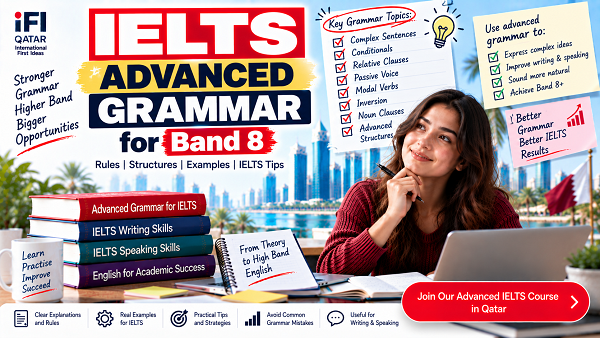
If you are aiming for IELTS Band 8, knowing basic English grammar is not enough.
At this level, you need to demonstrate that you can use a wide range of grammatical structures accurately, naturally and flexibly. This does not mean making every sentence complicated. In fact, trying to force advanced grammar into every sentence can create unnecessary errors.
The real goal is grammatical control.
You should be able to combine simple and complex structures, express relationships between ideas, show cause and effect, compare information, discuss hypothetical situations and communicate precise meanings without making frequent or systematic mistakes.
This guide covers the most useful areas of advanced IELTS grammar, including complex sentences, relative clauses, conditionals, passive structures, participle clauses, inversion, noun clauses, modal verbs, comparison structures, articles, punctuation and sentence variety.
What Grammar Do You Need for IELTS Band 8?
IELTS assesses grammar under the criterion Grammatical Range and Accuracy.
For Writing, the assessment considers the range and appropriacy of grammatical structures, the accuracy of sentences, the frequency and impact of grammatical errors, and punctuation. For Speaking, grammatical range and accuracy also considers how accurately and appropriately you use a range of grammatical forms while communicating.
For Band 8 Writing, the official descriptor expects a wide range of structures to be used flexibly and accurately. The majority of sentences should be error-free, while occasional non-systematic errors may occur without significantly affecting communication.
This means Band 8 grammar is about three things:
Range + Accuracy + Control
A candidate who uses ten advanced structures incorrectly is not demonstrating stronger grammar than someone who uses five structures accurately and appropriately.
Advanced IELTS Grammar vs Basic IELTS Grammar
The difference between basic and advanced grammar is not simply the length of a sentence.
Compare these examples:
Basic:
Many people work from home. It is convenient. It saves time.
More advanced:
Many people prefer working from home because it allows them to save commuting time and organise their schedules more flexibly.
The second version combines ideas into a logical grammatical structure.
Another example:
Basic:
Technology has changed education. Students can study online.
Advanced:
The rapid development of technology has transformed education by allowing students to access learning resources regardless of their location.
The advanced sentence expresses the relationship between the two ideas more precisely.
The Most Important Advanced IELTS Grammar Structures
If you are preparing for Band 8, focus on structures that allow you to express complex relationships naturally.
The most useful areas include:
- Complex sentences
- Subordinate clauses
- Relative clauses
- Conditionals
- Passive voice
- Modal verbs
- Participle clauses
- Noun clauses
- Cleft sentences
- Inversion
- Comparison structures
- Concession clauses
- Cause-and-effect structures
- Advanced noun phrases
- Reported speech
- Articles and determiners
- Advanced punctuation
You do not need to use all of these in every essay or Speaking answer.
The objective is to develop a flexible grammatical toolkit.
Complex Sentences for IELTS Band 8
Complex sentences are one of the most important areas of advanced IELTS grammar.
A complex sentence usually contains a main clause and at least one dependent clause.
For example:
Although online education is convenient, some students still prefer traditional classrooms.
The main idea is:
Some students still prefer traditional classrooms.
The dependent clause is:
Although online education is convenient.
Together, they create a relationship of contrast.
Cause and Effect
You can use complex structures to explain causes and consequences.
Basic:
Traffic is increasing. More people own cars.
Advanced:
Traffic congestion has increased because a growing number of people rely on private vehicles.
You can also reverse the structure:
Because a growing number of people rely on private vehicles, traffic congestion has increased.
Contrast
Useful structures include:
- although
- even though
- while
- whereas
- despite the fact that
- in spite of the fact that
For example:
Although online courses provide greater flexibility, they may not offer the same level of face-to-face interaction as traditional classes.
Purpose
Use:
- so that
- in order to
- in order that
- so as to
For example:
Governments should invest in public transport so that residents can travel more efficiently.
Or:
Governments should invest in public transport in order to reduce dependence on private vehicles.
Relative Clauses for IELTS
Relative clauses allow you to add information without creating unnecessary separate sentences.
Defining Relative Clauses
Students who receive regular feedback are more likely to recognise their weaknesses.
The relative clause identifies which students are being discussed.
Non-Defining Relative Clauses
Online learning, which has become increasingly popular, provides students with greater flexibility.
The additional information is separated by commas.
Advanced Relative Clauses
You can also use:
The main reason why many students choose online courses is flexibility.
Or:
The university at which she studied has recently introduced several new programmes.
However, do not use unnecessarily formal structures simply to sound advanced.
A natural:
The university where she studied…
may be preferable in many contexts.
Conditional Sentences for IELTS Band 8
Conditionals are extremely useful when discussing:
- hypothetical situations
- future possibilities
- consequences
- policies
- predictions
- social problems
First Conditional
Used for realistic future possibilities.
If governments invest in renewable energy, they can reduce their dependence on fossil fuels.
Second Conditional
Used for hypothetical or less likely situations.
If more people worked remotely, cities might experience less traffic congestion.
Third Conditional
Used for hypothetical situations in the past.
If the government had invested in public transport earlier, the city might not have experienced such severe congestion.
Mixed Conditionals
For more advanced expression:
If governments had invested more heavily in public transport in the past, cities would now have fewer traffic problems.
The past condition produces a present result.
This can be useful in sophisticated Task 2 arguments when the relationship is genuinely relevant.
Passive Voice in IELTS
The passive voice is useful when the action is more important than the person performing it.
Active
Scientists conducted the research in 2025.
Passive
The research was conducted in 2025.
The passive can be particularly useful in:
- Academic Writing Task 1
- Scientific topics
- Formal processes
- Reports
- Descriptions of systems
- Formal academic discussion
For example:
The data were collected from more than 500 participants.
Or:
New regulations have been introduced to reduce industrial emissions.
However, do not replace every active sentence with a passive structure.
Use the passive when it improves focus or fits the context.
Participle Clauses for Advanced IELTS Grammar
Participle clauses can make your writing more concise and sophisticated when used correctly.
Present Participle
Living in a large city, many people become accustomed to using public transport.
Past Participle
Designed to reduce congestion, the new transport system has attracted thousands of passengers.
Perfect Participle
Having completed the necessary research, the students presented their findings.
These structures can be useful, but they require careful attention to the subject.
Avoid dangling participles.
Incorrect:
Having arrived at the university, the lecture had already started.
The lecture did not arrive at the university.
Better:
Having arrived at the university, the students discovered that the lecture had already started.
The subject of the participle clause must logically match the subject of the main clause.
Modal Verbs for IELTS Band 8
Modal verbs allow you to express degrees of certainty, possibility, obligation and recommendation.
Useful modals include:
- can
- could
- may
- might
- must
- should
- would
Compare:
Technology will change education.
This is a strong prediction.
A more cautious statement might be:
Technology could significantly change the way education is delivered in the future.
Or:
Technology may play an increasingly important role in education.
This type of controlled language is particularly useful when discussing predictions and uncertain outcomes.
Hedging in IELTS Academic Writing
Academic writing often requires careful claims rather than absolute statements.
Useful expressions include:
- may
- might
- could
- is likely to
- tends to
- appears to
- is generally considered
- is often associated with
- can potentially
Compare:
Too absolute:
Social media causes young people to become less social.
More academically controlled:
Excessive social media use may reduce opportunities for face-to-face interaction among some young people.
The second sentence is more cautious and precise.
Advanced Noun Phrases
Strong noun phrases can make your IELTS writing more concise.
Instead of:
The number of people who use public transportation has increased significantly.
You could write:
There has been a significant increase in public transport use.
Another example:
Basic:
People are increasingly dependent on digital technology.
Advanced noun phrase:
Growing dependence on digital technology has transformed modern workplaces.
This type of grammatical compression can make academic writing more efficient.
Comparison Structures for IELTS
Comparison is particularly useful in IELTS Writing Task 1 and many Task 2 topics.
Useful structures include:
- whereas
- while
- compared with
- in comparison with
- significantly more than
- considerably less than
- twice as many as
- three times as much as
- the higher the…, the greater the…
For example:
While younger people tend to adopt new technologies quickly, older adults may require more time to become comfortable with them.
An advanced structure is:
The more accessible public transport becomes, the more likely people are to use it.
Concession Structures for Stronger Arguments
Concession structures allow you to recognise another perspective while maintaining your own position.
Useful forms include:
- although
- even though
- despite
- in spite of
- while
- admittedly
- notwithstanding
For example:
Although working from home offers considerable flexibility, it may not be suitable for every profession.
Another example:
Despite the convenience of online education, some students still benefit from direct interaction with teachers.
This is particularly useful for IELTS opinion essays because it allows you to acknowledge a limitation without abandoning your main argument.
Inversion for Advanced IELTS Grammar
Inversion changes the normal word order for emphasis.
It can demonstrate grammatical range, but it should be used sparingly.
Negative Adverbial Inversion
Never before has technology developed at such a rapid pace.
Normal structure:
Technology has never developed at such a rapid pace before.
Another example:
Rarely do people consider the long-term consequences of excessive consumption.
These structures can be impressive when used naturally.
However, they are not necessary for a high score.
Accuracy is more important than showing off a particular grammatical structure.
Cleft Sentences for Emphasis
Cleft sentences allow you to emphasise a particular part of an idea.
It-Cleft
It is access to reliable information that makes the internet particularly valuable to students.
What-Cleft
What many students need is more personalised feedback.
These structures can help you express emphasis clearly.
For example:
What governments should prioritise is the development of affordable public transport.
Again, use them when they genuinely improve the sentence.
Noun Clauses for IELTS
Noun clauses allow you to incorporate ideas into more complex sentences.
Common structures include:
- what
- whether
- why
- how
- that
For example:
What governments choose to prioritise can have a significant effect on future generations.
Another example:
It is important to consider whether the benefits of technological development outweigh its disadvantages.
Noun clauses are particularly useful when discussing opinions, causes and consequences.
Advanced Grammar for IELTS Writing Task 1
Advanced grammar can be especially valuable when describing data.
Comparisons
The percentage of students studying online was considerably higher than the figure for those attending traditional classes.
Approximation
Approximately one-third of respondents reported using the service regularly.
Change Over Time
The proportion of users increased steadily between 2015 and 2020 before declining slightly in the following year.
Contrast
While the number of international students increased substantially, domestic enrolment remained relatively stable.
Passive Structures
The data were collected from five different regions.
The important point is to describe the information accurately rather than use complicated grammar simply for its own sake.
Advanced Grammar for IELTS Writing Task 2
Task 2 gives you many opportunities to demonstrate grammatical range.
For example:
Although technological development has created unprecedented access to information, it has also raised concerns about privacy and digital dependency.
This sentence demonstrates:
- concessive clause
- present perfect
- complex noun phrases
- coordinated ideas
Another example:
If governments were to provide greater financial support for renewable energy, households might be more willing to adopt environmentally sustainable technologies.
This combines:
- conditional structure
- modal verb
- complex noun phrase
The grammar supports the argument rather than distracting from it.
Advanced Grammar for IELTS Speaking
Advanced grammar is not only important for Writing.
IELTS Speaking is also assessed for Grammatical Range and Accuracy, alongside Fluency and Coherence, Lexical Resource and Pronunciation. These criteria are equally weighted in the Speaking assessment.
In Speaking, advanced grammar should sound natural.
Basic Speaking Answer
I like living in Doha because it is convenient.
More Developed Answer
I enjoy living in Doha because, despite being a relatively busy city, it offers a good combination of modern facilities and cultural experiences.
The second answer demonstrates more grammatical variety while still sounding natural.
Conditional Speaking Example
If I had the opportunity to live abroad for a year, I would probably choose somewhere in Europe because I’d like to experience a completely different lifestyle.
Relative Clause Example
One place that I really enjoy visiting is the area around the Corniche, which has a great atmosphere in the evening.
The goal is controlled flexibility, not complicated speech.
Grammar Mistakes That Can Prevent Band 8
Advanced grammar is only useful if your basic grammar is already reliable.
Common recurring problems include:
Subject-Verb Agreement
Incorrect:
The number of students are increasing.
Correct:
The number of students is increasing.
Articles
Incorrect:
Technology has changed the way people communicate in society.
Correctness depends on context, but learners frequently omit or misuse articles with singular countable nouns.
For example:
It is useful tool.
should be:
It is a useful tool.
Countable and Uncountable Nouns
Incorrect:
Many informations are available online.
Correct:
A lot of information is available online.
Verb Tenses
Incorrect:
In recent years, technology changed the way people work.
Better:
In recent years, technology has changed the way people work.
Subject-Verb Agreement With Complex Subjects
Incorrect:
The benefits of this approach is clear.
Correct:
The benefits of this approach are clear.
Do not allow a nearby singular noun to distract you from the true subject.
Sentence Variety for IELTS Band 8
A strong essay should not contain the same sentence structure repeatedly.
Compare:
Technology is useful. Technology saves time. Technology improves communication. Technology provides access to information.
This is repetitive.
A more varied version is:
Technology has become an essential part of modern life because it saves time and improves communication. In addition, people can access enormous amounts of information almost instantly. Although these developments have created significant benefits, they have also introduced new social challenges.
The second version combines:
- simple structures
- compound structures
- complex structures
- subordinate clauses
- contrast
That is grammatical variety.
How to Combine Short Sentences Effectively
You should not combine every short sentence.
Instead, identify relationships between ideas.
Cause
People use smartphones extensively. Smartphones provide instant access to information.
Combine:
People use smartphones extensively because they provide instant access to information.
Contrast
Online learning is convenient. Some students prefer classrooms.
Combine:
Although online learning is convenient, some students prefer traditional classrooms.
Result
Public transport became more reliable. More residents began using it.
Combine:
As public transport became more reliable, more residents began using it.
This approach creates meaningful complexity.
How to Use Punctuation With Advanced Grammar
Punctuation becomes increasingly important as sentences become more complex.
Commas After Introductory Clauses
Although online learning is convenient, some students prefer traditional classrooms.
Commas With Non-Defining Relative Clauses
Online education, which has become increasingly popular, allows students to study remotely.
Avoid Comma Splices
Incorrect:
Technology is useful, it can also create problems.
Better:
Technology is useful, but it can also create problems.
Or:
Technology is useful; however, it can also create problems.
Or:
Although technology is useful, it can also create problems.
The official IELTS Writing guidance specifically includes punctuation within Grammatical Range and Accuracy.
Grammar Accuracy vs Grammatical Complexity
This is one of the most important lessons for Band 8 candidates.
Consider:
If governments had implemented more effective policies earlier, many of the problems that cities are currently experiencing could have been avoided.
This is grammatically complex.
But if you cannot control this structure accurately, it is better to write:
Governments could have avoided many current problems if they had introduced more effective policies earlier.
The second sentence is still advanced enough to demonstrate useful grammatical range.
The principle is:
Do not use a structure simply because it looks advanced. Use it because it expresses your meaning effectively.
How Many Advanced Grammar Structures Should You Use?
There is no official rule saying that you need a specific number of complex sentences to achieve Band 8.
The official Band 8 descriptor focuses on the wide range, flexibility and accuracy of structures, with the majority of sentences error-free and only occasional non-systematic errors.
Therefore, avoid formulas such as:
“Use exactly five complex sentences for Band 8.”
IELTS does not work that way.
Your grammatical range should emerge naturally from the ideas you need to express.
A Band 8 Grammar Upgrade Exercise
One of the best ways to improve is to transform basic sentences.
Example 1
Basic:
People exercise less. They have busy lifestyles.
Upgrade:
People tend to exercise less because increasingly demanding lifestyles leave them with limited free time.
Example 2
Basic:
Online education is convenient. It is not suitable for everyone.
Upgrade:
Although online education offers considerable flexibility, it may not be suitable for learners who benefit from face-to-face interaction.
Example 3
Basic:
Governments should improve public transport. This can reduce traffic.
Upgrade:
Governments should invest in improving public transport so that fewer commuters depend on private vehicles.
Example 4
Basic:
Technology has changed workplaces. Many employees now work remotely.
Upgrade:
The development of digital technology has transformed modern workplaces, enabling many employees to work remotely.
The objective is to learn how grammar can express relationships more efficiently.
A 7-Day Advanced IELTS Grammar Study Plan
Day 1: Complex Sentences
Practise:
- although
- because
- while
- whereas
- since
- so that
Write 10 sentences using different relationships.
Day 2: Conditionals
Practise:
- first conditional
- second conditional
- third conditional
- mixed conditional
Write examples related to common IELTS topics.
Day 3: Relative Clauses
Practise:
- who
- which
- that
- where
- whose
- non-defining clauses
Day 4: Passive and Participle Structures
Practise:
- passive voice
- present participle clauses
- past participle clauses
- perfect participle clauses
Day 5: Advanced Sentence Structures
Practise:
- noun clauses
- cleft sentences
- inversion
- advanced noun phrases
Day 6: Accuracy
Review:
- articles
- prepositions
- subject-verb agreement
- verb tenses
- countable and uncountable nouns
- punctuation
Day 7: Timed IELTS Writing
Write one complete Task 2 essay.
Then highlight:
- complex sentences
- conditionals
- relative clauses
- passive structures
- grammar mistakes
The goal is to identify whether your advanced structures are actually accurate.
A 30-Minute Daily Advanced Grammar Routine
If you are preparing for Band 8, consistency is more valuable than studying a large number of grammar rules once.
Try this routine:
5 minutes: Review one grammar structure.
10 minutes: Write five original examples.
5 minutes: Combine simple sentences into complex ones.
5 minutes: Correct your previous IELTS writing.
5 minutes: Speak about an IELTS topic using the target structure.
This final step is important because advanced grammar needs to become available in real-time Speaking as well as controlled Writing.
How to Self-Correct Your IELTS Grammar
After writing an essay, do not simply read it once.
Check it systematically.
Pass 1: Verb Check
Look for:
- incorrect tense
- missing auxiliary verbs
- subject-verb agreement
- incorrect verb forms
Pass 2: Noun Check
Look for:
- articles
- plural forms
- countable/uncountable nouns
- singular/plural agreement
Pass 3: Sentence Structure
Look for:
- fragments
- run-on sentences
- comma splices
- incomplete clauses
Pass 4: Advanced Structures
Check whether your:
- conditionals
- relative clauses
- passive structures
- participle clauses
- complex sentences
are actually correct.
Pass 5: Punctuation
Check:
- commas
- full stops
- apostrophes
- semicolons
- capital letters
This process is particularly useful for Band 8 preparation because occasional mistakes are very different from repeated, systematic errors.
Advanced IELTS Grammar Checklist
Before submitting an IELTS Writing response, ask:
Range
- Have I used a variety of sentence structures?
- Have I used complex sentences naturally?
- Have I combined different clause types?
- Have I used appropriate grammatical structures for the task?
Accuracy
- Are my verb tenses correct?
- Is subject-verb agreement accurate?
- Are articles correct?
- Are singular and plural forms correct?
- Are my prepositions accurate?
- Are my conditionals correctly formed?
Control
- Are my complex sentences actually clear?
- Have I avoided unnecessary grammatical complexity?
- Are my advanced structures used appropriately?
- Are most of my sentences error-free?
Punctuation
- Have I used commas correctly?
- Have I avoided comma splices?
- Are my sentences clearly separated?
- Have I checked punctuation in complex sentences?
Frequently Asked Questions About Advanced IELTS Grammar
What is advanced IELTS grammar?
Advanced IELTS grammar refers to the ability to use a broad range of grammatical structures accurately and appropriately in IELTS Speaking and Writing. It includes structures such as complex sentences, conditionals, relative clauses, passive forms and advanced clause combinations.
Do I need complex grammar to get Band 8?
A Band 8 performance requires a wide range of structures used flexibly and accurately, but simply using complicated grammar does not guarantee a high score. Accuracy, appropriacy and control are essential.
What grammar is most important for IELTS Band 8?
Focus on complex sentences, conditionals, relative clauses, passive structures, participle clauses, modal verbs, comparison structures, concession clauses, advanced noun phrases and accurate use of articles, tenses and agreement.
How can I improve my grammatical range for IELTS?
Practise transforming simple sentences into more sophisticated structures, write regularly under timed conditions, analyse your recurring errors and deliberately practise different grammatical forms in both Writing and Speaking.
Is grammar important in IELTS Speaking?
Yes. Grammatical Range and Accuracy is one of the four equally weighted IELTS Speaking assessment criteria. The other criteria are Fluency and Coherence, Lexical Resource and Pronunciation.
Should I use advanced grammar in every sentence?
No. Trying to make every sentence complicated can increase errors and reduce clarity. Use advanced structures when they help you express a relationship or meaning more precisely.
How many complex sentences should I use in IELTS Writing?
There is no fixed number. IELTS assesses the range, flexibility and accuracy of your grammar rather than requiring a specific number of complex sentences.
Can I get Band 8 with some grammar mistakes?
Yes. The official Band 8 Writing descriptor allows occasional non-systematic errors and inaccuracies as long as they have minimal impact on communication. The majority of sentences should be error-free.
What is the difference between Band 7 and Band 8 grammar?
The official descriptors indicate that Band 7 uses a variety of complex structures with some flexibility and accuracy, while Band 8 requires a wider range used flexibly and accurately, with the majority of sentences error-free and only occasional non-systematic errors.
Is advanced vocabulary more important than advanced grammar?
Neither should be treated as a substitute for the other. IELTS assesses Lexical Resource and Grammatical Range and Accuracy as separate criteria. Strong performance requires appropriate development across the assessment criteria.
Take Your IELTS Grammar to the Next Level
If you are already comfortable with basic English grammar but your IELTS score has stopped around Band 6 or 7, the next step is not simply to memorise more grammar rules.
You need to develop control.
That means learning how to:
- Choose the right structure for your meaning
- Build complex sentences accurately
- Avoid recurring grammar mistakes
- Use advanced structures naturally
- Improve sentence variety
- Write with greater precision
- Apply grammar under exam time pressure
- Use more sophisticated structures in Speaking without sounding unnatural
An advanced IELTS course can provide structured practice, correction and feedback that is difficult to obtain from grammar books alone.
Final Thoughts on Advanced IELTS Grammar for Band 8
Advanced IELTS grammar is not about making your English unnecessarily complicated.
It is about having enough grammatical range to express sophisticated ideas while maintaining strong control over accuracy.
Learn complex sentences, conditionals, relative clauses, passive structures, participle clauses, noun clauses and other advanced forms. But more importantly, learn when and why to use them.
Then combine advanced grammar with accurate basic structures, precise vocabulary, logical organisation and regular practice.
The goal is simple:
More range. Better accuracy. Greater control.
If you are aiming for Band 8, structured advanced training and detailed feedback can help you identify the grammatical patterns that are still limiting your score.
Ready to take your IELTS English to the next level?
Explore IFI Qatar’s Advanced IELTS Course and develop the grammar, writing and speaking skills you need for higher-band performance.