

Currently Empty: ر.ق 0,00


IELTS
IELTS Speaking Questions About Social Media and Internet
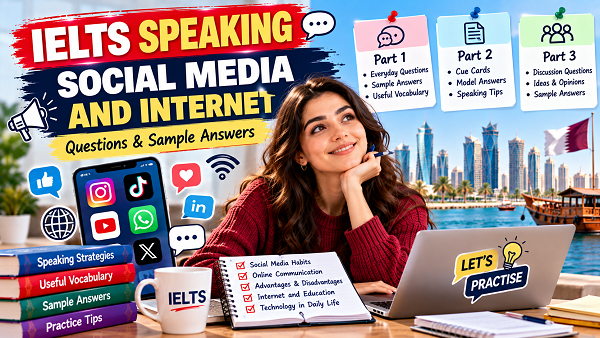
Social media and the internet are popular topics for English-speaking practice because they are closely connected to everyday life, communication, education, work and modern society.
If you are preparing for IELTS Speaking, practising IELTS social media speaking topics can help you develop the vocabulary, fluency and ideas you need to discuss technology-related questions with greater confidence.
In this guide, you will find IELTS Speaking questions about social media and the internet for Parts 1, 2 and 3, together with sample answers, useful vocabulary, collocations, answer strategies and practical exercises.
The questions in this article are for practice. They are not guaranteed IELTS exam questions.
What Are IELTS Social Media Speaking Topics?
IELTS social media speaking topics cover questions related to platforms, online communication, internet use, digital habits, technology and the way social media affects individuals and society.
You may be asked to discuss relatively familiar experiences in Part 1, describe a personal experience in Part 2, or discuss broader social issues in Part 3.
The official IELTS Speaking test lasts 11–14 minutes and has three parts. Part 1 focuses on familiar topics, Part 2 requires a longer individual response after one minute of preparation, and Part 3 develops a more general and abstract discussion.
Why Should You Practise Social Media Questions?
Social media is a useful topic for IELTS practice because it gives you opportunities to talk about:
- Personal habits
- Communication
- Friends and relationships
- Entertainment
- News
- Education
- Privacy
- Advertising
- Technology
- Online safety
- Social behaviour
- Changes in society
The objective is not to memorise answers. Instead, you should practise expressing your own ideas naturally and learn vocabulary that you can use flexibly.
IELTS Speaking Part 1 Social Media Questions and Sample Answers
Part 1 lasts approximately 4–5 minutes and includes questions about familiar topics and everyday experiences.
Social media questions in Part 1 are usually relatively personal and straightforward. Try to answer naturally rather than giving a long prepared speech.
Sample answer:
Yes, I use social media quite regularly, mainly to keep in touch with friends and follow topics that interest me. I probably spend more time on it than I should, but I try to avoid using it constantly throughout the day.
Sample answer:
I use Instagram the most because I enjoy visual content and it is an easy way to keep up with friends. I also follow a few educational accounts because they occasionally share useful information.
Sample answer:
I check social media several times a day, although I don’t spend hours on it continuously. I usually use it during short breaks or in the evening when I have finished my work.
Sample answer:
I mainly watch short videos, read posts and communicate with friends. I also follow some pages related to education, travel and technology, so I sometimes discover useful information while browsing.
Sample answer:
Sometimes, yes. It is very easy to lose track of time because there is always new content available. I try to control my usage by putting my phone away when I need to concentrate.
Sample answer:
Yes, but I used it much less than I do now. When I was younger, I mainly used social media to communicate with friends. Nowadays, I also use it for entertainment, information and professional purposes.
Do you prefer communicating online or face to face?
Sample answer:
For casual communication, I think online messaging is more convenient. However, for important conversations, I generally prefer speaking face to face because it feels more personal and makes it easier to understand someone’s emotions.
Sample answer:
Yes, most of my friends use social media every day. We sometimes share videos, news stories or interesting posts with each other, so it has become part of the way we communicate.
Do you follow celebrities or influencers?
Sample answer:
I follow a few public figures, but I don’t actively follow many influencers. I’m more interested in people who share useful content about subjects such as education, business, travel or technology.
Sample answer:
Definitely. Communication has become much faster and more convenient. We can send messages, photos and videos instantly, even when people live in different countries. However, I think face-to-face communication is still important.
Sample answer:
Yes. If I notice that I’m spending too much time scrolling, I sometimes take a break for a few days. I usually find that I can concentrate better when I reduce the amount of time I spend online.
What kind of content do you like seeing online?
Sample answer:
I prefer useful and informative content. For example, I enjoy watching educational videos, travel content and interviews because I can learn something new while I’m using social media.
How to Answer IELTS Social Media Part 1 Questions
Part 1 does not require complicated answers. Your goal should be to give a clear response and develop it naturally.
A useful structure is:
Direct answer → Reason → Example or extra detail
For example:
Question: Do you use social media?
Answer:
Yes, I do. I mainly use it to stay in touch with friends and follow educational content. For example, I often watch short videos about technology and language learning.
This is more effective than simply saying:
Yes, I do.
At the same time, you do not need to give a one-minute speech for a simple Part 1 question.
Use Personal Examples
Personal examples make answers easier to develop.
Instead of saying:
Social media is useful.
You could say:
I find social media useful because I can stay in contact with friends who live abroad.
Give a Reason
Adding a reason immediately makes your answer more developed.
Useful phrases include:
- because…
- mainly because…
- one reason is that…
- the main reason is…
- I suppose that’s because…
- I think this is partly because…
Add a Contrast
You can make your answer more interesting by showing two sides.
For example:
I use social media quite often because it is convenient, but I try not to use it when I’m studying.
This demonstrates your ability to develop an idea without using unnecessarily complicated language.
IELTS Speaking Part 2 Social Media Cue Cards
Part 2 is the individual long turn. You receive a task card, have one minute to prepare, and then speak for up to two minutes. The task card gives you points to include in your response.
Below are several social media and internet-related cue cards you can use for practice.
You should say:
- What the platform is
- How often you use it
- What you use it for
- And explain why you use it
Sample answer:
One social media platform I use regularly is Instagram. I started using it several years ago, and nowadays I probably check it a few times a day.
I mainly use it to keep in touch with friends and see what people are interested in. I also follow accounts related to travel, education and technology, so I often come across content that is genuinely useful.
What I like most about Instagram is that it is very visual. Instead of reading long articles, I can quickly understand an idea through a short video, image or infographic.
However, I think there is also a downside because it is quite easy to spend much longer on the platform than you originally intended. For that reason, I sometimes limit the amount of time I spend on it.
Overall, I use Instagram mainly because it combines communication and entertainment, and it also gives me access to information that matches my interests.
Describe a useful website you often visit
You should say:
- What the website is
- How you found it
- What you use it for
- And explain why you find it useful
Sample answer:
One website I find particularly useful is an online learning platform that provides educational courses and resources.
I discovered it when I was looking for materials to improve my English. Since then, I’ve used it several times a week, particularly when I want to learn something independently.
What I like about it is the variety of resources. I can watch lessons, read explanations and practise what I’ve learned. It is also convenient because I can use it whenever I have free time.
I think websites like this are extremely useful because they make education more accessible. Instead of depending entirely on traditional classes, people can learn new skills from almost anywhere.
You should say:
- What the post was about
- Where you saw it
- Why you found it interesting
- And explain what you thought about it
Sample answer:
I remember seeing a social media post about how people use artificial intelligence in education. I came across it while scrolling through my social media feed.
The post explained several ways students could use AI tools to organise their studies, practise languages and find ideas for projects. I found it interesting because I had already used some technology for studying, but I hadn’t thought about all of those possibilities.
What made the post particularly useful was that it included practical examples rather than simply making general claims.
I saved the post so I could look at some of the resources later. I think this is a good example of how social media can be useful when people use it to share educational information rather than just entertainment.
You should say:
- Who the person is
- Which platforms they use
- What they do online
- And explain why they use social media so much
Sample answer:
Someone I know who uses social media a lot is one of my close friends. They are very active online and regularly post photos, short videos and updates.
They mainly use social media to communicate with friends and follow current trends. They also enjoy creating content, so for them it is not simply a way of consuming information.
I think they use it so much because they genuinely enjoy interacting with other people online. They also find it entertaining and like receiving feedback on the content they create.
Personally, I wouldn’t want to spend quite as much time online, but I can understand why social media is appealing to them.
Describe something you learned from the internet
You should say:
- What you learned
- Where you learned it
- Why you wanted to learn it
- And explain how it helped you
Sample answer:
One useful thing I learned from the internet was how to improve my presentation skills.
I found a series of educational videos that explained how to organise information, speak clearly and keep an audience interested. I watched several of them because I had an important presentation coming up.
The advice was useful because it was practical and easy to apply. I learned how to structure my ideas more clearly and avoid putting too much information on a single slide.
As a result, I felt much more confident when I gave my presentation. It reminded me that the internet can be an extremely useful learning tool when you know how to find reliable information.
How to Structure an IELTS Social Media Cue Card
A simple four-part structure can help you keep speaking for up to two minutes.
Start With the Topic
Introduce what you are going to talk about.
Useful openings include:
- I’d like to talk about…
- One example that comes to mind is…
- The first thing I thought of was…
- I’d like to describe…
- One experience I remember clearly is…
Add Background Information
Explain when, where or how you discovered the subject.
For example:
I first came across this website when I was preparing for an exam.
Develop the Main Details
Explain what happened, what you did or why the subject matters.
Use linking expressions such as:
- because
- as a result
- for example
- in addition
- however
- on the other hand
- another reason is that
Finish With Your Opinion
End by explaining why the experience was important, useful, interesting or memorable.
For example:
Overall, I found the experience useful because it showed me how technology can make learning more convenient.
IELTS Speaking Part 3 Social Media Questions
Part 3 moves from personal experiences to broader and more abstract issues. The examiner may ask you to explain opinions, analyse issues, discuss advantages and disadvantages, or speculate about the future.
Sample answer:
Social media has made communication faster and more accessible. People can communicate instantly across long distances and share different types of content, including text, images and video.
However, I think there has also been a change in the quality of communication. Online messages can sometimes lack the emotional detail that people get from face-to-face conversations.
Sample answer:
One major advantage is connectivity. People can maintain relationships even when they live in different countries. Another benefit is access to information, because social media allows users to discover news, educational resources and professional opportunities very quickly.
Sample answer:
One major concern is that people can spend too much time using social media. This may affect productivity and reduce the amount of time they spend interacting with people in person.
Another issue is the spread of inaccurate information. Since content can be shared very quickly, users sometimes encounter information without knowing whether it is reliable.
Do you think people rely too much on the internet?
Sample answer:
In some areas, I think they do. People now use the internet for communication, entertainment, shopping, education and work, so it has become difficult to imagine daily life without it.
However, dependence is not necessarily negative. The internet can save time and provide valuable services. The important thing is to use it consciously rather than automatically.
How has the internet changed education?
Sample answer:
The internet has made educational resources much more accessible. Students can attend online classes, watch educational videos, access digital libraries and communicate with teachers remotely.
At the same time, having unlimited information can be challenging because students need to distinguish reliable sources from inaccurate ones.
Sample answer:
I think children should have appropriate limits rather than completely unrestricted access. Social media can help them communicate and discover educational content, but younger users may not fully understand issues such as privacy, cyberbullying or misleading information.
Parents and schools can therefore play an important role in teaching children how to use social media responsibly.
Sample answer:
I think it has both positive and negative effects. On the positive side, it allows people to communicate, share information and organise communities. On the negative side, it can contribute to misinformation, online conflict and excessive screen time.
So I wouldn’t describe social media as simply good or bad. Its impact largely depends on how people use it and how responsibly platforms are managed.
Sample answer:
I think digital communication will probably continue to play an important role in people’s lives. However, the platforms themselves may change significantly as new technologies develop.
For example, people may increasingly communicate through more immersive digital environments rather than traditional social media feeds.
Sample answer:
Governments may need to regulate certain aspects of social media, particularly areas involving online safety, privacy and illegal content.
However, regulation needs to be carefully designed because excessive control could create other problems. I think the main challenge is finding a balance between protecting users and allowing people to communicate freely.
How to Give Better Answers to IELTS Social Media Questions
The best answers are not necessarily the ones with the most complicated vocabulary.
IELTS examiners assess Speaking using four criteria: Fluency and Coherence, Lexical Resource, Grammatical Range and Accuracy, and Pronunciation. Each criterion contributes equally to the Speaking score.
Develop Your Ideas
Avoid giving one-sentence answers to questions that require explanation.
Instead of:
Social media is useful because it is convenient.
Try:
Social media is useful because it makes communication much more convenient. For example, I can stay in contact with friends who live abroad without having to make expensive phone calls.
Explain Why
Whenever possible, answer the question and explain your reasoning.
A useful formula is:
Opinion → Reason → Example → Result
For example:
I think social media is useful because it makes information easier to access. For example, I follow several educational accounts that share short explanations of complex topics. As a result, I often discover useful information without actively searching for it.
Compare the Past and Present
Social media is an excellent topic for practising comparisons.
Useful structures include:
- In the past…, whereas nowadays…
- Compared with the past…
- People used to…, but now…
- There has been a significant change in…
- These days…
Discuss Both Sides
Part 3 questions often require a broader discussion.
For example:
On the one hand, social media makes communication easier. On the other hand, it can reduce the amount of face-to-face interaction people have.
This gives you a natural way to organise contrasting ideas.
IELTS Social Media Vocabulary
You do not need to memorise hundreds of difficult words. Focus on vocabulary that you can use accurately and naturally.
General Social Media Vocabulary
| Word or Phrase | Meaning | Example |
|---|---|---|
| Social media platform | A website or app used for social interaction | Instagram is a popular social media platform. |
| Social networking | Using online platforms to communicate | Social networking has changed communication. |
| Social media user | Someone who uses social media | The number of social media users continues to grow. |
| Online community | A group connected through the internet | I joined an online community for language learners. |
| Digital content | Information published digitally | Young people consume a lot of digital content. |
| Social media feed | The stream of content shown to a user | I sometimes scroll through my social media feed. |
| Online interaction | Communication through the internet | Online interaction has become part of everyday life. |
| Content creator | Someone who produces online content | Many content creators share educational videos. |
| Influencer | A person who can influence an audience online | Some influencers promote products on social media. |
| Viral content | Content that spreads rapidly online | The video became viral within a few days. |
Internet Vocabulary for IELTS Speaking
Useful internet-related words include:
- Search engine
- Website
- Online platform
- Digital service
- Online learning
- Internet access
- Broadband connection
- Mobile application
- Online communication
- Digital technology
- Cybersecurity
- Data protection
- Online privacy
- Digital footprint
- Artificial intelligence
- Remote learning
- Online shopping
- Streaming service
Useful IELTS Social Media Collocations
Learning words in combinations can help you speak more naturally.
Communication Collocations
- communicate online
- stay in touch
- maintain relationships
- interact with others
- exchange information
- share experiences
- send instant messages
- communicate across borders
Example:
Social media makes it easier for people to stay in touch with friends who live abroad.
Technology Collocations
- use digital technology
- access information
- browse the internet
- use online services
- spend time online
- rely on technology
- adopt new technology
- keep up with technological developments
Example:
Many people rely on technology for work, education and communication.
Social Media Collocations
- post content
- share a post
- upload a video
- follow an account
- gain followers
- scroll through a feed
- create content
- engage with content
- build an online presence
Example:
Some businesses use social media to build an online presence and communicate directly with customers.
IELTS Social Media Grammar to Practise
Social media questions are particularly useful for practising several grammar structures.
Present Simple for Habits
I usually check social media in the evening.
Present Perfect for Change
Social media has changed the way people communicate.
Used to for Past Habits
I used to spend more time on social media when I was younger.
Comparatives
Online communication is faster than traditional communication.
Conditionals
If people spend too much time online, they may become less productive.
Modals for Discussion
Governments should protect users from harmful online content.
People should be more careful about sharing personal information.
Common Mistakes When Answering Social Media Questions
Memorising Complete Answers
Memorising an entire response can make your speech sound unnatural and may make it difficult to adapt when the examiner changes the question.
IELTS Speaking is designed to assess spontaneous communication, and official IELTS guidance emphasises natural language production rather than rehearsed responses.
Using Difficult Vocabulary Incorrectly
Using a complicated word is not automatically better.
For example, if you are unsure how to use a word such as “ubiquitous”, it is safer to use a simpler word accurately.
For Band 7 performance, the official descriptors emphasise flexible vocabulary use, some less common language, awareness of style and collocation, and effective paraphrasing.
Giving Extremely Short Answers
Part 1 questions are simple, but answering every question with only “yes” or “no” gives you little opportunity to demonstrate your speaking ability.
Add a reason, example or extra detail where appropriate.
Turning Every Answer Into a Speech
The opposite problem is also common.
You do not need to speak for two minutes when answering a simple Part 1 question.
Listen carefully to the question and give an appropriately developed response.
Repeating the Same Words
If you use “social media”, “good”, “bad” and “useful” repeatedly, your vocabulary may sound limited.
Practise alternatives such as:
- online platforms
- digital communication
- social networking
- beneficial
- convenient
- problematic
- time-consuming
- informative
Use alternatives only when they fit the meaning naturally.
How to Practise IELTS Social Media Speaking Topics
Effective practice should involve more than reading sample answers.
Practise Without Looking at the Answer
Choose a question and speak for 30–45 seconds.
Record yourself if possible.
Then listen and identify:
- Long pauses
- Repeated vocabulary
- Grammar mistakes
- Pronunciation problems
- Ideas that were difficult to explain
Use a One-Minute Idea Exercise
Choose a Part 2 cue card and give yourself one minute to prepare.
Write only keywords, not complete sentences.
For example:
Describe a useful website
- Website: learning platform
- Found: English study
- Use: 3 times/week
- Benefits: flexible + practical
- Result: more confident
Then speak for up to two minutes.
This mirrors the official Part 2 preparation structure.
Practise Part 3 With a Speaking Partner
Ask a partner to give you questions such as:
How has social media changed society?
Should governments regulate social media?
Will people depend more on the internet in the future?
Your partner should ask follow-up questions rather than simply listening to a prepared speech.
Record Your Answers
Recording yourself can reveal problems that are difficult to notice while speaking.
After each recording, ask:
- Did I answer the question directly?
- Did I explain my ideas?
- Did I use a range of vocabulary?
- Did I make repeated grammar errors?
- Was my pronunciation easy to understand?
- Did I hesitate too often?
7-Day IELTS Social Media Speaking Practice Plan
Day 1: Part 1 Questions
Practise 10 questions about your social media habits.
Focus on:
- Fluency
- Natural answers
- Giving reasons
- Personal examples
Day 2: Social Media Vocabulary
Learn 10–15 useful words and collocations.
Create your own example sentences instead of memorising dictionary definitions.
Day 3: Part 2 Cue Cards
Practise two social media and internet cue cards.
Give yourself one minute to prepare and speak for up to two minutes.
Day 4: Part 3 Opinions
Practise questions about:
- Privacy
- Children
- Education
- Advertising
- Social behaviour
Focus on explaining why you have an opinion.
Day 5: Compare Past and Present
Practise questions about how the internet has changed:
- Communication
- Education
- Shopping
- Entertainment
- Work
Use structures such as “used to”, “whereas”, “compared with” and the present perfect.
Day 6: Full Speaking Practice
Complete a simulated Speaking test covering:
- Part 1
- Part 2
- Part 3
Do not stop the recording when you make a mistake.
Day 7: Review and Repeat
Listen to your recordings from the week.
Choose your three biggest weaknesses and practise them again.
For example:
- Too many pauses
- Limited vocabulary
- Grammar mistakes
- Weak pronunciation
- Short answers
- Repetition
IELTS Social Media Speaking Practice Questions
Use these questions for additional practice.
Part 1 Questions
- How often do you use social media?
- What social media platform do you use most?
- What do you usually do online?
- Do you enjoy posting photos online?
- Do you follow many people on social media?
- Do your friends use social media a lot?
- Do you ever take breaks from social media?
- Do you prefer online or face-to-face communication?
- What type of online content do you enjoy?
- Did you use social media when you were younger?
Part 2 Cue Cards
- Describe a social media platform you use.
- Describe a useful website you often visit.
- Describe something useful you learned online.
- Describe a social media post you found interesting.
- Describe someone who uses social media a lot.
- Describe an online video that taught you something.
- Describe a time when the internet helped you solve a problem.
- Describe a website you would recommend to a friend.
Part 3 Questions
- How has social media changed communication?
- What are the advantages of social networking?
- What are the disadvantages of social media?
- Do people spend too much time online?
- How has the internet changed education?
- Should children have access to social media?
- Should social media companies be responsible for misinformation?
- How does social media affect relationships?
- Is online communication replacing face-to-face communication?
- Should governments regulate social media?
- How has the internet changed people’s working lives?
- Will people become more dependent on the internet in the future?
How to Improve Your IELTS Speaking Score With Social Media Topics
Social media is only one topic area, but it can help you practise many of the skills required for a higher Speaking score.
The official Band 7 descriptors include the ability to speak at length without noticeable effort or loss of coherence, use a range of vocabulary flexibly, use both simple and complex grammatical structures effectively, and demonstrate appropriate pronunciation features.
To work towards these skills, practise:
- Extending answers naturally
- Giving reasons and examples
- Comparing different viewpoints
- Paraphrasing
- Using topic-specific vocabulary
- Connecting ideas clearly
- Using a mixture of grammatical structures
- Speaking without excessive hesitation
- Developing Part 3 opinions
- Responding to unexpected follow-up questions
The goal is not to sound like a textbook.
The goal is to communicate your ideas clearly, naturally and effectively.
Frequently Asked Questions About IELTS Social Media Speaking Topics
Social media and internet-related subjects are useful areas for IELTS Speaking practice because they allow candidates to discuss familiar experiences as well as broader issues involving communication, technology and society. However, practice questions should not be treated as predictions of the actual exam.
Focus on useful words and collocations related to social media, communication, technology, privacy, online learning, digital content and internet use. Prioritise words that you understand and can use accurately.
Start with a direct answer and then add a reason, example or additional detail. Keep your response natural and appropriately developed rather than turning it into a memorised speech.
Practice topics can include describing a social media platform, website, online video, useful information found on the internet, social media post or person who uses social media frequently.
These are practice topics, not guaranteed questions.
Part 3 requires broader discussion. Give an opinion, explain your reasoning, provide an example where useful, and consider another perspective when appropriate.
Can I memorise answers for IELTS Speaking?
It is better to practise ideas, vocabulary and structures rather than memorising complete answers. Memorised responses can sound unnatural and may not adapt well when the examiner asks a different question. Official IELTS materials emphasise natural spoken production.
How can I practise IELTS Speaking at home?
You can practise by recording yourself, answering questions aloud, using cue cards, timing Part 2 responses and asking a partner to conduct a simulated Speaking test.
How can I get better at IELTS Speaking Part 3?
Practise discussing broader questions about causes, effects, advantages, disadvantages, changes and future developments. Try to explain your ideas rather than simply giving short opinions.
Practise IELTS Speaking With IFI Qatar
Practising IELTS social media speaking topics is a useful way to build confidence with vocabulary, idea development and spontaneous communication.
However, effective Speaking preparation should cover much more than one topic. You should practise Part 1, Part 2 and Part 3 questions across a wide range of subjects and receive feedback on fluency, vocabulary, grammar and pronunciation.
IFI Qatar can help IELTS candidates build their Speaking skills through structured IELTS preparation and practice.
If you are preparing for IELTS in Qatar and want more opportunities to practise with guidance, explore IFI Qatar’s IELTS preparation and Speaking practice options.
Start practising today, identify your weaknesses and build the confidence to speak naturally on unfamiliar topics.
Final Tips for IELTS Social Media Speaking Topics
When practising social media and internet questions, remember these five points:
- Do not memorise complete answers.
- Learn vocabulary in useful phrases and collocations.
- Develop your answers with reasons and examples.
- Practise both personal questions and broader Part 3 discussions.
- Record yourself and review your fluency, vocabulary, grammar and pronunciation.
Social media is a familiar subject, which makes it an excellent starting point for IELTS Speaking practice. Use the questions in this guide to build ideas, expand your vocabulary and practise expressing your opinions naturally.
The more you practise responding to different questions without memorising scripts, the more prepared you can become for the unexpected questions that are part of a real conversation.