

Currently Empty: ر.ق 0,00


IELTS
Online IELTS Preparation Course vs Classroom Course: Which Is Right for You?
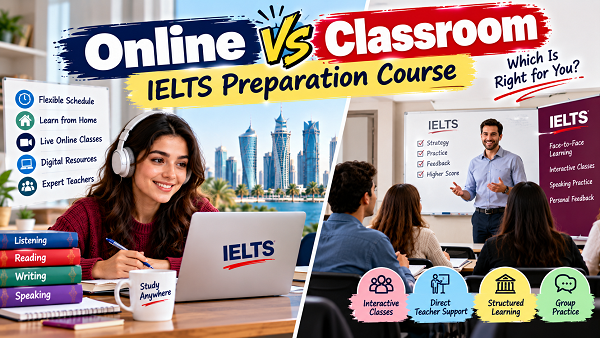
Choosing the right IELTS preparation format can make a significant difference to how consistently you study, how much feedback you receive, and how confidently you approach the exam.
For many students in Qatar, the decision comes down to two options: an online IELTS course or a traditional classroom IELTS course.
Both formats can provide structured IELTS preparation, teacher guidance, practice and exam strategies. The main difference is how you access your lessons and how the learning environment fits your schedule, learning style and preparation needs.
If you are trying to decide between online and face-to-face IELTS preparation, this guide explains the key differences, advantages, limitations and factors you should consider before enrolling.
Online IELTS Course vs Classroom Course: Quick Comparison
The right choice depends less on which format is “better” and more on which learning environment allows you to study consistently and receive the support you need.
| Factor | Online IELTS Course | Classroom IELTS Course |
|---|---|---|
| Location | Study from home or another suitable location | Attend a physical training centre |
| Flexibility | Usually higher | Usually based on a fixed schedule |
| Travel time | No commuting required | Requires travel to the centre |
| Teacher interaction | Live interaction may be available | Direct face-to-face interaction |
| Class environment | Digital classroom | Physical classroom |
| Group interaction | Depends on the course | Usually built into the classroom |
| Learning resources | Digital materials and recorded sessions may be available | Printed and/or digital materials may be provided |
| Speaking practice | Depends on course structure | Direct classroom practice |
| Writing feedback | Depends on instructor and programme | Can be provided directly in class |
| Best for | Busy schedules and remote learners | Students who prefer physical classrooms |
| Main consideration | Self-discipline and technology | Schedule and commuting |
IFI Qatar currently offers both online and face-to-face intensive IELTS preparation options. Its online programme includes 12 live interactive sessions, recorded sessions and digital resources, while the face-to-face intensive programme also includes 12 interactive 60-minute sessions.
What Is an Online IELTS Course?
An online IELTS course is a structured preparation programme delivered through an online learning environment.
Instead of travelling to a training centre, you attend lessons remotely using a computer or another suitable device. Depending on the programme, online IELTS preparation can include live teacher-led classes, digital resources, recorded lessons, practice exercises, mock tests and individual feedback.
A good online IELTS course should not simply consist of recorded videos.
For effective preparation, students should have opportunities to interact with an instructor, ask questions, practise IELTS tasks and receive feedback on areas such as Writing and Speaking.
How Online IELTS Preparation Works
A typical online IELTS course may include:
- Live instructor-led classes
- IELTS Listening, Reading, Writing and Speaking practice
- Exam strategies and time-management techniques
- Digital study materials
- Homework and practice tasks
- Writing correction and feedback
- Speaking practice
- Mock tests
- Recorded lessons or revision resources
- Progress tracking
The exact features depend on the provider, so students should always check what is included before enrolling.
Who Can Benefit From an Online IELTS Course?
An online IELTS course can be particularly suitable for students who:
- Have a busy work or university schedule
- Prefer studying from home
- Live far from the training centre
- Want to avoid commuting
- Need greater flexibility
- Are comfortable using digital learning platforms
- Prefer learning through a combination of live and digital resources
- Need IELTS preparation alongside other responsibilities
For students in Doha and other parts of Qatar, online preparation can also reduce the time spent travelling to and from classes.
What Is a Classroom IELTS Course?
A classroom IELTS course is delivered face-to-face at a physical training centre.
Students attend scheduled lessons and interact directly with their instructor and classmates. This format creates a traditional learning environment where students can ask questions, participate in activities and practise communication skills in person.
A classroom IELTS course may include:
- Face-to-face teacher instruction
- Group IELTS activities
- Speaking practice
- Writing exercises
- Reading and Listening practice
- Exam strategy training
- Homework
- Instructor feedback
- Practice tests
- Classroom discussions
IFI Qatar’s current face-to-face intensive programme consists of 12 interactive 60-minute sessions and focuses on IELTS skills, strategies, practice and instructor guidance.
Who Can Benefit From Classroom IELTS Preparation?
Classroom preparation may suit students who:
- Prefer face-to-face learning
- Learn better through direct interaction
- Enjoy studying with other students
- Need a structured physical environment
- Want immediate access to their instructor
- Find it difficult to maintain a study routine independently
- Prefer attending a dedicated training centre
Online IELTS Course vs Classroom Course: The Main Differences
The biggest difference is not the IELTS content itself. A well-designed programme should cover the skills and strategies required for the exam regardless of whether lessons are delivered online or in person.
The important differences are related to flexibility, interaction, environment, accessibility and learning habits.
Flexibility and Schedule
An online IELTS course can offer greater flexibility because students do not need to travel to a physical classroom.
This can be useful for professionals, university students and people with changing schedules.
Classroom courses generally operate according to a fixed timetable. While this may be less flexible, it can also provide valuable structure.
Teacher Interaction
Teacher interaction is important in IELTS preparation, particularly for Writing and Speaking.
With an online programme, students should check whether classes are live and interactive or mainly pre-recorded.
A live online IELTS course can provide opportunities to ask questions, practise tasks and communicate with the instructor.
In a classroom course, teacher interaction takes place face-to-face, which some learners find more natural and engaging.
Speaking Practice
Speaking is one of the four IELTS skills, and effective preparation requires more than memorising answers.
The official IELTS Speaking test lasts 11–14 minutes and consists of three parts. Candidates are assessed on fluency and coherence, lexical resource, grammatical range and accuracy, and pronunciation.
For this reason, students should ask how much speaking practice is included in a course.
A strong programme should give students opportunities to:
- Answer IELTS-style questions
- Speak under time pressure
- Develop ideas
- Practise Part 2 long turns
- Discuss more abstract topics
- Receive feedback
- Improve fluency and pronunciation
Writing Feedback
Writing is another area where instructor feedback can be especially valuable.
Simply writing essays is not enough. Students need to understand why an answer is strong or weak and what they should change.
When comparing an online IELTS course with a classroom course, ask:
- Does the instructor review Writing tasks?
- How often can students submit essays?
- Is feedback individual?
- Are common errors explained?
- Can students ask questions about their corrections?
The delivery format matters less than the quality and frequency of the feedback.
Interaction With Other Students
Classroom courses naturally create opportunities for face-to-face interaction between students.
This can be useful for pair activities, discussions, Speaking practice and collaborative exercises.
Online courses can also provide interaction, but the experience depends on the platform and teaching approach.
A live online course with breakout activities and active instructor involvement can provide considerably more interaction than a course based entirely on recorded lessons.
Travel and Accessibility
One of the clearest advantages of an online IELTS course is that you can attend lessons without travelling to the training centre.
This can be particularly useful if:
- You live outside central Doha
- You work long hours
- You have family responsibilities
- Traffic makes commuting inconvenient
- You prefer studying from home
A classroom course, on the other hand, requires you to plan travel time around every lesson.
Advantages of an Online IELTS Course
Online IELTS preparation can be a practical option for students who value flexibility and accessibility.
Study From Almost Anywhere
You can attend lessons from home, your workplace, or another suitable location with a reliable internet connection.
This removes the need to travel to a physical classroom for every session.
Save Commuting Time
For busy students, avoiding the journey to and from a training centre can make it easier to maintain a consistent study routine.
The time saved can also be used for IELTS homework, vocabulary revision or practice tests.
Greater Schedule Flexibility
Online learning can work well for students balancing IELTS preparation with:
- Full-time employment
- University studies
- Family responsibilities
- Other courses
- Travel
Access to Digital Learning Resources
Online programmes can integrate digital resources directly into the learning experience.
Depending on the course, these may include:
- Digital worksheets
- Online exercises
- Recorded lessons
- Practice materials
- Vocabulary resources
- Online feedback
- Mock tests
Comfortable Learning Environment
Some students concentrate better in a familiar environment.
Studying from home can reduce the distractions associated with travelling between locations and allow students to create a dedicated IELTS study space.
Advantages of a Classroom IELTS Course
Classroom preparation remains a strong option for students who prefer physical interaction and a structured environment.
Direct Face-to-Face Interaction
Some students find it easier to communicate with an instructor in person.
Questions can be asked immediately, and teachers can observe how students respond during activities.
Structured Learning Environment
Attending a physical class at a specific time can create accountability.
For students who struggle to study independently, having a fixed schedule may make it easier to stay consistent.
In-Person Speaking Practice
Classroom sessions can make it natural to practise speaking with instructors and other students.
This can be useful for students who need regular opportunities to speak English rather than simply study IELTS materials independently.
Classroom Discussions and Group Activities
Students can participate in discussions, pair work and group exercises.
These activities can be particularly useful for developing confidence in communicating ideas in English.
Which Is Better for IELTS Preparation: Online or Classroom?
There is no single format that is automatically better for every IELTS candidate.
The better option depends on your schedule, learning preferences, current English level, target band score and need for instructor support.
For example, an online IELTS course may be more suitable for a working professional who needs flexibility, while a classroom course may be more suitable for a student who learns best through direct face-to-face interaction.
The key question is not:
“Is online IELTS better than classroom IELTS?”
A better question is:
“Which learning environment will help me study consistently and get the feedback I need?”
How to Choose the Right Online IELTS Course
If you are considering an online IELTS course, do not choose based only on the course price or number of lessons.
Look at the complete learning experience.
Check Whether Classes Are Live
A live instructor-led course can provide opportunities to ask questions and practise in real time.
Ask whether the course is:
- Fully live
- Fully recorded
- A combination of live and recorded lessons
For students who need teacher support, live interaction can be particularly valuable.
Check What IELTS Skills Are Covered
The IELTS test assesses four skills: Listening, Reading, Writing and Speaking. Academic and General Training share the Listening and Speaking tests, while Reading and Writing differ.
Your preparation course should therefore cover the parts of the test relevant to the IELTS version you plan to take.
Check the Amount of Practice
Look for a programme that includes regular practice rather than focusing only on theory.
Useful preparation should include:
- IELTS-style questions
- Timed practice
- Writing tasks
- Speaking practice
- Listening exercises
- Reading exercises
- Mock tests
Official IELTS preparation resources also recommend using sample questions to become familiar with the test format and task types.
Ask About Writing and Speaking Feedback
This is particularly important.
Before enrolling, ask how instructors evaluate your Writing and Speaking performance.
A course can provide plenty of practice material, but personalised feedback can help you identify patterns that you may not notice yourself.
Check Whether the Course Matches Your Target
Your preparation needs may be different if you are aiming for Band 6 than if you need Band 7 or higher.
Ask whether the course provides:
- Level assessment
- Target-band guidance
- Individual feedback
- Progress tracking
- Mock testing
- Personalised recommendations
How to Choose the Right Classroom IELTS Course
If you prefer classroom preparation, consider more than the location.
Consider Class Size
A very large class may reduce the amount of individual interaction available to each student.
Ask how many students are normally in each class and how much opportunity you will have to speak and receive feedback.
Check the Schedule
Choose a timetable that you can realistically maintain.
An excellent course will not help much if you regularly miss lessons because the schedule does not fit your routine.
Evaluate the Instructor
The teacher is one of the most important parts of any IELTS preparation programme.
Look for an instructor who can explain:
- IELTS question types
- Band requirements
- Writing structure
- Speaking strategies
- Vocabulary development
- Grammar problems
- Time management
- Common exam mistakes
Look at the Complete Programme
Do not evaluate a classroom course only by the number of sessions.
Consider the full programme, including:
- Lesson duration
- Number of sessions
- Practice materials
- Writing feedback
- Speaking practice
- Mock tests
- Digital resources
- Instructor support
Online IELTS Course vs Classroom Course for Working Professionals
For working professionals, flexibility can be one of the most important factors.
An online IELTS course can eliminate commuting and make it easier to attend lessons from home after work.
However, professionals who prefer a fixed routine may find classroom learning more effective because the physical location creates a clear separation between work and IELTS preparation.
The best option depends on your working schedule and personal learning habits.
Online IELTS Course vs Classroom Course for University Students
University students often have changing schedules, assignments and exams.
An online course can make it easier to fit IELTS preparation around academic commitments.
However, students who enjoy group learning may prefer classroom preparation because it creates more opportunities for discussion and interaction.
Online IELTS Course vs Classroom Course for Busy IELTS Candidates in Qatar
For IELTS candidates in Qatar, practical considerations can also influence the decision.
Students living in or around Doha may choose between attending a physical IELTS preparation centre and studying online.
Consider:
- Your location
- Travel time
- Work schedule
- University timetable
- Family commitments
- Preferred learning environment
- Need for face-to-face interaction
- Access to reliable internet
- Personal study discipline
IFI Qatar currently provides both online and face-to-face IELTS preparation options, allowing students to choose a format that fits their circumstances.
Can an Online IELTS Course Prepare You for the Real IELTS Test?
Yes, an online preparation programme can prepare you for IELTS when it provides structured teaching, realistic practice and appropriate feedback.
The important distinction is between online preparation and taking the IELTS test online.
They are not the same thing.
An online IELTS course is a way of preparing for the examination. The actual IELTS test may be taken through different delivery methods depending on the test type, location and current availability.
IELTS states that Academic tests can be delivered at test centres or remotely online, while acceptance of IELTS Online should be checked directly with the organisation you are applying to. IELTS also states that tests required for UK Visas and Immigration must be taken at an official IELTS test centre.
Therefore, always check the requirements of your university, employer, professional body or immigration authority before choosing your test format.
What Should You Look for in a High-Quality IELTS Course?
Whether you choose online or classroom preparation, look for a course that combines teaching, practice, feedback and progress measurement.
A strong IELTS course should ideally provide:
- Experienced IELTS instructors
- Structured lessons
- Coverage of all required skills
- IELTS-specific strategies
- Regular practice
- Writing feedback
- Speaking practice
- Mock tests
- Progress assessment
- Study materials
- Opportunities to ask questions
- Clear guidance towards your target band
The delivery method is only one part of the decision.
The quality of the programme matters just as much.
Should You Choose an Online IELTS Course or Classroom Course?
Use this simple checklist before making your decision.
Choose an Online IELTS Course If You:
- Need flexible learning
- Have a busy schedule
- Prefer studying from home
- Want to avoid commuting
- Live far from the training centre
- Are comfortable learning digitally
- Want access to online resources
- Can maintain a regular study routine independently
Choose a Classroom IELTS Course If You:
- Prefer face-to-face teaching
- Learn better through direct interaction
- Enjoy group activities
- Need a structured physical environment
- Want regular in-person communication
- Prefer attending a dedicated training centre
- Find it difficult to stay motivated when studying remotely
Consider a Flexible Approach If You Need Both
Some students benefit from combining different forms of preparation.
For example, you might use structured lessons as your main preparation and supplement them with:
- IELTS mock tests
- Speaking practice
- Writing feedback
- Self-study
- Online resources
The goal should be to create a preparation routine that gives you enough practice and feedback to make measurable progress.
Frequently Asked Questions About Online IELTS Courses
Is an online IELTS course as effective as a classroom course?
An online course can be effective when it provides qualified instruction, live interaction, structured practice and meaningful feedback. The quality of the programme and the student’s consistency are important factors.
Is online IELTS preparation good for beginners?
Yes. Beginners can study IELTS online if the course is appropriate for their English level and provides structured guidance rather than expecting students to learn everything independently.
Can I improve my IELTS Speaking through an online course?
Yes. Online Speaking practice can be useful when students have regular opportunities to speak with instructors or other learners and receive feedback on fluency, vocabulary, grammar and pronunciation.
Can I get Writing feedback in an online IELTS course?
This depends on the course. Before enrolling, ask whether Writing tasks are reviewed individually and how frequently students receive feedback.
Is classroom IELTS preparation better for Speaking?
Not necessarily. Both online and classroom programmes can provide effective Speaking practice. What matters is the amount and quality of speaking practice, instructor interaction and feedback.
How many IELTS classes do I need?
There is no universal number of classes required. The amount of preparation depends on your current English level, target band, test date, available study time and weaknesses across the four skills.
Should I take an IELTS mock test before joining a course?
A diagnostic or mock test can help identify your current level and weaknesses. This can make it easier to choose an appropriate preparation strategy.
Is an online IELTS course suitable for people in Qatar?
Yes. Online preparation can be particularly practical for students and professionals in Qatar who want IELTS preparation without travelling to a physical training centre.
Prepare for IELTS With IFI Qatar
Choosing between an online IELTS course and classroom preparation is ultimately about finding the learning environment that fits your goals, schedule and study preferences.
At IFI Qatar, students can choose between online and face-to-face intensive IELTS preparation. The current online programme includes 12 live interactive sessions, recorded sessions and digital resources, while the face-to-face intensive programme includes 12 interactive 60-minute sessions.
If you are preparing for IELTS in Qatar and are not sure which option is right for you, start by considering your target band score, current level, schedule and preferred learning style.
Ready to start your IELTS preparation? Explore the IELTS course options at IFI Qatar and choose the format that fits your goals.
Final Thoughts
There is no universal answer to the question of whether an online IELTS course or a classroom course is better.
Online IELTS preparation can provide flexibility, accessibility and convenience, while classroom preparation can provide a structured physical environment and direct face-to-face interaction.
The most important factors are the quality of teaching, amount of practice, personalised feedback and consistency of your preparation.
Before enrolling, compare the course structure, instructor support, practice opportunities, Speaking and Writing feedback, schedule and overall learning experience.
Choose the format that you can realistically follow consistently—and turn your IELTS preparation into a structured plan rather than a collection of random practice sessions.