

Currently Empty: ر.ق 0,00


IELTS
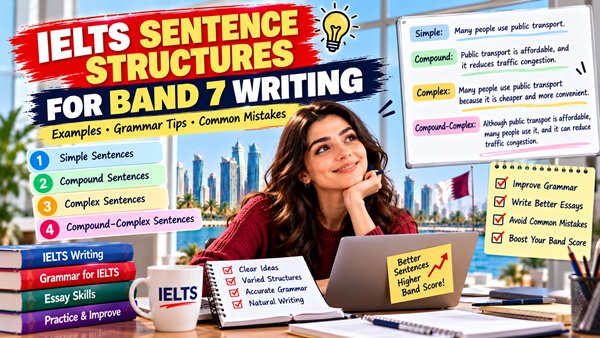
IELTS Sentence Structures for Band 7 Writing
Why Is Sentence Structure Important in IELTS Writing?
Sentence structure is one of the foundations of strong IELTS Writing.
You may have good ideas and a wide vocabulary, but if your sentences are repetitive, incomplete or grammatically inaccurate, your writing can become difficult to follow.
IELTS Writing is assessed using four criteria: Task Achievement/Task Response, Coherence and Cohesion, Lexical Resource, and Grammatical Range and Accuracy. Grammatical Range and Accuracy specifically considers the range and accuracy of grammar used in your response.
For Band 7, the official Writing descriptors state that candidates use a variety of complex structures with some flexibility and accuracy. Grammar and punctuation are generally well controlled, and error-free sentences are frequent, although a few grammatical errors may remain.
This means Band 7 writing is not about making every sentence complicated.
It is about being able to control different sentence structures and use them appropriately.
A strong IELTS essay might contain:
- Simple sentences for emphasis
- Compound sentences for connecting related ideas
- Complex sentences for explaining relationships
- Compound-complex sentences when appropriate
- Relative clauses for adding information
- Conditional sentences for discussing possible situations
- Passive structures when the focus is on an action or process
- Concession structures for presenting contrasting ideas
The key is variety + accuracy + relevance.
What Does Band 7 Require From Your Sentence Structure?
A common misconception is that you need to use extremely complicated grammar to achieve Band 7.
You do not.
The official Band 7 descriptor focuses on using a variety of complex structures with some flexibility and accuracy, rather than using complicated grammar in every sentence.
Consider these two examples:
Example A:
Many people use public transport. It is cheaper. It also reduces traffic.
These sentences are grammatically correct, but the structure is repetitive.
Example B:
Many people choose public transport because it is more affordable and can help reduce traffic congestion.
The second version combines ideas more effectively and demonstrates greater structural variety.
However, complexity is not automatically better.
For example:
Although public transport, which is used by millions of people, can, because of its affordability and accessibility, significantly reduce congestion which affects urban areas, many people, who prefer private vehicles, continue to drive because they believe that public transport is inconvenient.
This sentence is technically ambitious but unnecessarily difficult to read.
A better IELTS strategy is:
Use the simplest structure that expresses your idea accurately, then vary your structures throughout the essay.
The Main Types of IELTS Sentence Structures
There are four basic sentence structures that every IELTS candidate should understand:
- Simple sentences
- Compound sentences
- Complex sentences
- Compound-complex sentences
You do not need to use all four in every paragraph.
The objective is to combine them naturally.
Simple Sentences in IELTS Writing
A simple sentence contains one independent clause.
It normally includes:
Subject + Verb + Object/Complement
Examples
Governments should invest in public transport.
Technology influences modern education.
Many students study abroad.
Exercise improves physical health.
Simple sentences are not “bad” for IELTS.
In fact, they can be useful when you want to make an important point clearly.
When Should You Use Simple Sentences?
Use simple sentences when:
- Introducing a clear main idea
- Emphasising an important point
- Creating variety
- Making a conclusion direct
- Avoiding unnecessarily complicated grammar
For example:
Public transport has several advantages. It is affordable for many people.
The second sentence is simple, but it clearly reinforces the main idea.
The Problem With Using Only Simple Sentences
Consider this paragraph:
Public transport is important. It is affordable. It reduces traffic. It can reduce pollution. Many people use it. Governments should invest in it.
The grammar is mostly simple and understandable, but the paragraph sounds repetitive and lacks structural variety.
A stronger version could be:
Public transport is important because it is affordable for many people and can reduce traffic congestion. When more commuters use buses and trains instead of private cars, fewer vehicles are likely to be on the roads, which can also help reduce urban pollution.
The second version demonstrates a wider range of structures.
Compound Sentences for IELTS Writing
A compound sentence contains two independent clauses connected by a coordinating conjunction.
The most common coordinating conjunctions are:
FANBOYS
- For
- And
- Nor
- But
- Or
- Yet
- So
Basic Structure
Independent clause + conjunction + independent clause
Examples
Public transport is affordable, and it can reduce traffic congestion.
Some people prefer online education, but others believe that classroom learning is more effective.
Governments can improve public transport, so more people may choose to use it.
Using “And” Carefully
One common mistake is connecting too many ideas with “and.”
Weak:
Public transport is cheap and it is convenient and it reduces traffic and it can reduce pollution and governments should invest more in it.
Better:
Public transport is relatively affordable and convenient, and greater investment in this sector could reduce traffic congestion and pollution.
Or:
Public transport is relatively affordable and convenient. Greater investment in this sector could also reduce traffic congestion and pollution.
The goal is controlled writing rather than simply creating longer sentences.
Complex Sentences for IELTS Band 7
Complex sentences are particularly useful in IELTS Writing because they allow you to show relationships between ideas.
A complex sentence contains:
- One independent clause
- At least one dependent clause
Dependent clauses can show:
- Cause
- Contrast
- Condition
- Time
- Reason
- Purpose
- Result
Common Subordinating Conjunctions
Useful words include:
- Because
- Although
- While
- Whereas
- Since
- If
- Unless
- When
- As
- Before
- After
- Despite the fact that
Cause
Many people use public transport because it is cheaper than driving.
Contrast
Although public transport is affordable, some people still prefer to use private cars.
Condition
If governments improve public transport, more people may choose to leave their cars at home.
Time
When cities expand rapidly, public transport systems often come under pressure.
Complex sentences are particularly useful because they help you explain why, how, when and under what conditions something happens.
Compound-Complex Sentences for IELTS Writing
A compound-complex sentence combines features of compound and complex sentences.
For example:
Although public transport can be inconvenient in some areas, governments should continue investing in it because efficient transport systems can reduce congestion, and they can also improve access to employment.
This sentence contains:
- A dependent clause beginning with “Although”
- An independent clause
- A second independent idea connected with “and”
These structures can demonstrate grammatical flexibility.
However, they should be used carefully.
Do Not Force Compound-Complex Sentences
A common mistake is trying to make every sentence long because the candidate believes longer sentences automatically mean a higher score.
They do not.
A shorter, accurate sentence is better than a long sentence containing several grammatical errors.
For example:
Governments should invest more in public transport.
This is completely acceptable.
You could then develop the idea:
This investment would make public transport more reliable, which could encourage commuters to use buses and trains instead of private cars.
Together, the sentences create variety without unnecessary complexity.
Relative Clauses in IELTS Writing
Relative clauses are extremely useful for adding information without creating a separate sentence.
Common relative pronouns include:
- Who
- Which
- That
- Where
- Whose
Defining Relative Clauses
A defining relative clause provides essential information.
Students who study regularly are more likely to perform well in examinations.
Public transport systems that operate reliably can encourage people to leave their cars at home.
Non-Defining Relative Clauses
A non-defining relative clause adds additional information and normally uses commas.
Doha, which has experienced rapid development, has invested heavily in modern infrastructure.
Public transport, which is widely used in major cities, can reduce pressure on roads.
Why Relative Clauses Are Useful
They help you:
- Add detail
- Combine ideas
- Avoid repetitive sentences
- Demonstrate grammatical range
Instead of:
Many companies allow employees to work remotely. These companies can reduce office costs.
You could write:
Companies that allow employees to work remotely can reduce office costs.
Conditional Sentences for IELTS Writing
Conditionals are useful when discussing:
- Possible consequences
- Solutions
- Predictions
- Government policies
- Hypothetical situations
- Cause and effect
Zero Conditional
Used for general truths.
If + present simple, present simple
If people exercise regularly, they generally improve their physical health.
First Conditional
Used for possible future situations.
If + present simple, will + verb
If governments invest in public transport, more people will be encouraged to use it.
Second Conditional
Used for hypothetical or less likely situations.
If + past simple, would + verb
If cities invested more heavily in cycling infrastructure, more residents would probably cycle to work.
IELTS Example
If governments introduced higher taxes on unhealthy food, consumers might make healthier choices.
This structure is particularly useful for essays about government policy and solutions.
Passive Voice in IELTS Writing
The passive voice changes the focus of a sentence.
Active
Governments should improve public transport.
Passive
Public transport should be improved by governments.
The active version is usually more natural here.
However, passive structures are useful when the action is more important than the person or organisation responsible for it.
Examples
More investment should be directed towards public transport.
New regulations have been introduced to reduce pollution.
Renewable energy sources are increasingly being used to generate electricity.
Passive Voice in Task 1
Passive structures can be particularly useful when describing processes in Academic Writing Task 1.
For example:
The raw materials are transported to the factory before they are processed.
The passive voice is appropriate because the process, rather than the person performing each action, is the focus.
Cause-and-Effect Sentence Structures for IELTS
Cause and effect is one of the most important relationships in IELTS essays.
Useful structures include:
Because
People may choose public transport because it is more affordable.
As a result
Public transport is often cheaper than driving. As a result, it is particularly attractive to lower-income households.
Therefore
Many cities experience severe congestion; therefore, governments need to improve public transport systems.
Which Can Lead To
Excessive car use increases the number of vehicles on the road, which can lead to greater congestion.
Resulting In
Rapid population growth can place additional pressure on infrastructure, resulting in overcrowded public transport.
So That
Governments can expand public transport networks so that residents have more alternatives to private vehicles.
Using different cause-and-effect structures can improve grammatical variety while making your argument clearer.
Concession Sentence Structures for IELTS
Concession structures allow you to acknowledge an opposing point before presenting your own argument.
Useful structures include:
- Although
- Even though
- While
- Whereas
- Despite
- In spite of
Examples
Although online education offers greater flexibility, some students may struggle without face-to-face interaction.
Despite the convenience of private cars, excessive car use can contribute to traffic congestion.
While technology can improve access to information, it may also create distractions for students.
These structures are particularly useful for:
- Opinion essays
- Discussion essays
- Advantages and disadvantages essays
- Problem-solution essays
Participial Structures for More Advanced Writing
Participial structures can help you combine ideas efficiently.
Present Participle
Living in large cities, many people experience high levels of traffic congestion.
Past Participle
Designed to reduce emissions, electric vehicles are becoming increasingly common.
Result Structure
Many employees now work remotely, reducing the need for daily commuting.
These structures can be useful, but they must be used accurately.
A common mistake is creating a dangling modifier.
Incorrect:
Driving to work every day, traffic congestion can be frustrating.
The sentence incorrectly suggests that “traffic congestion” is driving to work.
Better:
Driving to work every day, many commuters find traffic congestion frustrating.
Or:
Daily commuting can be frustrating because of traffic congestion.
Accuracy should always come before complexity.
IELTS Sentence Structure for Body Paragraphs
Sentence structure should support the development of your ideas.
A useful IELTS body paragraph can follow this pattern:
Topic sentence → Explanation → Example → Result
For example:
One major advantage of public transport is that it can reduce household travel costs. Many commuters spend significant amounts of money on fuel, parking and vehicle maintenance, whereas buses and trains allow passengers to travel without these expenses. For example, a worker who uses public transport regularly may spend considerably less on commuting than someone who drives every day. As a result, reliable public transport can make urban living more affordable.
Notice the variety:
- Simple structure
- Complex structure
- Relative/comparative structure
- Cause-and-effect structure
The grammar supports the argument instead of distracting from it.
IELTS Sentence Structures for Introductions
Your introduction does not need extremely complex grammar.
A simple three-part approach works well:
- Paraphrase the question
- Give your position
- Introduce the main direction of your argument if appropriate
Example Question
Some people believe that governments should spend more money on public transport than on building new roads. To what extent do you agree or disagree?
Example Introduction
As urban populations continue to grow, many cities face increasing pressure on their transport networks. Although expanding road infrastructure can address some short-term problems, I believe that greater investment in public transport is a more sustainable solution because it can reduce congestion and provide affordable mobility.
This introduction combines:
- A time/condition clause
- An although clause
- A clear opinion
- A because clause
The result is grammatically varied without being unnecessarily complicated.
IELTS Sentence Structures for Conclusions
Your conclusion should be clear and concise.
Useful structures include:
Overall, I believe that…
Overall, I believe that governments should prioritise investment in public transport because of its long-term economic and environmental benefits.
Although…, I believe…
Although private vehicles offer greater convenience, I believe that public transport should receive greater government investment.
In conclusion,…
In conclusion, while online education provides greater flexibility, classroom learning remains valuable because it allows students to interact directly with teachers and classmates.
Avoid introducing completely new arguments in your conclusion.
How to Combine Simple and Complex Sentences in an IELTS Essay
A strong paragraph should not sound like a grammar exercise.
Compare these two versions.
Repetitive Version
Technology is important. Technology is used in education. Technology gives students access to information. Technology can make learning easier. Technology is becoming more common.
Improved Version
Technology has become increasingly important in education because it gives students immediate access to a wide range of information. Although traditional teaching methods remain valuable, digital tools can make learning more flexible and interactive. As a result, many educational institutions are incorporating technology into their classrooms.
The second paragraph uses different structures naturally.
That is the goal.
10 Useful IELTS Sentence Structures to Learn
Here are ten structures that can be adapted to many IELTS topics.
1. Because Structure
One reason why ___ is that ___.
Example:
One reason why people choose online courses is that they offer greater flexibility.
2. Although Structure
Although ___, ___.
Example:
Although technology can improve productivity, excessive use of digital devices may have negative effects.
3. Relative Clause
People who ___ are more likely to ___.
Example:
Students who practise regularly are more likely to develop stronger writing skills.
4. Conditional
If ___, ___ will/would ___.
Example:
If governments invested more in renewable energy, they could reduce their dependence on fossil fuels.
5. Cause and Effect
___ can lead to ___.
Example:
Excessive traffic can lead to increased air pollution.
6. Result Clause
___, which can ___.
Example:
Many employees now work from home, which can reduce commuting time.
7. Concession
Despite ___, ___.
Example:
Despite the high initial cost, renewable energy can provide long-term benefits.
8. While/Whereas
While ___, ___.
Example:
While online learning offers flexibility, classroom education provides more direct interaction.
9. Not Only…But Also
___ not only ___ but also ___.
Example:
Public transport not only reduces traffic congestion but also provides affordable mobility.
10. Participial Structure
___, resulting in ___.
Example:
Many cities are expanding cycling networks, resulting in safer conditions for cyclists.
These structures should be adapted to the question rather than memorised as complete sentences.
IELTS Sentence Structure Mistakes That Can Lower Your Score
Using Only Short Sentences
Short sentences are useful, but relying on them creates limited grammatical range.
Instead of:
Many people work remotely. They save time. They do not commute. They can spend more time with their families.
Try:
Many people who work remotely save commuting time, which allows them to spend more time with their families.
Making Every Sentence Long
Long sentences are not automatically better.
If a sentence contains too many clauses, the reader may struggle to understand your main point.
Aim for controlled complexity.
Joining Independent Clauses Incorrectly
Incorrect:
Technology is useful, it can also be distracting.
This is a comma splice.
Better:
Technology is useful, but it can also be distracting.
Or:
Technology is useful. However, it can also be distracting.
Starting Too Many Sentences With “Because”
Incorrect:
Because technology is useful. Many schools use it.
“Because technology is useful” is a dependent clause and cannot stand alone.
Better:
Because technology is useful, many schools use it.
Misusing Relative Clauses
Incorrect:
Students which study regularly usually achieve better results.
Better:
Students who study regularly usually achieve better results.
Incorrect Conditional Structures
Incorrect:
If governments will invest more, public transport will improve.
Better:
If governments invest more, public transport will improve.
Overusing “And”
Incorrect:
Governments should improve roads and build trains and increase buses and reduce pollution and provide cheaper transport.
Better:
Governments should improve public transport by expanding bus and rail networks. This could reduce congestion while providing residents with more affordable travel options.
Using Complex Grammar You Cannot Control
If a structure repeatedly produces errors, stop using it temporarily.
It is better to write:
Although this policy has some disadvantages, it could provide significant benefits.
than to attempt a complicated structure that contains several errors.
How to Improve IELTS Sentence Structure
Improving sentence structure requires more than memorising grammar rules.
Step 1: Identify Your Repeated Patterns
Take one of your IELTS essays and highlight:
- Simple sentences
- Compound sentences
- Complex sentences
- Relative clauses
- Conditionals
- Passive structures
If almost every sentence has the same pattern, your writing needs more variety.
Step 2: Upgrade One Sentence at a Time
Take two short sentences:
Public transport is affordable. It reduces traffic.
Combine them:
Public transport is affordable and can reduce traffic.
Then develop the relationship:
Because public transport is affordable, it can encourage more people to leave their cars at home, reducing traffic congestion.
This exercise teaches you how sentence structures develop.
Step 3: Practise One Structure With Different Topics
Take the structure:
Although ___, ___.
Use it with different IELTS topics.
Education:
Although online courses are convenient, some students prefer traditional classrooms.
Environment:
Although renewable energy requires substantial investment, it can provide long-term environmental benefits.
Technology:
Although artificial intelligence can improve productivity, it may create challenges for some workers.
Health:
Although modern medicine has advanced considerably, preventative healthcare remains important.
This helps you learn structures as flexible grammar tools rather than memorised sentences.
Step 4: Combine Grammar With Idea Development
Do not practise grammar separately from IELTS writing forever.
Eventually, you need to use the structures while developing real arguments.
For example:
If governments provide free access to sports facilities, more people may exercise regularly, which could reduce the long-term burden on public healthcare systems.
This sentence combines:
- Conditional grammar
- Cause and effect
- Relative structure
- Topic-specific vocabulary
A 7-Day IELTS Sentence Structure Practice Plan
Day 1: Simple and Compound Sentences
Practise combining short sentences using:
- And
- But
- So
- Yet
- Or
Write 10 examples.
Day 2: Complex Sentences
Practise:
- Because
- Although
- While
- If
- When
- Since
Write 10 sentences about common IELTS topics.
Day 3: Relative Clauses
Practise:
- Who
- Which
- That
- Where
- Whose
Write five sentences about education, technology, health, environment and employment.
Day 4: Conditionals
Practise first and second conditional structures.
Write examples involving:
- Government policy
- Education
- Environment
- Health
- Technology
Day 5: Passive and Participial Structures
Write sentences describing:
- Government actions
- Environmental processes
- Changes in society
- Manufacturing processes
Day 6: Write One Full Body Paragraph
Use at least three different sentence structures while maintaining clear idea development.
Do not force complexity.
Day 7: Write a Full IELTS Task 2 Essay
Write a complete essay under realistic time conditions.
Then highlight every sentence according to its structure.
Look for:
- Variety
- Accuracy
- Repetition
- Sentence fragments
- Run-on sentences
- Incorrect clauses
- Punctuation errors
IELTS recommends approximately 40 minutes for Writing Task 2, with a minimum of 250 words.
How to Check Your Sentence Structure Before Submitting an IELTS Essay
Leave a few minutes at the end of the Writing task for proofreading.
Check each sentence for five things:
1. Does It Have a Complete Structure?
Look for sentence fragments.
2. Does the Subject Agree With the Verb?
Check:
Governments invest
not:
Governments invests
3. Is the Clause Correctly Connected?
Check conjunctions such as:
- Although
- Because
- While
- If
- Which
4. Is the Punctuation Correct?
Pay particular attention to:
- Commas
- Full stops
- Apostrophes
- Semicolons
5. Is the Sentence Actually Necessary?
If a sentence is extremely long but does not add useful information, simplify it.
Good IELTS grammar is not about showing how many structures you know.
It is about using grammar effectively to communicate your ideas.
IELTS Sentence Structure and Coherence
Sentence structure also affects the way your ideas flow.
The official IELTS Writing criteria assess Coherence and Cohesion separately from Grammatical Range and Accuracy, but the two areas work together in practice. Coherence and Cohesion considers how ideas are organised and how cohesive devices such as conjunctions, pronouns and linking expressions are used.
Compare:
People should use public transport. It is cheaper. This is good for society. There are fewer cars. This reduces pollution.
with:
People should be encouraged to use public transport because it is generally more affordable than private car ownership. If more commuters choose buses and trains, fewer vehicles may be on the roads, which could help reduce urban pollution.
The second version makes the relationships between ideas much clearer.
Sentence structure is therefore not just a grammar issue.
It is also a communication and organisation tool.
Do You Need Complex Sentences in Every IELTS Paragraph?
No.
A Band 7 essay should demonstrate variety, but you should not force a complex sentence into every line.
A natural paragraph might look like this:
One major advantage of online education is its flexibility. Students can access lessons from almost anywhere, which is particularly useful for people who work full-time. Although some learners may miss face-to-face interaction, online courses allow them to organise their study around other responsibilities. As a result, this form of education can make learning more accessible to a wider group of people.
This paragraph contains different sentence structures without sounding artificial.
That is the target.
IELTS Sentence Structure: Band 6 vs Band 7
The difference is not simply “short sentences versus long sentences.”
A stronger Band 7 performance demonstrates more controlled variety.
| Area | Typical Band 6 Pattern | Band 7 Target |
|---|---|---|
| Sentence variety | Mix of simple and complex forms | Variety of complex structures |
| Accuracy | Some errors | Generally well controlled |
| Complex grammar | Attempts may be inconsistent | Used with some flexibility |
| Sentence development | Often straightforward | Ideas connected more effectively |
| Punctuation | Some errors | Generally well controlled |
| Error-free sentences | Less consistent | Frequent |
| Control | Can become repetitive | More flexible |
The official descriptors make clear that Band 7 involves a variety of complex structures used with some flexibility and accuracy, while grammar and punctuation are generally well controlled.
So the goal should not be:
“I need longer sentences.”
The better goal is:
“I need more variety and better control of sentence structures.”
IELTS Sentence Structure Practice Exercise
Improve the following sentences by combining ideas naturally.
Exercise 1
Many people work from home. They save commuting time.
Possible answer:
Many people who work from home save commuting time.
Exercise 2
Public transport is affordable. Some people still prefer cars.
Possible answer:
Although public transport is affordable, some people still prefer to use private cars.
Exercise 3
Cities are becoming more crowded. Governments need better transport systems.
Possible answer:
As cities become more crowded, governments need to develop more efficient transport systems.
Exercise 4
Students use technology. They can access more educational resources.
Possible answer:
Students who use technology can access a wider range of educational resources.
Exercise 5
Governments invest in renewable energy. They may reduce dependence on fossil fuels.
Possible answer:
If governments invest in renewable energy, they may reduce their dependence on fossil fuels.
After completing these exercises, create your own examples instead of simply memorising the model answers.
Frequently Asked Questions About IELTS Sentence Structure
What is sentence structure in IELTS?
IELTS sentence structure refers to the way words, phrases and clauses are organised to create grammatically accurate and meaningful sentences. In IELTS Writing, candidates should demonstrate a variety of sentence structures while maintaining grammatical control.
What sentence structures should I use for IELTS Band 7?
You should be comfortable using simple, compound and complex sentences, along with structures such as relative clauses, conditionals, passive voice and concession clauses. The official Band 7 descriptor requires a variety of complex structures used with some flexibility and accuracy.
Do I need complex sentences to get Band 7?
Band 7 requires a variety of complex structures, but you do not need to make every sentence complex. Simple and compound sentences can be useful when they are used naturally and accurately.
How many complex sentences should I use in IELTS Writing?
There is no official requirement specifying a particular number or percentage of complex sentences. Quality, variety, flexibility and accuracy are more important than reaching an arbitrary number.
Are long sentences better for IELTS?
No. A long sentence is not automatically a better sentence. A sentence should be long enough to express the relationship between ideas clearly while remaining grammatically controlled.
What is the best sentence structure for IELTS Task 2?
There is no single best structure for every sentence. A strong Task 2 essay normally combines different structures to explain ideas, show cause and effect, compare viewpoints, give examples and develop arguments.
How can I improve my IELTS sentence structure?
Practise transforming simple sentences into compound and complex structures, study common grammatical patterns, write full paragraphs and review your errors. Regular feedback can also help identify recurring grammatical problems.
Can I memorise IELTS sentence structures?
You can learn useful grammatical patterns, but you should avoid memorising complete sentences or paragraphs and inserting them regardless of the question. Your grammar should be adapted to the ideas and topic of the actual task.
Does sentence structure affect my IELTS Writing score?
Yes. Grammatical Range and Accuracy is one of the four IELTS Writing assessment criteria. At Band 7, candidates are expected to use a variety of complex structures with some flexibility and accuracy.
Is IELTS sentence structure important for both Academic and General Training?
Yes. Both Academic and General Training Writing are assessed using the same four broad criteria, including Grammatical Range and Accuracy. Task 1 differs between the two tests, while Task 2 requires an essay of at least 250 words.
Improve Your IELTS Grammar With Structured Preparation
Learning individual grammar rules is only the beginning.
To improve your IELTS Writing, you need to use those structures while:
- Developing relevant ideas
- Writing coherent paragraphs
- Answering the exact question
- Using appropriate vocabulary
- Managing your time
- Checking your work
- Correcting recurring mistakes
At IFI Qatar, structured IELTS preparation can help you develop these skills through guided practice and feedback.
If sentence structure is one of your weaknesses, don’t simply memorise more grammar rules. Identify the structures you struggle to control, practise them in IELTS-style sentences and apply them repeatedly in full Writing tasks.
Ready to improve your IELTS Writing? Explore IFI Qatar’s IELTS preparation courses and get structured support for grammar, Writing and the skills you need for your target score.
Final Tips for IELTS Sentence Structure
Remember these principles when preparing for IELTS Writing:
1. Do not confuse complexity with quality.
Longer sentences are not automatically better.
2. Build variety.
Combine simple, compound and complex structures naturally.
3. Prioritise accuracy.
A controlled sentence is more useful than an ambitious sentence full of errors.
4. Learn structures, not memorised essays.
Grammar patterns should help you express your own ideas.
5. Connect grammar to meaning.
Use conditionals for conditions, relative clauses for additional information, and concession structures for contrast.
6. Proofread your recurring mistakes.
Your personal error patterns are one of the best guides for improving your grammar.
7. Practise in complete IELTS responses.
The ultimate goal is not to write isolated grammar exercises. It is to produce clear, accurate and well-developed IELTS Writing responses.
For Band 7, the goal is simple:
Use a variety of sentence structures, control them accurately, and make every structure serve your ideas.