

Currently Empty: ر.ق 0,00


IELTS
How IELTS Examiners Score Writing Tasks: Assessment Criteria Explained
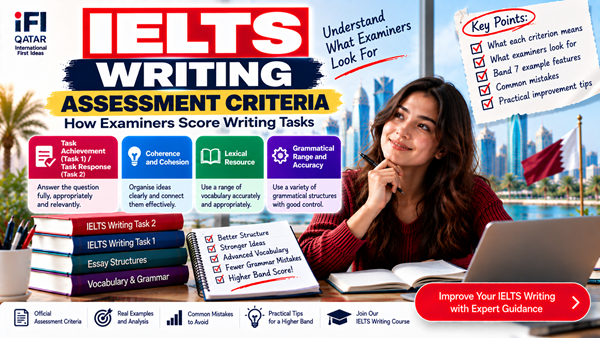
Understanding how IELTS examiners score Writing can completely change the way you prepare.
Many candidates focus on learning advanced vocabulary, memorising essay structures or writing as many practice essays as possible. But if you do not understand what examiners are actually assessing, it can be difficult to identify why a response receives a particular band score or what you need to improve.
IELTS Writing is assessed using four key criteria:
- Task Achievement / Task Response
- Coherence and Cohesion
- Lexical Resource
- Grammatical Range and Accuracy
For Task 1, examiners assess Task Achievement. For Task 2, they assess Task Response. The other three criteria apply to both tasks. Each criterion is assessed separately, and Task 2 contributes twice as much as Task 1 to the overall Writing score.
This guide explains each IELTS Writing assessment criterion, what examiners look for, common problems that reduce scores and practical ways to improve your writing.
How Is IELTS Writing Scored?
The IELTS Writing test consists of two tasks and lasts 60 minutes.
For Academic IELTS:
- Task 1: At least 150 words
- Task 2: At least 250 words
- Approximately 20 minutes are recommended for Task 1
- Approximately 40 minutes are recommended for Task 2
Task 1 asks you to describe visual information such as a graph, chart, table, diagram or process. Task 2 requires you to write an essay responding to a point of view, argument or problem.
For General Training IELTS, Task 1 is a letter rather than a visual-data report, while Task 2 is an essay. The same four assessment areas are used.
The Four IELTS Writing Assessment Criteria
| Assessment criterion | What it measures |
|---|---|
| Task Achievement / Task Response | How fully and appropriately you answer the task |
| Coherence and Cohesion | How clearly you organise and connect your ideas |
| Lexical Resource | Your range, accuracy and appropriacy of vocabulary |
| Grammatical Range and Accuracy | Your range and accuracy of grammatical structures |
Each criterion is assessed independently. Within an individual task, the four criteria are equally weighted, but Task 2 has twice the overall weighting of Task 1.
This is important because a candidate cannot compensate indefinitely for a weak area simply by using impressive vocabulary.
For example, an essay may contain sophisticated words but still receive a lower score if it does not answer all parts of the question or if the ideas are poorly organised.
What Is Task Achievement in IELTS Writing Task 1?
Task Achievement is the criterion used for IELTS Writing Task 1.
It evaluates how fully, appropriately, accurately and relevantly you fulfil the requirements of the task.
For Academic Task 1, the information you need is provided in the graph, chart, table or diagram. Your job is to select and report the most important information rather than simply describe every number or detail.
For General Training Task 1, you need to write a letter that appropriately achieves its purpose and covers the required points.
What Examiners Look for in Academic Task 1
A strong Academic Task 1 response should generally:
- identify the main features
- provide a clear overview
- select relevant data or information
- make meaningful comparisons where appropriate
- support descriptions with accurate figures when necessary
- organise information logically
- use an appropriate academic or neutral style
A common mistake is trying to mention every figure in a graph.
For example, if a chart contains eight categories, listing every number without identifying the major trends does not necessarily demonstrate effective task achievement.
Instead, ask:
What are the two or three most important things the reader needs to know?
The Importance of an Overview
An overview is one of the most important parts of an Academic Task 1 response.
It should summarise the main trends, differences or stages without becoming a detailed description of the data.
For example:
Weak:
The percentage was 20% in 2010 and increased to 25% in 2015.
Better overview:
Overall, the proportion of people using public transport increased considerably, while private car use showed a downward trend.
The second example focuses on the main pattern rather than individual figures.
Task Achievement in General Training Task 1
For General Training candidates, Task 1 involves writing a letter in response to a situation.
The task may require you to:
- request information
- provide information
- explain a situation
- make a complaint
- apologise
- invite someone
- suggest a solution
The letter needs to fulfil its purpose and address the points required by the task. IELTS also notes that the letter may require a personal, semi-formal or formal style depending on the situation.
A response that ignores one of the required points may weaken its Task Achievement score even if the grammar and vocabulary are strong.
What Is Task Response in IELTS Writing Task 2?
Task Response is used to assess IELTS Writing Task 2.
It considers how fully you respond to the question, how well you develop and support your main ideas, how relevant those ideas are and how clearly you present your position.
This is one of the most important areas for Task 2 preparation.
Answer Every Part of the Question
Many candidates read an IELTS question too quickly and begin writing immediately.
That can lead to an incomplete answer.
For example:
Some people believe university education should be free for everyone. Others believe students should pay tuition fees. Discuss both views and give your own opinion.
This question requires more than simply discussing free education.
You need to:
- discuss the first view
- discuss the second view
- give your own opinion
If one part is missing or poorly developed, your Task Response may suffer.
Develop Your Main Ideas
An idea is not fully developed simply because you have mentioned it.
Compare:
Free university education is beneficial because it helps students.
with:
Free university education can improve access to higher education, particularly for students from low-income families. If tuition fees are removed, students who might otherwise be unable to afford university may have a greater opportunity to pursue professional qualifications.
The second example develops the initial idea by explaining how and why the benefit occurs.
Support Your Arguments
IELTS encourages candidates to support their ideas with relevant examples.
You do not need to invent statistics.
A simple, relevant example from general knowledge or experience can be enough.
For example:
For example, students from low-income households may be more likely to abandon plans for university if tuition fees are unaffordable.
The example directly supports the argument.
Make Your Position Clear
For opinion questions, your position should be clear.
Avoid making the examiner guess what you believe.
For example:
Although both approaches have advantages, I believe governments should provide greater financial support for students who cannot afford university fees.
This makes the writer’s position clear.
What Is Coherence and Cohesion?
Coherence and Cohesion evaluates how effectively you organise and connect your ideas and information.
IELTS describes coherence in terms of logical organisation and progression, while cohesion concerns how relationships between ideas and sentences are made clear through appropriate cohesive devices.
In simple terms:
Coherence = Is your writing easy to follow?
Cohesion = Are your ideas and sentences connected effectively?
Logical Organisation
Your reader should be able to understand:
- what your main idea is
- why you are making the point
- how the next idea relates to it
- how the argument develops
A common structure for Task 2 is:
Introduction
→ Position / main answer
Body Paragraph 1
→ Main idea
→ Explanation
→ Example
Body Paragraph 2
→ Main idea
→ Explanation
→ Example
Conclusion
→ Summary / restatement of position
The exact structure can vary, but the underlying principle remains the same: ideas should progress logically.
Paragraphing Matters
Each paragraph should have a clear purpose.
For example:
Body Paragraph 1: Economic benefits
Body Paragraph 2: Social benefits
This is generally clearer than putting unrelated economic, social and environmental arguments into one long paragraph.
Cohesive Devices
Cohesive devices include words and expressions that show relationships between ideas.
Examples include:
- however
- therefore
- as a result
- in addition
- although
- because
- for example
- consequently
- while
- in contrast
But using more linking words does not automatically produce better cohesion.
IELTS preparation resources specifically emphasise the appropriate use of cohesive devices.
Avoid Overusing Linking Words
This paragraph sounds mechanical:
Firstly, technology is useful. Secondly, it saves time. Moreover, it provides information. Furthermore, it helps people communicate. Finally, it improves productivity.
The problem is not that these words are grammatically incorrect.
The problem is that the paragraph relies too heavily on obvious connectors rather than developing a natural flow of ideas.
Instead:
Technology has made many everyday activities more efficient. People can now access information within seconds, communicate with others around the world and complete many tasks online. As a result, technology has become an important part of both personal and professional life.
The relationships between ideas are clear without excessive signposting.
What Is Lexical Resource in IELTS Writing?
Lexical Resource refers to your use of vocabulary.
Examiners consider factors such as:
- range of vocabulary
- accuracy
- appropriacy
- precision
- spelling
- word formation
- ability to use vocabulary flexibly
Official IELTS preparation resources explain that higher levels require increasingly flexible and precise vocabulary use rather than simply a large collection of difficult words.
Range of Vocabulary
A strong response should not depend on the same basic words repeatedly.
For example, instead of using important in every paragraph, depending on context you might use:
- significant
- essential
- crucial
- influential
- fundamental
However, these words are not interchangeable in every sentence.
Vocabulary range must be combined with accuracy and appropriacy.
Precision Matters
Consider:
Governments should do something about traffic.
This is understandable but vague.
A more precise version could be:
Governments should introduce measures to reduce traffic congestion in major cities.
The second sentence communicates a clearer idea.
Collocations Matter
Collocations are words that naturally occur together.
Examples include:
- make a decision
- conduct research
- economic growth
- raise awareness
- reduce emissions
- play a significant role
- public transport
- achieve a goal
Using appropriate collocations can make your writing more natural and precise.
Avoid Forced “Advanced” Vocabulary
One of the most common misconceptions about IELTS Writing is that every sentence needs difficult vocabulary.
It does not.
For example:
Governments should implement multifaceted paradigmatic interventions to ameliorate transportation-related congestion.
This may look sophisticated, but it is unnecessarily complicated.
A clearer alternative is:
Governments should introduce effective measures to reduce traffic congestion.
IELTS assessment is not a competition to use the longest words.
The vocabulary needs to be appropriate, accurate and effective.
What Is Grammatical Range and Accuracy?
Grammatical Range and Accuracy evaluates both the variety of grammatical structures you use and how accurately and appropriately you use them.
This means examiners look at two related questions:
How varied is your grammar?
and:
How accurately do you use it?
Use a Range of Sentence Structures
Your writing should not consist entirely of short, simple sentences.
For example:
Technology is useful. It saves time. It helps people communicate. It provides information.
These sentences are grammatically simple.
A more varied version could be:
Although technology has created some social challenges, it has made everyday communication considerably easier. People can access information instantly, while online services allow them to complete many tasks without leaving home.
This example uses a wider range of structures.
Complex Sentences
Complex sentences can help you express relationships between ideas.
For example:
Although online education is convenient, it may not be suitable for students who require face-to-face interaction.
The sentence clearly communicates contrast.
Other useful structures include:
- relative clauses
- conditional sentences
- concessive clauses
- passive structures
- participle clauses
- comparative structures
The goal is not to use every structure in one essay.
The goal is to demonstrate control over a suitable range.
Accuracy Is Essential
A wide grammatical range is not enough if many sentences contain errors.
For example:
Governments should provides more support because students needs financial assistance.
The intended meaning is clear, but there are grammatical errors.
Correct:
Governments should provide more support because students need financial assistance.
Accuracy allows your ideas to be communicated more effectively.
What Does a Band 7 IELTS Writing Response Look Like?
The official IELTS Band Descriptors provide detailed descriptions for each band.
At Band 7, the descriptors expect a response that addresses the task appropriately, presents and develops a clear position, organises information logically, uses vocabulary with sufficient flexibility and precision, and demonstrates a variety of complex structures with generally good control.
This does not mean that a Band 7 response must contain perfect English.
A Band 7 response can still contain errors.
The important question is whether the overall performance meets the characteristics described by the relevant band descriptor.
Band 7 Task Response
A strong Band 7 Task 2 response should:
- address the main parts of the question
- present a clear position
- develop main ideas
- support ideas appropriately
- maintain relevance
Band 7 Coherence and Cohesion
The response should generally:
- organise information logically
- show clear progression
- use paragraphs effectively
- use cohesive devices appropriately
- maintain clear relationships between ideas
Band 7 Lexical Resource
The response should demonstrate:
- sufficient vocabulary range
- some flexibility
- appropriate word choice
- reasonable precision
- generally controlled spelling and word formation
Band 7 Grammar
The response should demonstrate:
- a variety of complex structures
- generally good grammatical control
- frequent error-free sentences
- errors that do not significantly interfere with communication
The official descriptors should always be treated as the reference point rather than relying on informal “Band 7 vocabulary lists” or memorised formulas.
What Is the Difference Between Band 6 and Band 7 Writing?
The move from Band 6 to Band 7 is not simply about learning more difficult vocabulary.
It is often about greater control, development, precision and flexibility.
| Area | Typical Band 6 characteristics | What Band 7 requires |
|---|---|---|
| Task Response | Addresses the task but development may be uneven | Clear position with better-developed and supported ideas |
| Coherence & Cohesion | Generally coherent but may have weaknesses | Clear progression and more flexible cohesion |
| Vocabulary | Adequate range with some errors | Greater flexibility and precision |
| Grammar | Mix of simple and complex structures | More controlled use of complex structures |
These descriptions are simplified summaries; the official band descriptors should be used when evaluating an actual script.
The important lesson is that moving up a band usually requires improvement across several areas rather than simply adding more sophisticated words.
Does Good Vocabulary Guarantee a High IELTS Writing Score?
No.
Vocabulary is only one of the four assessment criteria.
Consider an essay with excellent vocabulary but these problems:
- it does not answer all parts of the question
- the main position is unclear
- ideas are not developed
- paragraphs are poorly organised
- grammar errors are frequent
Strong vocabulary alone cannot solve these problems.
Similarly, an essay with relatively simple vocabulary can still communicate ideas effectively if the vocabulary is accurate, appropriate and sufficiently varied.
Does Perfect Grammar Guarantee a High Score?
No.
Grammar is also only one criterion.
A grammatically accurate essay can still have problems with:
- Task Response
- idea development
- organisation
- vocabulary
- relevance
The best approach is to develop all four areas together.
How Examiners Assess Task 1 and Task 2 Differently
Although the same overall scoring framework is used, Task 1 and Task 2 have different purposes.
| Task 1 | Task 2 | |
|---|---|---|
| Academic | Describe visual information | Discuss a point of view, argument or problem |
| General Training | Write a letter | Discuss a point of view, argument or problem |
| Main task criterion | Task Achievement | Task Response |
| Minimum length | 150 words | 250 words |
| Approximate time | 20 minutes | 40 minutes |
| Weight in Writing score | Lower | Twice Task 1 |
Task 2 carries twice the weight of Task 1, so candidates should allocate preparation time and test-day time accordingly.
Common Mistakes That Lower IELTS Writing Scores
Understanding the assessment criteria makes it easier to identify the mistakes that matter.
Not Answering the Full Question
A candidate may write a well-organised essay but fail to answer one part of a two-part question.
Solution: Identify every instruction in the question before writing.
Writing Memorised Essays
Memorised answers can fail to address the specific question.
IELTS itself warns candidates against relying on formulaic responses that do not appropriately answer the prompt.
Solution: Learn structures and strategies, but generate your ideas specifically for the question.
Using Too Many Linking Words
Overusing words such as “Firstly,” “Moreover” and “Furthermore” can make writing sound mechanical.
Solution: Focus on logical relationships between ideas rather than inserting connectors into every sentence.
Using Difficult Words Incorrectly
A sophisticated word used incorrectly can damage clarity and accuracy.
Solution: Prioritise precise vocabulary that you understand and can use naturally.
Writing Only Simple Sentences
A response made almost entirely of simple sentences may not demonstrate sufficient grammatical range for higher bands.
Solution: Practise combining ideas with appropriate complex structures.
Writing Extremely Long Sentences
The opposite problem is also common.
Long sentences with multiple grammatical errors can make ideas difficult to follow.
Solution: Aim for controlled sentence variety rather than maximum sentence length.
Ignoring the Overview in Academic Task 1
Listing figures without identifying the main trends can weaken the response.
Solution: Spend time identifying the major features before writing.
Spending Too Much Time on Task 1
Because Task 2 carries twice the weighting, spending too much of the 60-minute test on Task 1 can leave insufficient time for the essay.
Solution: Practise completing Task 1 efficiently and reserve approximately 40 minutes for Task 2.
A Practical IELTS Writing Self-Assessment Checklist
Before submitting a practice essay, assess it against the four criteria.
Task Achievement / Task Response
Ask:
- Did I answer the exact question?
- Did I address every part?
- Is my position clear where required?
- Did I develop my main ideas?
- Did I provide relevant support or examples?
- Did I stay on topic?
Coherence and Cohesion
Ask:
- Does each paragraph have a clear purpose?
- Is the order of ideas logical?
- Does each paragraph have a clear central idea?
- Are ideas connected naturally?
- Have I overused linking words?
Lexical Resource
Ask:
- Did I use a sufficient range of vocabulary?
- Are my word choices accurate?
- Did I use collocations naturally?
- Did I repeat the same words too often?
- Are spelling and word-formation errors controlled?
Grammatical Range and Accuracy
Ask:
- Did I use a variety of sentence structures?
- Did I use some complex structures?
- Are my sentences grammatically accurate?
- Did I check subject-verb agreement?
- Did I check articles, prepositions and verb forms?
- Are punctuation errors affecting clarity?
How to Improve Your IELTS Writing Score
The most effective improvement strategy is to stop treating Writing as one single skill.
Instead, divide your preparation into the four assessment criteria.
Improve Task Response
Practise:
- analysing questions
- identifying every instruction
- generating relevant ideas
- developing explanations
- supporting arguments with examples
- writing clear positions
Improve Coherence and Cohesion
Practise:
- paragraph organisation
- topic sentences
- logical progression
- referencing
- substitution
- linking ideas naturally
Improve Lexical Resource
Practise:
- topic vocabulary
- collocations
- paraphrasing
- precise word choice
- word families
- avoiding repetition
Improve Grammar
Practise:
- complex sentences
- relative clauses
- conditionals
- passive structures
- comparison
- concession
- punctuation
- sentence variety
Then combine all four skills through timed IELTS tasks.
How to Use IELTS Band Descriptors During Practice
One of the most useful preparation techniques is to use the official Band Descriptors when reviewing your writing.
Instead of saying:
“I think this essay is Band 7.”
ask more specific questions:
Did I fully address the task?
Are my ideas sufficiently developed?
Is my argument logically organised?
Is my vocabulary sufficiently flexible and precise?
Do I demonstrate a range of grammatical structures with good control?
This makes your practice more objective.
It also helps you identify the difference between what you intended to write and what is actually visible in your response.
Why Professional IELTS Writing Feedback Can Help
Self-study is useful, but it can be difficult to identify your own recurring mistakes.
For example, you may know that your grammar is “mostly correct” without noticing that you repeatedly make errors with:
- articles
- subject-verb agreement
- prepositions
- complex sentences
- verb forms
- punctuation
Similarly, you may believe your essay is well organised while a reader sees unclear progression between paragraphs.
Structured feedback can help identify these patterns.
A good IELTS Writing course should not simply correct individual mistakes. It should connect those mistakes to the IELTS Writing assessment criteria and show you how to improve your performance systematically.
IELTS Writing Assessment Criteria FAQ
What are the four IELTS Writing assessment criteria?
The four criteria are Task Achievement or Task Response, Coherence and Cohesion, Lexical Resource, and Grammatical Range and Accuracy. Task Achievement is used for Task 1, while Task Response is used for Task 2.
Which IELTS Writing criterion is most important?
Within each individual task, the four assessment criteria are equally weighted. However, Task 2 contributes twice as much as Task 1 to the overall Writing score.
How is IELTS Writing Task 2 scored?
Task 2 is assessed using Task Response, Coherence and Cohesion, Lexical Resource, and Grammatical Range and Accuracy. The four criteria are equally weighted within the task, while Task 2 itself has twice the weighting of Task 1 in the overall Writing score.
What does Task Response mean in IELTS?
Task Response measures how fully you answer the Task 2 question, how clearly you present your position, and how effectively you develop and support relevant ideas.
What is Task Achievement in IELTS Task 1?
Task Achievement measures how fully, appropriately, accurately and relevantly your Task 1 response fulfils the requirements of the task.
What does Lexical Resource mean in IELTS Writing?
Lexical Resource refers to the range, accuracy, appropriacy and precision of vocabulary used in your response. It also involves areas such as spelling and word formation.
What does Coherence and Cohesion mean?
Coherence concerns the logical organisation and progression of ideas, while cohesion concerns how effectively relationships between ideas and information are expressed using appropriate cohesive devices.
How is grammar assessed in IELTS Writing?
Grammatical Range and Accuracy evaluates the range of grammatical structures you use and how accurately and appropriately you use them.
Can I get a high IELTS Writing score with some grammar mistakes?
Yes. A high-band response does not necessarily have to be completely error-free. The official Band Descriptors evaluate the overall range, accuracy and control of grammar at each band level. For example, the Band 9 descriptor still refers to minor errors being extremely rare rather than claiming that every response must contain absolutely no error.
Is Task 2 more important than Task 1?
Yes. Task 2 carries twice as much weight as Task 1 when the overall IELTS Writing score is calculated.
Improve Your IELTS Writing With Expert Training
Understanding the IELTS writing assessment criteria is the first step toward more focused preparation.
Instead of simply writing essay after essay, use the four criteria to understand exactly what needs improvement:
Task Response → Coherence and Cohesion → Lexical Resource → Grammatical Range and Accuracy
Work on each area separately, then combine them through timed practice.
If you are preparing for IELTS in Qatar and want structured feedback on your Writing performance, an IELTS Writing course can help you identify weaknesses, develop stronger responses and practise according to the assessment criteria.
Ready to improve your IELTS Writing? Join an IELTS Writing Course at IFI Qatar and prepare with structured practice and expert guidance.