

Currently Empty: ر.ق 0,00


IELTS
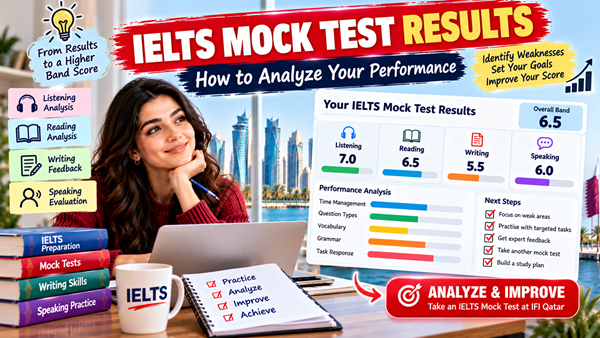
IELTS Mock Test Results: How to Analyze Your Performance
What Do IELTS Mock Test Results Tell You?
An IELTS mock test result is more than a number. It is a snapshot of how you perform under exam-style conditions and can help you identify the areas that need the most attention before your real IELTS test.
Your results should help you answer four important questions:
- What is my current performance level?
- Which IELTS skill is holding me back?
- Why am I losing marks?
- What should I practise next?
The most useful approach is to look beyond your overall estimated band score and examine your Listening, Reading, Writing and Speaking performance separately.
Official IELTS results report individual scores for all four skills as well as an overall band score. The overall score is calculated by averaging the four section scores and rounding according to IELTS scoring rules.
A well-designed mock test can therefore work as a diagnostic tool. Instead of simply telling you whether you performed well or badly, it can show you where your preparation needs to change.
Your mock test score is not the end result. It is the starting point for your next stage of preparation.
How to Read Your IELTS Mock Test Results
Start by creating a simple score profile.
| IELTS Skill | Mock Test Score | Target Score | Gap | Priority |
|---|---|---|---|---|
| Listening | 6.5 | 7.0 | 0.5 | Medium |
| Reading | 7.0 | 7.0 | 0.0 | Low |
| Writing | 5.5 | 7.0 | 1.5 | High |
| Speaking | 6.0 | 7.0 | 1.0 | High |
This type of table is much more useful than looking only at an overall score.
For example, a candidate with an estimated overall Band 6.5 may assume that every skill is approximately the same level. However, their actual profile could be:
- Listening: 7.5
- Reading: 7.0
- Writing: 5.5
- Speaking: 6.0
In this case, spending most of the study time on Listening would probably not address the biggest gap.
Compare Your Current Score With Your Target
The first step is to identify the difference between your current performance and the score you need.
For example:
Current Writing: 5.5
Target Writing: 7.0
Gap: 1.5 bands
This gives you a more useful preparation objective than simply saying:
“I need to improve my IELTS.”
Your goal becomes:
“I need to improve my Writing performance from approximately Band 5.5 to the level required for Band 7.”
That makes your study plan more specific.
Do Not Focus Only on Your Overall Band
Your overall score can hide important differences between individual skills.
Suppose your mock test produces:
- Listening: 7.5
- Reading: 7.0
- Writing: 5.5
- Speaking: 6.0
Your weakest area is clearly not Listening or Reading.
Your analysis should therefore focus on Writing and Speaking, while maintaining your stronger skills.
How Is the IELTS Overall Band Score Calculated?
The official IELTS overall band score is based on the average of your Listening, Reading, Writing and Speaking scores. The result is rounded to the nearest whole or half band according to IELTS rounding rules.
For example:
| Listening | Reading | Writing | Speaking | Average | Overall |
|---|---|---|---|---|---|
| 6.5 | 6.5 | 5.5 | 6.0 | 6.125 | 6.0 |
| 7.0 | 7.0 | 6.0 | 6.5 | 6.625 | 6.5 |
| 7.5 | 7.0 | 6.5 | 7.0 | 7.0 | 7.0 |
However, a mock-test provider may use an estimated band score rather than an official IELTS result.
Your mock result should therefore be treated as a preparation benchmark, not as an official IELTS Test Report Form.
Why Your Mock Score May Differ From Your Real IELTS Score
A mock test can indicate your current performance, but it cannot guarantee your official IELTS result.
Differences can occur because of:
- Test-day pressure
- Concentration
- Question difficulty
- Familiarity with the topic
- Time-management issues
- Performance fluctuations
- The quality of the mock test
- The quality of Writing and Speaking assessment
For this reason, use your mock result to make preparation decisions rather than treating it as a guaranteed prediction of your final score.
How to Analyze Your IELTS Listening Mock Test Results
Listening and Reading are relatively straightforward to diagnose because they contain questions with correct or incorrect answers.
The IELTS Listening test contains 40 questions. Each correct answer receives one mark, and the raw score is converted to the IELTS 9-band scale. The exact number of marks required for a particular band can vary slightly between test versions.
For example, IELTS states that around 30 correct answers out of 40 corresponds to Band 7 in Listening on average.
Check Your Raw Score
Do not record only the band score.
Record:
Correct answers: 28/40
Estimated band: approximately 6.5
Then investigate where the incorrect answers occurred.
Analyze Listening Mistakes by Question Type
Create a mistake log such as:
| Question Type | Correct | Incorrect | Main Problem |
|---|---|---|---|
| Multiple Choice | 5/6 | 1 | Distractor |
| Form Completion | 7/8 | 1 | Spelling |
| Matching | 4/6 | 2 | Lost concentration |
| Sentence Completion | 6/8 | 2 | Vocabulary |
This gives you a much clearer picture.
If you repeatedly lose marks in one question type, that question type should become part of your targeted practice.
Ask Why You Missed Each Answer
For every incorrect answer, ask:
- Did I not hear the answer?
- Did I hear it but misunderstand it?
- Did I miss the speaker’s correction?
- Did I lose concentration?
- Did I misunderstand the question?
- Did I make a spelling mistake?
- Did I write the wrong number of words?
- Did I choose an answer because of a distractor?
The answer tells you what to practise.
How to Analyze Your IELTS Reading Mock Test Results
IELTS Reading also contains 40 questions, with one mark awarded for each correct answer. Academic and General Training Reading are scored on the same IELTS band scale, but the tests contain different material and the raw-score requirements for a particular band can differ.
For example, IELTS currently gives approximately 30 correct answers as the average mark associated with Band 7 in Academic Reading, while around 35 is associated with Band 7 in General Training Reading. Exact boundaries can vary between test versions.
Record Your Reading Raw Score
Instead of writing only:
Reading: Band 6.5
record:
Correct answers: 28/40
Then break the result down by question type.
Analyze Reading Mistakes by Question Type
Useful categories include:
- Multiple choice
- True/False/Not Given
- Yes/No/Not Given
- Matching headings
- Matching information
- Matching sentence endings
- Sentence completion
- Summary completion
- Note completion
- Table completion
- Diagram labels
You may discover that your overall Reading score is not caused by a general lack of English ability.
For example, you might perform well on sentence completion but consistently lose marks on Matching Headings.
That is a strategy problem worth targeting.
Analyze Your Time Management
Ask yourself:
- Did I finish all three passages?
- How much time did I spend on Passage 1?
- Did one difficult question consume too much time?
- Did I guess unanswered questions at the end?
- Did I have enough time to review my answers?
If you regularly run out of time, your study plan should include timed Reading practice rather than simply completing more untimed questions.
How to Analyze Your IELTS Writing Mock Test Results
Writing requires a different type of analysis.
You cannot evaluate Writing simply by counting correct answers.
Official IELTS Writing assessment uses four criteria:
- Task Achievement/Task Response
- Coherence and Cohesion
- Lexical Resource
- Grammatical Range and Accuracy
Task 2 carries more weight than Task 1.
Your Writing mock-test feedback should therefore identify why your performance received its estimated band level.
Check Your Task Response
Ask:
- Did I answer every part of the question?
- Did I clearly address the main issue?
- Did I present a clear position when required?
- Did I develop my main ideas?
- Did I support ideas with explanations or examples?
- Did I stay relevant to the question?
A common problem is writing a lot without actually developing the answer sufficiently.
Check Your Coherence and Cohesion
Look at:
- Paragraph organisation
- Topic sentences
- Logical progression
- Referencing
- Linking devices
- Connections between ideas
Using more linking words does not automatically create better cohesion.
The important question is whether the reader can follow your argument easily.
Check Your Lexical Resource
Review:
- Repeated vocabulary
- Incorrect word choice
- Collocation errors
- Spelling
- Word formation
- Topic-specific vocabulary
- Overuse of memorised phrases
IELTS assesses not only the range of vocabulary but also how accurately and appropriately vocabulary is used.
Check Your Grammar
Look for patterns rather than isolated mistakes.
For example:
- Articles
- Subject-verb agreement
- Verb tense
- Prepositions
- Sentence structure
- Relative clauses
- Conditionals
- Complex sentences
- Punctuation
If the same grammar error appears repeatedly, it should become a priority in your preparation.
How to Analyze Your IELTS Speaking Mock Test Results
Speaking also requires more than a simple score.
IELTS Speaking is assessed using four equally weighted criteria:
- Fluency and Coherence
- Lexical Resource
- Grammatical Range and Accuracy
- Pronunciation
A useful Speaking mock-test report should therefore show where your performance is strongest and where it needs work.
Analyze Fluency and Coherence
Ask:
- Do I speak continuously?
- Do I pause too often?
- Do I frequently restart sentences?
- Can I extend my answers?
- Are my ideas logically connected?
- Do I rely heavily on fillers such as “um” and “you know”?
A candidate can have good vocabulary but still struggle to communicate smoothly.
Analyze Your Vocabulary
Look for:
- Repeated basic words
- Incorrect word choices
- Limited topic vocabulary
- Natural collocations
- Ability to paraphrase
- Ability to express precise meanings
The objective is not to use the most complicated word possible.
The objective is to use vocabulary accurately, naturally and appropriately.
Analyze Your Grammar
Review:
- Sentence variety
- Verb forms
- Complex structures
- Accuracy
- Repeated errors
- Ability to express different time frames and relationships
A useful question is:
Can I produce a variety of structures accurately while speaking naturally?
Analyze Pronunciation
Pronunciation feedback should focus on whether your speech is easy to understand and how effectively you use pronunciation features.
Pay attention to:
- Individual sounds
- Word stress
- Sentence stress
- Intonation
- Rhythm
- Connected speech
- Overall intelligibility
You do not need to sound like a native English speaker.
The focus should be on clear and effective communication.
How to Find Your Biggest IELTS Weakness
After analyzing all four sections, rank your weaknesses.
Use this simple system:
| Area | Current Level | Target | Gap | Priority |
|---|---|---|---|---|
| Listening | 7.0 | 7.0 | 0.0 | Low |
| Reading | 6.5 | 7.0 | 0.5 | Medium |
| Writing | 5.5 | 7.0 | 1.5 | Very High |
| Speaking | 6.0 | 7.0 | 1.0 | High |
Your preparation should not automatically give every skill equal study time.
If Writing is significantly below your target, it may deserve more attention than a skill that is already close to the required level.
Use the Gap-Impact Method
For each weakness, ask:
How far am I from my target?
Then ask:
How frequently does this problem occur?
For example:
Problem: Grammar mistakes in Writing
Gap: 1.0–1.5 bands
Frequency: Very high
Priority: High
Compare that with:
Problem: Two Reading questions lost because of careless mistakes
Gap: Small
Frequency: Low
Priority: Low
This prevents you from spending hours fixing minor issues while ignoring major ones.
How to Turn IELTS Mock Test Results Into a Study Plan
Your results become useful when you turn them into specific actions.
Use this formula:
Result → Problem → Cause → Action → Reassessment
For example:
Example 1: Reading
Result: 27/40
Problem: Low performance in Matching Headings
Cause: Difficulty identifying the main idea
Action: Practise identifying paragraph purpose and main ideas
Reassessment: Complete another timed Reading section
Example 2: Writing
Result: Estimated Band 5.5
Problem: Ideas are relevant but insufficiently developed
Cause: Main points are stated without enough explanation or support
Action: Practise developing each idea using explanation and examples
Reassessment: Submit another Task 2 response for feedback
Example 3: Speaking
Result: Estimated Band 6.0
Problem: Frequent hesitation
Cause: Difficulty extending answers spontaneously
Action: Practise answering unfamiliar questions for 60–90 seconds
Reassessment: Complete another Speaking mock test
This is much more effective than simply writing “practise IELTS more” in your notebook.
How Often Should You Take an IELTS Mock Test?
There is no universal number of mock tests that every candidate needs.
The important factor is what you do between tests.
Taking repeated mock tests without analyzing mistakes can create the illusion of progress.
A better cycle is:
Step 1: Take a Baseline Mock Test
Find out where you currently stand.
Step 2: Analyze the Results
Identify your weakest skills and recurring mistakes.
Step 3: Practise Targeted Skills
Spend your study time on the problems revealed by the test.
Step 4: Take Another Mock Test
Measure whether your performance has changed.
Step 5: Compare Results
Look for improvements in:
- Band scores
- Raw scores
- Question types
- Timing
- Writing criteria
- Speaking criteria
- Recurring mistakes
This creates a continuous improvement cycle.
How to Track IELTS Mock Test Results Over Time
Keep a simple progress tracker.
| Test | Listening | Reading | Writing | Speaking | Overall | Main Issue |
|---|---|---|---|---|---|---|
| Mock 1 | 6.5 | 6.0 | 5.5 | 6.0 | 6.0 | Writing |
| Mock 2 | 7.0 | 6.5 | 6.0 | 6.0 | 6.5 | Writing |
| Mock 3 | 7.0 | 7.0 | 6.5 | 6.5 | 7.0 | Writing |
| Mock 4 | 7.5 | 7.0 | 6.5 | 7.0 | 7.0 | Writing |
This makes trends easier to see.
You may discover that your overall score has improved while one skill remains consistently below your target.
That is an important signal.
Track Mistakes, Not Just Scores
A strong IELTS preparation tracker can include:
| Date | Skill | Question/Task | Mistake | Cause | Corrective Action |
|---|---|---|---|---|---|
| Oct 1 | Reading | Matching Headings | 3 wrong | Main idea | Heading practice |
| Oct 3 | Writing | Task 2 | Weak development | Planning | Idea development |
| Oct 5 | Speaking | Part 3 | Long pauses | Limited fluency | Timed speaking |
This turns your mock tests into a long-term diagnostic system.
What If Your IELTS Mock Test Score Is Lower Than Expected?
Do not panic.
A lower-than-expected mock score is useful if you understand why it happened.
First, check whether the test was completed under realistic conditions.
Then review:
- Time management
- Question types
- Accuracy
- Vocabulary
- Grammar
- Task response
- Fluency
- Concentration
- Test strategy
For example, a low Reading result may come from poor time management rather than a general inability to understand English.
Likewise, a low Writing result may be caused by weak task response or organisation rather than vocabulary alone.
The goal is to diagnose the problem before deciding what to change.
What If Your IELTS Mock Test Score Is Higher Than Expected?
A strong mock result is encouraging, but it should still be analyzed carefully.
Ask:
- Was the test completed under realistic conditions?
- Did I follow the time limits?
- Was the test appropriate for my IELTS type?
- Did I receive reliable Writing and Speaking feedback?
- Did I make careless mistakes?
- Is the result consistent with previous practice?
If several realistic mock tests produce similar results, you have more useful evidence about your current performance.
One unusually high score should not automatically determine whether you are ready for the official exam.
Why Writing and Speaking Feedback Matters
Listening and Reading have objectively correct answers, making them easier to review independently.
Writing and Speaking are different.
A candidate may know that an essay “looks good” without recognizing:
- Weak task response
- Underdeveloped ideas
- Repetitive vocabulary
- Poor paragraph progression
- Grammar patterns
- Limited flexibility
- Speaking hesitation
- Pronunciation problems
Official IELTS assessment uses specific criteria for both Writing and Speaking, so meaningful feedback should connect your performance to those criteria.
This is why a mock test with structured feedback can be more useful than a test that gives you only an overall estimated score.
What Makes a Useful IELTS Mock Test Result?
A useful result should answer more than:
“What band did I get?”
Ideally, it should tell you:
Your Current Performance
What is your estimated level in each skill?
Your Strongest Areas
Which skills or question types are already performing well?
Your Weakest Areas
Where are you losing the most marks?
Your Recurring Mistakes
Which errors appear repeatedly?
Your Next Steps
What should you practise before your next assessment?
Your Progress
Are your results improving over time?
IFI Qatar describes its mock-test service as a way to simulate the IELTS environment and help candidates identify areas for improvement. Its current information also lists Academic and General mock-test options, with feedback available depending on the selected service.
IELTS Mock Test Results Checklist
Before moving on from your mock test, make sure you have answered all of these questions:
- What is my overall estimated band?
- What is my Listening score?
- What is my Reading score?
- What is my Writing score?
- What is my Speaking score?
- What score do I actually need?
- What is the gap between my current and target scores?
- Which skill has the biggest gap?
- Which question types cause the most problems?
- What mistakes do I repeat?
- Are my problems caused by knowledge, strategy or timing?
- What should I practise this week?
- When should I reassess my performance?
If you cannot answer these questions, you probably have not fully analyzed your IELTS mock test results yet.
IELTS Mock Test Results: A Practical Example
Imagine a candidate needs an overall Band 7.
Their first mock test produces:
- Listening: 7.0
- Reading: 6.5
- Writing: 5.5
- Speaking: 6.0
Instead of studying all four skills equally, the candidate creates this plan:
Listening: Maintain current level with regular practice.
Reading: Improve accuracy and timing.
Writing: Focus on Task Response, idea development, grammar and vocabulary.
Speaking: Improve fluency, answer extension and pronunciation.
After several weeks of targeted preparation, the candidate takes another mock test.
The purpose of the second test is not simply to get another score.
It is to answer:
Did the targeted preparation solve the problems identified in the first test?
That is how mock testing becomes a measurement system rather than a collection of practice exams.
Frequently Asked Questions About IELTS Mock Test Results
What are IELTS mock test results?
IELTS mock test results are estimated scores from a practice IELTS examination. They can show your performance in Listening, Reading, Writing and Speaking and help identify areas that require further preparation.
Are IELTS mock test results official?
No. A mock test does not produce an official IELTS Test Report Form. It is a preparation and assessment tool designed to help you understand your current performance.
How accurate are IELTS mock test results?
Accuracy depends on the quality of the mock test and how closely it follows IELTS test conditions and assessment standards. Listening and Reading are easier to score objectively, while Writing and Speaking require reliable assessment against IELTS criteria.
How do I analyze my IELTS mock test score?
Compare each skill with your target score, identify your largest gaps, review your mistakes, determine why those mistakes occurred and create a targeted study plan.
Should I focus on my overall IELTS mock test score?
No. Your overall score is useful, but you should also examine Listening, Reading, Writing and Speaking individually. A weaker individual skill can be hidden by stronger performance in other sections.
What should I do after getting my IELTS mock test results?
Record your scores, analyze mistakes, identify recurring problems, prioritize your weakest areas, practise those areas and take another mock test later to measure progress.
Can IELTS mock test results predict my real IELTS score?
A mock test can provide an indication of your current preparation level, but it cannot guarantee your official IELTS result.
How can I improve my IELTS mock test results?
Start by identifying the specific reasons you are losing marks. Then use targeted practice, feedback and timed exam simulations to address those weaknesses before taking another mock test.
Should I take an IELTS mock test before booking the real exam?
A mock test can be useful if you are unsure about your current level or whether you are ready for the official examination. It can provide information that helps you decide what preparation is still needed.
Is an IELTS mock test useful for Band 7?
Yes. Candidates targeting Band 7 can use mock tests to identify specific gaps in Listening, Reading, Writing and Speaking and track whether targeted preparation is improving their performance.
Where can I take an IELTS mock test in Qatar?
IFI Qatar offers IELTS mock-test options for candidates preparing in Qatar, including Academic and General options. Current availability and feedback options should be checked before booking.
Turn Your IELTS Mock Test Results Into a Better Study Plan
Knowing your IELTS mock test score is useful.
Knowing why you received that score and what to do next is much more valuable.
Use your result to identify:
- Your current level
- Your target level
- Your biggest score gap
- Your recurring mistakes
- Your weakest question types
- Your most important skills to improve
Then turn those findings into a targeted preparation plan.
If you are preparing for IELTS in Qatar and want a structured assessment before your official exam, an IELTS mock test at IFI Qatar can help you practise under test conditions, identify weaknesses and understand what to work on next.
Don’t just take a mock test. Analyze the result, improve the weak areas and test your progress again.
Ready to find out where you really stand? Book your IELTS Mock Test with IFI Qatar and turn your results into an actionable preparation plan.
Final Tips for Analyzing IELTS Mock Test Results
Remember these five principles:
1. Look beyond the overall band.
Your individual skill scores tell you where the real problems are.
2. Analyze mistakes, not just marks.
Every mistake should teach you something about your preparation.
3. Separate knowledge problems from strategy problems.
You may know the English but still lose marks because of timing or technique.
4. Give Writing and Speaking proper attention.
These skills require assessment against specific IELTS criteria, not just answer checking.
5. Use every mock test to make the next stage of preparation more targeted.
The real value of an IELTS mock test is what you do with the results.