

Currently Empty: ر.ق 0,00


IELTS
IELTS Listening Common Problems and Solutions: How to Improve Your Score
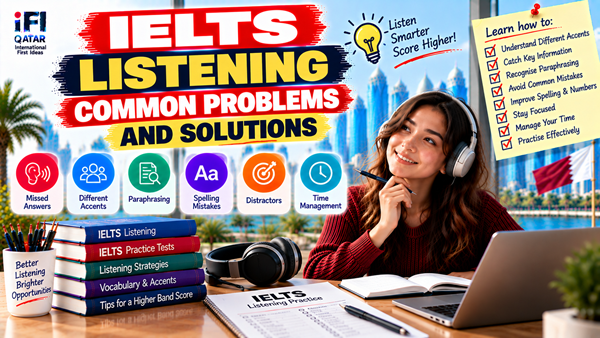
Do you understand English when you watch videos or talk to people, but struggle to get the same results in IELTS Listening? You are not alone. Many candidates can follow everyday conversations yet lose marks during the test because they miss important details, misunderstand unfamiliar accents, or struggle to keep up with the recording.
The problem is not always your English level. Sometimes, you know the vocabulary but fail to recognise a paraphrased answer. In other cases, you hear the correct information but write it incorrectly or lose your concentration while thinking about a previous question.
The good news is that most IELTS Listening problems can be addressed with targeted practice.
In this guide, you will learn about the most common IELTS Listening difficulties, why they happen, and how to overcome them with practical exercises. You will also discover how to build a study routine that helps you become a more accurate and confident listener.
What Are the Most Common IELTS Listening Problems?
The most common IELTS Listening problems include missing answers, struggling with different accents, misunderstanding paraphrasing, making spelling mistakes, losing concentration, and running out of time to review answers.
Understanding the reason behind each mistake is the first step towards improving your performance.
| IELTS Listening Problem | Why It Happens | Practical Solution |
|---|---|---|
| Missing answers | You focus too long on a previous question | Move on and follow the recording |
| Difficulty with accents | You have limited exposure to different English varieties | Practise with varied audio sources |
| Not recognising paraphrases | You expect to hear the exact words in the question | Learn synonyms and meaning-based listening |
| Spelling mistakes | You recognise the answer but write it incorrectly | Practise spelling and word forms |
| Losing concentration | You become distracted or mentally tired | Use focused, timed listening practice |
| Confusing distractors | You select an answer before the speaker finishes explaining | Listen for corrections and changes of opinion |
| Difficulty with numbers and names | Similar sounds are easy to confuse | Practise details using short recordings |
| Poor time management | You do not use the question-preview time effectively | Predict likely answers before listening |
| Missing word limits | Your answer contains unnecessary words | Read the instructions carefully |
| Struggling with long recordings | You lose track of the main idea and supporting details | Practise listening for structure and key information |
1. Missing Answers Because the Recording Moves Too Quickly
One of the most frustrating IELTS Listening problems is missing an answer and then losing track of the next several questions.
You may still be thinking about a word you did not understand when the speaker has already moved on. As a result, one missed answer can lead to several more mistakes.
Why Does This Happen?
The IELTS Listening test requires you to process information in real time. You cannot pause the official recording whenever you want to reconsider an answer.
If you spend too much time trying to recover a missed detail, you may stop following the conversation.
How to Solve This Problem
Develop the habit of moving forward when you miss an answer.
- Do not spend several seconds trying to remember a word you did not catch.
- Move your attention to the next question.
- Listen for the information that answers the next question.
- Use the available review time to revisit your responses.
Practise with short recordings and deliberately train yourself to continue listening even when you miss a detail.
Practice exercise: Listen to a one-minute conversation and answer five questions. If you miss one answer, leave it temporarily and continue with the recording. Afterwards, review the missed question using the transcript, if available.
The goal is to prevent one mistake from affecting the rest of the section.
2. Difficulty Understanding Different English Accents
Some IELTS candidates become comfortable with one English accent but struggle when they hear another.
For example, you may understand a familiar American speaker but find a British, Australian, or New Zealand accent more challenging.
IELTS Listening can include a range of English accents, so relying on only one pronunciation variety may limit your preparation.
How to Improve Your Listening Across Accents
Build familiarity with different speakers gradually.
Useful resources include:
- English-language interviews
- Educational podcasts
- News reports
- University lectures
- Documentary programmes
- Official IELTS practice recordings
Choose material that is appropriate for your current level. You do not need to understand every word in every recording.
Instead, focus on identifying the main idea, important details, and the words that signal relationships between ideas.
Use a Three-Stage Listening Method
First listen: Understand the main idea.
Try to identify the topic, speakers, and purpose of the conversation.
Second listen: Focus on details.
Listen for names, dates, locations, reasons, and other information relevant to the task.
Third listen: Review difficult sections.
Use a transcript when available to identify unfamiliar expressions, reduced sounds, and pronunciation patterns.
Over time, this process can help you recognise spoken English more efficiently.
3. Failing to Recognise Paraphrasing
A major challenge in IELTS Listening is that the recording often expresses an idea differently from the wording used in the question.
If you listen only for exact keyword matches, you may miss the correct answer even when you understand the conversation.
Example of IELTS Listening Paraphrasing
Question:
Why did the student choose the course?
Recording:
“I wanted something that would fit around my part-time job.”
Possible answer:
The schedule was flexible.
The speaker does not use the exact word flexible. However, the meaning indicates that the course fits the student’s work schedule.
How to Improve Your Paraphrasing Skills
Before the recording starts, identify the key meaning of each question and think about possible alternative expressions.
For example:
| Question Keyword | Possible Paraphrases |
|---|---|
| Increase | Rise, grow, go up |
| Decrease | Fall, decline, drop |
| Difficult | Challenging, demanding, complicated |
| Affordable | Inexpensive, reasonably priced, within budget |
| Postpone | Delay, put off, reschedule |
| Convenient | Practical, suitable, easy to arrange |
| Reason | Cause, explanation, factor |
| Improve | Develop, enhance, become better |
These alternatives are examples rather than exact equivalents in every context. Always use the meaning of the full sentence to identify the correct answer.
Practice exercise: Take five IELTS Listening questions and rewrite each question using different words while preserving its meaning. Then listen to a recording and identify the relevant information without relying on exact keyword matches.
4. Making Spelling and Word-Form Mistakes
Sometimes, you hear the correct answer but still lose the mark because you write it incorrectly.
Spelling, singular and plural forms, and grammatical fit can all affect whether your answer is accepted.
For example, you might hear a word correctly but write a singular noun when the required answer is plural.
Common Spelling Problems
Candidates may struggle with:
- Similar-sounding words
- Unfamiliar names
- Double consonants
- Word endings
- Singular and plural nouns
- Common British and American spelling variations
How to Reduce Spelling Errors
Create a personal spelling list from your practice tests.
Include words that you frequently misspell, especially vocabulary related to education, accommodation, transportation, and everyday services.
Then practise writing the words from memory rather than simply reading them.
You should also check whether the answer fits the sentence and follows the question’s word limit.
For example, if the instructions say NO MORE THAN TWO WORDS, an answer containing three words may be rejected even if the meaning is correct.
5. Losing Concentration During the Test
IELTS Listening requires sustained attention. Even a brief distraction can cause you to miss important information.
Some candidates become distracted because they are worried about their score. Others start thinking about an earlier question instead of listening to the current recording.
How to Improve Your Concentration
Start with short, focused listening sessions before progressing to longer recordings.
Try the following routine:
- Put away your phone and other distractions.
- Read the questions before listening when the test allows time to do so.
- Identify the type of information you need.
- Listen actively instead of trying to understand every word.
- Review your answers after the recording.
Gradually increase the length of your practice sessions until you can maintain concentration throughout a full Listening test.
Focus on Meaning, Not Every Word
You do not need to understand every word to answer a question correctly.
Your objective is to identify the information relevant to the task. Trying to translate every sentence into your first language can slow down your processing and make it easier to miss the next answer.
Practise understanding the overall meaning directly in English.
6. Choosing Distractors Instead of the Correct Answer
IELTS Listening questions sometimes include information that sounds relevant but is not the final answer.
A speaker may mention one option, correct themselves, explain a change of plan, or reject an earlier suggestion.
If you select an answer as soon as you hear a familiar keyword, you may choose the wrong option.
Example of a Listening Distractor
Question: Which day will the meeting take place?
Recording:
“We originally planned to meet on Tuesday, but several people are unavailable, so we’ve moved it to Thursday.”
Incorrect answer: Tuesday
Correct answer: Thursday
The first day is mentioned, but the speaker later changes the plan.
How to Recognise Distractors
Pay attention to expressions that introduce corrections or changes, such as:
- Actually…
- However…
- Instead…
- We have decided to…
- We originally planned to…
- The only problem is…
- Rather than…
These expressions do not always introduce a correction, but they can signal that the speaker is adding information that changes the meaning.
Practice exercise: Find a short conversation containing a change of plan or opinion. Write down the first option mentioned and the final decision. This helps you learn to follow the complete meaning rather than reacting to the first familiar word.
7. Struggling With Numbers, Dates, Times, and Names
Questions involving numbers and specific details can be difficult because similar sounds may be easy to confuse.
You might hear a phone number incorrectly, confuse a date, or miss a price because the speaker says it quickly.
How to Practise Listening for Details
Use short recordings that contain:
- Telephone numbers
- Prices
- Addresses
- Dates
- Times
- Room numbers
- Names and spellings
Listen once and write down the information. Then listen again to check your answers.
For example, practise distinguishing between similar numbers and noticing corrections such as:
The appointment is at 3:15 — sorry, I mean 3:50.
The important skill is to follow the complete statement and notice whether the speaker changes the information.
8. Not Using the Question-Preview Time Effectively
Before each part of IELTS Listening, candidates have an opportunity to read the upcoming questions according to the test instructions.
If you use this time to read without thinking about the information required, you may find it harder to follow the recording.
How to Preview Questions Strategically
Before listening:
- Underline key words.
- Identify the type of answer required.
- Predict whether the answer is likely to be a name, number, noun, adjective, or short phrase.
- Notice word limits.
- Look for differences between answer options.
For example, if the question asks for a reason, listen for an explanation. If it asks for a date, prepare to recognise a date rather than focusing on every detail of the conversation.
Predictions should guide your attention, not force you to expect only one specific word.
9. Finding Multiple-Choice Questions Difficult
Multiple-choice questions can be challenging because several options may contain similar information.
A speaker may discuss all the options, but only one accurately answers the question.
How to Improve Multiple-Choice Accuracy
First, read the question and identify what it is asking.
Then compare the options and notice their differences. This helps you focus on the information that distinguishes the correct answer from the alternatives.
During the recording:
- Listen for the main idea behind each option.
- Avoid choosing an answer simply because you hear the same word.
- Pay attention to explanations, contrasts, and corrections.
- Select the option that matches the speaker’s complete meaning.
After practising, review why the incorrect options were tempting. Understanding the reason for each error is more useful than simply checking the correct letter.
10. Struggling With Maps, Plans, and Directions
Map-labelling questions can be difficult if you lose track of the speaker’s position or confuse directional language.
These tasks often require you to understand spatial relationships and follow a sequence of instructions.
How to Improve Map-Labeling Skills
Before listening, study the map and identify the starting point, key landmarks, and direction indicators.
Practise vocabulary such as:
- Opposite
- Next to
- Behind
- In front of
- Between
- At the end of
- On the left
- On the right
- Turn left
- Turn right
- Straight ahead
During practice, trace the route with your finger while listening.
If you lose your position, avoid spending too long trying to recover it. Follow the next instruction and continue.
11. Finding Section 3 and Section 4 Difficult
Later parts of IELTS Listening may challenge candidates because they involve more complex discussions, academic topics, or longer stretches of information.
You may need to follow several speakers, recognise different opinions, or identify specific details within a lecture.
How to Prepare for Longer and More Complex Recordings
Develop your ability to recognise the structure of a conversation or lecture.
Listen for:
- The main topic
- Changes in the discussion
- Reasons and examples
- Contrasting opinions
- Conclusions
- Important supporting details
For academic-style recordings, practise taking brief notes while listening. Focus on key information rather than trying to write down every sentence.
You can also listen to educational talks or lectures on unfamiliar subjects to become more comfortable with different topics and speaking styles.
12. Repeating Practice Tests Without Analysing Mistakes
Completing many practice tests does not automatically improve your Listening score.
If you check only the final result and move on to another test, you may continue making the same mistakes.
A more effective approach is to use every practice test as a learning opportunity.
How to Review an IELTS Listening Practice Test
After completing a test:
Step 1: Check your answers.
Identify which questions you answered correctly and incorrectly.
Step 2: Classify each mistake.
Was the problem vocabulary, spelling, paraphrasing, concentration, timing, or a distractor?
Step 3: Review the relevant audio.
Listen again to the difficult section. Use a transcript when available.
Step 4: Understand the correct answer.
Identify the exact information that supports the answer and why your original response was incorrect.
Step 5: Practise the same skill.
Complete a short exercise that targets the weakness you identified.
Keep a simple error log so you can see whether the same problem occurs repeatedly.
How to Improve Your IELTS Listening Score: A 7-Day Practice Plan
A structured routine can help you address your weaknesses without spending every study session completing a full test.
| Day | Main Focus | Practice Activity |
|---|---|---|
| Day 1 | Diagnostic practice | Complete a Listening practice test and classify your mistakes |
| Day 2 | Paraphrasing | Practise synonyms and meaning-based listening |
| Day 3 | Numbers and spelling | Complete short exercises with names, dates, and figures |
| Day 4 | Accents and connected speech | Listen to varied English audio and review difficult phrases |
| Day 5 | Distractors and multiple choice | Practise identifying corrections and changes of opinion |
| Day 6 | Maps and longer recordings | Practise directions, lecture structure, and note-taking |
| Day 7 | Review and assessment | Revisit recurring mistakes and complete another timed practice section |
Adjust the plan according to your results. If spelling is your biggest weakness, spend more time on spelling and word forms. If you regularly miss answers because you lose concentration, focus on following the recording and moving on after a missed question.
How Many Hours Should You Practise IELTS Listening?
There is no single number of hours that works for every candidate.
Your ideal study time depends on your current English level, target band score, preparation period, and the problems you need to address.
A focused 30–45-minute session may be a useful starting point for daily practice.
For example:
| Activity | Suggested Time |
|---|---|
| Focused listening exercise | 10 minutes |
| Review incorrect answers | 10 minutes |
| Transcript and vocabulary analysis | 10 minutes |
| Targeted listening practice | 10–15 minutes |
You can complete longer sessions when necessary, but make sure that you spend time analysing mistakes rather than simply increasing the number of recordings you complete.
When Should You Join an IELTS Preparation Course?
Self-study can help you develop listening habits and become familiar with the test format. However, you may find it difficult to identify why your score has stopped improving.
A structured IELTS preparation course can help you practise different question types, understand your weaknesses, and follow a more organised learning plan.
Consider additional support if:
- Your Listening score has remained unchanged despite regular practice.
- You repeatedly make the same mistakes.
- You struggle to recognise paraphrased information.
- You find certain question types consistently difficult.
- You need guidance on how to review practice tests.
- You are unsure how to prepare for your target band score.
A course is most useful when it combines realistic practice with explanations, targeted exercises, and regular progress reviews.
Improve Your IELTS Listening With IFI Qatar
If you are preparing for IELTS in Qatar, developing a structured study routine can help you prepare more confidently for the test.
IFI Qatar offers IELTS-related preparation services to help candidates work towards their English-language goals. A suitable preparation course can help you practise Listening question types, develop test strategies, and identify areas that need more attention.
Before choosing a course, consider your current level, target score, available study time, and the type of support you need.
If you are unsure where to begin, contact IFI Qatar to explore the available IELTS preparation options and find a suitable next step.
Frequently Asked Questions About IELTS Listening Problems
Why is IELTS Listening so difficult?
IELTS Listening can be challenging because candidates must understand spoken information in real time while dealing with different accents, paraphrasing, distractors, and strict timing. Limited vocabulary and unfamiliar pronunciation patterns can also make it harder to identify answers.
How can I improve my IELTS Listening score quickly?
Start by identifying the mistakes you make most often. Review the relevant recordings, practise paraphrasing, work on spelling, and complete targeted exercises. Consistent practice with detailed error analysis is generally more useful than completing tests without reviewing them.
Why do I understand English but get a low IELTS Listening score?
Understanding everyday English and answering IELTS Listening questions are related but different skills. You may understand the general meaning of a conversation yet miss specific details, fail to recognise paraphrases, or select distractors. Practising the test format can help you address these problems.
Should I listen to English with subtitles?
Subtitles can help you understand unfamiliar vocabulary and compare written words with spoken pronunciation. However, practise listening without subtitles as well. A useful method is to listen first, check the transcript afterwards, and then listen again.
How can I stop missing answers in IELTS Listening?
Read the questions before listening when time is available, identify the information you need, and follow the recording carefully. If you miss an answer, move on instead of thinking about it for too long.
Is spelling important in IELTS Listening?
Yes. A response with incorrect spelling may be marked wrong even if you recognised the intended word. Practise commonly misspelled vocabulary, singular and plural forms, and words you frequently encounter in practice tests.
How can I improve my IELTS Listening at home?
Use a combination of IELTS practice recordings, podcasts, interviews, and educational audio. Practise active listening, review difficult sections with transcripts, maintain an error log, and gradually increase the length of your timed practice sessions.
Can an IELTS preparation course improve my Listening score?
A structured course can help you understand the test format, practise difficult question types, and follow a targeted study plan. Your progress depends on your starting level, the quality of instruction, and how consistently you apply what you learn.
Start Solving Your IELTS Listening Problems Today
Improving IELTS Listening is not simply about hearing more English. It is about learning to recognise relevant information, understand paraphrasing, avoid distractors, manage your attention, and analyse your mistakes.
Start by completing a practice section and identifying your three most common problems. Work on those weaknesses systematically, then reassess your performance to see what has improved.
If you want a more structured approach to your preparation, explore an IELTS preparation course at IFI Qatar and take the next step towards improving your Listening performance and overall IELTS readiness.