

Currently Empty: ر.ق 0,00


IELTS
IELTS 30 Day Study Plan: How to Prepare for Your Exam in One Month
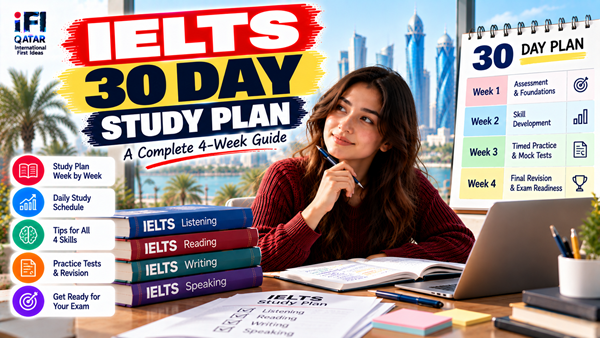
Preparing for IELTS in just 30 days can feel challenging, especially if you need to achieve a specific band score for university admission, immigration, professional registration or employment. However, a focused IELTS 30 day study plan can help you use your remaining time effectively, identify your weaknesses and build confidence before exam day.
The key is not to study everything at once. Instead, you need to understand your current English level, prioritise the skills that need the most improvement, practise under exam conditions and review your mistakes consistently.
This guide provides a practical four-week IELTS preparation plan for both IELTS Academic and IELTS General Training candidates. You will learn what to study each week, how to organise your daily schedule, when to take mock tests and how to decide whether additional coaching could help you reach your target score.
Quick answer: A good 30-day IELTS study plan starts with a diagnostic test, focuses on skill development during the first two weeks, increases timed practice in the third week and uses the final week for mock tests, targeted revision and exam readiness. The amount of progress you can make depends on your starting level, target band score and available study time.
Is 30 Days Enough to Prepare for IELTS?
Thirty days can be enough to improve your IELTS performance, particularly if your English foundation is already reasonably strong and you can study consistently. However, one month does not guarantee a particular band score.
Your results will depend on several factors:
- Your current English proficiency: Candidates who already understand English well may need more exam-specific practice than general language study.
- Your target band score: Moving from Band 6 to Band 6.5 may require a different approach from aiming for Band 8.
- Your weakest skills: Writing and Speaking may require detailed feedback, while Reading and Listening often benefit from regular timed practice and careful error analysis.
- Your available study time: Two focused hours a day can be more productive than a longer session without a clear objective.
- The quality of your practice: Reviewing why an answer was wrong is more useful than repeatedly completing exercises without analysing mistakes.
Before starting, check the English-language requirements of the university, employer or immigration pathway you are applying to. Some institutions require minimum scores in individual skills as well as an overall IELTS band score.
How Many Hours Should You Study Each Day?
A practical starting point is to study for approximately two to three focused hours per day, five or six days a week, if your schedule allows. Use the remaining time for light revision, English exposure or rest.
| Current situation | Suggested daily study time | Main priority |
|---|---|---|
| Already close to your target | 1.5–2 hours | Timed practice and exam technique |
| Need to improve several skills | 2–3 hours | Skill development and error correction |
| Have a significant language gap | 3 hours or more, if sustainable | Core English skills plus IELTS practice |
These are planning guidelines, not guarantees of improvement. If your English level is substantially below your target, you may need more than 30 days.
IELTS 30 Day Study Plan at a Glance
The most effective way to organise your preparation is to give each week a specific purpose. This prevents you from spending too much time on your favourite skill while neglecting areas that need improvement.
| Week | Main focus | Key activities | Expected outcome |
|---|---|---|---|
| Week 1: Days 1–7 | Assessment and foundations | Diagnostic test, skill review, error log | Understand your strengths and weaknesses |
| Week 2: Days 8–14 | Skill development | Targeted Reading, Listening, Writing and Speaking practice | Address recurring problems |
| Week 3: Days 15–21 | Timed exam practice | Full sections, timed essays, Speaking simulations | Improve pacing and consistency |
| Week 4: Days 22–30 | Mock tests and revision | Full practice tests, error correction, final preparation | Become more familiar with exam conditions |
The exact activities should reflect your IELTS format, current level and target score. IELTS Academic and General Training share the same Listening and Speaking tests, but their Reading and Writing tasks differ.
Week 1: Assess Your Level and Build a Strong Foundation
Days 1–7: Identify what is holding back your score.
Your first week should establish a baseline. Without this step, you may spend valuable preparation time practising skills you have already mastered.
Day 1: Take a Diagnostic IELTS Practice Test
Complete a realistic practice test using reliable IELTS preparation materials. Try to follow the official timing for each section.
Assess all four skills:
- Listening
- Reading
- Writing
- Speaking
Record your estimated scores and note where you struggled. If you are unfamiliar with the IELTS format, use this first test to understand the question types and timing rather than treating the result as a definitive prediction of your exam score.
For Writing and Speaking, seek feedback from a suitably experienced teacher if possible. Self-assessment alone may not reveal problems with task response, coherence, grammatical accuracy or pronunciation.
Days 2–3: Focus on Reading and Listening
Spend these sessions reviewing your diagnostic results.
For Reading, practise identifying keywords, recognising paraphrases, locating specific information and managing your time. Pay attention to question types such as True/False/Not Given, matching headings and multiple-choice questions.
For Listening, practise predicting possible answers before the recording begins, identifying paraphrased information and recognising distractors. Review incorrect answers and determine whether the problem was vocabulary, concentration, spelling or misunderstanding the question.
Do not simply count your correct answers. Identify the reason behind every significant mistake.
Days 4–5: Evaluate Writing and Grammar
Complete one Writing Task 1 and one Writing Task 2 exercise appropriate to your IELTS test type.
For IELTS Academic, Task 1 usually involves describing visual information, such as a chart, table, process or map. For IELTS General Training, Task 1 involves writing a letter.
Task 2 requires an essay for both test types.
Review the following:
- Whether you answered every part of the question
- Whether your ideas are logically organised
- Whether each paragraph has a clear purpose
- Whether your vocabulary is accurate and appropriate
- Whether grammatical errors affect clarity
Avoid memorising complete essays. Learn how to plan, develop and support ideas so that you can respond effectively to unfamiliar questions.
Days 6–7: Practise Speaking and Review Your Progress
Record yourself answering IELTS Speaking questions. Listen to the recording and look for repeated pauses, unclear pronunciation, repetitive vocabulary and answers that lack development.
Practise all three parts of the Speaking test:
- Part 1: Give natural, direct answers about familiar topics.
- Part 2: Organise a longer response around a clear sequence of ideas.
- Part 3: Explain opinions, compare ideas and support arguments with reasons or examples.
At the end of Day 7, review your error log and select your three highest-priority weaknesses for the following week.
Week 1 checkpoint: You should understand your approximate current level, the IELTS question types that cause the most difficulty and the skills that deserve the greatest share of your study time.
Week 2: Improve Your Four IELTS Skills
Days 8–14: Turn your weaknesses into specific practice goals.
During Week 2, spend less time taking complete tests and more time practising individual skills. Each session should target a particular problem.
Day 8: Improve IELTS Listening Accuracy
Complete a Listening practice section and review the transcript after finishing.
Focus on:
- Recognising paraphrased information
- Following conversations and explanations
- Identifying changes in a speaker’s answer
- Spelling words correctly
- Checking singular and plural forms
- Following word limits in answer instructions
Replay difficult sections and try to understand why you missed each answer. If you cannot follow the recording even after repeated listening, work on the underlying vocabulary and listening comprehension rather than relying entirely on exam strategies.
Day 9: Develop IELTS Reading Speed and Accuracy
Complete timed Reading exercises using question types you found difficult during Week 1.
Practise skimming to understand the general meaning of a passage and scanning to locate specific details. However, do not rely on these techniques mechanically: some questions require you to understand the relationship between ideas or distinguish the writer’s claims from information presented in the text.
Review your incorrect answers and identify whether the problem was:
- Misunderstanding the question
- Missing a paraphrase
- Confusing similar information
- Spending too long on one question
- Making an unsupported assumption
Day 10: Strengthen IELTS Writing Task 2
Practise planning and writing an essay under timed conditions.
Before writing, identify the exact question type. You may need to discuss an opinion, compare views, explain a problem and its solutions, or examine advantages and disadvantages.
Use a clear structure:
- Introduction that addresses the question
- Body paragraph developing your first main idea
- Body paragraph developing another relevant idea
- Conclusion that directly answers the task
A clear structure is useful, but it does not replace relevant ideas, logical development and accurate language.
After writing, check whether your response fully addresses the prompt. Review grammar, vocabulary, paragraph development and sentence clarity.
Day 11: Practise IELTS Academic or General Training Task 1
Choose the task that matches your test.
For IELTS Academic: Practise selecting and comparing the most important features in a chart, table, map or process. Include an overview where appropriate, and avoid describing every detail without prioritising the key information.
For IELTS General Training: Practise writing a letter that fulfils the required purpose and addresses all the bullet points. Pay attention to tone, organisation and the level of formality.
Review your response against the task requirements before focusing on minor grammar corrections.
Day 12: Improve IELTS Speaking Fluency
Choose several common topics, such as work, study, technology, travel, education or daily routines.
For each question:
- Answer directly.
- Add a reason or explanation.
- Include a relevant example when appropriate.
- Use varied but natural vocabulary.
- Avoid memorised responses that do not answer the actual question.
For Part 2, practise making brief notes during the preparation period and delivering a coherent response within the allotted speaking time.
For Part 3, develop your ability to explain why something happens, compare different perspectives and discuss possible consequences.
Day 13: Review Grammar and Vocabulary in Context
Do not try to memorise hundreds of disconnected words in one day.
Instead, select vocabulary related to topics that commonly appear in IELTS practice materials. Learn the meaning, collocations, grammatical patterns and natural use of each expression.
Review grammar errors that repeatedly appear in your writing or speech, such as:
- Subject–verb agreement
- Articles and countable nouns
- Verb tenses
- Complex sentence structures
- Relative clauses
- Punctuation and sentence boundaries
Your aim is accurate, flexible language rather than unnecessary complexity.
Day 14: Complete a Weekly Progress Check
Repeat selected exercises from your first-week assessment. Compare your performance and identify whether your accuracy, timing or understanding has improved.
Choose the next week’s priorities based on evidence. If your Reading score is improving but Writing remains inconsistent, adjust your schedule instead of automatically allocating equal time to every skill.
Week 2 checkpoint: You should have a more targeted study routine, a record of recurring mistakes and a clearer understanding of which techniques are helping.
Week 3: Practise Under Realistic IELTS Exam Conditions
Days 15–21: Improve performance under time pressure.
In the third week, begin combining individual skills into longer, timed practice sessions. Your goal is to apply what you have learned when you cannot pause, check answers repeatedly or consult notes.
Days 15–16: Complete Timed Reading and Listening Sections
Complete a full Listening test and a full Reading test on separate sessions, or combine them if your schedule allows.
Follow the timing and instructions for your test format. After each test, spend sufficient time reviewing your errors.
For Listening, note where you lost information and whether you misunderstood a word, a speaker’s intention or a correction.
For Reading, identify which question types consumed the most time. Practise moving on when a question is taking too long and returning to it if time permits.
Day 17: Complete a Timed Writing Session
Practise both Writing tasks under the timing rules for your IELTS format.
For the standard IELTS Writing test, Task 1 has a recommended time of about 20 minutes and Task 2 about 40 minutes. Task 2 carries greater weight in the Writing score, so planning your time appropriately matters.
Review your work against the assessment criteria. Ask whether your response addresses the task, develops ideas coherently, uses vocabulary appropriately and demonstrates grammatical range and accuracy.
If possible, obtain teacher feedback. Writing performance can be difficult to assess accurately without understanding the scoring criteria.
Day 18: Simulate the Speaking Test
Ask a teacher, study partner or another suitable practice partner to conduct a Speaking simulation.
Try to answer without stopping to correct every sentence. The purpose is to practise responding naturally, developing ideas and maintaining communication.
Afterwards, review the recording for recurring issues. Focus on a small number of improvements rather than attempting to fix every weakness at once.
Days 19–20: Take and Review a Full Mock Test
Use one session for a realistic full-test simulation, where possible, and another for reviewing the results.
A useful review includes:
- Estimated performance in each skill
- Questions answered incorrectly and why
- Time-management problems
- Repeated language errors
- Differences between your current performance and your target
If you are using an online mock test, make sure its materials and scoring approach are appropriate for your test type. For Speaking and Writing, automated feedback should not be treated as a guaranteed prediction of your official band score.
Day 21: Consolidate Your Weakest Areas
Use the results of your mock test to plan a focused revision session.
For example, if you repeatedly lose marks in Reading True/False/Not Given questions, review the difference between a statement that contradicts the passage and one for which the passage provides insufficient information.
If your Writing responses lack development, practise explaining the reasoning behind each main idea and supporting it with relevant details.
Week 3 checkpoint: You should be more comfortable with exam timing and have a specific list of issues to address during the final week.
Week 4: Final Revision and Exam Readiness
Days 22–30: Refine your approach without exhausting yourself.
The final week should not be an attempt to learn the entire English language from scratch. Concentrate on your most important weaknesses, practise consistently and protect your ability to concentrate.
Day 22: Review Your Mock Test Results
Read through your error log and group your mistakes by cause.
For example, distinguish between vocabulary gaps, careless errors, misunderstood instructions and time-management problems. Different causes require different solutions.
Choose no more than three major priorities for your remaining preparation.
Day 23: Focus on Listening and Reading Accuracy
Complete targeted exercises for your weakest Listening and Reading question types.
Practise checking spelling, word limits, grammatical fit and whether your answer matches the meaning of the passage or recording.
Do not spend the entire day completing test after test. Give yourself enough time to review the questions you get wrong.
Day 24: Focus on Writing Quality
Complete one timed writing exercise and review it carefully.
Check whether you have answered every part of the question, organised your ideas logically and used accurate language. If you have access to qualified feedback, use it to identify problems that are difficult to notice yourself.
Avoid learning an entirely new essay template at this stage. Familiarity with a reliable planning process is usually more useful.
Day 25: Practise Speaking and Pronunciation
Complete a Speaking simulation and listen to your answers.
Work on clarity, word stress, sentence stress and natural pacing. You do not need to eliminate your accent to perform well; the priority is understandable pronunciation and effective communication.
Practise extending answers with relevant explanations and examples rather than adding unnecessary words.
Day 26: Take Another Full Mock Test
If possible, complete a second realistic mock test using appropriate materials and timing.
Compare the result with your earlier practice test, but avoid treating a single score as a precise forecast of your official result. Performance can vary between tests, and Writing and Speaking estimates may be less reliable without expert assessment.
If your results remain significantly below your target, consider whether you need targeted coaching or a realistic reassessment of your exam timeline.
Day 27: Analyse Your Final Mock Test
Review every significant error. Identify what you can realistically improve before exam day.
Prioritise correct procedures, familiar question types and avoiding repeated mistakes. Do not attempt to memorise answers or predict the exact questions that will appear.
Day 28: Revise Key Strategies
Review your personal notes for all four skills.
Your revision might include:
- Reading question-type strategies
- Listening spelling and word-limit checks
- Writing planning and paragraph structure
- Speaking topic practice and answer development
- Grammar and vocabulary errors you repeatedly make
Keep this session focused and manageable.
Day 29: Prepare for the Exam
Confirm your test date, time, location or online arrangements, and the identification documents required for your specific booking.
Review the instructions provided by your test centre. If you are taking IELTS on computer, make sure you understand the test interface and have practised the relevant format.
Avoid an exhausting study session. Light revision, a normal routine and sufficient sleep are more sensible than staying up late to complete another full test.
Day 30: Stay Calm and Follow Your Plan
If your exam is today, avoid cramming unfamiliar vocabulary or attempting to learn new techniques at the last minute.
Allow enough time to arrive or sign in, follow the test centre’s instructions and focus on the task in front of you.
If your exam is tomorrow, use Day 30 for light revision, final checks and rest. Adjust the schedule so that you do not finish an exhausting mock test immediately before the real exam.
Week 4 checkpoint: You should know your test-day routine, understand your main strategies and be prepared to manage the exam without relying on last-minute cramming.
A Daily IELTS Study Schedule You Can Follow
If you are unsure how to divide your time, use the following two-hour schedule as a starting point. Adjust it according to your weakest skills and your progress.
| Study activity | Suggested time | Purpose |
|---|---|---|
| Vocabulary and grammar review | 15 minutes | Address recurring language errors |
| Listening or Reading practice | 30 minutes | Improve comprehension and accuracy |
| Writing practice | 30 minutes | Develop task response and written language |
| Speaking practice | 20 minutes | Build fluency and answer development |
| Error review | 25 minutes | Learn from mistakes and plan the next session |
| Total | 120 minutes | Focused daily preparation |
This is a flexible schedule, not a requirement to practise every skill for the same amount of time every day. On a full mock-test day, use a longer session and move some activities to another day.
How to Adjust the Plan for Your Target Band Score
Your target should influence the way you use your 30 days.
If you are aiming for Band 6.0–6.5: Focus on understanding question requirements, reducing avoidable errors, improving paragraph organisation and building consistent performance across the four skills.
If you are aiming for Band 7.0: Work on the quality and precision of your language, stronger development of ideas, accurate interpretation of questions and the specific weaknesses revealed by timed practice.
If you are aiming for Band 8.0 or higher: Prioritise fine-grained accuracy, sophisticated but natural language use, precise task response and consistent performance under exam conditions. A month may be sufficient for some candidates who are already close to this level, but substantial gaps in English proficiency usually require longer preparation.
These are broad study priorities, not official definitions of the bands or guaranteed outcomes. IELTS assesses each skill using its published criteria, and the most effective preparation depends on your current performance.
Common Mistakes to Avoid During a 30-Day IELTS Preparation Plan
Even a well-organised schedule can be ineffective if you approach it in the wrong way.
1. Studying Without Assessing Your Current Level
Completing random exercises does not tell you whether you are moving towards your target. Begin with a diagnostic test and repeat selected assessments to measure progress.
2. Practising Only Your Favourite Skill
Candidates often spend more time on Reading or Listening because answers are easier to check. However, weak Writing or Speaking performance can prevent you from achieving your overall goal or a required minimum score in an individual skill.
3. Memorising Essays and Speaking Answers
Memorised responses may fail to address the actual question and can sound unnatural. Learn structures, vocabulary and planning techniques that help you respond to different prompts.
4. Taking Mock Tests Without Reviewing Them
A mock test is useful only when you learn from the results. Keep an error log, identify patterns and turn those patterns into specific practice activities.
5. Ignoring Feedback on Writing and Speaking
It is difficult to identify every issue in your own work. Qualified feedback can reveal problems with task response, coherence, grammatical accuracy, pronunciation and the development of ideas.
6. Trying to Improve Everything at Once
A month is a limited period. Focus first on the problems that most affect your performance and that you can realistically address before the exam.
Should You Take an IELTS Preparation Course Before Your Exam?
Self-study can be effective, particularly if you already understand the IELTS format, can assess your progress reliably and know how to correct your mistakes.
However, a structured IELTS preparation course or consultation may be valuable if you are uncertain about your current level, repeatedly receive similar practice scores or need feedback on Writing and Speaking.
Consider getting expert guidance if:
- You have a specific target score for an application deadline.
- You need to improve one or more skills quickly.
- You are unsure why your mock-test results are not improving.
- You struggle to assess your essays or speaking responses objectively.
- You need a realistic study schedule that fits around work or university.
A useful consultation should begin by understanding your target score, exam date, current performance and available study time. It should then identify priorities and recommend a preparation approach suited to your needs.
No course can guarantee a particular IELTS band score, but relevant feedback and structured practice can help you prepare more efficiently.
Get IELTS Preparation Guidance from IFI Qatar
If you are preparing for IELTS in Qatar and your exam is approaching, IFI Qatar can help you explore suitable preparation options.
Before choosing a course, identify the score you need, the skills you find most difficult and the time you can realistically dedicate to study. These details make it easier to determine whether you need general preparation, targeted coaching or additional mock-test practice.
Contact IFI Qatar to discuss your IELTS preparation needs and explore a study plan that fits your target score and exam timeline.
Frequently Asked Questions About the IELTS 30 Day Study Plan
Can I prepare for IELTS in 30 days?
Yes, 30 days can be enough for focused preparation if your current English level is reasonably close to your target. Your progress will depend on your starting point, study time, target score and the quality of your practice. Candidates with larger language gaps may need a longer preparation period.
How many hours should I study for IELTS every day?
Around two to three focused hours per day can be a useful starting point for a one-month plan. Adjust the schedule according to your current level, work commitments and weakest skills. Consistent practice and detailed error review matter more than simply accumulating study hours.
Is one month enough to get Band 7 in IELTS?
It may be enough for a candidate whose current performance is already close to Band 7. If you are substantially below that level, especially in Writing or Speaking, you may need more time. Take a diagnostic test and assess each skill before deciding whether a 30-day timeline is realistic.
How many mock tests should I take in 30 days?
A practical plan can include one diagnostic test at the beginning, a timed progress assessment during the third week and one or two full mock tests during the final stages. You can add more targeted practice tests if needed, but every mock test should be followed by a careful review.
Should I study IELTS Academic or General Training first?
Prepare for the test you actually need to take. Listening and Speaking are the same in both versions, while Reading and Writing differ. Check the requirements of your university, employer or relevant application pathway before booking your exam.
Which IELTS skill should I practise the most?
Prioritise the skills that are furthest from your required score and the weaknesses that are most likely to affect your result. Do not automatically divide your study time equally across Listening, Reading, Writing and Speaking.
Can I improve my IELTS Writing score in one month?
You may be able to improve your Writing performance in a month, particularly if you focus on task response, paragraph organisation, idea development and recurring language errors. Regular timed practice and qualified feedback can help you identify what needs to change, although the amount of improvement varies by candidate.
What should I do in the final 24 hours before IELTS?
Review your personal notes, confirm your test arrangements and required identification, and follow the instructions from your test centre. Avoid exhausting yourself with a full mock test or trying to memorise large amounts of new vocabulary. Prioritise rest and a calm, familiar routine.
Is an IELTS preparation course better than self-study?
Neither approach is automatically better for every candidate. Self-study can work well when you have a clear plan and can evaluate your progress accurately. A preparation course may be more useful when you need structured guidance, targeted practice or expert feedback on Writing and Speaking.
Final Thoughts: Make Every Day of Your IELTS Preparation Count
A successful IELTS 30 day study plan is built around clear priorities, regular practice and honest assessment. Start by identifying your current level, spend the first two weeks addressing weaknesses, introduce timed practice in the third week and use the final days to review your progress and prepare for exam day.
Most importantly, do not measure progress only by the number of tests you complete. Measure it by whether you understand your mistakes, apply better strategies and perform more consistently.
If you are unsure how to organise your remaining preparation time or whether your target score is realistic, consider speaking with an IELTS preparation specialist at IFI Qatar. A focused consultation can help you identify your next steps and make better use of the time available before your exam.