

Currently Empty: ر.ق 0,00


IELTS
IELTS Grammar Rules Every Student Must Know
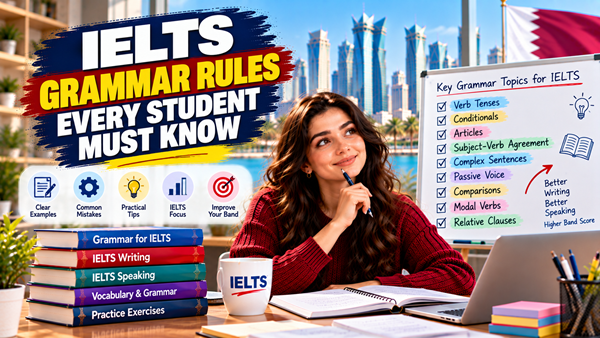
Grammar plays an important role in IELTS preparation, particularly in the Writing and Speaking tests. Even when you have good ideas and a wide vocabulary, frequent grammatical errors can make your meaning less clear and affect how effectively you communicate.
The good news is that you do not need to memorise every English grammar rule to prepare for IELTS. You need to understand the structures that help you express ideas accurately, compare information, explain reasons, discuss possibilities and develop arguments.
In this guide, you will learn the essential IELTS grammar rules, see practical examples, understand common mistakes and discover how to apply grammar more effectively in Writing and Speaking.
Why Is Grammar Important for IELTS?
Grammar is one of the four assessment criteria in IELTS Writing and one of the four assessment criteria in IELTS Speaking. In both tests, examiners consider your grammatical range and accuracy alongside other aspects of your performance.
This means that knowing grammar rules is not enough on its own. You must also use grammatical structures appropriately when answering questions, describing information and communicating ideas.
How Grammar Affects IELTS Writing
In Writing, grammar helps you construct clear sentences, organise arguments and communicate information precisely.
For example:
Incorrect: Many student wants to study abroad because it offer better opportunities.
Correct: Many students want to study abroad because it offers better opportunities.
The second sentence uses correct subject–verb agreement and plural forms, making the message clearer.
How Grammar Affects IELTS Speaking
In Speaking, grammar helps you explain experiences, describe situations and discuss unfamiliar topics. You should be able to use a range of structures naturally rather than relying entirely on short, simple sentences.
For example:
Basic: I like studying online. It is convenient.
More developed: I like studying online because it allows me to manage my time more effectively.
The second version combines ideas into a more developed sentence while maintaining clarity.
Which Grammar Areas Should You Learn First?
Prioritise the following areas when preparing for IELTS:
- Verb tenses and time references
- Subject–verb agreement
- Articles and countable or uncountable nouns
- Complex sentences and conjunctions
- Relative clauses
- Conditionals
- Modal verbs
- Passive voice
- Comparative and superlative structures
- Punctuation and sentence boundaries
These areas provide a practical foundation for communicating accurately across different IELTS question types.
IELTS Grammar Rule 1: Use Verb Tenses Correctly
Verb tenses help you communicate when an action happens and how it relates to other events. Choosing the correct tense is especially important when describing past experiences, current situations, future plans and changes over time.
Present Simple for Facts, Habits and General Statements
Use the present simple to describe routines, general truths and situations that are generally true.
Examples:
- Many students use online resources to prepare for IELTS.
- Regular practice improves language skills.
- Public transport plays an important role in urban areas.
Remember to add -s or -es to the verb when the subject is he, she or it.
Incorrect: Online learning provide greater flexibility.
Correct: Online learning provides greater flexibility.
Present Perfect for Experiences and Changes Connected to the Present
Use the present perfect to discuss experiences or situations that have a connection to the present.
Examples:
- I have studied English for three years.
- Technology has changed the way people communicate.
- The number of international students has increased in recent years.
A useful pattern is:
Subject + have/has + past participle
Do not normally use the present perfect with a finished past time expression such as yesterday or in 2020.
Incorrect: I have taken the IELTS test last year.
Correct: I took the IELTS test last year.
Past Simple for Completed Past Events
Use the past simple when describing events that happened and finished in the past.
Examples:
- I completed my university degree in 2024.
- The company introduced a new policy last year.
- The percentage increased between 2010 and 2020.
This tense is particularly useful in Speaking Part 2 when describing a past experience and in Academic Writing Task 1 when reporting historical data.
Future Forms for Predictions, Plans and Intentions
Use appropriate future forms to discuss plans and expected events.
Examples:
- I will probably pursue a postgraduate degree.
- I am going to take an IELTS preparation course.
- I am meeting my tutor tomorrow.
Choose the structure that matches your intended meaning. Do not use future forms simply because you are discussing something that has not happened yet; context and meaning determine the best choice.
IELTS Grammar Rule 2: Master Subject–Verb Agreement
Subject–verb agreement means that the verb must match its subject in number and person.
This rule is simple in principle but frequently causes errors in longer IELTS sentences.
Singular and Plural Subjects
Use a singular verb with a singular third-person subject in the present simple, and a plural verb with a plural subject.
| Incorrect | Correct |
|---|---|
| She work in Doha. | She works in Doha. |
| People believes that education is important. | People believe that education is important. |
| The main reason are cost. | The main reason is cost. |
| These problems affects students. | These problems affect students. |
Pay Attention to the Main Subject
Words between the subject and the verb do not necessarily determine whether the verb is singular or plural.
Incorrect: The quality of educational programmes have improved.
Correct: The quality of educational programmes has improved.
The main subject is quality, which is singular. The plural noun programmes does not change the subject.
Common Agreement Traps
Pay particular attention to expressions such as:
- Each student has a different learning style.
- Everyone needs sufficient preparation.
- The number of international students is increasing.
- A number of students are preparing for the exam.
Learning these patterns can help you avoid errors in both short sentences and complex arguments.
IELTS Grammar Rule 3: Use Articles and Determiners Accurately
Articles are small words, but they can make a significant difference to grammatical accuracy.
English uses a, an and the, as well as nouns without an article in certain contexts.
When to Use A and An
Use a or an with a singular countable noun when referring to something nonspecific or introducing it for the first time.
Use a before a consonant sound and an before a vowel sound.
Examples:
- I attended a university in Qatar.
- She completed an important assignment.
- He wants to become an engineer.
Remember that the choice depends on the sound, not simply the first written letter.
When to Use The
Use the when the reader or listener can identify the specific person or thing being discussed.
Examples:
- The course I enrolled in was very useful.
- The information in the report supports this argument.
- The government introduced a new policy.
When to Use No Article
Some nouns, particularly plural countable nouns and uncountable nouns, can be used without an article when speaking generally.
Examples:
- Education can improve employment opportunities.
- Students need access to reliable information.
- Technology influences modern communication.
Compare these sentences:
- Education is important. Education in general is important.
- The education provided by this institution is excellent. A specific educational service is being discussed.
Avoid Common Article Mistakes
Incorrect: Internet has changed the way people communicate.
Correct: The internet has changed the way people communicate.
Incorrect: I received an useful piece of advice.
Correct: I received a useful piece of advice.
The word useful begins with a consonant sound, so a is appropriate.
IELTS Grammar Rule 4: Understand Countable and Uncountable Nouns
Countable and uncountable nouns affect articles, plural forms and the use of quantifiers.
Countable Nouns
Countable nouns have singular and plural forms.
Examples include:
- student / students
- opportunity / opportunities
- problem / problems
- suggestion / suggestions
You can use numbers with countable nouns: three students, two opportunities.
Uncountable Nouns
Uncountable nouns are not normally used with a/an or in the plural when they have their usual uncountable meaning.
Common examples include:
- information
- advice
- research
- equipment
- furniture
- knowledge
Incorrect: The teacher gave me several useful advices.
Correct: The teacher gave me some useful advice.
You can also say:
- a piece of advice
- a piece of information
- several pieces of equipment
Choose Quantifiers Carefully
| Use | Examples |
|---|---|
| Countable nouns | many students, a few opportunities, fewer mistakes |
| Uncountable nouns | much information, a little progress, less pollution |
| Both, depending on meaning | some, enough, a lot of |
Incorrect: There are less cars on the road today.
Correct: There are fewer cars on the road today.
Use fewer with countable plural nouns and less with uncountable nouns in standard comparisons.
IELTS Grammar Rule 5: Build Complex Sentences Correctly
Complex sentences help you communicate relationships between ideas, including reasons, contrasts, conditions and results.
However, longer sentences are not automatically better. The aim is to combine ideas accurately without making the meaning difficult to follow.
Use Because to Explain Reasons
Basic: Public transport is useful. It reduces traffic congestion.
Combined: Public transport is useful because it reduces traffic congestion.
The word because introduces a reason.
Avoid using because and so together unnecessarily in the same basic cause-and-effect construction.
Incorrect: Because public transport is convenient, so many people use it.
Correct: Because public transport is convenient, many people use it.
Alternatively: “Public transport is convenient, so many people use it.”
Use Although and Even Though to Show Contrast
Example: Although online learning is convenient, some students prefer face-to-face classes.
You can also place the contrast in the second clause:
“Some students prefer face-to-face classes although online learning is convenient.”
Do not normally use but to connect the same two clauses when although already performs that function.
Incorrect: Although online learning is convenient, but some students prefer classroom lessons.
Correct: Although online learning is convenient, some students prefer classroom lessons.
Use While and Whereas for Contrasts
These conjunctions are useful when comparing different opinions, groups or trends.
Example: While some people prefer working remotely, others value the social interaction of an office.
In IELTS Academic Writing Task 1, while and whereas can also help compare figures or patterns.
Use Since and As to Explain Reasons
Since and as can introduce reasons, depending on context.
Example: Since university education can be expensive, students should consider their financial circumstances carefully.
Use the conjunction that makes the relationship between your ideas clear. Avoid inserting linking words into every sentence simply to make your writing appear more advanced.
IELTS Grammar Rule 6: Use Relative Clauses to Add Information
Relative clauses allow you to describe people, places, things and ideas without creating unnecessary short sentences.
Use Who for People
Basic: I met a teacher. She helped me improve my writing.
Improved: I met a teacher who helped me improve my writing.
Use Which for Things
Basic: I bought a book. It explains English grammar.
Improved: I bought a book which explains English grammar.
In many contexts, that can also be used in a defining relative clause for people or things, although who is generally preferred for people in formal writing.
Use Where for Places
Basic: Doha is a city. Many international students study there.
Improved: Doha is a city where many international students study.
Understand Defining and Non-Defining Relative Clauses
A defining relative clause identifies which person or thing you mean.
“The students who completed the practice test received feedback.”
This refers to the students who completed the test.
A non-defining relative clause adds extra information about an already identified person or thing.
“Doha, which is the capital of Qatar, attracts students from many countries.”
Non-defining relative clauses are separated by commas and generally do not use that.
Using relative clauses accurately can make your writing more concise and your speaking more natural.
IELTS Grammar Rule 7: Learn Conditional Sentences
Conditionals help you discuss possibilities, consequences, hypothetical situations and alternative outcomes.
They are especially useful in IELTS Speaking Part 3 and Writing Task 2, where you may need to explain what could happen if a situation changed.
Zero Conditional for General Truths
Structure: If + present simple, present simple.
Example: If people exercise regularly, they generally improve their physical fitness.
Use this form for general facts, habits or predictable relationships.
First Conditional for Real Possibilities
Structure: If + present simple, will + base verb.
Example: If students practise consistently, they will become more familiar with the test format.
This structure describes a possible future result.
Second Conditional for Hypothetical Situations
Structure: If + past simple, would + base verb.
Example: If I had more free time, I would study English every evening.
This form is useful when discussing an imagined or less likely situation.
Third Conditional for Unreal Past Situations
Structure: If + past perfect, would have + past participle.
Example: If I had managed my time better, I would have completed the test.
Use this structure to discuss an alternative past and its imagined result.
Common Conditional Mistake
Incorrect: If I will have enough time, I will attend the course.
Correct: If I have enough time, I will attend the course.
In a standard first conditional sentence, use the present simple in the if-clause rather than will.
IELTS Grammar Rule 8: Use Modal Verbs to Express Meaning Precisely
Modal verbs help you express ability, possibility, advice, necessity and degrees of certainty.
Can and Could for Ability and Possibility
Examples:
- Online resources can help students practise independently.
- Better planning could reduce unnecessary stress.
Could can express possibility or a more tentative suggestion, depending on context.
Should and Ought to for Advice
Examples:
- Students should review their mistakes after each mock test.
- Governments ought to invest in public transport.
Use these forms when discussing recommendations or possible solutions in IELTS Writing Task 2.
Must and Have to for Necessity
Examples:
- Candidates must follow the test instructions.
- Students have to manage their time carefully during the Writing test.
The exact distinction between must and have to depends on context, but both can express necessity.
May and Might for Possibility
Examples:
- Remote working may reduce commuting time.
- The policy might improve access to education.
Use these structures when the outcome is possible rather than certain.
Avoid treating modal verbs as interchangeable. Choose the one that accurately communicates your intended level of certainty or obligation.
IELTS Grammar Rule 9: Understand Active and Passive Voice
Active and passive voice allow you to present information from different perspectives.
Active Voice
The subject performs the action.
Example: Researchers conducted the study in 2025.
Passive Voice
The subject receives the action.
Example: The study was conducted in 2025.
The passive voice is particularly useful when the action or process is more important than the person performing it.
When Should You Use Passive Voice in IELTS?
Passive constructions are useful in Academic Writing Task 1 when describing manufacturing processes or stages in which the actor is unknown or unimportant.
Example: The materials are heated before the mixture is transferred to a container.
Passive voice can also be appropriate in formal writing when the focus is on a process, decision or result.
However, do not use the passive voice in every sentence. Active voice is often clearer when the person or organisation performing an action is important.
IELTS Grammar Rule 10: Use Comparatives and Superlatives Accurately
Comparisons are important in IELTS Writing Task 1 and can also support arguments in Writing Task 2 and Speaking.
Comparatives for Two Things
Use comparative forms to identify differences.
Examples:
- Online courses are often more flexible than classroom courses.
- The second figure was lower than the first.
- Public transport is less expensive than driving in some cities.
Superlatives for Extremes
Use superlatives to identify the highest or lowest degree within a group.
Examples:
- This was the most popular option.
- The northern region recorded the highest figure.
- Cycling was the least common form of transport.
Avoid Double Comparatives
Incorrect: This solution is more easier to implement.
Correct: This solution is easier to implement.
Incorrect: It is the most cheapest option.
Correct: It is the cheapest option.
Distinguish Between As…As and Than
Use as…as to indicate equality and than to compare differences.
- “The two courses are as effective as each other” expresses equality.
- “The second course is more intensive than the first” expresses a difference.
For Academic Writing Task 1, make sure your comparisons are supported by the data and use the correct units when describing changes.
IELTS Grammar Rule 11: Use Gerunds and Infinitives Correctly
Some verbs are followed by a gerund, while others are followed by an infinitive. Choosing the correct form helps you produce natural English.
Verbs Followed by Gerunds
Common examples include enjoy, avoid, consider and suggest.
Examples:
- I enjoy learning new vocabulary.
- Students should avoid repeating the same mistakes.
- I suggest practising under timed conditions.
Verbs Followed by Infinitives
Common examples include want, decide, hope and plan.
Examples:
- I want to improve my Writing score.
- She decided to take a mock test.
- They plan to study abroad.
Verbs That Can Take Both Forms
Some verbs can be followed by a gerund or an infinitive, sometimes with a change in meaning.
For example:
- “I stopped smoking” means I gave up the activity.
- “I stopped to smoke” means I stopped another activity in order to smoke.
Learn common verb patterns as part of your vocabulary practice rather than assuming that every verb follows the same rule.
IELTS Grammar Rule 12: Avoid Sentence Fragments and Run-On Sentences
Even if you know many grammar rules, errors in sentence structure can make your writing difficult to follow.
Avoid Sentence Fragments
A fragment is an incomplete sentence presented as a complete one.
Incorrect: Because many students need English for university.
Correct: Many students study English because they need it for university.
Alternatively: “Because many students need English for university, they practise regularly.”
Avoid Run-On Sentences
A run-on sentence joins independent clauses incorrectly.
Incorrect: Online learning is convenient many students prefer it.
Correct: Online learning is convenient, so many students prefer it.
You could also write: “Online learning is convenient. Many students prefer it.”
Use Punctuation to Improve Clarity
Use full stops to separate complete sentences, commas where grammatically appropriate and apostrophes to indicate possession or contractions.
In formal IELTS Writing, contractions such as don’t and can’t are generally best avoided in favour of do not and cannot. More importantly, ensure that punctuation reflects the grammatical structure of your sentences.
Common IELTS Grammar Mistakes Every Student Should Avoid
Understanding individual rules is useful, but you also need to recognise errors that repeatedly appear in your own writing and speaking.
| Common mistake | Correct form |
|---|---|
| She go to university. | She goes to university. |
| Many student study English. | Many students study English. |
| I have seen him yesterday. | I saw him yesterday. |
| An useful method | A useful method |
| Many informations | Much information / several pieces of information |
| More better results | Better results |
| Although it was expensive, but I bought it. | Although it was expensive, I bought it. |
| If I will have time, I will practise. | If I have time, I will practise. |
| People is concerned about pollution. | People are concerned about pollution. |
| I look forward to meet you. | I look forward to meeting you. |
How to Correct Your Personal Grammar Errors
Do not simply read a list of mistakes and move on. Use this process:
- Identify an error in your own sentence.
- Write the corrected version.
- Identify the rule that explains the correction.
- Create two or three new sentences using the same structure.
- Check whether you can use the structure correctly in a timed Writing or Speaking practice session.
This method helps turn grammatical knowledge into practical language skills.
How to Practise IELTS Grammar Effectively
Learning grammar rules is only the beginning. You need to apply them in realistic IELTS tasks and monitor whether your accuracy improves.
Practise Grammar in Context
Instead of memorising isolated rules, use them to answer IELTS-style questions.
For example, practise conditionals by discussing environmental policies, relative clauses by describing people or places, and comparative structures by analysing charts.
Contextual practice helps you understand when a structure is useful and how it communicates meaning.
Review Your Writing Against the IELTS Criteria
After completing a Writing task, check your work for:
- Correct verb tenses
- Subject–verb agreement
- Articles and noun forms
- Sentence variety
- Accurate use of conjunctions
- Punctuation and sentence boundaries
- Appropriate complex structures
Do not try to use every grammatical structure in one essay. Choose structures that fit your ideas and make sure you can use them accurately.
Record and Review Your Speaking
Speaking practice can reveal grammar mistakes that you do not notice when writing.
Record a short answer to an IELTS Speaking question and listen for recurring problems, such as incorrect past-tense forms, missing articles or incomplete sentences.
Repeat the answer, correcting those errors while keeping your delivery natural.
Build a Weekly Grammar Routine
A simple routine can help you practise consistently.
| Day | Grammar focus | Practice activity |
|---|---|---|
| Monday | Verb tenses | Describe past experiences and future plans |
| Tuesday | Subject–verb agreement and articles | Correct errors in sample sentences |
| Wednesday | Complex sentences | Explain reasons and compare opinions |
| Thursday | Conditionals and modal verbs | Discuss hypothetical situations and solutions |
| Friday | Relative clauses and passive voice | Describe people, places and processes |
| Saturday | Comparatives and sentence structure | Complete a short IELTS Writing task |
| Sunday | Review and correction | Revisit recurring mistakes and rewrite sentences |
Adapt this schedule to your current level and available study time. Consistency and feedback are more important than completing a fixed number of exercises.
IELTS Grammar Practice: Test Your Knowledge
Complete these short exercises to check your understanding of some essential IELTS grammar rules.
Exercise 1: Choose the Correct Verb
- Many students ___ English to improve their career opportunities. (study / studies)
- The number of international applicants ___ increased recently. (has / have)
- If I ___ more time, I would practise every day. (have / had)
Exercise 2: Correct the Mistakes
- She has completed the course last month.
- The teacher gave me several useful advices.
- Although the course was difficult, but I learned a lot.
Exercise 3: Combine the Sentences
- Online learning is flexible. Many students prefer it. Use because.
- I met a tutor. The tutor helped me improve my writing. Use a relative clause.
Answers and Explanations
- study — The plural subject students takes the base form.
- has — The main subject is number, which is singular.
- had — The second conditional uses the past simple in the if-clause.
- “She completed the course last month.” — Use the past simple with a finished past time.
- “The teacher gave me several useful pieces of advice.” — Advice is uncountable.
- “Although the course was difficult, I learned a lot.” — Do not use but with this although construction.
- “Many students prefer online learning because it is flexible.” — Because introduces the reason.
- “I met a tutor who helped me improve my writing.” — Who introduces a relative clause referring to a person.
If you made mistakes, revisit the relevant sections and write a few original examples before attempting the exercises again.
Frequently Asked Questions About IELTS Grammar Rules
What are the most important grammar rules for IELTS?
The most useful areas to prioritise include verb tenses, subject–verb agreement, articles, countable and uncountable nouns, complex sentences, conditionals, relative clauses, modal verbs, passive voice and comparisons. Your priorities should also reflect the errors you make most frequently.
Is grammar important for IELTS Band 7?
Yes. Grammatical range and accuracy contribute to both the IELTS Writing and Speaking assessments. However, a Band 7 result depends on performance across all relevant assessment criteria, not grammar alone.
Do I need to use complex sentences in IELTS Writing?
You should be able to use a range of sentence structures where appropriate. Complex sentences can help you explain reasons, show contrasts and develop arguments, but they must remain grammatically accurate and easy to understand.
How can I improve my IELTS grammar quickly?
Focus on the grammar errors that repeatedly appear in your own work. Study the relevant rule, correct your sentences, create new examples and apply the structure in timed Writing and Speaking practice. Feedback can help you identify mistakes that you may overlook yourself.
Which grammar topics are most important for IELTS Writing Task 1?
For Academic Writing Task 1, focus on accurate verb tenses, comparative structures, subject–verb agreement and appropriate complex sentences. You may also need passive voice for process diagrams and accurate language for describing trends, proportions and changes.
Which grammar topics are useful for IELTS Speaking?
Verb tenses, conditionals, relative clauses, modal verbs and complex sentences are useful for expressing experiences, explaining opinions and discussing hypothetical situations. The goal is to communicate naturally and accurately rather than force advanced grammar into every answer.
Can memorising grammar rules improve my IELTS score?
Memorising rules can help you understand English structures, but you must also apply them correctly in actual test responses. Regular practice, error correction and feedback are essential for turning knowledge into performance.
Should I study grammar separately or practise it through IELTS questions?
A combination of both is effective. Study a specific rule when you need to understand it, then practise using it in IELTS-style Writing and Speaking tasks. This connects grammatical knowledge with the skills assessed in the exam.
Strengthen Your IELTS Grammar with IFI Qatar
Understanding grammar rules is an important step towards clearer IELTS Writing and more confident Speaking. To make meaningful progress, you also need to apply those rules in practice tasks, identify recurring mistakes and learn how to correct them.
IFI Qatar offers IELTS preparation programmes for learners who want structured practice and guidance. If you need support with grammatical accuracy, sentence construction, Writing tasks or Speaking practice, explore the available preparation courses and choose an option that matches your learning needs.
Ready to improve your IELTS performance? Contact IFI Qatar to discuss your preparation goals and find a suitable IELTS course.
A stronger IELTS result begins with understanding your weaknesses, practising deliberately and applying what you learn consistently.