

Currently Empty: ر.ق 0,00


IELTS
IELTS Speaking Fluency Tips for a Higher Band Score
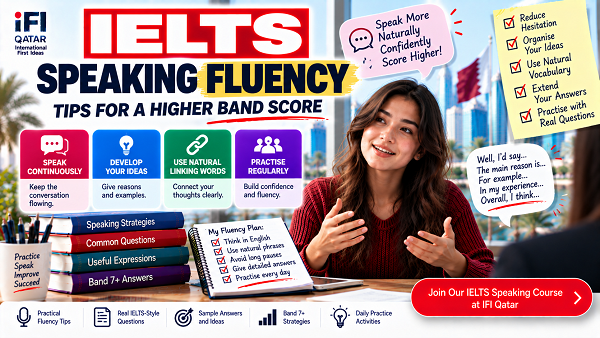
Fluency is one of the first things IELTS candidates notice when they listen to a strong speaker.
A fluent candidate does not necessarily speak extremely fast or use complicated vocabulary in every sentence. Instead, they can develop ideas, keep speaking, connect their thoughts and respond to questions without excessive hesitation.
In the IELTS Speaking test, Fluency and Coherence is one of four equally weighted assessment criteria, alongside Lexical Resource, Grammatical Range and Accuracy, and Pronunciation. IELTS describes fluency and coherence in terms of speaking at a normal speed without too much hesitation, organising ideas logically and using cohesive devices appropriately.
This guide explains what IELTS speaking fluency really means and gives you practical strategies to improve your performance in Parts 1, 2 and 3.
What Is Fluency in IELTS Speaking?
IELTS Speaking fluency is your ability to communicate continuously and naturally without excessive hesitation, repetition or breakdowns in communication.
However, fluency does not mean speaking as quickly as possible.
You can speak at a moderate speed and still demonstrate strong fluency if you:
- develop your answers naturally
- avoid excessive pauses
- connect ideas clearly
- respond directly to questions
- use appropriate vocabulary
- recover smoothly when you make a mistake
- maintain your speech without frequent breakdowns
The official IELTS Band Descriptors show that higher-band performance involves speaking at length with limited repetition or self-correction and developing topics coherently. At Band 7, candidates are expected to speak at length without noticeable effort or loss of coherence, although some hesitation, repetition or self-correction can still occur.
How Is IELTS Speaking Fluency Scored?
The IELTS Speaking test lasts approximately 11–14 minutes and consists of three parts. Speaking is assessed using four equally weighted criteria:
- Fluency and Coherence
- Lexical Resource
- Grammatical Range and Accuracy
- Pronunciation
The final Speaking score is based on performance across these four areas.
What Examiners Look for in Fluency and Coherence
Examiners consider whether you can:
- speak at a natural pace
- speak at length
- organise your ideas logically
- connect ideas appropriately
- respond without excessive hesitation
- develop your answers
- use cohesive devices effectively
This means that fluency is not simply about eliminating every pause.
A short pause while thinking is normal.
The problem occurs when hesitation becomes so frequent that it makes communication difficult or prevents you from developing your ideas.
IELTS Speaking Fluency by Band Level
The official Band Descriptors provide useful differences between performance levels.
Around Band 6
A Band 6 speaker can generally speak at length, but may experience some loss of coherence because of repetition, self-correction or hesitation.
This means you can still make mistakes and pause occasionally.
The key is to maintain communication.
Around Band 7
At Band 7, the descriptor expects the candidate to speak at length without noticeable effort or loss of coherence. Some language-related hesitation, repetition or self-correction may still occur.
The important difference is greater control.
You are generally able to keep your answer moving rather than stopping repeatedly to search for words.
Around Band 8
At Band 8, the official descriptor describes fluent speech with only occasional repetition or self-correction. Hesitation is usually related to developing content rather than searching for language.
This is an important distinction.
A strong speaker may pause because they are deciding what to say next, rather than struggling to find basic vocabulary or grammar.
Why Do IELTS Candidates Struggle With Fluency?
There are several common reasons.
Translating From Your First Language
One of the biggest obstacles is mentally translating every sentence before saying it.
For example, the process may be:
Question → think in your first language → translate → check grammar → speak
This takes time and often creates unnatural pauses.
A better approach is to practise thinking in simple English:
Question → idea → English response
You do not need perfect English before you start speaking.
Trying to Use Difficult Vocabulary
Some candidates stop frequently because they are trying to remember a sophisticated word.
For example:
“I think… um… the… uh… socioeconomic…”
If you cannot remember the exact word, use a simpler expression.
Instead of stopping for several seconds, say:
“I think it has a significant effect on people’s lives.”
Clear communication is more useful than forcing vocabulary you cannot retrieve quickly.
Overthinking Grammar
Grammar accuracy matters, but constantly checking every sentence before speaking can destroy fluency.
If you spend too much time thinking:
Is this present perfect or past simple?
Should I use “has” or “have”?
Is this sentence grammatically perfect?
your speech may become fragmented.
Practise structures until they become easier to produce automatically.
Lack of Speaking Practice
Reading and listening can improve your English, but they do not automatically make you fluent.
You need regular opportunities to produce language.
Speaking is a performance skill.
The more frequently you practise retrieving language in real time, the easier it becomes.
15 IELTS Speaking Fluency Tips
The following strategies can help you become more comfortable speaking continuously and developing your answers.
1. Stop Trying to Speak Too Fast
Speaking quickly does not automatically mean speaking fluently.
If you speak too fast, you may:
- lose grammatical control
- mispronounce words
- repeat yourself
- become difficult to understand
- run out of ideas
Instead, aim for a steady, comfortable pace.
Imagine that you are having a normal conversation rather than trying to finish your answer as quickly as possible.
2. Speak in Meaningful Chunks
Do not try to produce every sentence word by word.
Learn useful groups of words.
For example:
- from my point of view
- one of the main reasons is that
- what I particularly like is
- as far as I know
- in my experience
- one example that comes to mind is
- the main advantage is that
These chunks can make speech easier to produce because you are retrieving phrases rather than constructing every word individually.
3. Extend Your Answers Naturally
Short answers make it difficult to demonstrate your speaking ability.
For example:
Do you enjoy reading?
Weak:
Yes, I do.
Better:
Yes, I do. I particularly enjoy reading non-fiction because I like learning about new subjects. I usually read in the evening when I have some free time.
You do not need to speak for a very long time in Part 1.
But you should give enough information to demonstrate your ability to communicate naturally.
4. Use the Answer → Reason → Example Pattern
One simple way to extend an answer is:
Answer → Reason → Example
For example:
Do you enjoy cooking?
Yes, definitely. I find cooking quite relaxing because it gives me a break from work. For example, I often cook dinner with my family at the weekend.
This structure helps you avoid one-sentence answers.
5. Practise Paraphrasing
Sometimes you know what you want to say but cannot remember one particular word.
Do not stop.
Paraphrase.
For example, if you forget:
“commute”
you could say:
“travel from home to work every day.”
The ability to explain an idea in another way is extremely useful for maintaining fluency.
It also develops the flexibility needed for IELTS Speaking.
6. Use Natural Fillers
Short expressions can give you time to organise your thoughts.
Useful examples include:
- Well, I would say…
- That’s an interesting question.
- Let me think about that.
- I suppose…
- In my experience…
- I haven’t really thought about that before, but…
- If I had to choose, I’d say…
Use these naturally.
Do not begin every answer with the same phrase.
7. Avoid Excessive “Um” and “Er”
Some hesitation is normal.
However, repeatedly saying:
um… um… um…
can make your speech sound less controlled.
Instead, use a short natural pause or a meaningful phrase while organising your thoughts.
For example:
“That’s an interesting question. I suppose the main reason is…”
This gives you a moment to think while maintaining communication.
8. Record Yourself Speaking
Recording yourself is one of the simplest ways to identify fluency problems.
Choose an IELTS Speaking question and speak for one to two minutes.
Then listen for:
- long pauses
- repeated words
- unfinished sentences
- excessive fillers
- unnecessary repetition
- pronunciation problems
- places where you lose your train of thought
You may notice problems that you do not feel while speaking.
9. Practise Speaking Without Stopping
Choose a familiar topic and speak continuously for one minute.
For example:
Describe your hometown.
Your objective is not perfect grammar.
Your objective is to keep communicating.
After one minute, repeat the exercise and try to improve the organisation and vocabulary.
Then repeat it again.
This develops your ability to retrieve language under time pressure.
10. Use the One-Minute Preparation in Part 2 Properly
In Part 2, you receive a topic card and have one minute to prepare before speaking for up to two minutes.
Do not try to write complete sentences during your preparation time.
Instead, write short keywords.
For example:
Describe a memorable trip
- Turkey
- last summer
- family
- Istanbul
- food
- unexpected rain
- favourite memory
These notes give you a structure without forcing you to memorise an answer.
11. Organise Part 2 as a Story
A simple chronological structure can make Part 2 easier.
For example:
Beginning
When and where it happened.
Middle
What you did and what happened.
Development
Why the experience was interesting or important.
Ending
How you felt and why you remember it.
This gives you a natural sequence to follow.
12. Learn to Keep Speaking When You Make a Mistake
Fluent speakers make mistakes.
You do not need to stop completely every time you notice one.
For example:
“I go—sorry, I went to Dubai last year…”
Then continue.
A short self-correction is very different from stopping repeatedly to analyse every sentence.
The official Band Descriptors allow some repetition and self-correction even at higher bands; the issue is how frequently it occurs and whether it affects fluency and coherence.
13. Practise Part 3 Discussion Skills
Part 3 requires more than personal experiences.
The examiner asks questions connected to Part 2 and gives you opportunities to discuss more abstract ideas.
Practise structures such as:
Opinion → Explanation → Example → Result
For example:
I think governments should invest more in public transport. The main reason is that efficient transport can reduce congestion and make cities easier to live in. For example, reliable metro systems can encourage people to leave their cars at home. As a result, cities may experience less traffic and lower emissions.
This structure helps you develop ideas rather than giving short opinions.
14. Use Linking Expressions Naturally
Useful expressions include:
- because
- although
- however
- for example
- as a result
- in addition
- on the other hand
- in my experience
- generally speaking
But do not force a linking word into every sentence.
Your ideas should connect naturally.
15. Practise With Unpredictable Questions
Memorising answers is risky.
The IELTS Speaking test is designed as an interactive assessment, and the official IELTS guidance notes that the format does not allow candidates to rehearse set responses beforehand.
Instead, practise responding to unfamiliar questions.
For example:
Why do some people prefer working from home?
Should governments encourage people to use public transport?
How might technology change education in the future?
Your goal is to develop the ability to generate and organise ideas quickly.
IELTS Speaking Fluency Tips for Part 1
Part 1 focuses on familiar topics such as home, family, work, studies and interests. It lasts approximately 4–5 minutes.
Give More Than a One-Sentence Answer
If the examiner asks:
Do you enjoy living in your city?
Instead of:
Yes, I do.
Try:
Yes, I do. I particularly like the convenience because there are plenty of restaurants, shops and public transport options nearby.
You have answered the question directly and added a reason.
Avoid Memorised Introductions
Do not prepare a long speech about yourself.
Part 1 is interactive.
Answer the question you are asked.
IELTS Speaking Fluency Tips for Part 2
Part 2 gives you one minute to prepare and asks you to speak for up to two minutes.
Use Keywords, Not Sentences
Your notes should remind you of your ideas.
They should not become a script.
For example:
A person who influenced you
- uncle
- engineer
- childhood
- encouraged reading
- career advice
- still in contact
Then develop those ideas naturally.
Keep Developing the Topic
If you finish one idea quickly, explain:
- why
- how
- when
- where
- what happened next
- how you felt
- what you learned
This helps you continue speaking without simply repeating the same point.
IELTS Speaking Fluency Tips for Part 3
Part 3 is a longer discussion connected to Part 2 and focuses on more abstract issues.
Move Beyond Personal Examples
Instead of only saying:
“I think people should exercise because I enjoy exercising.”
You could develop the idea:
“I think regular exercise is important for society as a whole because it can improve physical health and reduce pressure on healthcare systems. Schools and workplaces can also encourage people to become more active.”
The second response develops a broader argument.
Compare Different Perspectives
Useful structures include:
- On the one hand…
- On the other hand…
- Compared with…
- While some people believe…
- From a long-term perspective…
- This may be true in some cases, but…
These expressions can help you organise more complex answers.
How to Stop Translating in Your Head
You do not need to completely eliminate your first language from your thinking.
Instead, reduce your dependence on translation.
Start With Simple English Thoughts
During everyday activities, describe what you are doing in English.
For example:
“I’m making coffee.”
“I need to leave in ten minutes.”
“The traffic looks quite heavy today.”
“I need to finish this task before lunch.”
This builds faster access to English.
Think in Phrases
Instead of translating individual words, build automatic phrase combinations.
For example:
make a decision
take responsibility
deal with a problem
have a positive impact
from my point of view
This makes speech faster and more natural.
How Vocabulary Affects IELTS Speaking Fluency
Vocabulary and fluency are closely connected.
If you know only one way to express an idea, forgetting one word can stop your entire sentence.
For example:
“It was… um… I don’t know the word…”
Paraphrasing gives you another option.
Instead of searching for:
“convenient”
you might say:
“easy to use and saves a lot of time.”
The meaning remains clear.
This is one reason why learning vocabulary by topic and context can be more useful than memorising isolated words.
How Grammar Affects IELTS Speaking Fluency
Grammar also affects fluency.
If you are constantly constructing complicated sentences that you cannot control, your speech may become slow and hesitant.
Start with structures you can use accurately.
For example:
I think… because…
Then gradually add:
Although…, I think… because…
And eventually:
Although there are some disadvantages, I would argue that… because…
The objective is controlled complexity rather than complexity for its own sake.
A 15-Minute Daily IELTS Fluency Routine
You do not need to spend hours every day to practise fluency.
Try this 15-minute routine.
Minutes 1–3: Warm-Up
Talk about your day without preparing anything.
For example:
- What did you do today?
- What are you going to do tomorrow?
- What was the most interesting thing that happened?
Minutes 4–7: Part 1 Practice
Answer five familiar IELTS Speaking questions.
Try to give two or three connected sentences for each.
Minutes 8–11: Part 2 Practice
Choose a cue card.
Use one minute to prepare keywords, then speak for up to two minutes.
Minutes 12–15: Part 3 Practice
Answer one or two abstract questions.
Focus on:
- giving an opinion
- explaining why
- providing an example
- discussing consequences
Record yourself if possible.
A 7-Day IELTS Speaking Fluency Plan
Day 1: Familiar Topics
Practise Part 1 questions about:
- home
- work
- studies
- hobbies
- family
Day 2: Describing Experiences
Practise Part 2 topics involving:
- trips
- memorable events
- people
- activities
Day 3: Paraphrasing
Choose 10 words and practise explaining each one without using the original word.
Day 4: Part 3 Opinions
Practise questions about:
- education
- technology
- work
- environment
Day 5: One-Minute Speaking
Choose random topics and speak continuously for one minute.
Day 6: Full Speaking Practice
Complete Parts 1, 2 and 3 in one session.
The complete Speaking test takes approximately 11–14 minutes.
Day 7: Review
Listen to your recordings and identify:
- longest pauses
- repeated words
- frequent fillers
- grammar problems
- vocabulary gaps
- ideas that were difficult to develop
Then create a focused practice plan for the following week.
Common IELTS Speaking Fluency Mistakes
Speaking Too Quickly
Fast speech can reduce clarity and grammatical control.
Giving Very Short Answers
Short answers give you fewer opportunities to demonstrate your ability to develop ideas.
Memorising Full Answers
Memorised answers may not fit the actual question and can sound unnatural.
Using Too Many Fillers
A few natural fillers are fine. Constant “um,” “er” and “you know” can interfere with fluency.
Stopping After Every Mistake
Minor mistakes do not always require you to restart your sentence.
Repeating the Same Vocabulary
If every answer uses:
good, nice, interesting, very good
your vocabulary may sound limited.
Trying to Sound Too Advanced
Do not use expressions you cannot control naturally.
Clear communication should come first.
How to Know If Your IELTS Speaking Fluency Is Improving
Do not measure progress only by how confident you feel.
Track specific behaviours.
After recording yourself, ask:
| Skill | Question |
|---|---|
| Continuity | Can I keep speaking without frequent long pauses? |
| Development | Can I explain my ideas rather than give one-sentence answers? |
| Organisation | Do my ideas follow a logical order? |
| Paraphrasing | Can I explain an idea when I forget a word? |
| Self-correction | Can I correct small mistakes without losing my flow? |
| Vocabulary | Can I use different expressions naturally? |
| Grammar | Can I produce longer structures with reasonable control? |
| Pronunciation | Can the listener understand me easily? |
This gives you a more useful picture of your progress than simply asking whether you “sound fluent.”
IELTS Speaking Fluency FAQ
How can I improve my IELTS Speaking fluency?
Practise speaking regularly, reduce unnecessary hesitation, learn useful language chunks, develop answers with reasons and examples, practise paraphrasing and record yourself to identify recurring problems.
What does IELTS Speaking fluency mean?
IELTS Speaking fluency refers to your ability to speak at a natural pace, develop ideas and maintain coherent communication without excessive hesitation, repetition or breakdowns.
Does speaking faster increase my IELTS Speaking score?
No. Speaking faster does not automatically improve your score. Fluency involves maintaining communication, developing ideas and speaking without excessive hesitation while remaining understandable.
How long should I speak in IELTS Speaking Part 2?
You receive one minute to prepare and then speak for up to two minutes.
How can I stop pausing in IELTS Speaking?
Do not aim to eliminate every pause. Instead, reduce unnecessary hesitation by practising common topics, learning useful phrases, paraphrasing unfamiliar words and speaking regularly without stopping to correct every small mistake.
Is hesitation bad in IELTS Speaking?
Some hesitation is normal. The IELTS Band Descriptors recognise that even higher-band speakers may occasionally hesitate, repeat themselves or self-correct. The important issue is how frequently this happens and whether it affects coherence.
Can I use fillers in IELTS Speaking?
Yes, natural expressions such as “Well,” “I suppose” or “That’s an interesting question” can help you organise your thoughts. However, excessive fillers can make your speech less natural and harder to follow.
How can I improve my Speaking from Band 6 to Band 7?
Focus on speaking at length without losing coherence, developing your answers, reducing unnecessary hesitation and repetition, and improving your control across all four Speaking criteria. The official Band 6 and Band 7 descriptors provide the clearest reference for the differences.
Should I memorise IELTS Speaking answers?
It is better to practise ideas, vocabulary, structures and response strategies than to memorise complete answers. You need to respond naturally to the specific questions you receive.
Build Better IELTS Speaking Fluency With Structured Training
Improving IELTS speaking fluency is not about speaking as quickly as possible or memorising hundreds of advanced phrases.
It is about becoming more comfortable with real-time communication.
Focus on:
- speaking at a controlled pace
- developing your answers
- organising ideas logically
- using natural vocabulary
- paraphrasing when necessary
- reducing unnecessary hesitation
- practising all three Speaking parts
- reviewing your performance regularly
Most importantly, practise speaking rather than only studying English.
If you are preparing for IELTS in Qatar and want structured support, an IELTS Speaking course can help you practise with targeted questions, feedback and strategies designed around the Speaking assessment criteria.
Ready to speak with more confidence? Join an IELTS Speaking Course at IFI Qatar and build the fluency, vocabulary, grammar and communication skills you need for test day.