

Currently Empty: ر.ق 0,00


IELTS
Daily English Practice Plan for IELTS Students
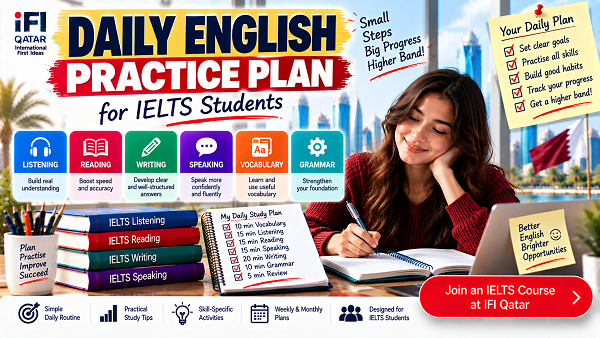
Preparing for IELTS is not simply about completing practice tests.
If you want to improve your English and achieve a stronger IELTS score, you need a consistent study routine that develops the skills tested in the exam while also improving your general ability to communicate in English.
A well-designed English study plan can help you decide what to practise each day, how much time to spend on each skill and how to measure your progress.
The most effective routine is not necessarily the longest one. A focused 60- to 90-minute study session completed consistently can be more useful than studying for several hours once or twice a week.
This guide provides a practical daily English practice plan for IELTS students, including Reading, Listening, Writing, Speaking, vocabulary, grammar and review activities.
Why Do IELTS Students Need an English Study Plan?
Many IELTS candidates study without a clear routine.
They might:
- memorise vocabulary one day
- complete a Reading test the next day
- watch English videos occasionally
- write an essay when they have time
- practise Speaking only shortly before the exam
This approach can make progress difficult to measure.
A structured English study plan gives you a repeatable system.
Instead of asking:
“What should I study today?”
you already know what to do.
A good plan also helps you balance the four IELTS skills:
- Listening
- Reading
- Writing
- Speaking
while developing the supporting skills that influence performance:
- vocabulary
- grammar
- pronunciation
- paraphrasing
- fluency
- time management
How Much Should You Study for IELTS Every Day?
There is no single number of hours that every IELTS student needs.
Your ideal study time depends on:
- current English level
- target IELTS band
- test date
- strengths and weaknesses
- previous English experience
- availability outside work or school
For many students, 60–90 minutes of focused daily practice is a realistic starting point.
If you have more time, you can extend the sessions.
If you have less time, focus on the highest-priority activities rather than trying to complete everything.
A 60-Minute Daily Plan
A basic 60-minute routine could look like this:
| Activity | Time |
|---|---|
| Vocabulary | 10 minutes |
| Listening or Reading | 15 minutes |
| Grammar | 10 minutes |
| Speaking | 10 minutes |
| Writing | 10 minutes |
| Review | 5 minutes |
You do not have to practise every activity equally every day.
The schedule can change depending on your current weaknesses.
A 90-Minute Daily Plan
If you have more time:
| Activity | Time |
|---|---|
| Vocabulary | 10 minutes |
| Listening | 15 minutes |
| Reading | 15 minutes |
| Speaking | 15 minutes |
| Writing | 20 minutes |
| Grammar | 10 minutes |
| Review | 5 minutes |
This gives you exposure to all major areas without turning your study session into an exhausting full mock test every day.
The Best Daily English Practice Routine for IELTS
A strong daily routine should include three stages:
Learn → Practise → Review
Learn
Spend some time learning new language.
For example:
- vocabulary
- collocations
- grammar structures
- pronunciation
- useful expressions
Practise
Use the language actively.
For example:
- answer Speaking questions
- write a paragraph
- complete a Reading exercise
- listen to an English recording
- summarise what you heard
Review
Look at your mistakes.
Ask:
What did I get wrong?
Why did I get it wrong?
What can I do differently next time?
The review stage is often overlooked, but it is one of the most valuable parts of an English study plan.
Daily IELTS Vocabulary Practice
Vocabulary should be part of your daily routine, but you do not need to memorise dozens of isolated words.
Focus on useful vocabulary that you can actually use.
Learn Vocabulary by Topic
IELTS topics commonly include areas such as:
- education
- technology
- health
- environment
- work
- transportation
- society
- culture
- tourism
- cities
- government
- media
Instead of learning random words, create topic groups.
For example:
Environment
- climate change
- carbon emissions
- renewable energy
- fossil fuels
- environmental protection
- sustainable development
- natural resources
Learn Collocations
A collocation is a combination of words that naturally occur together.
For example:
- make a decision
- conduct research
- raise awareness
- play a significant role
- improve living standards
- reduce carbon emissions
Learning vocabulary as phrases can make it easier to use English naturally in Speaking and Writing.
Use New Words in Sentences
Do not stop after memorising a definition.
If you learn:
significant impact
create a sentence:
Social media has a significant impact on the way people communicate.
Then use the phrase in a Speaking answer or Writing paragraph.
Daily IELTS Grammar Practice
Grammar should not be studied only by reading rules.
You need to practise using grammar.
Focus on One Grammar Area at a Time
For example:
Monday: Tenses
Tuesday: Articles
Wednesday: Prepositions
Thursday: Complex sentences
Friday: Conditionals
Saturday: Relative clauses
Sunday: Review
This is more manageable than trying to study every grammar rule at once.
Practise Grammar in Context
Instead of completing 50 isolated grammar questions, take one structure and use it in IELTS-related sentences.
For example, practise conditionals:
If governments invest more in public transport, cities may experience less traffic congestion.
Then create your own examples.
Keep a Grammar Error List
Write down recurring mistakes.
For example:
- articles
- subject-verb agreement
- verb tense
- prepositions
- plural nouns
- sentence structure
Review this list regularly.
Your own mistakes are often more useful than a generic list of grammar rules.
Daily IELTS Listening Practice
Listening improves when you practise regularly.
You do not need to complete a full IELTS Listening test every day.
Use Short Listening Sessions
Spend 10–15 minutes listening to English.
You can use:
- IELTS practice recordings
- educational videos
- interviews
- podcasts
- English news
- lectures
- conversations
The goal is to expose yourself to natural spoken English.
Listen for Specific Information
During IELTS preparation, practise identifying:
- names
- dates
- numbers
- locations
- opinions
- changes of opinion
- reasons
- examples
- key details
Practise With Different Accents
IELTS Listening can include different English accents, so do not limit your listening practice to one speaker or one variety of English.
Train yourself to understand different voices and speaking styles.
Use the Listen → Check → Repeat Method
Choose a short recording.
Step 1: Listen without subtitles.
Step 2: Check your understanding.
Step 3: Listen again with a transcript if available.
Step 4: Identify unfamiliar expressions.
Step 5: Listen again.
This helps connect pronunciation with vocabulary and meaning.
Daily IELTS Reading Practice
Reading practice should develop both accuracy and speed.
Read for 15–20 Minutes
Choose an appropriate English text and focus on understanding:
- the main idea
- supporting details
- opinions
- examples
- relationships between ideas
Practise Paraphrasing
IELTS Reading often requires you to recognise information expressed differently.
For example:
Text:
The number of people working remotely increased significantly.
Paraphrase:
There was a substantial rise in remote employment.
Practising paraphrases helps you recognise the same idea when different vocabulary is used.
Build a Reading Error Log
When you answer an IELTS Reading question incorrectly, record:
- question type
- your answer
- correct answer
- location of the answer
- reason for your mistake
For example:
| Question type | Mistake | Lesson |
|---|---|---|
| True/False/Not Given | Chose True | The passage did not provide the information |
| Matching Headings | Chose detail instead of main idea | Focus on paragraph purpose |
| Multiple Choice | Missed paraphrase | Look for meaning, not exact words |
Daily IELTS Speaking Practice
Speaking requires active practice.
Reading about Speaking strategies will not automatically make you fluent.
You need to speak.
Practise Part 1 Questions
Choose three to five familiar questions.
For example:
Do you enjoy reading?
What do you usually do at weekends?
Do you like your hometown?
Try to answer naturally rather than memorising model answers.
Use Answer + Reason + Example
A simple structure can help you extend answers.
Answer:
Yes, I really enjoy reading.
Reason:
I find it a good way to relax after work.
Example:
For example, I usually read for about 20 minutes before going to bed.
This gives you a more developed response without making it sound memorised.
Practise Part 2
Choose one cue card.
Take one minute to prepare.
Write keywords rather than complete sentences.
Then speak continuously.
Record yourself if possible.
After finishing, listen for:
- long pauses
- repetition
- grammar mistakes
- pronunciation problems
- vocabulary gaps
Practise Part 3
Part 3 requires more developed answers.
Try:
Opinion → Reason → Example → Result
For example:
I think public transport should be improved because it can reduce traffic congestion. For example, reliable metro systems can encourage people to leave their cars at home. As a result, cities may become less crowded and more environmentally friendly.
Daily IELTS Writing Practice
You do not need to write a complete IELTS essay every day.
In fact, focused writing exercises can sometimes be more useful.
Practise Introductions
Choose an IELTS Writing Task 2 question and write only the introduction.
Focus on:
- paraphrasing the question
- clearly presenting your position
- avoiding memorised phrases
Practise Topic Sentences
Choose a topic and write three possible topic sentences.
For example:
Governments should invest more heavily in public transport.
Then develop one into a complete paragraph.
Practise One Body Paragraph
Use:
Main idea → Explanation → Example → Result
For example:
One major advantage of public transport is that it can reduce traffic congestion. When more people use buses and trains instead of private cars, fewer vehicles are present on the roads during peak hours. For example, cities with reliable metro systems can encourage commuters to leave their cars at home. As a result, public transport can contribute to more efficient urban mobility.
Review Your Writing
After writing, check:
Task
- Did I answer the question?
Vocabulary
- Did I repeat the same words?
Grammar
- Are my sentences accurate?
Organisation
- Does each paragraph have one clear purpose?
Examples
- Are my examples relevant?
A 7-Day English Study Plan for IELTS
If you want a simple weekly structure, use the following plan.
Day 1: Vocabulary + Reading
Vocabulary: Learn 10 topic-related collocations.
Reading: Complete one IELTS Reading passage or focused exercise.
Speaking: Answer three Part 1 questions using your new vocabulary.
Review: Record your mistakes.
Day 2: Listening + Grammar
Listening: Complete one IELTS Listening section.
Grammar: Study one grammar structure.
Speaking: Use the grammar structure in five spoken sentences.
Review: Check your Listening mistakes.
Day 3: Writing
Vocabulary: Review previous words.
Writing: Write one Task 2 introduction and one body paragraph.
Grammar: Check sentence accuracy.
Speaking: Explain your essay topic for two minutes.
Day 4: Reading + Speaking
Reading: Practise one difficult question type.
Speaking: Complete one Part 2 cue card.
Part 3: Answer two discussion questions.
Review: Analyse your fluency and vocabulary.
Day 5: Listening + Writing
Listening: Complete another Listening section.
Writing: Practise Academic Task 1 or General Training Task 1, depending on your test.
Vocabulary: Record useful expressions from your practice.
Day 6: Speaking + Grammar
Speaking: Complete Parts 1, 2 and 3.
Grammar: Review your most common errors.
Pronunciation: Practise difficult words and phrases.
Day 7: Weekly Review
Do not spend the entire day learning new material.
Review the week.
Check:
- vocabulary learned
- grammar mistakes
- Reading errors
- Listening errors
- Speaking recordings
- Writing mistakes
Then decide what to prioritise next week.
A 30-Day English Study Plan for IELTS
If your test is several weeks away, you can organise your preparation into four stages.
Week 1: Build Your Foundation
Focus on:
- core vocabulary
- essential grammar
- understanding IELTS question types
- basic Speaking practice
- short Reading and Listening exercises
The objective is to identify your current level and major weaknesses.
Week 2: Build Skills
Increase the difficulty.
Focus on:
- topic vocabulary
- paraphrasing
- complex grammar
- Reading strategies
- Listening strategies
- Writing structure
- Speaking development
Week 3: Apply Your Skills
Start combining skills.
For example:
- Reading + vocabulary
- Listening + pronunciation
- Writing + grammar
- Speaking + vocabulary
Complete more timed activities.
Week 4: Test and Refine
Focus on:
- full practice tests
- timing
- error analysis
- weak question types
- Speaking simulations
- Writing feedback
Avoid trying to learn hundreds of new words at the last minute.
Focus on using what you already know accurately.
How to Create a Study Plan Based on Your Weaknesses
A good English study plan should not be identical for every student.
Suppose your current performance looks like this:
| Skill | Current level | Priority |
|---|---|---|
| Listening | Strong | Medium |
| Reading | Strong | Medium |
| Writing | Weak | High |
| Speaking | Average | High |
You should not spend 25% of your study time on every skill.
Instead, increase the time spent on Writing and Speaking.
For example:
- Writing: 30%
- Speaking: 30%
- Reading: 15%
- Listening: 15%
- Vocabulary/Grammar: 10%
The exact percentages can change as your performance improves.
How to Track Your IELTS Progress
Your study plan should include measurable targets.
Instead of writing:
“Improve my English.”
set a specific target:
“Complete three Speaking recordings this week.”
Or:
“Learn 30 environment-related collocations and use 15 of them in sentences.”
Or:
“Complete two timed Reading passages and reduce my average mistakes.”
Create a Weekly Progress Sheet
Track:
| Area | This Week | Next Target |
|---|---|---|
| Reading | 28/40 | 31/40 |
| Listening | 30/40 | 33/40 |
| Writing | Grammar errors: 12 | Reduce to 7 |
| Speaking | Frequent hesitation | Fewer long pauses |
| Vocabulary | 35 new collocations | Review and use 25 |
The exact targets should reflect your current level and test requirements.
Should You Study English Every Day?
For most IELTS students, regular exposure is more useful than occasional intensive study.
Daily English practice helps maintain:
- vocabulary recall
- grammar awareness
- listening familiarity
- speaking confidence
- reading speed
Even on busy days, a short session can keep the habit going.
A 20-minute session is better than abandoning your routine completely.
For example:
5 minutes: vocabulary review
5 minutes: listening
5 minutes: Speaking
5 minutes: grammar or reading
Consistency matters.
What to Do When You Have Only 30 Minutes
Not everyone has 90 minutes every day.
If you have only 30 minutes, use a compact routine.
30-Minute IELTS Routine
5 minutes: vocabulary review
10 minutes: Reading or Listening
10 minutes: Speaking or Writing
5 minutes: error review
Alternate the main skill each day.
For example:
Monday: Reading
Tuesday: Listening
Wednesday: Writing
Thursday: Speaking
Friday: Reading
Saturday: Listening
Sunday: Review
What to Do When You Have 2 Hours
If you have two hours available, avoid simply doing two complete practice tests.
Instead:
20 minutes: Vocabulary
20 minutes: Listening
20 minutes: Reading
30 minutes: Writing
20 minutes: Speaking
10 minutes: Grammar review
This provides broad exposure while leaving time for active practice.
Common English Study Plan Mistakes
Studying Without a Goal
If you do not know what you are trying to improve, it is difficult to measure progress.
Learning Too Many Words
Memorising 50 words without using them is less effective than learning 10 useful words and practising them repeatedly.
Doing Practice Tests Without Reviewing Them
A score tells you where you are.
Your mistakes tell you how to improve.
Ignoring Speaking
Many students spend most of their preparation time reading and writing because these activities feel easier to study alone.
Speaking requires active practice.
Avoiding Writing Feedback
You may not notice recurring writing problems without someone reviewing your work.
Changing Your Plan Every Few Days
Constantly switching between study methods can prevent you from building a consistent routine.
Give your plan enough time to produce measurable results.
How to Stay Consistent With IELTS Preparation
Motivation can change from day to day.
A routine makes studying less dependent on motivation.
Set a Fixed Study Time
Choose a time that fits your schedule.
For example:
7:00–8:00 PM every weekday.
Keep Your Materials Ready
Have your:
- notebook
- vocabulary list
- IELTS practice materials
- headphones
- timer
ready before your session starts.
Use Small Daily Targets
Instead of:
“Study English for two hours.”
try:
“Learn 10 collocations and use them in five sentences.”
Specific goals are easier to complete.
Track Your Streak
A simple calendar can help you see whether you are maintaining consistency.
The goal is not perfection.
The goal is regular practice.
Should You Use an IELTS Course With a Self-Study Plan?
Self-study can be effective, especially when you have a clear plan and reliable materials.
However, some areas are difficult to assess independently.
This is particularly true for:
- Speaking fluency
- Pronunciation
- Writing organisation
- Task Response
- vocabulary accuracy
- recurring grammar problems
A structured IELTS course can provide:
- guided lessons
- expert feedback
- targeted practice
- accountability
- realistic exam tasks
- personalised correction
- a structured study schedule
The best approach depends on your current level, target score and learning preferences.
IELTS English Study Plan FAQ
What is the best English study plan for IELTS?
The best plan is one that balances Listening, Reading, Writing and Speaking while also developing vocabulary and grammar. It should be adjusted according to your current weaknesses and target band.
How many hours should I study English for IELTS each day?
There is no universal number. A consistent 60–90 minutes of focused study can provide a practical routine for many students, while students with limited time can use shorter sessions.
Can I prepare for IELTS by studying English for 30 minutes a day?
Yes. A 30-minute routine can still be useful if you study consistently and focus on high-priority skills. You can alternate Reading, Listening, Writing and Speaking across different days.
Should I practise IELTS every day?
Regular practice is generally more useful than occasional intensive sessions. Your daily routine does not need to include a complete IELTS test.
How can I improve my English vocabulary for IELTS?
Learn vocabulary by topic, focus on collocations and use new words in your own sentences, Speaking answers and Writing practice.
How can I improve IELTS Speaking at home?
Record yourself answering Part 1, Part 2 and Part 3 questions. Review your recordings for hesitation, repetition, grammar, vocabulary and pronunciation.
How can I improve IELTS Writing without a teacher?
You can improve through structured practice, official assessment criteria, self-correction and comparing your writing against reliable model responses. However, personalised feedback can help identify recurring problems that are difficult to recognise yourself.
Should I do a full IELTS mock test every day?
No. Full mock tests are useful for measuring performance and practising under realistic conditions, but focused skill practice and detailed error analysis are also essential.
When should I start my IELTS study plan?
Start as early as practical. The amount of preparation you need depends on your current English level, target score and test date.
Your Next Step: Build a Consistent IELTS Routine
A successful IELTS preparation plan does not have to be complicated.
Start with a realistic daily routine:
Learn vocabulary → practise a skill → speak or write → review mistakes
Then repeat the process consistently.
As your skills improve, increase the difficulty and introduce more timed IELTS practice.
Remember that IELTS preparation is not only about knowing the test format. It is also about developing the English skills needed to communicate clearly and confidently.
If you want guidance, structured practice and expert support, an IELTS course can help you turn your study time into a more focused preparation programme.
Ready to improve your English and prepare for IELTS with a structured plan? Join an IELTS Course at IFI Qatar and get the guidance, practice and support you need to move towards your target score.