

Currently Empty: ر.ق 0,00


IELTS
IELTS Speaking Questions About Food and Cooking
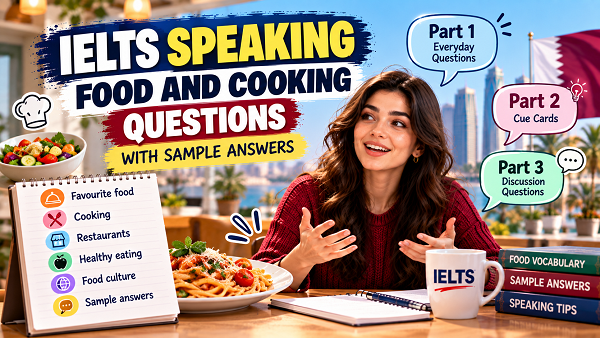
What Are IELTS Food Speaking Questions?
Food is a useful topic for IELTS Speaking practice because it connects to everyday experiences, personal preferences, habits, culture and broader social issues.
You may encounter questions about food or cooking while practising IELTS Speaking Part 1, Part 2 or Part 3. However, practice questions should not be treated as predictions of the exact questions that will appear in your exam.
The IELTS Speaking test lasts 11–14 minutes and consists of three parts. Part 1 focuses on familiar topics, Part 2 requires a longer individual talk, and Part 3 develops a more general discussion related to the Part 2 topic.
Food is particularly useful for practice because it allows you to develop answers using:
- Personal experiences
- Preferences
- Reasons
- Examples
- Comparisons
- Descriptions
- Opinions
- Causes and effects
- Social and cultural ideas
The goal is not to memorise answers.
Instead, use food-related questions to practise speaking spontaneously, extending your answers and using vocabulary naturally.
How Is Food Assessed in the IELTS Speaking Test?
Food is not a separate scoring category in IELTS Speaking.
Your performance is assessed across four criteria:
- Fluency and Coherence
- Lexical Resource
- Grammatical Range and Accuracy
- Pronunciation
These four criteria are used throughout the Speaking test.
Fluency and Coherence
This criterion considers how effectively you keep speaking, organise your ideas and connect your points.
For food questions, avoid giving extremely short answers.
Instead of:
Yes, I like cooking.
Try:
Yes, I really enjoy cooking, especially at weekends, because I have more time to experiment with different recipes.
The second answer gives the examiner more language to assess and develops the idea naturally.
Lexical Resource
Your vocabulary should be varied enough to express your meaning accurately.
For food topics, useful vocabulary includes words related to:
- Ingredients
- Cooking methods
- Flavour
- Texture
- Nutrition
- Eating habits
- Restaurants
- Traditional food
- Healthy lifestyles
At Band 7, IELTS expects vocabulary to be used flexibly, with some ability to use less common and idiomatic items and effective paraphrasing when needed.
Grammatical Range and Accuracy
Try to use a mixture of simple and complex structures.
For example:
I usually cook at home because it is cheaper.
You can develop this into:
Although cooking at home takes more time, I prefer it because I can control the ingredients and prepare healthier meals.
The second example demonstrates greater structural variety while remaining natural.
Pronunciation
Your pronunciation should allow the examiner to understand you without excessive effort.
You do not need to sound like a native English speaker.
Instead, focus on:
- Clear individual sounds
- Word stress
- Sentence stress
- Natural rhythm
- Intonation
- Connected speech
- Overall intelligibility
IELTS Speaking Part 1 Food Questions
Part 1 lasts approximately 4–5 minutes and covers familiar topics and everyday experiences.
Food questions in Part 1 are usually personal and relatively accessible.
You may be asked about:
- Your favourite foods
- Cooking
- Eating habits
- Restaurants
- Meals
- Healthy food
- Food preferences
- Traditional dishes
The key is to answer naturally rather than delivering a memorised speech.
IELTS Food Speaking Questions About Favourite Foods
Question 1: What is your favourite food?
Sample answer:
My favourite food is probably grilled chicken with rice because it is simple, filling and quite healthy. I usually have it for lunch or dinner, and I especially enjoy it when it is prepared with fresh vegetables and spices.
Question 2: What kind of food do you like?
Sample answer:
I enjoy a variety of food, but I particularly like dishes that are fresh and well-seasoned. I tend to prefer Middle Eastern and Asian food because both cuisines use a lot of herbs, spices and fresh ingredients.
Question 3: Is there any food you do not like?
Sample answer:
Yes, there are a few things I don’t really enjoy. I’m not particularly fond of very oily food because it feels too heavy, especially when I eat it during the day.
Question 4: Has your taste in food changed over time?
Sample answer:
Definitely. When I was younger, I preferred fast food and sweets, but my tastes have changed as I’ve become more conscious of my health. These days, I usually prefer lighter meals with vegetables and lean protein.
IELTS Food Speaking Questions About Meals
Question 5: What do you usually have for breakfast?
Sample answer:
On weekdays, I usually have a fairly simple breakfast, such as eggs, bread and fruit. If I’m in a hurry, I might just have coffee and something light before leaving home.
Question 6: What is your favourite meal of the day?
Sample answer:
Dinner is probably my favourite meal because I have more time to relax. I can eat slowly and talk to my family instead of rushing through the meal.
Question 7: Do you usually eat three meals a day?
Sample answer:
Most of the time, yes. I normally have breakfast, lunch and dinner, although I sometimes have a small snack between meals if I’m particularly busy or hungry.
Question 8: Do you prefer a big meal or a small meal?
Sample answer:
I generally prefer moderate-sized meals because I don’t like feeling too full. I think eating smaller portions throughout the day can also make it easier to stay energetic.
IELTS Speaking Part 1 Questions About Cooking
Cooking is another common area for IELTS Speaking practice because it allows you to discuss routines, skills, preferences and experiences.
Questions About Cooking at Home
Question 1: Do you enjoy cooking?
Sample answer:
Yes, I do. I wouldn’t say I’m an excellent cook, but I enjoy preparing simple meals because it’s relaxing and I can choose exactly what ingredients to use.
Question 2: How often do you cook?
Sample answer:
I cook several times a week, usually in the evening. At weekends, I have more free time, so I sometimes prepare something more complicated.
Question 3: What kind of food can you cook?
Sample answer:
I can prepare several basic dishes, including pasta, rice dishes, grilled chicken and different types of salads. I’m also learning how to make a few traditional dishes.
Question 4: Who usually cooks in your home?
Sample answer:
It depends on the day. I sometimes cook myself, but other members of my family also prepare meals. We usually share the responsibility rather than having one person do everything.
Questions About Learning to Cook
Question 5: When did you learn to cook?
Sample answer:
I started learning basic cooking when I was a teenager. At first, I could only prepare very simple meals, but I gradually became more confident by watching other people and trying different recipes.
Question 6: Who taught you how to cook?
Sample answer:
Mostly my family taught me. I also learned a few techniques from cooking videos online, especially when I wanted to try something unfamiliar.
Question 7: Would you like to improve your cooking skills?
Sample answer:
Definitely. I’d like to become better at preparing healthy meals and learn more about international cuisines. I think cooking is a useful skill that can save money and improve your diet.
Question 8: Is cooking an important skill?
Sample answer:
Yes, I think it is. Being able to cook means that people don’t have to rely on restaurants or processed food all the time. It can also give people more control over what they eat.
IELTS Speaking Part 1 Questions About Restaurants
Restaurants give you opportunities to practise vocabulary related to dining out, service and personal preferences.
Restaurant Questions and Sample Answers
Question 1: Do you often eat at restaurants?
Sample answer:
I eat at restaurants occasionally, probably once or twice a week. I usually go when I’m meeting friends or when I don’t have enough time to cook at home.
Question 2: What kind of restaurants do you like?
Sample answer:
I prefer casual restaurants that serve fresh food and have a comfortable atmosphere. I don’t necessarily look for expensive places because good food and friendly service are more important to me.
Question 3: Do you prefer eating at home or at a restaurant?
Sample answer:
I prefer eating at home most of the time because it’s more comfortable and usually cheaper. However, I enjoy going to restaurants when I want to socialise or try something new.
Question 4: What makes a restaurant good?
Sample answer:
I think several things matter, including the quality of the food, cleanliness, service and atmosphere. Personally, I also appreciate restaurants that have a varied menu and reasonable prices.
IELTS Speaking Part 1 Questions About Healthy Food
Health-related food questions allow you to practise giving opinions and explaining personal habits.
Healthy Eating Questions
Question 1: Do you think you have a healthy diet?
Sample answer:
I think my diet is reasonably healthy, although there is definitely room for improvement. I try to eat vegetables and fresh food regularly, but I occasionally eat fast food when I’m busy.
Question 2: What healthy food do you like?
Sample answer:
I like fresh fruit, vegetables, grilled fish and nuts. I particularly enjoy fruit because it’s convenient and doesn’t require any preparation.
Question 3: Do you think people eat enough healthy food?
Sample answer:
Probably not. Many people have busy lifestyles, so they choose convenient processed food instead of preparing fresh meals. Price and availability can also influence people’s choices.
Question 4: What could people do to improve their eating habits?
Sample answer:
They could start by making small changes, such as eating more vegetables, reducing sugary drinks and planning meals in advance. I think realistic changes are easier to maintain than strict diets.
How to Answer IELTS Food Speaking Part 1 Questions
A useful Part 1 answer is usually more developed than a simple “yes” or “no”, but it should still sound like natural conversation.
A useful structure is:
Answer → Reason → Example or Detail
For example:
Do you enjoy cooking?
Answer: Yes, I do.
Reason: I find it relaxing after a busy day.
Example: I usually prepare simple meals such as pasta or grilled chicken.
Combined:
Yes, I do. I find cooking quite relaxing after a busy day, and I usually prepare simple meals such as pasta or grilled chicken.
Avoid Overlong Part 1 Answers
Part 1 is not the place to deliver a two-minute speech.
The examiner needs to ask several questions, so your responses should be developed but conversational.
Avoid One-Word Answers
Weak:
Yes.
Better:
Yes, definitely. I enjoy cooking because I can experiment with different ingredients.
The second response gives you an opportunity to demonstrate fluency, vocabulary and grammar.
IELTS Speaking Part 2 Food Cue Cards
Part 2 is the long turn.
You receive a task card, have one minute to prepare, and then speak for up to two minutes. The examiner may ask one or two brief questions afterward.
Food is a useful topic for practising Part 2 because you can describe:
- A favourite dish
- A memorable meal
- A restaurant
- A person who cooks well
- A traditional food
- A meal you prepared
- A food you tried for the first time
- A special celebration involving food
These are practice topics, not predictions of actual exam questions.
Cue Card 1: Describe a Favourite Food
You should say:
- What it is
- When you usually eat it
- Where you usually eat it
- And explain why you like it
Sample answer:
One of my favourite foods is grilled chicken with rice and vegetables. I usually eat it for dinner, particularly when I want something filling but not too heavy.
I normally prepare it at home, although there are also a few restaurants that serve a similar dish. What I like most about it is that it is simple but still full of flavour. I can also change the ingredients depending on what I have available.
Another reason I like it is that it reminds me of meals I often had with my family when I was younger. So, for me, it is not just a convenient meal; it also has a personal connection.
Overall, I would say it is one of those dishes that I could eat regularly without getting bored.
Cue Card 2: Describe a Meal You Really Enjoyed
You should say:
- When you had it
- Where you had it
- Who you were with
- And explain why you enjoyed it
Sample answer:
A meal I particularly remember was a family dinner we had to celebrate a special occasion. We went to a restaurant that specialised in traditional food, and there were several different dishes on the table.
I was with several members of my family, so the atmosphere was quite lively. We ordered a mixture of main dishes, salads and desserts, which meant that everyone could try something different.
What made the meal memorable was not just the food but the experience. We spent several hours talking, laughing and catching up, which doesn’t always happen when everyone is busy with work or study.
I think that is why I remember the meal so clearly. The food was excellent, but the company and the atmosphere made the experience much more enjoyable.
Cue Card 3: Describe a Traditional Food From Your Country
You should say:
- What the food is
- What ingredients it contains
- When people usually eat it
- And explain why it is important
Sample answer:
A traditional food I would like to talk about is a dish that is commonly prepared for family gatherings and special occasions. It usually contains rice, meat and a variety of herbs and spices.
It is often prepared when families get together, particularly during celebrations or holidays. The preparation can take quite a long time because several ingredients need to be cooked separately before they are combined.
I think the dish is important because food is closely connected to culture. Older family members often teach younger people how to prepare traditional dishes, so recipes and cooking techniques can be passed from one generation to another.
Personally, I enjoy this type of food because it reminds me of family gatherings and special occasions.
Cue Card 4: Describe a Restaurant You Like
You should say:
- Where it is
- What kind of food it serves
- Who you usually go there with
- And explain why you like it
Sample answer:
There is a restaurant I really like near the area where I live. It serves a mixture of local and international dishes, so there are plenty of options to choose from.
I usually go there with friends or family, particularly at weekends. The restaurant has a relaxed atmosphere, and the staff are generally friendly and helpful.
What I like most is the quality of the food. The portions are reasonable, and the menu includes several healthy options as well as more traditional dishes.
I also like the fact that it is not excessively formal. You can have a good meal and spend time talking without feeling rushed, which makes it a place I enjoy returning to.
Cue Card 5: Describe a Food You Tried for the First Time
You should say:
- What the food was
- Where you tried it
- Who you were with
- And explain what you thought of it
Sample answer:
One food I tried for the first time was a type of Asian noodle dish that I had never tasted before. I tried it at a restaurant with a friend who recommended it to me.
At first, I wasn’t sure whether I would like it because it contained several ingredients that I wasn’t familiar with. However, once I tried it, I found the flavour surprisingly enjoyable.
What I liked most was the combination of different textures and spices. It was quite different from the food I normally eat, so it was an interesting experience.
Since then, I’ve actually tried similar dishes several times, so that first experience encouraged me to become more adventurous with food.
How to Structure an IELTS Food Cue Card Answer
A strong Part 2 answer needs enough content to keep you speaking for the required time.
A useful structure is:
Introduction → Background → Details → Personal reaction → Conclusion
For example:
Introduction: The food I want to talk about is…
Background: I first tried it when…
Details: It contains… and it is usually served…
Personal reaction: What I particularly like about it is…
Conclusion: Overall, it is memorable because…
This is not a script to memorise.
Use it as a flexible framework.
Use the One-Minute Preparation Time Effectively
When you receive a food cue card, write only keywords.
For example:
Favourite dish
- Grilled chicken
- Family recipe
- Dinner
- Healthy
- Easy to prepare
- Childhood memories
Do not try to write complete sentences.
Your notes should remind you what to say rather than become something you read.
IELTS Speaking Part 3 Food Questions
Part 3 develops a broader discussion connected to the Part 2 topic.
The questions become more general and abstract, and you may need to explain opinions, analyse issues, compare ideas or speculate about possible outcomes.
Food is particularly useful for Part 3 because it connects with:
- Health
- Culture
- Education
- Advertising
- Government policy
- Technology
- Family life
- The economy
- Lifestyle changes
IELTS Food Speaking Questions About Healthy Eating
Question 1: Why do some people have unhealthy eating habits?
Sample answer:
There are several reasons. One is that people often have busy lifestyles and choose convenient food because they don’t have enough time to cook. Another factor is advertising, which can encourage people to buy highly processed food. Price can also be important, particularly for families with limited budgets.
Question 2: Should schools teach children about healthy eating?
Sample answer:
Yes, I think they should. Schools can help children understand the relationship between diet and health from an early age. However, education should be combined with practical activities, such as teaching students how to prepare simple healthy meals.
Question 3: What can governments do to encourage healthy eating?
Sample answer:
Governments could use several approaches. They could provide clearer nutritional information, regulate certain types of food advertising and support public education campaigns. They could also make healthy food more affordable and accessible.
IELTS Food Speaking Questions About Cooking
Question 4: Why are fewer people cooking at home nowadays?
Sample answer:
I think modern lifestyles are a major factor. Many people work long hours and have limited time, so ordering food can seem more convenient than preparing a meal. In addition, food-delivery services have made restaurant meals much easier to access.
Question 5: Do you think cooking should be taught in schools?
Sample answer:
I think basic cooking could be a useful practical subject. Students could learn how to prepare simple meals, understand nutrition and plan a basic budget. These are life skills that could benefit them when they become independent.
Question 6: Has technology changed the way people cook?
Sample answer:
Yes, significantly. People can now find recipes, watch cooking tutorials and learn new techniques online. Kitchen appliances have also made some cooking processes faster and easier. As a result, people have access to more information and tools than previous generations did.
IELTS Food Speaking Questions About Restaurants
Question 7: Why do people like eating in restaurants?
Sample answer:
Restaurants offer more than just food. They provide an opportunity to socialise, celebrate special occasions and take a break from cooking. For some people, trying different cuisines is also an enjoyable way to experience new cultures.
Question 8: How have restaurants changed in recent years?
Sample answer:
One major change is the growth of food-delivery services. People can now order meals from a much wider range of restaurants without leaving home. Restaurants have also become more diverse, with international cuisines becoming increasingly available in many cities.
IELTS Food Speaking Questions About Food Culture
Question 9: Why is food important to culture?
Sample answer:
Food is closely connected to history, family traditions and social occasions. Traditional dishes are often prepared during celebrations, and recipes can be passed from one generation to another. In that sense, food can help preserve cultural identity.
Question 10: Do you think traditional food will disappear in the future?
Sample answer:
I don’t think it will disappear completely, although it may change. Younger generations are often exposed to international cuisines, but traditional food remains important during family gatherings and cultural celebrations. Some traditional dishes may simply be adapted to modern lifestyles.
IELTS Food Speaking Questions About Advertising
Question 11: How does food advertising influence people?
Sample answer:
Advertising can influence people’s choices by making certain products appear attractive, convenient or fashionable. Children may be particularly influenced by colourful advertising and promotional campaigns. This is one reason why some people believe food marketing should be regulated more carefully.
Question 12: Should advertising for unhealthy food be restricted?
Sample answer:
I think some restrictions could be reasonable, particularly when advertising is aimed at children. However, regulation should be balanced with individual responsibility. People also need access to clear information so that they can make informed decisions.
How to Give Better Answers to IELTS Food Questions
The strongest answers are not necessarily the longest.
They are clear, developed and relevant.
A useful framework is:
Point → Reason → Example → Result
Example
Question:
Why do people eat fast food?
Point:
One major reason is convenience.
Reason:
Many people have busy work and study schedules.
Example:
For example, someone who finishes work late may choose to buy a takeaway instead of cooking dinner.
Result:
As a result, fast food can become a regular part of their diet.
Combined:
One major reason people eat fast food is convenience. Many people have busy work and study schedules, so they don’t always have enough time to prepare meals. For example, someone who finishes work late may choose to buy a takeaway instead of cooking dinner. As a result, fast food can become a regular part of their diet.
This structure helps you develop an answer without memorising a complete script.
IELTS Food Vocabulary for Speaking
Vocabulary should be learned in context rather than as isolated lists.
General Food Vocabulary
| Word/Phrase | Meaning | Example |
|---|---|---|
| balanced diet | A diet containing a healthy variety of foods | A balanced diet is important for maintaining good health. |
| processed food | Food that has been changed from its original form | Many processed foods contain high levels of salt. |
| fresh produce | Fresh fruit and vegetables | I try to buy fresh produce whenever possible. |
| home-cooked meal | Food prepared at home | I prefer home-cooked meals because I can control the ingredients. |
| takeaway | Food bought from a restaurant to eat elsewhere | I occasionally order a takeaway when I’m busy. |
| eating habits | The way someone normally eats | People’s eating habits often change as they get older. |
| portion size | The amount of food served | Restaurant portion sizes can be quite large. |
| nutritional value | The amount of useful nutrients in food | Fresh vegetables have considerable nutritional value. |
| comfort food | Food that makes someone feel relaxed or happy | Soup is one of my favourite comfort foods. |
| food waste | Food that is thrown away | Restaurants can play a role in reducing food waste. |
Vocabulary for Describing Taste
Useful adjectives include:
- Delicious
- Flavourful
- Spicy
- Sweet
- Salty
- Bitter
- Sour
- Mild
- Rich
- Fresh
- Savoury
- Creamy
- Crunchy
- Crispy
Instead of repeatedly saying “very good”, try to describe the food more precisely.
For example:
The dish was really flavourful and slightly spicy.
Vocabulary for Cooking
Useful cooking verbs include:
- Bake
- Boil
- Fry
- Grill
- Roast
- Steam
- Stir
- Chop
- Slice
- Season
- Marinate
- Mix
- Serve
Example:
First, the vegetables are chopped and seasoned before they are grilled.
Vocabulary for Healthy Eating
Useful phrases include:
- Maintain a balanced diet
- Reduce sugar intake
- Cut down on processed food
- Eat a variety of foods
- Consume fresh ingredients
- Follow healthy eating habits
- Maintain a healthy lifestyle
- Avoid excessive amounts of salt
- Increase vegetable consumption
Useful IELTS Food Collocations
Collocations can make your Speaking vocabulary sound more natural.
Food and Health Collocations
- Healthy eating habits
- Balanced diet
- Nutritional value
- Healthy lifestyle
- Processed food
- Fresh ingredients
- Excessive sugar consumption
- High-calorie food
- Nutrient-rich food
Cooking Collocations
- Prepare a meal
- Follow a recipe
- Try a new recipe
- Prepare fresh ingredients
- Cook from scratch
- Add spices
- Serve a meal
- Experiment with flavours
Restaurant Collocations
- Eat out
- Dine out
- Order a meal
- Try a new restaurant
- Local cuisine
- Traditional dishes
- Friendly service
- Reasonable prices
- Relaxed atmosphere
Instead of memorising twenty phrases at once, choose a few and practise using them in complete sentences.
IELTS Food Grammar You Can Use in Speaking
Food questions are a useful opportunity to practise different grammatical structures.
Present Simple for Habits
I usually cook dinner at home.
I often eat breakfast before work.
Present Perfect for Changes
My eating habits have changed significantly over the last few years.
Comparatives for Comparing Food
Home-cooked food is generally healthier than fast food.
Conditionals for Part 3
If people had more time to cook, they might eat fewer processed foods.
Relative Clauses for Adding Detail
I have a restaurant near my home that serves excellent traditional food.
Cause-and-Effect Structures
People often choose takeaway food because it is convenient.
Concession Structures
Although fast food is convenient, it is not always the healthiest option.
The objective is not to force advanced grammar into every answer.
Use the structure that best expresses your idea.
Common Mistakes in IELTS Food Speaking Questions
Giving Very Short Answers
Weak:
Yes, I like cooking.
Better:
Yes, I enjoy cooking because I find it relaxing, especially when I have enough time to try a new recipe.
Memorising Complete Answers
Memorised answers can sound unnatural and may not fit the exact question.
IELTS Speaking is designed to assess spontaneous spoken language, and official IELTS materials specifically describe the test as one that does not allow candidates to rehearse set responses beforehand.
Learn useful structures and vocabulary instead of memorising paragraphs.
Using the Same Vocabulary Repeatedly
If every answer contains:
good food
very tasty
nice restaurant
very delicious
your vocabulary will sound limited.
Practise more precise descriptions.
Your answer should remain connected to the question.
If the examiner asks about healthy eating, do not spend most of your response describing your last holiday simply because you remember that story.
Speaking Too Quickly
Speaking quickly does not automatically improve your score.
Aim for a natural pace that allows you to:
- Organise your thoughts
- Pronounce words clearly
- Control grammar
- Develop ideas
Using Advanced Words Incorrectly
An unusual word is not useful if you use it incorrectly.
Accurate, natural vocabulary is more valuable than complicated vocabulary that you cannot control.
Using Too Many Fillers
Common fillers include:
- Umm
- You know
- Like
- Actually
- Basically
Some hesitation is natural, but excessive fillers can affect fluency.
How to Practise IELTS Food Speaking Questions
The most effective practice is active speaking rather than silently reading model answers.
Practice Method 1: Answer Without Preparation
Choose a question and give yourself 5–10 seconds to think.
Then answer for approximately 20–30 seconds.
This is useful for Part 1 practice.
Practice Method 2: Record Your Answers
Record yourself answering food questions.
Then listen and identify:
- Hesitation
- Repetition
- Grammar errors
- Vocabulary problems
- Pronunciation issues
- Weak idea development
Practice Method 3: Use Follow-Up Questions
After answering one question, ask yourself:
Why?
Then:
Can I give an example?
Then:
Has this changed over time?
This teaches you to extend your ideas naturally.
Practice Method 4: Practise Part 2 Under Time Conditions
Take a food cue card.
Use:
- 1 minute to prepare
- Up to 2 minutes to speak
Then listen to your recording.
Check whether you:
- Covered the bullet points
- Kept speaking
- Used varied vocabulary
- Organised your ideas
- Repeated yourself too much
Practice Method 5: Turn Part 2 Into Part 3
After completing a Part 2 cue card about food, create broader questions.
For example:
Part 2: Describe a traditional food.
Then ask:
Why are traditional foods important?
How have eating habits changed?
Should governments protect traditional cuisine?
Why do younger people try international food?
This is excellent preparation for the transition from personal experience to abstract discussion.
7-Day IELTS Food Speaking Practice Plan
Day 1: Favourite Food
Practise questions about:
- Favourite food
- Least favourite food
- Eating habits
- Favourite meals
Focus on natural Part 1 answers.
Day 2: Cooking
Practise:
- Cooking at home
- Learning to cook
- Favourite recipes
- Cooking skills
Record your answers.
Day 3: Restaurants
Practise:
- Eating out
- Restaurant preferences
- Restaurant service
- Favourite restaurants
Focus on descriptive vocabulary.
Day 4: Healthy Food
Practise:
- Healthy eating
- Unhealthy food
- Diet
- Food choices
Focus on cause-and-effect language.
Day 5: Food Cue Cards
Complete three Part 2 cue cards.
Give yourself exactly one minute to prepare for each.
Day 6: Food and Society
Practise Part 3 questions about:
- Food culture
- Advertising
- Health
- Government policy
- Technology
- Restaurants
Focus on developing opinions.
Day 7: Full Food Speaking Simulation
Complete:
Part 1: 4–5 minutes of familiar questions
Part 2: 1 minute preparation + up to 2 minutes speaking
Part 3: 4–5 minutes of discussion
Then review your performance using the four IELTS Speaking criteria.
IELTS Food Speaking Band 7 Strategy
A Band 7 candidate should not simply try to use “big words.”
The official Band 7 descriptors emphasise a range of features, including the ability to keep going and produce long turns, use vocabulary flexibly, use a range of structures, and produce frequent error-free sentences.
Build Longer Answers Naturally
Instead of stopping after one sentence, develop your idea.
I enjoy cooking.
Add:
I enjoy cooking because it allows me to relax.
Then:
I usually cook at weekends because I have more free time.
This creates a developed answer without sounding memorised.
Use Paraphrasing
If you forget a word, explain it another way.
For example, if you forget “ingredients”, you could say:
the different foods and products that you use to prepare a meal
The official Speaking assessment considers the ability to paraphrase when necessary.
Give Specific Examples
Instead of:
I like healthy food.
Say:
I try to eat healthy food, particularly grilled fish, fresh vegetables and fruit, because I feel more energetic when my diet is balanced.
Specific examples make your answers more natural and developed.
Avoid Trying to Sound Perfect
Band 7 does not mean producing completely error-free speech.
The official descriptors allow some errors, while expecting effective use of a range of structures and frequent error-free sentences.
Focus on communicating clearly and flexibly rather than stopping every few seconds to correct yourself.
IELTS Food Speaking Question Bank for Extra Practice
Use these questions after completing the main practice sections.
Part 1 Food Questions
- What is your favourite type of food?
- Do you enjoy trying new foods?
- What food did you dislike as a child?
- How often do you eat at home?
- Do you usually eat with your family?
- What is your favourite meal?
- Do you prefer sweet or savoury food?
- Do you eat healthy food?
- How often do you eat fast food?
- Do you enjoy cooking?
- Who usually cooks in your family?
- What food do you usually eat at weekends?
- Do you prefer homemade food?
- What food is popular in your country?
- Do you enjoy eating in restaurants?
Part 2 Food Cue Cards
- Describe a meal you really enjoyed.
- Describe your favourite food.
- Describe a traditional food from your country.
- Describe a restaurant you like.
- Describe a food you tried for the first time.
- Describe a meal you prepared for someone.
- Describe someone who is good at cooking.
- Describe a special meal you had with your family.
- Describe a food you would recommend to a foreign visitor.
- Describe a dish that reminds you of your childhood.
Part 3 Food Questions
- Why are eating habits changing?
- Why do people eat fast food?
- Should schools teach children about nutrition?
- How can governments encourage healthy eating?
- Why are traditional foods important?
- Will traditional food become less popular?
- How has technology changed cooking?
- How have food-delivery services changed people’s habits?
- Should unhealthy food advertising be restricted?
- Why do people enjoy eating in restaurants?
- How does food bring people together?
- Why do people try food from other cultures?
- How can society reduce food waste?
- Should healthy food be cheaper than unhealthy food?
- How might people’s diets change in the future?
Frequently Asked Questions About IELTS Food Speaking Questions
What are IELTS food speaking questions?
IELTS food speaking questions are practice questions related to food, cooking, eating habits, restaurants, healthy eating and food culture. They can be used to prepare for different types of Speaking responses across Parts 1, 2 and 3.
Are food questions common in IELTS Speaking?
Food is a useful topic for IELTS Speaking practice because it relates to familiar personal experiences as well as broader issues such as health, culture and lifestyle. However, practice topics should not be treated as predictions of the exact questions that will appear in a particular test.
What food questions are asked in IELTS Speaking Part 1?
Part 1 food questions may ask about your favourite food, cooking habits, meals, restaurants, healthy eating and personal preferences. Part 1 focuses on familiar topics and everyday experiences.
How do I answer IELTS food questions?
Give a direct answer first, then develop it with a reason, explanation, example or personal detail. Avoid one-word answers and avoid memorising complete responses.
How long should my IELTS Speaking Part 1 food answer be?
There is no official fixed number of seconds for each answer. Your response should be developed enough to demonstrate your speaking ability while remaining natural and conversational.
What food vocabulary should I use in IELTS Speaking?
Useful vocabulary includes words related to ingredients, cooking methods, taste, texture, nutrition, restaurants, eating habits and traditional cuisine. Learn words in phrases and sentences rather than memorising isolated lists.
How can I get Band 7 in IELTS Speaking?
Focus on all four assessment criteria: Fluency and Coherence, Lexical Resource, Grammatical Range and Accuracy, and Pronunciation. At Band 7, candidates are expected to use language flexibly, produce longer turns and use a range of structures effectively, while some errors may still occur.
Should I memorise IELTS food speaking answers?
No. Memorising complete answers is risky because the actual question may be different. Practise flexible structures, vocabulary, idea development and paraphrasing instead.
Paraphrase it or explain what you mean using simpler language. The ability to paraphrase is part of effective Speaking performance.
Is the IELTS Speaking test the same for Academic and General Training?
Yes. The Speaking test is the same for IELTS Academic and IELTS General Training. It lasts 11–14 minutes and contains three parts.
Can I practise IELTS food speaking questions by myself?
Yes. You can record yourself answering questions, review your vocabulary and grammar, and practise timed cue cards. However, feedback from an experienced teacher or Speaking coach can help identify problems that you may not notice yourself.
Improve Your IELTS Speaking With Targeted Coaching
Practising IELTS food speaking questions can help you build confidence, vocabulary and fluency, but simply reading sample answers is not enough.
To improve your Speaking performance, you need to practise:
- Answering unfamiliar questions
- Developing ideas
- Speaking without memorised scripts
- Using vocabulary naturally
- Controlling grammar
- Improving pronunciation
- Responding to follow-up questions
- Speaking under realistic conditions
A Speaking coach can help you identify the specific problems affecting your performance and give you targeted feedback based on the IELTS assessment criteria.
For learners preparing for IELTS in Qatar, structured Speaking practice can be particularly useful when preparing for a specific target score.
Ready to improve your IELTS Speaking? Explore IELTS Speaking coaching at IFI Qatar and practise with structured feedback designed around your target score.
Final Tips for IELTS Food Speaking Questions
When practising food and cooking topics, remember these key points:
Answer naturally.
Do not try to sound like a textbook.
Develop your ideas.
Give a reason, example or explanation when appropriate.
Use vocabulary in context.
Learn phrases such as “balanced diet”, “fresh ingredients” and “eat out” rather than memorising isolated words.
Vary your grammar.
Use simple and complex structures naturally.
Paraphrase when necessary.
If you forget a word, explain the idea using different language.
Do not memorise complete answers.
Build flexible speaking skills instead.
Practise all three parts.
Part 1 requires personal answers, Part 2 requires a longer talk, and Part 3 requires broader discussion and analysis.
Record yourself.
Listening to your own answers can reveal hesitation, repetition and pronunciation problems.
Get feedback.
A teacher or Speaking coach can help you identify weaknesses that are difficult to notice independently.
Most importantly, use food questions as a way to practise real communication, not just as a vocabulary exercise.
The better you become at expressing your own ideas clearly and naturally, the more prepared you will be for IELTS Speaking topics beyond food and cooking.