

Currently Empty: ر.ق 0,00


IELTS
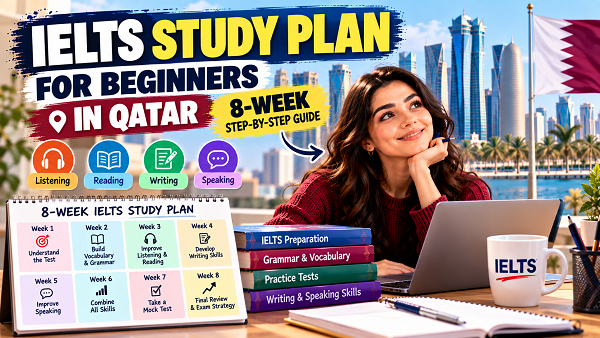
IELTS Study Plan for Beginners in Qatar
Why Do Beginners Need an IELTS Study Plan?
Starting IELTS preparation without a clear plan can make the process confusing. You may know that you need a higher IELTS score, but you may not know which skills to study first, how much time to spend on each section, or when you should start taking mock tests.
A structured IELTS study plan turns a large goal into smaller, measurable steps.
For beginners in Qatar, an effective plan should combine:
- IELTS test-format knowledge
- English language development
- Listening practice
- Reading practice
- Writing practice
- Speaking practice
- Vocabulary and grammar development
- Feedback
- Timed practice
- Mock tests
- Progress tracking
IELTS assesses four skills: Listening, Reading, Writing and Speaking. Listening and Speaking are the same in Academic and General Training, while the Reading and Writing components are different.
That means your study plan should be based not only on improving your English, but also on learning how to perform effectively in the specific IELTS test you need.
The goal of an IELTS study plan is not simply to study more. It is to study the right skills in the right order.
How Long Should a Beginner Study for IELTS?
There is no single preparation period that is suitable for every IELTS candidate.
The amount of time you need depends on:
- Your current English level
- Your target band score
- Whether you are taking Academic or General Training
- Your previous English experience
- Your strengths and weaknesses
- Your exam date
- How many hours you can study each week
- Whether you are studying independently or with an IELTS course
For many beginners, an 8-week IELTS study plan provides a useful framework because it allows enough time to understand the exam, build core skills, practise specific question types, receive feedback and complete realistic mock tests.
However, eight weeks should be treated as a planning framework rather than a guarantee.
A candidate starting with a lower English level may need several additional weeks or months of preparation.
How to Estimate Your IELTS Preparation Time
Start by comparing your current performance with your required score.
For example:
| Skill | Current Level | Target | Gap |
|---|---|---|---|
| Listening | 6.0 | 7.0 | 1.0 |
| Reading | 6.5 | 7.0 | 0.5 |
| Writing | 5.5 | 7.0 | 1.5 |
| Speaking | 6.0 | 7.0 | 1.0 |
This candidate has the largest gap in Writing.
Therefore, the study plan should allocate more targeted preparation to Writing instead of simply dividing study time equally between all four skills.
Why Your Target Score Matters
Your target should come from the actual requirement of your university, employer, professional organisation or immigration authority.
For example, a candidate who needs:
Overall 6.5 with no skill below 6.0
has a different preparation objective from someone who needs:
Overall 7.0 with no skill below 7.0.
Always identify the exact score requirement before building your final study schedule.
What Should Beginners Learn Before Starting IELTS Practice?
Before completing large numbers of practice questions, beginners should understand how IELTS works.
The current IELTS Academic test contains four sections:
- Listening
- Reading
- Writing
- Speaking
The published IELTS Academic timings are approximately 30 minutes for Listening, 60 minutes for Reading, 60 minutes for Writing and 11–14 minutes for Speaking.
Your first stage should therefore focus on understanding the exam and establishing a baseline.
Learn the IELTS Test Format
Understand:
- The number of sections
- The timing of each section
- The types of questions
- How each section is assessed
- Which test type you need
- What score you need
This prevents you from spending weeks practising tasks that are not relevant to your test.
Identify Your Current IELTS Level
Take a diagnostic assessment before creating your detailed study schedule.
Your diagnostic should give you a general picture of your current performance in:
- Listening
- Reading
- Writing
- Speaking
You do not need to treat the first result as an official prediction.
Instead, use it as your starting point.
Build a Personal Error Log
Create one document or notebook where you record recurring problems.
For example:
| Skill | Problem | Example | Correction |
|---|---|---|---|
| Listening | Missed numbers | 15 instead of 50 | Practise numbers |
| Reading | Not Given errors | Confused False/Not Given | Review question strategy |
| Writing | Weak development | Ideas not explained | Use explanation + example |
| Speaking | Long pauses | Frequent hesitation | Timed speaking practice |
Your error log should become one of the most important parts of your IELTS preparation.
Which IELTS Test Should You Prepare For?
Before following an IELTS study plan, make sure you know whether you need IELTS Academic or IELTS General Training.
IELTS Academic is commonly used for undergraduate or postgraduate study and some professional registration purposes. General Training is designed for different purposes, including certain work, training and migration contexts. The exact requirement should always be confirmed with the organisation requesting your English test.
IELTS Academic Preparation
Academic candidates need to prepare for:
- Academic Reading
- Academic Writing Task 1
- Academic Writing Task 2
- Listening
- Speaking
Academic Writing contains two tasks and lasts 60 minutes. Task 1 requires at least 150 words, while Task 2 requires at least 250 words. Task 2 contributes twice as much as Task 1 to the Writing score.
IELTS General Training Preparation
General Training candidates prepare for:
- General Training Reading
- General Training Writing Task 1
- General Training Writing Task 2
- Listening
- Speaking
General Training Writing also lasts 60 minutes. Task 1 requires a letter of at least 150 words, while Task 2 requires an essay of at least 250 words. Task 2 contributes twice as much as Task 1.
Why Your IELTS Test Type Changes Your Study Plan
Listening and Speaking preparation can be shared between the two main IELTS test types, but Reading and Writing require test-specific practice.
For example, an Academic candidate should spend substantial preparation time on:
- Graphs
- Charts
- Tables
- Diagrams
- Academic Reading passages
A General Training candidate should also practise:
- Letter writing
- Everyday texts
- Workplace-related texts
- General Training Reading question types
Choosing the correct test before starting intensive preparation prevents wasted study time.
8 Week IELTS Study Plan for Beginners in Qatar
The following 8-week IELTS study plan is designed for beginners who want a structured path from understanding the exam to completing realistic mock tests.
You can increase or decrease the daily workload depending on your current English level, target score and available time.
Week 1: Understand IELTS and Establish Your Baseline
The first week is about understanding the exam rather than trying to complete hundreds of questions.
Week 1 Goals
By the end of Week 1, you should:
- Understand the IELTS format
- Know whether you need Academic or General Training
- Identify your target score
- Complete a diagnostic assessment
- Identify your strongest and weakest skills
- Start an IELTS vocabulary notebook
- Identify your most common grammar problems
Week 1 Listening Practice
Focus on:
- Understanding the main idea
- Identifying specific information
- Names and places
- Numbers and dates
- Spelling
- Following changes in information
IELTS Listening contains four parts and 40 questions, and the recording is played once.
Do not focus only on the number of correct answers.
After every practice session, analyse your mistakes.
Week 1 Reading Practice
Start learning:
- Skimming
- Scanning
- Finding keywords
- Identifying the main idea
- Understanding paragraph purpose
Do not translate every sentence.
The goal is to understand how to locate and interpret information efficiently.
Week 1 Writing Practice
Learn the basic structure of IELTS Writing.
For Task 2, practise:
- Understanding the question
- Identifying the question type
- Writing a clear introduction
- Developing body paragraphs
- Writing a conclusion
Do not worry about producing a perfect Band 7 essay during your first week.
Week 1 Speaking Practice
Practise speaking about familiar subjects:
- Your hometown
- Your studies
- Your work
- Your family
- Your hobbies
- Your daily routine
- Your future plans
Focus on speaking clearly and naturally.
Week 1 Target
Understand the test, identify your starting level and create a realistic preparation routine.
Week 2: Build IELTS Grammar and Vocabulary
The second week focuses on the language foundation you will use throughout your preparation.
Week 2 Vocabulary Practice
Organise vocabulary into common IELTS topics such as:
- Education
- Technology
- Environment
- Health
- Work
- Transport
- Society
- Government
- Travel
Avoid memorising long lists of isolated words.
Instead, learn:
Word → Meaning → Collocation → Example
For example:
reduce
reduce carbon emissions
Governments should introduce policies to reduce carbon emissions.
This makes vocabulary easier to transfer into Writing and Speaking.
Week 2 Grammar Practice
Focus on grammar that directly affects IELTS performance:
- Verb tenses
- Subject-verb agreement
- Articles
- Prepositions
- Countable and uncountable nouns
- Sentence structure
- Relative clauses
- Conditionals
- Comparatives
- Complex sentences
Do not attempt to memorise every grammar rule in English.
Prioritise the mistakes you actually make.
Week 2 Speaking Routine
Spend approximately 10–15 minutes speaking English aloud each day.
Record yourself when possible.
After listening to your recording, identify:
- Repeated words
- Long pauses
- Grammar errors
- Pronunciation problems
- Incomplete answers
Week 2 Target
Build the vocabulary and grammar foundation needed for IELTS-specific practice.
Week 3: Improve IELTS Listening and Reading
By Week 3, begin more focused exam practice.
Week 3 Listening Strategy
After completing a Listening practice test, classify your mistakes.
Ask:
- Did I fail to hear the answer?
- Did I misunderstand the speaker?
- Did I lose concentration?
- Did I miss a correction?
- Did I make a spelling error?
- Did I misunderstand the question?
- Did I choose an answer because of a distractor?
This analysis is more valuable than simply checking the answer key.
Week 3 Reading Strategy
Start practising common Reading question types, including:
- Multiple choice
- Matching headings
- True/False/Not Given
- Yes/No/Not Given
- Sentence completion
- Summary completion
- Matching information
IELTS Academic Reading contains three sections and 40 questions within 60 minutes.
Week 3 Timing Practice
Start introducing realistic time limits.
Your objective is to improve both:
Accuracy + Speed
If you understand the passage but consistently fail to finish on time, time management needs to become part of your study plan.
Week 3 Target
Improve accuracy while gradually developing IELTS exam speed.
Week 4: Develop IELTS Writing Skills
Writing deserves structured preparation because it combines language ability with task-specific skills.
Week 4 Writing Task 2 Practice
Learn how to:
- Analyse the question
- Identify the exact task
- Decide your position
- Generate relevant ideas
- Develop explanations
- Give appropriate examples
- Organise paragraphs
- Write an effective conclusion
Practise common Task 2 question types such as:
- Opinion essays
- Discussion essays
- Advantages and disadvantages
- Causes and solutions
- Two-part questions
Week 4 Writing Task 1 Practice
If you are taking IELTS Academic, practise:
- Graphs
- Charts
- Tables
- Diagrams
- Processes
If you are taking General Training, practise:
- Formal letters
- Semi-formal letters
- Informal letters
Week 4 Writing Feedback
Get your Writing reviewed if possible.
Ask for feedback on:
- Task Achievement or Task Response
- Coherence and Cohesion
- Lexical Resource
- Grammatical Range and Accuracy
These are the four assessment criteria used for IELTS Writing.
Week 4 Target
Learn how to answer IELTS Writing tasks correctly and identify your recurring Writing weaknesses.
Week 5: Improve IELTS Speaking Performance
By Week 5, your Speaking practice should become more structured.
IELTS Speaking takes approximately 11–14 minutes and consists of three parts.
Week 5 Speaking Part 1
Practise answering questions about familiar topics.
Focus on:
- Answering directly
- Adding a short explanation
- Giving a relevant example when useful
- Using natural vocabulary
- Avoiding memorised responses
Week 5 Speaking Part 2
Practise cue cards using this routine:
- Read the task card.
- Use the one-minute preparation period.
- Make short notes.
- Speak for up to two minutes.
- Record your answer.
- Review your performance.
IELTS Speaking Part 2 gives candidates one minute to prepare and asks them to speak for approximately two minutes.
Week 5 Speaking Part 3
Practise broader and more abstract discussion questions.
Use a simple development pattern:
Answer → Explain → Example → Result
For example:
I believe governments should invest more in public transport because reliable transport can make cities more accessible. For example, efficient bus and rail networks can help people travel to work without depending entirely on private cars. As a result, better public transport can benefit both individuals and the wider community.
Week 5 Speaking Feedback
Speaking is assessed using:
- Fluency and Coherence
- Lexical Resource
- Grammatical Range and Accuracy
- Pronunciation
Use these criteria when reviewing your Speaking practice.
Week 5 Target
Speak more naturally, develop your answers and reduce unnecessary hesitation.
Week 6: Combine All Four IELTS Skills
Week 6 is when your preparation should become more integrated.
Week 6 Daily Study Routine
A possible two-hour schedule could be:
| Activity | Time |
|---|---|
| Vocabulary and Grammar | 20 minutes |
| Listening or Reading | 30 minutes |
| Writing | 40 minutes |
| Speaking | 20 minutes |
| Error Review | 10 minutes |
You can adjust this schedule depending on your weaknesses.
Week 6 Timed Practice
Complete:
- One timed Listening practice
- One timed Reading practice
- One Writing Task 1
- One Writing Task 2
- Several Speaking sessions
The goal is to transition from individual skill exercises to more realistic IELTS performance.
Week 6 Error Analysis
Review your error log.
Identify:
- The most frequent grammar mistake
- The most difficult Reading question type
- Your biggest Listening problem
- Your biggest Writing weakness
- Your biggest Speaking weakness
Week 6 Target
Combine language development, IELTS strategies and realistic timed practice.
Week 7: Take an IELTS Mock Test and Analyse Your Results
Week 7 is the point where your preparation should become much more exam-focused.
Week 7 Full Mock Test
Complete a realistic mock test under exam-style conditions.
Record your performance in:
- Listening
- Reading
- Writing
- Speaking
The purpose is not simply to obtain a score.
The purpose is to identify what still needs improvement.
Week 7 Score Analysis
Create a table like this:
| Skill | Result | Target | Gap | Main Problem | Next Action |
|---|---|---|---|---|---|
| Listening | 6.5 | 7.0 | 0.5 | Distractors | Targeted Listening practice |
| Reading | 7.0 | 7.0 | 0 | Timing | Maintain |
| Writing | 6.0 | 7.0 | 1.0 | Idea development | Writing feedback |
| Speaking | 6.0 | 7.0 | 1.0 | Fluency | Speaking practice |
This converts your mock-test result into a practical study plan.
Week 7 Mock Test Review
Ask:
- Which skill is furthest from my target?
- Which question types cause the most mistakes?
- Am I losing marks because of knowledge or strategy?
- Am I running out of time?
- Are my Writing problems related to Task Response, vocabulary or grammar?
- Are my Speaking problems related to fluency, vocabulary, grammar or pronunciation?
Week 7 Target
Use your mock-test results to create a targeted final-week preparation plan.
Week 8: Consolidate Your IELTS Preparation
The final week should focus on consolidation rather than trying to learn everything again.
Week 8 Weakness Review
Prioritise your biggest remaining weaknesses.
For example:
Writing weakness: Spend more time developing ideas and reviewing grammar.
Reading weakness: Focus on the question types where you lose the most marks.
Listening weakness: Practise the sections and question types causing repeated mistakes.
Speaking weakness: Increase timed speaking and feedback sessions.
Week 8 Final Mock Test
Complete another realistic mock test if your preparation schedule allows it.
Compare it with your earlier result.
Look for changes in:
- Accuracy
- Timing
- Writing performance
- Speaking fluency
- Question-type performance
- Confidence under test conditions
Do not assume that one mock score guarantees your official IELTS result.
Use the result as evidence about your current preparation level.
Week 8 Final Review
Review:
- Your vocabulary notebook
- Your grammar error log
- Your Writing feedback
- Your Speaking feedback
- Your Reading strategies
- Your Listening mistakes
- Your mock-test results
Week 8 Target
Enter the IELTS exam with a clear strategy and a realistic understanding of your current performance.
How Many Hours a Day Should Beginners Study IELTS?
There is no official number of hours that every IELTS candidate must study each day.
The appropriate schedule depends on your current level, target score and exam date.
One-Hour IELTS Study Schedule
A beginner with a longer preparation period could use:
- 15 minutes vocabulary
- 15 minutes Listening
- 15 minutes Reading
- 15 minutes Speaking or Writing
Two-Hour IELTS Study Schedule
A more intensive daily routine could include:
- 20 minutes vocabulary and grammar
- 30 minutes Listening or Reading
- 40 minutes Writing
- 20 minutes Speaking
- 10 minutes error review
Three-Hour IELTS Study Schedule
Candidates with more available time could use:
- 30 minutes vocabulary and grammar
- 40 minutes Listening
- 40 minutes Reading
- 50 minutes Writing
- 20 minutes Speaking
The important principle is consistency rather than simply increasing study hours.
A focused two-hour session can be more useful than several hours of unfocused practice.
How Should Students and Professionals in Qatar Follow an IELTS Study Plan?
Your IELTS schedule should fit your actual lifestyle.
A plan that looks impressive on paper but cannot be followed consistently will not help.
IELTS Study Plan for University Students
Students can often use:
- Short weekday sessions
- Longer weekend sessions
- University breaks
- Morning or evening practice
For example:
| Day | Main Activity |
|---|---|
| Monday | Listening + Vocabulary |
| Tuesday | Reading + Grammar |
| Wednesday | Writing |
| Thursday | Speaking |
| Friday | Listening + Reading |
| Saturday | Writing + Speaking |
| Sunday | Mock Test + Review |
IELTS Study Plan for Working Professionals in Doha
If you work full-time, shorter and more consistent sessions may be more realistic.
For example:
Morning: 15 minutes Listening
Lunch break: 15 minutes Vocabulary
Evening: 30–45 minutes Writing or Reading
Weekend: Longer Speaking and mock-test sessions
The key is to create a schedule that you can follow every week.
IELTS Study Plan for Busy Beginners
If you have very limited time, use smaller study blocks.
For example:
- 15 minutes Listening
- 15 minutes vocabulary
- 30 minutes Reading or Writing
- 10 minutes Speaking
These short sessions can gradually build consistency.
How Should You Build an IELTS Band 7 Study Plan?
If Band 7 is your target, your preparation should increasingly focus on accuracy, flexibility and effective exam performance.
Listening Preparation for Band 7
Focus on:
- Question prediction
- Distractors
- Spelling
- Numbers
- Concentration
- Understanding different accents
Reading Preparation for Band 7
Focus on:
- Skimming
- Scanning
- Locating information
- Question analysis
- Timing
- Difficult question types
Writing Preparation for Band 7
Focus on:
- Task Response or Task Achievement
- Coherence and Cohesion
- Lexical Resource
- Grammatical Range and Accuracy
- Idea development
- Paragraph structure
- Sentence variety
IELTS Writing is assessed using these four criteria, with Task 2 contributing twice as much as Task 1 to the Writing score.
Speaking Preparation for Band 7
Focus on:
- Fluency and Coherence
- Lexical Resource
- Grammatical Range and Accuracy
- Pronunciation
The objective is not to memorise complicated language.
It is to communicate ideas clearly and flexibly with appropriate vocabulary and grammar.
How Often Should You Take an IELTS Mock Test?
Mock tests should be used strategically.
Taking a full test every day is not necessarily the most effective way to prepare.
Baseline Mock Test
Take an initial mock test near the beginning of your preparation.
Its purpose is to:
- Establish your starting point
- Identify weaknesses
- Understand your current performance
Mid-Preparation Mock Test
Take another mock test after several weeks of targeted preparation.
Its purpose is to:
- Measure progress
- Identify remaining gaps
- Check whether your preparation strategy is working
Final Mock Test
Take a final realistic simulation before the official exam if appropriate.
Its purpose is to:
- Check timing
- Test your strategies
- Identify remaining weaknesses
- Practise exam conditions
The most important part is what happens after the mock test.
Analyse the result and change your preparation accordingly.
How Can You Track Progress During IELTS Preparation?
Do not measure your preparation only by the number of hours studied.
Track actual performance.
Weekly IELTS Progress Tracker
| Week | Listening | Reading | Writing | Speaking | Main Improvement |
|---|---|---|---|---|---|
| 1 | 5.5 | 6.0 | 5.0 | 5.5 | Baseline |
| 3 | 6.0 | 6.5 | 5.5 | 5.5 | Reading |
| 5 | 6.5 | 6.5 | 6.0 | 6.0 | Writing |
| 7 | 7.0 | 7.0 | 6.5 | 6.5 | All skills |
These numbers are only an example of how to track progress. Actual improvement varies significantly between candidates.
Track Mistakes as Well as Scores
Your tracker should also record:
- Grammar mistakes
- Vocabulary problems
- Reading question types
- Listening errors
- Writing weaknesses
- Speaking problems
- Timing issues
A candidate who knows why they are losing marks can create a much more effective study plan.
What Are the Most Common IELTS Study Plan Mistakes?
Studying Without a Target Score
“I want a higher IELTS score” is too vague.
Instead, identify the exact score you need.
Studying Only Vocabulary
Vocabulary is important, but IELTS requires four skills.
You also need to practise:
- Listening
- Reading
- Writing
- Speaking
Taking Too Many Mock Tests
Mock tests are useful, but repeatedly taking tests without reviewing mistakes limits their value.
Ignoring Speaking Practice
Speaking requires active practice.
Reading vocabulary lists does not automatically improve your ability to speak fluently.
Avoiding Writing Feedback
It can be difficult to identify your own Writing weaknesses.
Feedback can reveal problems with:
- Task response
- Organisation
- Vocabulary
- Grammar
- Idea development
Using the Same Routine Every Day
A strong study plan should contain different activities:
- Learning
- Practice
- Review
- Feedback
- Timed work
- Mock testing
Trying to Improve Everything at Once
Prioritise your largest weaknesses.
If your Reading score is already at your target but your Writing score is significantly lower, your study plan should reflect that difference.
Should Beginners Self-Study or Join an IELTS Course in Qatar?
Both approaches can work, depending on the candidate.
Self-study may suit learners who:
- Are disciplined
- Have a clear study schedule
- Understand the IELTS format
- Can evaluate their own progress
- Have access to reliable preparation materials
A structured IELTS course can be useful for candidates who:
- Are beginners
- Have a specific target score
- Have a fixed exam date
- Need Writing feedback
- Need Speaking practice
- Want structured lessons
- Need accountability
- Are unsure which resources to use
IFI Qatar currently offers comprehensive IELTS preparation in both online and face-to-face formats. Its current Comprehensive Program provides 24 sessions of 60 minutes and covers the four IELTS components, with live lessons, practice materials, feedback and assessments.
What to Look for in an IELTS Course in Qatar
Before registering, check whether the course includes:
- All four IELTS skills
- A structured curriculum
- Writing feedback
- Speaking practice
- Mock tests
- Progress assessments
- Experienced instructors
- A schedule that fits your routine
- Preparation aligned with your target score
The right course should complement your study plan rather than simply provide more classroom hours.
Online vs Face-to-Face IELTS Preparation in Qatar
Both formats can be suitable depending on your schedule and learning preferences.
| Factor | Online IELTS Course | Face-to-Face IELTS Course |
|---|---|---|
| Flexibility | High | Moderate |
| Location | Study remotely | Attend the centre |
| Teacher interaction | Live online | In person |
| Commute | None | Required |
| Speaking practice | Live online | Face-to-face |
| Classroom environment | Virtual | Physical |
| Suitable for | Busy learners | Learners who prefer classroom study |
IFI Qatar currently provides both online and face-to-face comprehensive IELTS preparation options.
Choose the format that you can attend consistently and that gives you enough opportunity to practise the skills you need to improve.
What Should IELTS Beginners in Qatar Know About the Current Test Format?
IELTS test delivery has changed in 2026.
IELTS announced that from mid-2026, paper-based IELTS would be phased out globally, with exact timelines varying by market. In selected markets, candidates can choose a Writing on Paper option while the overall test remains computer-delivered.
This makes it important to check the current format of your specific test session when booking.
Your preparation should reflect the format you expect to encounter on test day.
How to Prepare for IELTS on Computer
If your test is computer-delivered, practise:
- Reading on screen
- Typing Writing responses
- Using the keyboard efficiently
- Managing time digitally
- Reading long passages on screen
- Navigating between questions
What If Writing on Paper Is Available?
IELTS Writing on Paper allows candidates to complete the Writing component by hand while the questions remain on screen. The Writing tasks, scoring and time allocation are the same as standard IELTS on computer; only the response method differs. Availability depends on the market and test session.
If this option is relevant to you, verify availability when selecting your test.
IELTS Study Plan Checklist for Beginners
Before your exam, make sure you can answer “yes” to these questions:
- I know which IELTS test I need.
- I know my required target score.
- I have completed a diagnostic assessment.
- I understand the IELTS test format.
- I have a weekly study schedule.
- I practise Listening regularly.
- I practise Reading under time limits.
- I practise Writing regularly.
- I receive Writing feedback.
- I practise Speaking regularly.
- I review my grammar mistakes.
- I learn vocabulary by topic and collocation.
- I have completed realistic mock tests.
- I analyse my mock-test results.
- I know my weakest skill.
- I have a final preparation strategy.
- I know what test format to expect.
Frequently Asked Questions About IELTS Study Plans
What is the best IELTS study plan for beginners?
A strong beginner IELTS study plan starts with a diagnostic assessment, introduces the test format, develops all four skills, adds targeted practice, includes feedback and finishes with realistic mock tests.
How many weeks should I study IELTS?
There is no universal number of weeks. Your preparation period should depend on your current English level, target score, exam date and available study time. An eight-week plan can provide a useful framework, but some candidates will need considerably more preparation.
Can I prepare for IELTS in eight weeks?
Yes, an eight-week plan can provide a structured preparation framework, particularly if you already have a reasonable English foundation. Candidates starting at a lower level may need a longer period.
How many hours should I study IELTS every day?
There is no official daily study-hour requirement. Your ideal schedule depends on your starting level, target score and exam date. Consistent, focused study is generally more useful than simply increasing the number of hours.
What should I study first for IELTS?
Start by understanding the IELTS format and completing a diagnostic assessment. Then identify your weakest areas and build your study schedule around those weaknesses.
Should beginners study grammar before IELTS?
Grammar is important, but you do not need to study general English grammar for months before starting IELTS preparation. Combine grammar development with IELTS-specific Listening, Reading, Writing and Speaking practice.
How often should I take an IELTS mock test?
Use mock tests at strategic stages of your preparation. A baseline test, a mid-preparation assessment and a final simulation can help you measure progress and identify remaining weaknesses.
Is an IELTS course better than self-study?
It depends on the learner. Self-study can work for disciplined candidates who understand the exam and can evaluate their own performance. A structured course can be particularly useful for beginners who need guidance, Writing feedback, Speaking practice and accountability.
Can I prepare for IELTS online in Qatar?
Yes. IFI Qatar currently offers an online comprehensive IELTS preparation programme as well as face-to-face preparation.
How can I improve my IELTS score faster?
Start by identifying the specific weaknesses preventing you from reaching your target. Then focus your study time on those areas, use targeted practice, get feedback where necessary and measure your progress through realistic mock tests.
When should I book my IELTS exam?
Ideally, choose your exam date after considering your current level, target score and realistic preparation time. Allow enough time for targeted practice and mock-test analysis before the official exam.
Start Your IELTS Preparation in Qatar With a Structured Study Plan
A successful IELTS preparation strategy does not need to be complicated.
The process can be summarised as:
Assess → Plan → Learn → Practise → Get Feedback → Take a Mock Test → Analyse → Improve → Repeat
For beginners in Qatar, the biggest advantage of a structured study plan is that it removes uncertainty.
Instead of randomly switching between vocabulary lists, practice tests and online videos, you know what you need to study each week and why.
IFI Qatar currently offers comprehensive IELTS preparation through both online and face-to-face programmes, with 24-session comprehensive options covering the four IELTS components.
If you want instructor guidance, structured practice and a clear preparation pathway, explore IFI Qatar’s IELTS preparation options and choose a programme that fits your target score, schedule and learning needs.
Start with the right plan, identify your weaknesses early and build your IELTS preparation around measurable progress.
Final Tips for Following an IELTS Study Plan
A good IELTS study plan should be realistic, measurable and flexible enough to respond to your progress.
Remember these principles:
Start with your current level.
Do not create a plan based only on your desired band score.
Set a specific target.
Know both your overall target and any minimum score required in individual skills.
Study all four skills.
Do not ignore Speaking or Writing simply because Listening and Reading are easier to practise independently.
Prioritise your weaknesses.
Your study time should reflect the gaps revealed by your diagnostic tests and mock tests.
Practise under realistic conditions.
Timing and exam strategy are important parts of IELTS preparation.
Analyse every important mistake.
Do not simply check the answer and move on.
Get feedback where you need it.
Writing and Speaking can particularly benefit from structured assessment and feedback.
Use mock tests strategically.
A mock test should tell you what to improve next.
Keep your final week focused.
Review and consolidate instead of trying to learn everything from the beginning.
Choose support that fits your situation.
If you need structure, feedback and accountability, an IELTS preparation course can make your preparation more organised.
The objective is not simply to spend more hours studying English.
The objective is to follow a focused IELTS study plan that moves you from your current level toward the score you actually need.