

Currently Empty: ر.ق 0,00


IELTS
How to Choose an IELTS Mock Test That Matches Your Target Band
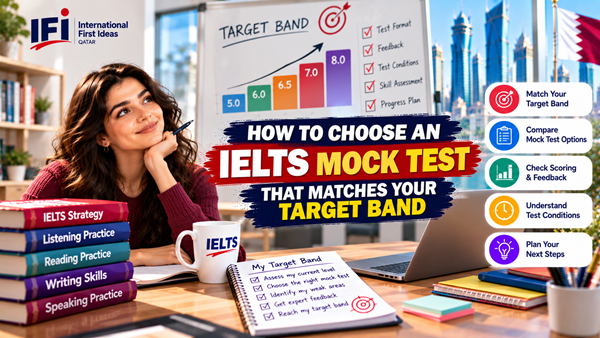
Choosing the right IELTS mock test can make your preparation more focused and your next steps easier to plan. If you are aiming for IELTS Band 6.0, 6.5, 7.0 or higher, you need more than a set of practice questions. You need an assessment that reflects your intended IELTS test format, helps you understand your current performance and shows you which skills require further work.
The best IELTS mock test for your target band is one that helps you measure your readiness against a clear goal. It should offer realistic exam conditions, appropriate assessment methods and useful feedback that you can turn into an effective study plan.
For candidates preparing for IELTS in Qatar, choosing the right mock test before booking the official exam can help make preparation more purposeful. Here is how to compare your options and select an assessment that fits your needs.
Why Your Target IELTS Band Should Influence Your Mock Test Choice
Your target band score determines what you need to assess, how you should interpret your results and where to focus your preparation.
For example, a candidate aiming for Band 6.0 may need to improve consistency and reduce frequent errors. Someone targeting Band 7.0 may need to demonstrate stronger control of complex language, more precise vocabulary and better-developed responses, depending on their current performance and the skills being assessed.
A suitable mock test should help you understand the gap between your current level and your goal.
Identify Your Required IELTS Band Score
Start by confirming the score you actually need. Universities, employers, immigration authorities and professional registration bodies may have different IELTS requirements.
Check three things before choosing a mock test:
- Your overall band requirement: The minimum overall score you must achieve.
- Your individual skill requirements: Whether you need a minimum score in Listening, Reading, Writing or Speaking.
- Your IELTS test type: Whether you need Academic or General Training.
For example, a university may require an overall Band 7.0 with no individual skill below 6.5. A candidate with an overall practice score of 7.0 but a Writing score of 6.0 would still need to address that weakness.
Always confirm the exact requirements with the organisation receiving your IELTS results.
Understand Your Current Level Before Booking
Your target score is only one part of the decision. You also need a realistic estimate of your current performance.
If you have already completed a full practice test, review your scores and identify your weakest skills. If you have only practised individual questions, a full mock test may be a better starting point because it reveals how you perform across the complete exam under time pressure.
A mock test is an assessment of your current performance, not a guarantee of your eventual official IELTS score.
What Makes a Good IELTS Mock Test for Your Target Band?
Not all IELTS practice tests provide the same value. A short online quiz may help you practise vocabulary or question types, but it does not necessarily show how you would perform in a complete IELTS examination.
Before booking, compare the following features.
1. Accurate IELTS Test Format
Your mock test should match the IELTS test you intend to take.
Listening and Speaking are common to IELTS Academic and General Training, but the Reading and Writing components differ. Academic Writing Task 1 involves describing visual information, whereas General Training Writing Task 1 requires a letter.
A mock test using the wrong format may give you practice, but it will not fully prepare you for the tasks you will face on test day.
2. Realistic Timing and Exam Conditions
A useful IELTS mock test should help you practise managing time, maintaining concentration and completing tasks within the expected limits.
Look for an assessment that reflects the timing and structure of the relevant test. Practising without time limits can be valuable during the learning stage, but timed practice is important when evaluating exam readiness.
3. Reliable Assessment of Your Performance
Listening and Reading answers can often be checked against an answer key, allowing you to calculate an approximate raw score. However, Writing and Speaking require more detailed evaluation.
A strong mock-test option should make clear how each skill is assessed and what kind of result you will receive.
4. Actionable Feedback
A score tells you where you performed. Feedback helps explain what to improve.
For Writing, useful feedback may identify problems with task response, organisation, vocabulary or grammatical accuracy. For Speaking, it may highlight fluency, coherence, pronunciation and language control.
Before paying for a mock test, check whether detailed feedback is included, whether you receive only a score or also improvement recommendations, and whether the assessment covers all four skills.
5. A Clear Next Step After the Test
Your mock-test result should help you decide what to do next.
You may need to focus on one weak skill, improve time management, practise a particular question type or take another full mock test after targeted preparation.
Repeatedly taking tests without reviewing mistakes is unlikely to be the most efficient use of your study time.
How to Choose an IELTS Mock Test Based on Your Target Band
Your target score can help you decide what to prioritise when comparing mock-test options. The examples below are general preparation guidance, not official score predictions or fixed rules for every candidate.
If Your Target Is IELTS Band 5.0–5.5
At this stage, you may benefit from understanding the test format, improving accuracy and identifying recurring language difficulties.
Choose a mock test that helps you:
- Understand the structure of all four IELTS skills.
- Identify common question types that cause difficulty.
- Practise completing tasks within the time limits.
- Recognise frequent vocabulary and grammar errors.
- Establish a starting point for your study plan.
If your results are inconsistent, focus on building the skills needed for your target before relying on repeated full-length tests.
If Your Target Is IELTS Band 6.0–6.5
Candidates aiming for Band 6.0–6.5 often benefit from a combination of timed practice and detailed review.
When choosing your mock test, prioritise:
- A realistic assessment of your current band level.
- Identification of recurring mistakes across the four skills.
- Feedback on Writing and Speaking, where available.
- Practice with unfamiliar questions rather than memorised answers.
- A clear way to track progress after additional preparation.
If you consistently score well in Listening and Reading but struggle with Writing, an assessment that includes meaningful Writing feedback may offer more value than a test that provides only an overall estimate.
If Your Target Is IELTS Band 7.0 or Higher
A higher target requires you to examine the quality and consistency of your performance, not just the number of questions you answer correctly.
Consider a mock test that helps you evaluate:
- Whether your performance remains consistent under time pressure.
- How effectively you develop and organise Writing responses.
- Whether your vocabulary and grammar support clear, precise communication.
- How fluently and coherently you respond during Speaking.
- Whether any individual skill falls below your required minimum.
For candidates aiming for Band 7.0 or above, feedback on productive skills can be especially useful because an answer that communicates the main idea may still have weaknesses in organisation, language accuracy or development.
Remember that your required band score should guide your preparation, but your assessment should reflect the official IELTS scoring criteria rather than a provider’s marketing claims.
Should You Choose an IELTS Mock Test With Feedback?
For many candidates, feedback is one of the most valuable features to consider when selecting a mock test.
A test-only option may be sufficient if you primarily want to experience the format, practise timing or check your performance in objectively marked sections. An assessment with feedback may be more useful if you need to understand why you are not reaching your target band.
When a Test-Only Option May Be Enough
A test-only mock can be appropriate when:
- You are already familiar with IELTS question types.
- You can independently review your Listening and Reading mistakes.
- You mainly want to practise under timed conditions.
- You have already received detailed feedback on Writing and Speaking elsewhere.
You should still review your answers carefully rather than treating the final score as the only useful outcome.
When a Mock Test With Feedback Is Worth Considering
Feedback may be a better investment when:
- You do not know why your Writing score is below your target.
- You find it difficult to evaluate your own Speaking performance.
- You repeatedly make similar mistakes despite practising.
- You need help deciding which skills to prioritise.
- You want a more structured preparation plan before booking your official test.
For example, if your target is Band 7.0 but your Writing performance remains below that level, identifying specific issues in task response, coherence, vocabulary or grammar can help you focus your next study sessions.
The important question is not simply whether feedback costs more. It is whether the additional assessment information will help you make better preparation decisions.
How to Evaluate Your IELTS Mock Test Results
After completing a mock test, resist the temptation to focus only on the overall score. Your skill-by-skill results often reveal more about what you need to do next.
IELTS reports an overall band score and individual scores for Listening, Reading, Writing and Speaking. The overall score is calculated from the four skill scores and rounded to the nearest half band. Official IELTS guidance also explains that Listening and Reading raw-score conversions can vary slightly between test versions. Official IELTS scoring guidance.
Review Listening and Reading Performance
For Listening and Reading, review both your approximate score and the types of questions you answered incorrectly.
Ask yourself:
- Did you lose marks because you misunderstood the passage or recording?
- Did you miss answers because you ran out of time?
- Were spelling, word limits or answer-transfer mistakes responsible?
- Are there particular question types that repeatedly cause problems?
A raw score can help estimate your performance, but it should not be treated as an exact prediction of your official band.
Review Writing and Speaking Performance
Writing and Speaking need a different approach because they are assessed using multiple criteria.
IELTS Writing assessment considers task achievement or task response, coherence and cohesion, lexical resource, and grammatical range and accuracy. Speaking is assessed using fluency and coherence, lexical resource, grammatical range and accuracy, and pronunciation. Official IELTS assessment information.
When reviewing your results, look for specific improvement areas rather than simply asking whether your answer was good or bad.
For Writing, examine how clearly you answer the question, develop your ideas, organise paragraphs and control language. For Speaking, consider whether you can extend your answers naturally, connect ideas, use vocabulary appropriately and speak clearly.
Turn Your Results Into a Preparation Plan
Use your mock-test report to decide what to do next.
| What your result shows | Recommended next step |
|---|---|
| Listening and Reading are below target | Practise weak question types and review incorrect answers |
| Writing is below your required score | Work on task response, organisation and language accuracy; seek feedback where possible |
| Speaking is below target | Practise structured responses and review fluency, coherence and pronunciation |
| Scores vary significantly between tests | Investigate timing, concentration and recurring mistakes before retesting |
| All four skills are close to target | Continue targeted practice and consider another full mock test to check consistency |
Your next action should address the weakness revealed by the assessment. Taking another test immediately without changing your preparation may simply reproduce the same result.
Online IELTS Mock Test vs In-Person IELTS Mock Test
Both online and in-person mock tests can support IELTS preparation. The right option depends on the type of assessment you need and the conditions you want to practise.
| Feature | Online mock test | In-person mock test |
|---|---|---|
| Convenience | Can be easier to schedule and access | Requires travel and an available session |
| Test environment | Depends on the platform and your surroundings | Can provide a more structured testing environment |
| Timing practice | Useful when the test is properly timed | Useful for practising under supervised conditions |
| Feedback | Depends on the provider and assessment format | Depends on the provider and service booked |
| Speaking assessment | May use recorded responses or live assessment | May offer direct interaction, depending on the service |
| Best suited for | Flexible practice and selected skill assessments | Candidates who value a structured, in-person assessment |
Neither format is automatically better for every candidate. Compare the actual test coverage, assessment quality, feedback and conditions rather than choosing solely on the basis of delivery format.
For candidates in Doha and elsewhere in Qatar, an in-person mock test may be worth considering if they prefer a dedicated testing environment before their official exam.
What to Check Before Booking an IELTS Mock Test in Qatar
If you are comparing IELTS mock-test providers in Qatar, confirm the practical details before making a payment.
Use this checklist:
- Test type: Does the mock test match your intended IELTS Academic or General Training exam?
- Skill coverage: Does it assess Listening, Reading, Writing and Speaking, or only selected sections?
- Test format: Is the assessment computer-based, paper-based or delivered through another practice format?
- Timing: Are the relevant time limits followed?
- Scoring: How are results calculated and communicated?
- Feedback: Is written or verbal feedback included, and what does it cover?
- Booking details: What dates, fees and session arrangements are available?
- Next steps: Will the result help you identify areas for further preparation?
Check the current service description and availability directly with the provider. Do not assume that every mock test includes the same assessment, feedback or facilities.
Choosing a Mock Test at IFI Qatar
IFI Qatar offers IELTS preparation and mock-test services for candidates in Doha and across Qatar. The centre’s published information describes mock-test options designed to help candidates practise the test format and evaluate their readiness before the official exam.
When considering a mock test with IFI Qatar, confirm which test type is appropriate for your goal, which skills are assessed and whether the option you select includes feedback.
If you are unsure which assessment is most suitable, explain your target band, current scores and intended test type when enquiring. This makes it easier to identify an option that aligns with your preparation needs.
How Often Should You Take an IELTS Mock Test?
There is no single ideal number of mock tests for every candidate. Your preparation time, current performance, target band and remaining weaknesses should guide your decision.
A practical approach is to use mock tests at key stages of preparation:
- Initial assessment: Establish your starting point and identify the largest gaps.
- Targeted practice: Work on the skills and question types highlighted by your results.
- Progress assessment: Take another mock test when you have completed meaningful practice.
- Readiness check: Consider a further full assessment when you need to evaluate whether your performance is consistent enough for your target.
Avoid taking full mock tests so frequently that you have no time to learn from the results. The purpose of each assessment is to inform your next step, not simply to accumulate scores.
Common Mistakes When Choosing an IELTS Mock Test
Choosing the wrong assessment can make your preparation less effective. Watch out for these common mistakes.
Choosing a Test Only Because It Is Free
Free practice materials can be useful for learning question types and checking objective answers. However, they may not provide a complete assessment of all four skills or detailed feedback on Writing and Speaking.
Compare what is included before deciding whether a free or paid option better suits your needs.
Ignoring the Difference Between Academic and General Training
The two IELTS test types have different Reading and Writing components. Always choose a mock test that matches the exam you plan to take.
Focusing Only on the Overall Band Score
An overall score can conceal an individual skill that falls below your required minimum. Review all four skill scores before deciding whether you are ready.
Expecting a Mock Test to Guarantee Your Official Score
A mock test provides an estimate of performance under particular conditions. It cannot guarantee the score you will receive in the official exam.
Use the result as a guide to preparation, and confirm important scoring decisions through appropriate assessment and official IELTS information.
Taking Repeated Tests Without Reviewing Mistakes
If the same errors appear in every test, more testing alone may not solve the problem. Review your answers, identify patterns and adjust your preparation before attempting another assessment.
Frequently Asked Questions About IELTS Mock Tests for Target Bands
Which IELTS mock test is best for my target band?
The best IELTS mock test is one that matches your intended IELTS test type, follows realistic timing, assesses the skills you need to evaluate and provides results that help you identify your next steps. If you are struggling with Writing or Speaking, consider whether detailed feedback is available.
Can an IELTS mock test accurately predict my official band score?
A mock test can provide an estimate of your current performance, but it cannot guarantee your official score. The accuracy of the estimate depends on the test quality, assessment method, test conditions and how consistently you perform.
Should I take a full IELTS mock test or practise individual skills?
A full mock test is useful when you need an overview of your readiness across the exam. Individual skill practice is useful when you already know which area needs improvement. Many candidates benefit from combining both approaches at different stages of preparation.
Is an IELTS mock test with feedback worth the extra cost?
It can be worthwhile if the feedback helps you understand weaknesses that are difficult to assess independently, particularly in Writing and Speaking. Before booking, confirm what the feedback includes and whether it provides specific improvement recommendations.
How do I choose between an IELTS Academic and General Training mock test?
Choose the test type that matches your intended official IELTS exam. Listening and Speaking are common to both, but Reading and Writing differ. If you are unsure which test you need, first check the requirements of the university, organisation or authority requesting your result.
Should I take an IELTS mock test before booking my official exam?
A mock test can help you evaluate your current performance before committing to an exam date. It is particularly useful if you are uncertain about your weakest skills or whether your results are consistently close to your required score. However, the decision should also take account of your deadlines and the requirements of the organisation receiving your results.
Where can I take an IELTS mock test in Qatar?
IFI Qatar offers IELTS mock-test and preparation services in Doha. Contact the centre to confirm the available test types, assessment coverage, feedback options, prices and session dates before booking.
Choose the Right IELTS Mock Test and Prepare With a Clearer Goal
Your target band should guide every part of your IELTS preparation, including the mock test you choose. A suitable assessment helps you understand your current performance, identify gaps in your skills and decide what to work on before taking the official exam.
Rather than choosing a mock test based only on price or convenience, compare the test format, timing, assessment quality and feedback available. The right choice is the one that gives you useful information about your readiness and helps you prepare more effectively.
Ready to assess your IELTS performance? Contact IFI Qatar to explore the available mock-test options, confirm the assessment that matches your needs and take a more structured step towards your target band score.