

Currently Empty: ر.ق 0,00


IELTS
IELTS Band Score Calculator: How Listening and Reading Scores Are Converted
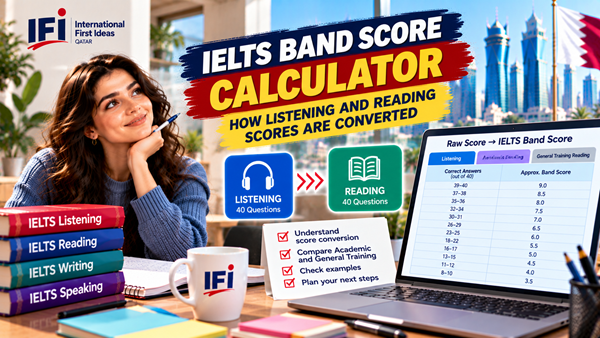
If you have completed an IELTS practice test, you probably want to know what your result means. How many correct answers do you need for Band 6.0, 7.0 or 8.0? Is getting 30 answers correct enough for Band 7? And does the conversion work differently for IELTS Academic and General Training Reading?
An IELTS band score calculator helps you estimate your Listening and Reading band scores from the number of correct answers. Both sections contain 40 questions, and each correct answer earns one mark. Your raw score is then converted to the IELTS band scale from 1 to 9.
However, Listening and Reading do not use exactly the same conversion table, and Academic Reading differs from General Training Reading. The figures in this guide are approximate benchmarks based on official IELTS scoring guidance, not guaranteed boundaries for every test version.
How Does the IELTS Band Score Calculator Work?
An IELTS band score calculator converts your raw score—the number of correct answers out of 40—into an estimated band score.
For example, if you answer 30 out of 40 Listening questions correctly, your raw score is 30/40. Official IELTS guidance identifies approximately 30 correct answers as the average benchmark for Listening Band 7.0.
The process is straightforward:
- Complete a practice test with 40 questions.
- Check your answers using the test’s answer key.
- Count your correct answers.
- Select the correct conversion guide for Listening, Academic Reading or General Training Reading.
- Use the result as an estimate of your current performance.
Important: A raw score is not the same as a band score. Getting 30 answers correct does not mean your band score is 30, and converting your raw score to a percentage does not directly produce your IELTS band.
What Is an IELTS Raw Score?
Your raw score is simply the number of questions you answer correctly.
If you answer 27 questions correctly in Listening, your raw score is 27/40. If you answer 32 correctly in Academic Reading, your raw score is 32/40.
Each correct answer earns one mark. Incorrect answers do not receive a mark, so it is important to check spelling, word limits and answer accuracy when reviewing your practice test.
What Is an IELTS Band Score?
IELTS uses a nine-band scale to report English-language proficiency. Listening, Reading, Writing and Speaking each receive an individual band score, which can be reported in whole or half bands, such as 6.0, 6.5 or 7.0.
The overall IELTS band score is calculated separately from the four individual skill scores. Your Listening or Reading raw score alone does not determine your overall result.
IELTS Listening Band Score Conversion Table
The IELTS Listening test contains 40 questions across four parts. Each correct answer earns one mark, and the raw score is converted to a band score.
The following table shows commonly used approximate benchmarks. The exact number of correct answers needed for a particular band can vary slightly between test versions.
| Correct Answers out of 40 | Approximate Listening Band |
|---|---|
| 39–40 | 9.0 |
| 37–38 | 8.5 |
| 35–36 | 8.0 |
| 32–34 | 7.5 |
| 30–31 | 7.0 |
| 26–29 | 6.5 |
| 23–25 | 6.0 |
| 18–22 | 5.5 |
| 16–17 | 5.0 |
| 13–15 | 4.5 |
| 11–12 | 4.0 |
| 8–10 | 3.5 |
These ranges are useful for preparation and self-assessment, but they should not be treated as a fixed official conversion table for every IELTS test.
How Many Correct Answers Do You Need for Listening Band 7?
As an average benchmark, around 30 correct answers out of 40 corresponds to IELTS Listening Band 7.0.
If your current result is 25/40, you should focus on identifying why you are losing marks and work towards a more consistent score. If you are already scoring around 30/40, your next goal may be to improve accuracy and aim for a higher raw score.
Use several practice tests to understand your typical performance rather than relying on one result.
How Many Correct Answers Do You Need for Listening Band 8?
Official IELTS scoring guidance gives approximately 35 correct answers out of 40 as the average benchmark for Listening Band 8.0.
This means that you generally need a high level of accuracy to reach Band 8.0. Small mistakes can matter, particularly when you are aiming for a higher score.
To improve, review your incorrect answers carefully. Common causes of lost marks include spelling mistakes, distractors, missed information, number errors and losing concentration during the recording.
IELTS Academic Reading Band Score Conversion Table
IELTS Academic Reading contains 40 questions across three sections and lasts 60 minutes. Each correct answer receives one mark before the raw score is converted to a band score.
The following table provides commonly used approximate conversion ranges for preparation.
| Correct Answers out of 40 | Approximate Academic Reading Band |
|---|---|
| 39–40 | 9.0 |
| 37–38 | 8.5 |
| 35–36 | 8.0 |
| 33–34 | 7.5 |
| 30–32 | 7.0 |
| 27–29 | 6.5 |
| 23–26 | 6.0 |
| 19–22 | 5.5 |
| 15–18 | 5.0 |
| 13–14 | 4.5 |
| 10–12 | 4.0 |
The exact conversion can vary between test versions. For example, official IELTS guidance identifies approximately 30 correct answers as the average benchmark for Academic Reading Band 7.0 and around 35 for Band 8.0.
How Many Correct Answers Do You Need for Academic Reading Band 6?
As an average benchmark, approximately 23 correct answers out of 40 corresponds to Academic Reading Band 6.0.
If you are currently scoring around 18–20 correct answers, review the question types that cause the most difficulty. You may need to improve your ability to identify paraphrases, distinguish between False and Not Given, or locate specific information quickly.
If your result is already close to 23 correct answers, focus on accuracy and time management to improve consistency.
How Many Correct Answers Do You Need for Academic Reading Band 7?
Approximately 30 correct answers out of 40 is the average benchmark for Academic Reading Band 7.0.
Reaching this level requires more than understanding the general meaning of a passage. You also need to identify relevant details, recognise paraphrased information, follow arguments and avoid mistakes in completion questions.
After each practice test, record your raw score and analyse your errors. This will help you identify whether your main challenge is comprehension, vocabulary, question interpretation or time management.
IELTS General Training Reading Band Score Conversion
General Training Reading also contains 40 questions and is scored on the same nine-band scale. However, the raw-score requirements differ from Academic Reading because the two tests contain different reading material.
General Training Reading includes everyday, workplace and general-interest texts. Although the scoring scale is the same, you generally need more correct answers in General Training Reading to reach a given band compared with Academic Reading.
The following table shows commonly used approximate benchmarks.
| Correct Answers out of 40 | Approximate General Training Reading Band |
|---|---|
| 40 | 9.0 |
| 39 | 8.5 |
| 37–38 | 8.0 |
| 36 | 7.5 |
| 34–35 | 7.0 |
| 32–33 | 6.5 |
| 30–31 | 6.0 |
| 27–29 | 5.5 |
| 23–26 | 5.0 |
| 19–22 | 4.5 |
| 15–18 | 4.0 |
These figures are approximate preparation benchmarks, not guaranteed score boundaries. Always use the appropriate conversion guidance for your practice material and remember that official IELTS conversions can vary by test version.
Why Is General Training Reading Scored Differently?
Academic and General Training Reading assess different types of reading material. Academic Reading includes texts appropriate for students entering higher education or seeking professional registration, while General Training Reading focuses more on everyday and workplace contexts.
Both tests assess reading ability, but the raw-score conversion accounts for differences between test versions.
For example, approximately 30 correct answers is the average benchmark for Academic Reading Band 7.0, while around 35 correct answers is the average benchmark for General Training Reading Band 7.0.
This is why you should never use an Academic Reading table to estimate a General Training Reading score.
IELTS Listening vs Reading: Are the Conversion Tables the Same?
No. Listening and Reading both contain 40 questions, and each correct answer earns one mark. However, the conversion from raw score to band score differs between sections.
The following comparison shows selected average benchmarks from official IELTS guidance.
| Approximate Band | Listening | Academic Reading | General Training Reading |
|---|---|---|---|
| 5.0 | 16 | 15 | 23 |
| 6.0 | 23 | 23 | 30 |
| 7.0 | 30 | 30 | 35 |
| 8.0 | 35 | 35 | 38 |
These are average benchmarks, not a universal conversion rule for every test version. The figures for General Training Reading are particularly important because using the Academic Reading conversion can lead you to overestimate your result.
Always check which section you are calculating before interpreting your raw score.
How to Calculate Your IELTS Overall Band Score
Your Listening and Reading scores are only two components of your IELTS result. The overall band score combines your individual scores for Listening, Reading, Writing and Speaking.
To estimate your overall score, add the four skill bands and divide the total by four. The result is then rounded according to IELTS rounding rules.
IELTS Overall Band Score Formula
Overall band score = (Listening + Reading + Writing + Speaking) ÷ 4
For example, suppose your estimated skill scores are:
| IELTS Skill | Estimated Band |
|---|---|
| Listening | 7.0 |
| Reading | 6.5 |
| Writing | 6.0 |
| Speaking | 6.5 |
| Average | 6.5 |
The average is 6.5, so the estimated overall band is 6.5.
If the average ends in .25, it rounds up to the next half band. If it ends in .75, it rounds up to the next whole band. Other fractional averages are rounded down to the nearest whole or half band.
Remember that the quality of your Writing and Speaking estimates matters. These sections are assessed using specific criteria, so a simple raw-score calculator cannot accurately determine those bands from the number of correct answers.
Why Your IELTS Band Score Calculator Result May Be Different From Your Official Score
An IELTS band score calculator is useful for preparation, but it cannot guarantee your official result.
There are several reasons why your estimated band may differ from the score you receive in the actual exam.
Different Test Versions Can Have Different Conversion Boundaries
IELTS explains that the exact number of marks required for a particular Listening or Reading band can vary slightly between test versions.
The tests are designed and standardised to maintain comparable levels of ability, but the raw-score boundaries are not necessarily identical for every version.
Practice Tests May Not Match Official Test Difficulty
A practice test may be easier or more difficult than the test you eventually take. Some online quizzes also contain fewer than 40 questions or use unofficial scoring systems.
For a more meaningful estimate, complete a full-length practice test that follows the appropriate format and timing.
Your Performance Can Change Under Exam Conditions
Your concentration, time management and familiarity with question types can affect your result. A score from one practice test is only a snapshot of your performance at that time.
Take several realistic practice tests and look for a consistent pattern before making decisions about your readiness.
Writing and Speaking Need Different Assessment Methods
Listening and Reading can be scored by counting correct answers. Writing and Speaking require assessment against IELTS criteria.
If you want to estimate your overall band, use credible assessments for all four skills rather than assuming your Writing and Speaking bands will match your Listening and Reading results.
How to Use Your IELTS Practice Score to Improve Your Band
Calculating your band score is only the first step. The next step is to understand what your result tells you about your preparation.
Record Your Raw Scores After Every Practice Test
Keep a simple record of your Listening and Reading results.
| Practice Test | Listening Raw Score | Estimated Listening Band | Reading Raw Score | Estimated Reading Band |
|---|---|---|---|---|
| Test 1 | 23/40 | 6.0 | 20/40 | Approx. 5.5 |
| Test 2 | 26/40 | Approx. 6.5 | 23/40 | Approx. 6.0 |
| Test 3 | 30/40 | Approx. 7.0 | 27/40 | Approx. 6.5 |
This example illustrates how you might track progress. The band estimates are illustrative and depend on the conversion table used; they are not guaranteed official results.
Identify the Question Types That Cost You Marks
After checking your answers, group your mistakes by question type.
For Listening, you might discover that you lose marks in multiple-choice questions, form completion or matching tasks. For Reading, you may struggle with matching headings, True/False/Not Given or locating specific details.
Practise your weakest question types between full tests instead of immediately taking another test without reviewing your mistakes.
Take a Full IELTS Mock Test Before Your Official Exam
A full mock test can help you practise timing, assess performance across the test and identify skills that need more work.
If you are preparing for IELTS in Qatar, consider an IELTS mock test that matches your intended test type and format. A realistic assessment can provide a clearer picture of your readiness than a short online quiz.
Want to understand your current IELTS level more clearly? Explore IELTS mock-test options with IFI Qatar to practise under test-like conditions and identify areas for improvement before your official exam.
Frequently Asked Questions About the IELTS Band Score Calculator
How do I calculate my IELTS Listening band score?
Count your correct answers out of 40 and compare your raw score with an approximate IELTS Listening conversion table. Each correct answer receives one mark. The exact conversion can vary slightly between test versions.
How many correct answers do I need for IELTS Listening Band 7?
Approximately 30 correct answers out of 40 is the average benchmark for Listening Band 7.0. Treat this as a guide rather than a guaranteed score boundary.
How many correct answers do I need for IELTS Reading Band 7?
For Academic Reading, approximately 30 correct answers is the average benchmark for Band 7.0. For General Training Reading, the corresponding average benchmark is around 35 correct answers.
Are IELTS Academic and General Training Reading scored the same way?
Both use the same nine-band scale, but their raw-score conversion requirements differ. General Training Reading generally requires more correct answers to achieve the same band because the test material differs.
Can I calculate my overall IELTS band score from Listening and Reading alone?
No. Your overall IELTS band is calculated from Listening, Reading, Writing and Speaking. You need a score estimate for all four skills to calculate your overall band.
Is an IELTS band score calculator accurate?
A calculator can provide a useful estimate if it uses an appropriate conversion guide. However, the raw-score boundaries can vary between test versions, and practice-test results do not guarantee your official IELTS score.
Does a higher raw score always mean a higher band?
Within the same section and conversion scale, a higher raw score generally corresponds to a higher band. However, you should use the correct table for your section and test type rather than comparing raw scores across different sections.
Should I take an IELTS mock test before booking the official exam?
A mock test can help you assess your current performance, practise under timed conditions and identify weaknesses. It is especially useful if you are unsure whether your Listening and Reading results are consistently close to your target band.
Take the Next Step Towards Your Target IELTS Band
Understanding the IELTS band score conversion system helps you interpret your practice results and prepare more strategically. Use the correct conversion guide for Listening, Academic Reading or General Training Reading, and remember that raw-score boundaries can vary slightly between test versions.
Most importantly, do not focus only on the final number. Review your mistakes, track your progress and use realistic practice tests to assess your readiness across the four IELTS skills.
Ready to assess your IELTS performance? Explore IELTS mock-test options with IFI Qatar and use your results to build a more focused preparation plan before your official exam.