

Currently Empty: ر.ق 0,00


IELTS
How to Simulate Real IELTS Exam Conditions at Home
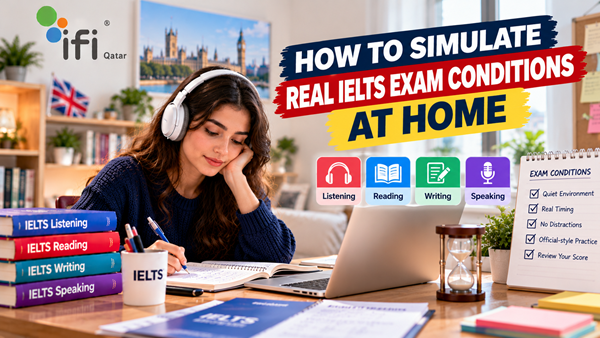
Preparing for IELTS at home can be convenient, affordable, and effective. You can practise Listening, Reading, Writing, and Speaking at your own pace, use official sample questions, and repeat difficult exercises until you understand your mistakes.
However, there is an important difference between practising IELTS questions and taking a realistic IELTS mock test at home.
When you study without time limits, pause recordings whenever you want, check answers immediately, or rewrite an essay several times, you are practising individual skills rather than simulating the actual exam experience. These activities are useful during preparation, but they may not reveal how well you can perform under test conditions.
To simulate real IELTS exam conditions at home, you need to follow the correct test format, use strict time limits, minimise distractions, complete the tasks without assistance, and evaluate your performance afterwards.
This guide explains how to set up a realistic IELTS practice test at home, simulate all four test sections, measure your progress, and recognise when a structured mock test with professional feedback could help you prepare more effectively.
Why Take an IELTS Mock Test at Home?
An IELTS mock test at home allows you to practise the exam format before booking your official test. It can help you identify weaknesses, improve time management, and become more familiar with the pressure of completing several tasks within a limited period.
However, the value of your practice depends on how closely you follow the test conditions.
Understand Your Current IELTS Level
Completing a timed practice test gives you a clearer picture of your current performance than answering isolated questions.
For example, you might achieve a high score when practising Reading without a time limit but struggle to finish all three passages in 60 minutes.
Similarly, you may write a strong essay when you have an entire afternoon to edit it but find it difficult to organise your ideas within the Writing test’s time limit.
A realistic practice test helps you identify the difference between your untimed ability and your performance under pressure.
Improve Time Management
Time management is an essential part of IELTS preparation.
During the test, you must decide how much time to spend on each question, when to move on from a difficult task, and how to review your answers without leaving other questions incomplete.
Practising with a timer helps you develop a more realistic sense of how quickly you need to work.
Become Familiar with Exam Pressure
Even candidates with strong English skills can find timed examinations challenging.
You may become distracted by the clock, lose concentration during a long Reading passage, or struggle to organise your ideas during Writing.
Simulating exam conditions helps you practise maintaining concentration and making decisions when time is limited.
Identify Areas That Need Improvement
A complete mock test can reveal weaknesses that individual exercises might not expose.
For example, you may discover that:
- Your Listening accuracy decreases when you cannot pause the recording.
- You spend too long on difficult Reading questions.
- You struggle to complete Writing Task 2 within the available time.
- Your Speaking answers become less organised when you record yourself under timed conditions.
These findings can help you plan your next stage of preparation more effectively.
What You Need to Simulate IELTS Exam Conditions at Home
Before starting your mock test, prepare your environment and materials.
The objective is to remove unnecessary interruptions and reproduce the conditions of the test format you intend to take as closely as possible.
Choose the Correct IELTS Test
First, confirm whether you are preparing for IELTS Academic or IELTS General Training.
Both tests assess Listening, Reading, Writing, and Speaking. However, their Reading and Writing sections differ.
IELTS Academic is generally intended for candidates pursuing higher education or professional registration, while IELTS General Training is commonly used for certain migration, work, and training purposes.
Your intended university, employer, immigration authority, or other receiving organisation should confirm which test you need.
Once you have selected the correct test, use practice materials designed for that version.
Prepare Your Study Space
Choose a quiet room where you can work without interruptions.
Before starting, make sure you have:
- A desk and comfortable chair.
- A computer if you are practising the computer-delivered format.
- Reliable headphones for Listening practice.
- A timer or clock.
- Appropriate writing materials if you are practising a permitted handwritten format.
- Official or reliable IELTS practice questions.
- Answer sheets or a document for recording your responses.
- Water available outside the immediate test-taking area, if you want to follow stricter test-room conditions.
Keep unrelated books, notes, dictionaries, and study materials out of reach.
You should not consult them during the test itself.
Remove Distractions
Put your mobile phone on silent and place it away from your desk. Turn off notifications on your computer and close unrelated browser tabs.
Let other people in your household know that you need uninterrupted time.
Avoid checking messages, answering calls, or taking casual breaks during the timed sections.
If you need to pause because of a genuine interruption, record what happened. However, do not count an interrupted session as a fully realistic mock test.
Use the Correct Test Format
If your official IELTS test will be computer-delivered, practise using a computer whenever possible.
Get comfortable with reading questions on a screen, entering answers, navigating between tasks, and typing your Writing responses.
If your test includes a permitted handwritten Writing option, practise that format if you intend to use it.
The closer your practice is to your intended test format, the more useful it will be for identifying practical difficulties before test day.
Understand the Real IELTS Test Timing
Before starting a full mock test, familiarise yourself with the timing of each section.
The IELTS Academic test takes approximately 2 hours and 45 minutes across four skills. The Listening, Reading, and Writing sections are normally completed in one session, while Speaking may be scheduled separately depending on the test arrangements.
| Test section | Approximate duration | Main objective |
|---|---|---|
| Listening | 30 minutes | Understand recordings and answer 40 questions |
| Reading | 60 minutes | Complete 40 questions across three sections |
| Writing | 60 minutes | Complete two writing tasks |
| Speaking | 11–14 minutes | Respond to questions and discuss topics with an examiner |
These timings describe the standard IELTS Academic format. IELTS General Training has the same Listening and Speaking timings, while its Reading and Writing content differs.
For computer-delivered Listening, follow the instructions and timing displayed in the practice interface you use. Do not assume that every practice resource reproduces the official interface or timing perfectly.
For a realistic home simulation, use the timing appropriate to your selected test and avoid giving yourself extra time.
How to Simulate the IELTS Listening Test at Home
The Listening section assesses your ability to understand spoken English in different contexts, including everyday conversations and educational discussions.
A common preparation mistake is to pause recordings, replay difficult sentences, or read the transcript before completing the questions. These activities can help you learn, but they do not accurately simulate the test.
Step 1: Use a Complete Listening Practice Test
Choose a reliable IELTS Listening practice test with audio, questions, and an answer key.
Ideally, use official IELTS sample materials or another reputable resource that follows the test format.
Make sure the practice questions are suitable for your target test.
Step 2: Read the Questions Before the Recording Starts
Use the time provided by the practice material to read the questions and understand what information you need to identify.
Pay attention to:
- Names and places.
- Dates and numbers.
- Keywords and possible paraphrases.
- Word limits in completion questions.
- Grammatical clues that indicate the type of answer required.
Do not try to predict every answer. Instead, prepare yourself to recognise relevant information when you hear it.
Step 3: Play the Audio Without Pausing
Play the recording once and complete the questions as you listen.
Do not pause, rewind, or replay difficult sections during the timed attempt.
If you miss an answer, continue listening. Spending too long thinking about a missed question can cause you to lose information from the next one.
This is particularly important in IELTS Listening because recordings are played according to the test instructions rather than at your preferred pace.
Step 4: Follow the Instructions and Timing
Complete the questions within the time allowed by your chosen test format.
If your practice resource includes a separate answer-transfer period, follow its instructions. If you are practising the computer-delivered format, use the relevant on-screen timing and answer-entry process.
Do not add extra time simply because a question was difficult.
Step 5: Check Your Answers After the Test
When the section is finished, compare your answers with the answer key.
Record:
- Your number of correct answers.
- The question types you found difficult.
- Any spelling mistakes.
- Questions you missed because you misunderstood the recording.
- Questions you missed because you were distracted or thinking about an earlier answer.
Use the official or reputable scoring guidance associated with your practice material to estimate your Listening band.
Remember that practice-test conversions are estimates. Exact raw-score boundaries can vary between test versions.
How to Simulate the IELTS Reading Test at Home
IELTS Reading tests your ability to understand written information, identify details, recognise main ideas, and interpret relationships between statements.
The main challenge is often completing the questions accurately within 60 minutes.
Step 1: Prepare Three Reading Sections
For a full IELTS Academic Reading simulation, choose a practice test with three passages and 40 questions.
If you are taking IELTS General Training, use appropriate General Training materials, which have a different Reading structure and content.
Avoid selecting individual questions from different sources if your goal is to simulate a complete test.
Step 2: Start a 60-Minute Timer
Begin the timer when you start the test.
Do not pause it to check vocabulary, search for explanations, or take an unplanned break.
You should practise managing the same overall time limit you will face during the Reading section.
Step 3: Manage Your Time Across the Passages
You can use the following as a starting point for IELTS Academic Reading:
| Passage | Suggested time |
|---|---|
| Passage 1 | 15–17 minutes |
| Passage 2 | 18–20 minutes |
| Passage 3 | 23–25 minutes |
| Total | 60 minutes |
This is a suggested practice strategy, not an official allocation. Adjust it according to your strengths and the difficulty of the passages.
The key is to avoid spending too much time on one difficult question.
If a question is taking too long, make a provisional choice if possible and move on. Return to it later if time remains.
Step 4: Do Not Use a Dictionary
During the timed attempt, do not look up unfamiliar words.
Instead, use the context of the sentence, the surrounding paragraph, and your understanding of the passage to work out the meaning.
You can look up unfamiliar vocabulary after the test as part of your review.
This separation helps you distinguish between your current reading ability and the vocabulary you still need to learn.
Step 5: Record Your Answers Within the Time Limit
Complete all answer-entry tasks according to the practice format you are using.
For computer-delivered practice, become familiar with selecting answers, entering words, and navigating the interface.
Do not rely on additional time after the timer finishes to complete questions you left unanswered.
Step 6: Review Your Mistakes
After the test, identify the questions you answered incorrectly and examine the relevant sections of the passage.
Ask yourself:
- Did I misunderstand the question?
- Did I miss a synonym or paraphrase?
- Did I confuse a specific detail with the main idea?
- Did I choose an answer based on assumptions?
- Did I run out of time?
- Did I make an avoidable spelling or word-limit error?
Classifying your mistakes will help you decide whether you need more vocabulary practice, question-type strategies, or timed Reading exercises.
How to Simulate the IELTS Writing Test at Home
The Writing section is particularly difficult to evaluate independently because grammar, vocabulary, organisation, task response, and other assessment criteria all influence performance.
You can still simulate the writing process realistically at home, but estimating your own band score requires caution.
Step 1: Practise Both Writing Tasks
For IELTS Academic, Task 1 involves describing or summarising visual information, while Task 2 requires you to write an essay in response to a point of view, argument, or problem.
For IELTS General Training, Task 1 is a letter-writing task, while Task 2 is an essay.
Use prompts designed for your test type.
Step 2: Set a 60-Minute Timer
Complete both tasks within the total time allowed.
A useful starting point is:
| Writing task | Suggested time | Minimum word count |
|---|---|---|
| Task 1 | 20 minutes | 150 words |
| Task 2 | 40 minutes | 250 words |
These are recommended time allocations rather than separate official timers.
Task 2 carries greater weight in the Writing score, so allocating more time to it is generally sensible.
Step 3: Use the Format You Will Take on Test Day
If you will take IELTS on a computer and type your answers, practise typing under timed conditions.
If you will use an available Writing on Paper option, practise writing by hand.
Pay attention to how quickly you can produce a clear response, organise paragraphs, and check your work.
For computer practice, avoid using grammar-checking software, generative AI, or other writing assistance during the timed attempt.
These tools can be useful for learning after the test, but they would make your mock result less representative of independent performance.
Step 4: Follow the Assessment Criteria
After the test, review your responses against the relevant IELTS Writing assessment criteria.
For Task 1, consider whether you:
- Addressed the task accurately.
- Included the main information or key features.
- Organised information clearly.
- Used appropriate vocabulary.
- Used a range of grammatical structures accurately.
For Task 2, consider whether you:
- Addressed all parts of the question.
- Presented a clear position where required.
- Developed your main ideas with explanations and examples.
- Organised your argument logically.
- Used appropriate vocabulary and grammar.
Meeting the minimum word count does not automatically mean that a response will achieve a particular band score.
Step 5: Get Feedback on Your Writing
Self-review can identify obvious weaknesses, but it may not reveal every problem affecting your score.
For example, you may believe that your essay answers the question fully, while an experienced assessor might identify an underdeveloped argument or a lack of clear progression.
If you repeatedly struggle to estimate your Writing band, consider obtaining feedback from a qualified IELTS teacher or an appropriate writing assessment service.
A structured assessment can help you understand what needs to change before your next mock test.
How to Simulate the IELTS Speaking Test at Home
Speaking can be difficult to practise realistically because the official test involves interaction with an examiner.
Recording yourself is a useful alternative for independent preparation, although it cannot fully reproduce a live speaking assessment.
Step 1: Follow the Three-Part Speaking Format
The IELTS Speaking test lasts approximately 11–14 minutes and has three parts:
- Part 1: Questions about familiar topics, such as your home, work, studies, or interests.
- Part 2: An individual long turn based on a task card, including preparation time.
- Part 3: A discussion that explores broader and more abstract ideas related to the Part 2 topic.
Practise using the correct structure and timing rather than answering a random list of questions without limits.
Step 2: Record Your Responses
Use your phone, computer, or another recording device to record your answers.
Once you begin, avoid stopping the recording to correct mistakes or repeat sentences.
Treat the session as if you were speaking to an examiner who cannot see your preparation notes.
Step 3: Practise Speaking Without Memorised Scripts
Avoid memorising complete answers for common IELTS Speaking topics.
Instead, practise organising your ideas quickly and expressing them naturally.
A memorised response may not answer the question directly, and it can become difficult to adapt when the examiner asks an unexpected follow-up question.
Focus on answering the question, developing your ideas, and using language you can control accurately.
Step 4: Review Your Recording
Listen to your recording after the session.
Notice whether you:
- Answered the question directly.
- Developed your answers with explanations or examples.
- Used a reasonable range of vocabulary.
- Repeated the same expressions too frequently.
- Paused excessively while searching for words.
- Used grammatical structures accurately.
- Spoke clearly and maintained a natural pace.
Do not judge your Speaking performance solely by your accent. IELTS Speaking assesses several aspects of spoken language, and having a particular accent does not automatically determine your band score.
Step 5: Practise with a Partner When Possible
If you can practise with a teacher or another speaker, ask them to conduct a mock Speaking interview.
They can ask follow-up questions and help you become more comfortable responding spontaneously.
For more reliable feedback, seek an assessment from someone familiar with IELTS Speaking criteria.
How to Create a Realistic IELTS Mock Test Schedule at Home
If you want to simulate the full IELTS test, plan the session before you begin.
The following schedule is an example for IELTS Academic. It covers the approximate duration of all four sections, but the exact order and arrangements should reflect the format of your intended test.
Before the Test: Preparation
Spend 10–15 minutes preparing your materials and workspace.
- Choose a complete practice test.
- Confirm the correct test type.
- Check your computer, headphones, and timer.
- Put away notes and unrelated materials.
- Close notifications and other applications.
- Make sure you have enough uninterrupted time.
Do not use this preparation period to study answers or review vocabulary from the test you are about to take.
During the Test: Follow the Timed Sections
Complete Listening, Reading, and Writing in one continuous practice session, with no planned breaks between them if you want to reproduce the usual test-day arrangement.
Then complete Speaking separately if necessary, using the correct timing and structure.
| Stage | Activity | Approximate duration |
|---|---|---|
| 1 | Listening | 30 minutes |
| 2 | Reading | 60 minutes |
| 3 | Writing | 60 minutes |
| 4 | Speaking | 11–14 minutes |
| Total | All four skills | Approximately 2 hours 41–44 minutes, excluding setup and any additional format-specific timing |
The total shown is the sum of the approximate section timings, not a replacement for the official overall test duration. Actual arrangements can vary by delivery format, and you should follow the instructions for the test you intend to take.
After the Test: Review Your Performance
Once all four sections are complete, take a short break before reviewing your answers.
Use the answer key for Listening and Reading, and evaluate Writing and Speaking against the appropriate criteria.
Record your results and identify the most important weaknesses to address.
Do not change your answers after the timer ends and then count the corrected answers as your mock-test score. Keep the original result separate from any later corrections so that you can measure your progress accurately.
Common Mistakes That Make Home IELTS Mock Tests Unrealistic
Even a complete practice test may provide misleading results if you do not follow consistent conditions.
Pausing the Listening Recording
Pausing the audio gives you more processing time than you would normally have during the test.
Better approach: Play the recording according to the practice instructions and review the transcript only after completing the section.
Giving Yourself Extra Time in Reading
An additional five or ten minutes can make a substantial difference to your performance.
Better approach: Stop when the time limit ends. Record unfinished questions and use them to identify time-management weaknesses.
Rewriting Essays Until They Sound Perfect
Repeated editing outside the timed session can make your writing appear stronger than it would be under exam conditions.
Better approach: Complete both tasks within 60 minutes and save your original responses before making any corrections.
Using AI to Improve Answers During the Test
Grammar tools, translation software, and AI writing assistants can correct errors or suggest better expressions while you work.
Using them during a timed mock test means you are no longer measuring your independent performance.
Better approach: Complete the test without assistance. Use tools afterwards to learn from your mistakes, not to change the original result.
Ignoring Speaking Practice
Some candidates focus almost entirely on Listening and Reading because their answers are easier to check.
However, avoiding Speaking practice can leave you unprepared for timed responses, follow-up questions, and spontaneous discussion.
Better approach: Record a complete Speaking practice session and review it regularly.
Estimating Your Own Writing and Speaking Scores Too Confidently
A candidate may understand the topic and use advanced vocabulary but still have weaknesses in organisation, task response, grammatical accuracy, or fluency.
Better approach: Treat self-assessment as an initial guide. Seek qualified feedback when you need a more dependable evaluation of your performance.
How to Calculate Your IELTS Mock Test Score
After completing your practice test, use the available answer keys and assessment guidance to evaluate your performance.
However, Listening, Reading, Writing, and Speaking require different scoring approaches.
Estimate Your Listening Band Score
Count your correct answers out of 40 and compare your raw score with a reputable IELTS conversion guide.
Remember that the exact raw-score boundaries for a band can vary by test version.
Estimate Your Reading Band Score
Calculate your correct answers out of 40.
Use the conversion guidance for the correct test type because Academic and General Training Reading have different raw-score conversion requirements.
Do not use an Academic Reading conversion chart to estimate a General Training result.
Evaluate Writing and Speaking Separately
Writing and Speaking cannot be scored reliably by counting correct answers.
They require assessment against specific criteria.
For Writing, review task achievement or task response, coherence and cohesion, lexical resource, and grammatical range and accuracy, as applicable to the task.
For Speaking, review fluency and coherence, lexical resource, grammatical range and accuracy, and pronunciation.
If you need an accurate estimate of your current band, consider a qualified assessment rather than relying entirely on your own judgement.
Record Your Results in a Progress Tracker
A simple tracker can help you compare performance across multiple practice tests.
| Practice date | Listening | Reading | Writing | Speaking | Main weakness | Next action |
|---|---|---|---|---|---|---|
| Test 1 | Record score | Record score | Record estimate | Record estimate | Identify after review | Choose one priority |
| Test 2 | Record score | Record score | Record estimate | Record estimate | Compare with Test 1 | Adjust practice |
| Test 3 | Record score | Record score | Record estimate | Record estimate | Check recurring errors | Plan next step |
Avoid treating an estimated overall band as definitive if your Writing or Speaking scores have not been assessed reliably.
The purpose of the tracker is to identify patterns and guide your preparation.
Home IELTS Mock Test vs a Structured IELTS Mock Test
Practising at home is valuable, especially when you are learning the test format or developing individual skills. However, a self-administered mock test has limitations.
The main difference is not simply where the test takes place. It is how consistently the test is administered and how accurately your performance is evaluated.
| Factor | IELTS mock test at home | Structured mock test with appropriate assessment |
|---|---|---|
| Environment | Controlled by you | Depends on the provider and test format |
| Timing | Depends on your discipline | Can provide a more structured timed session |
| Listening and Reading | Can be checked against answer keys | Can be checked and reviewed systematically |
| Writing feedback | Usually self-assessed unless external feedback is arranged | May include assessment or feedback, depending on the service |
| Speaking feedback | Often based on self-review or a practice partner | May include feedback from a suitably qualified assessor, depending on the service |
| Performance review | Depends on your own analysis | May provide a structured report or recommendations |
| Main advantage | Convenient and flexible | Can offer more objective feedback and a consistent assessment process |
A structured mock test is not automatically better in every respect. Its value depends on the quality of the materials, the relevance of the test format, the assessment process, and the feedback provided.
For candidates who have already completed several home practice tests but are unsure why their scores are not improving, external assessment can be particularly useful.
When Should You Move from Home Practice to a Structured IELTS Mock Test?
You do not need to stop practising at home to benefit from a structured mock test. The two approaches can complement each other.
However, there are several situations in which additional assessment may be worthwhile.
You Keep Getting Similar Scores
If your Listening or Reading scores remain at approximately the same level across several tests, you may need to identify recurring error patterns rather than complete more tests without analysis.
A structured review can help you determine which skills or question types deserve attention.
You Cannot Estimate Your Writing Band
If your essays seem strong but your estimated band remains uncertain, external feedback may reveal weaknesses that are difficult to recognise independently.
This can help you focus on the specific assessment criteria affecting your performance.
You Are Unsure About Your Speaking Performance
Recording yourself is useful, but it does not fully reproduce an interactive speaking assessment.
Feedback from a suitably qualified IELTS teacher or assessor can help you understand how to improve fluency, coherence, vocabulary, grammar, and pronunciation.
Your Official Test Date Is Approaching
As your test date gets closer, you need more than familiarity with individual question types.
You also need to know whether you can complete the test within the required time and whether your performance is consistent across all four skills.
A realistic mock test can help you evaluate these areas before the official exam.
How IFI Qatar Can Support Your IELTS Mock Test Preparation
Home practice is an important part of IELTS preparation, but completing a test is only one step. Understanding your results and knowing what to improve next are equally important.
At IFI Qatar, you can enquire about available IELTS mock test and preparation options to help you choose an appropriate next step based on your current needs.
Before selecting a service, consider what kind of support would be most useful:
- A timed practice test to assess your current performance.
- A review of your Listening and Reading results.
- Feedback on your Writing responses.
- Speaking practice and assessment.
- Guidance on which skills to prioritise before your official test.
The available services, assessment format, and feedback options should be confirmed directly before booking.
If you have already completed several IELTS mock tests at home, bring your practice results and a record of your recurring mistakes when seeking advice. These details can help you explain where you are struggling and what kind of support you need.
Ready to move beyond self-practice? Contact IFI Qatar to enquire about available IELTS mock test options and find out how structured practice or assessment could support your preparation.
Frequently Asked Questions About IELTS Mock Tests at Home
Can I take a full IELTS mock test at home?
Yes. You can complete a full IELTS-style mock test at home using suitable practice materials, strict timing, and a distraction-free environment. However, a self-administered mock test is not an official IELTS result and may not reproduce every aspect of the test-centre experience.
How long should an IELTS mock test at home take?
The four IELTS sections have a combined duration of approximately 2 hours and 45 minutes in the standard IELTS Academic format. For realistic practice, follow the timing and instructions for your chosen test and delivery format.
How can I simulate real IELTS exam conditions at home?
Use a complete practice test, set the correct time limits, remove distractions, avoid dictionaries and AI tools during the attempt, and complete the sections without unplanned breaks. Review your answers only after finishing the timed session.
Should I practise IELTS on a computer or on paper?
Choose the practice format that reflects the test you intend to take. IELTS delivery arrangements and available Writing options can vary by market, so confirm the format available for your booking before deciding how to practise.
Can I calculate my IELTS band score from a home mock test?
You can estimate your Listening and Reading bands using raw scores and appropriate conversion guidance. Writing and Speaking require assessment against specific criteria, so self-estimates may be less reliable.
How often should I take an IELTS mock test?
The ideal frequency depends on your current level, preparation time, and target score. Complete a diagnostic test early, use targeted practice to address weaknesses, and take further full mock tests when you have made meaningful progress or need to evaluate your readiness.
Is a free IELTS practice test enough to prepare for the exam?
Free practice tests can help you understand the test format and develop essential skills. However, completing practice questions alone may not provide enough feedback to identify weaknesses in Writing, Speaking, or time management. Combine practice with careful review and qualified feedback when needed.
Why should I book a mock test if I can practise at home?
Home practice is convenient, but independent assessment can be difficult, particularly for Writing and Speaking. A suitable structured mock test may offer more consistent timing, feedback, and a clearer understanding of what to improve next.
Do IELTS mock tests guarantee a higher band score?
No. A mock test can help you assess your performance and identify areas for improvement, but it cannot guarantee a particular official IELTS result. Progress depends on your current skills, preparation, feedback, and consistency.
Final Checklist: Are You Ready for a Realistic Home IELTS Mock Test?
Before starting your next practice test, use this checklist to confirm that you are ready.
- I have selected the correct IELTS test type.
- I am using suitable practice materials.
- I know the timing for all four sections.
- My desk is organised and free from unrelated materials.
- My phone and notifications are turned off.
- I have prepared the correct equipment for my chosen test format.
- I will not pause recordings or use extra time during the timed attempt.
- I will complete Writing without grammar-checking or AI assistance.
- I have arranged a way to practise and review Speaking.
- I will record my original scores before correcting mistakes.
- I will use the results to create a targeted improvement plan.
- I will seek additional feedback if I cannot assess my Writing or Speaking reliably.
The more consistently you follow these conditions, the more useful your home mock tests will become.
Start with a realistic practice session, review your results carefully, and use the evidence to decide what to improve next. If you need a clearer picture of your readiness, enquire about the IELTS mock test and assessment options available through IFI Qatar.