

Currently Empty: ر.ق 0,00


IELTS
Relative Clauses in English: Defining and Non-Defining Clauses Explained
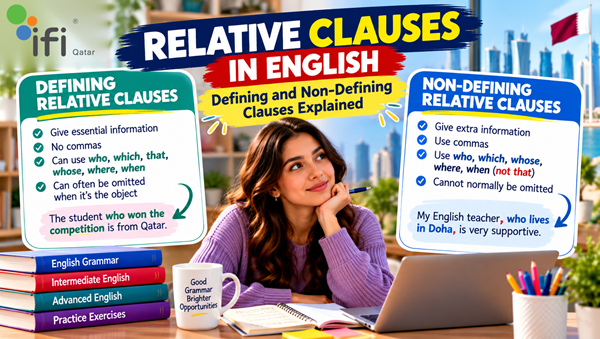
Relative clauses in English help you add information about people, places, things, and situations without creating several short, repetitive sentences. They are essential for building more detailed sentences and communicating ideas clearly in both spoken and written English.
For example, compare these sentences:
- The woman is my English teacher. She lives in Doha.
- The woman who lives in Doha is my English teacher.
The second sentence combines the two ideas using a relative clause. It sounds more natural and makes the relationship between the information clearer.
However, not all relative clauses work in the same way. Some provide information that identifies exactly who or what we are talking about, while others add extra information that can be removed without changing the main meaning of the sentence.
These are known as defining relative clauses and non-defining relative clauses.
In this guide, you will learn the difference between them, how to use relative pronouns correctly, when to use commas, and how to avoid common grammar mistakes. You will also find practical exercises to help you apply the rules in your own English.
What Are Relative Clauses in English?
A relative clause is a part of a sentence that gives information about a noun or pronoun. It usually begins with a relative pronoun, such as who, whom, whose, which, or that, or a relative adverb, such as where or when.
Consider these examples:
- The student who won the competition is from Qatar.
- I bought a laptop that has a long battery life.
- This is the restaurant where we had dinner.
- She is the teacher whose classes I enjoy.
In each example, the bold section is a relative clause. It provides additional information about a person, object, place, or other noun.
Relative clauses are useful because they allow you to combine related ideas into a single sentence.
Why Are Relative Clauses Important?
Learning relative clauses can help you:
- Build longer and more natural sentences.
- Avoid unnecessary repetition.
- Give precise descriptions of people and things.
- Improve your formal and academic writing.
- Express relationships between ideas more clearly.
- Communicate more confidently in conversations.
For example:
Without a relative clause:
“I met a student. The student speaks four languages. The student wants to study abroad.”
With a relative clause:
“I met a student who speaks four languages and wants to study abroad.”
The second version is more concise and connects the information naturally.
What Is the Difference Between Defining and Non-Defining Relative Clauses?
There are two main types of relative clauses: defining and non-defining.
The most important difference is whether the information is necessary to identify the person or thing being discussed.
What Is a Defining Relative Clause?
A defining relative clause provides essential information about a noun. Without this information, the reader or listener may not know exactly which person or thing you mean.
For example:
“The students who completed the assignment received certificates.”
The relative clause who completed the assignment identifies the students who received certificates. It suggests that not all the students necessarily received one.
Another example:
“The book that you recommended was excellent.”
The clause that you recommended identifies which book the speaker means.
Key rules for defining relative clauses:
- They provide essential identifying information.
- They do not take commas around the relative clause.
- They can begin with relative pronouns such as who, whom, whose, which, and that, depending on the context.
- The relative pronoun can sometimes be omitted when it functions as the object of the clause.
What Is a Non-Defining Relative Clause?
A non-defining relative clause adds extra information about a person or thing that is already identifiable. Removing the clause does not change the basic reference of the sentence.
For example:
“My English teacher, who lives in Doha, speaks three languages.”
The main statement is that the teacher speaks three languages. The information about living in Doha is additional.
Another example:
“Doha, which is the capital of Qatar, attracts visitors from around the world.”
The clause which is the capital of Qatar adds information about Doha.
Key rules for non-defining relative clauses:
- They provide additional rather than essential identifying information.
- They are separated from the main clause by commas.
- They can use who, whom, whose, and which, depending on the sentence.
- They do not normally use that.
- The relative pronoun cannot normally be omitted.
Defining vs Non-Defining Relative Clauses: Comparison Table
| Feature | Defining Relative Clause | Non-Defining Relative Clause |
|---|---|---|
| Purpose | Identifies which person or thing is meant | Adds extra information |
| Commas | No commas | Commas are required |
| Use of that | Possible in many defining clauses | Not normally used |
| Omission of the relative pronoun | Sometimes possible when it is the object | Not normally possible |
| Example | The car that I bought is electric. | My car, which I bought last year, is electric. |
The choice between these structures can affect the meaning of a sentence, so it is important to consider both grammar and context.
Relative Pronouns in English: Who, Whom, Whose, Which and That
Relative pronouns connect a relative clause to the noun it describes. The correct choice depends on whether you are referring to a person, a thing, or possession, as well as the grammatical role of the pronoun within the clause.
How to Use Who
Use who to refer to people when the relative pronoun functions as the subject of the relative clause.
Examples:
- The woman who works at the reception desk is very helpful.
- I know a student who speaks Arabic and English.
- The teacher who explained the lesson was patient.
- People who exercise regularly often develop healthy habits.
In each example, who performs the action or connects the subject to the information in the clause.
For example:
“The student who won the prize is my friend.”
The student won the prize, so who is the subject of the relative clause.
How to Use Whom
Use whom to refer to people when the pronoun functions as the object of a verb or preposition. It is more common in formal English than in everyday conversation, where who is frequently used instead.
Examples:
- The woman whom I met yesterday is a doctor.
- The candidate whom we interviewed was well prepared.
- The person to whom I sent the email has replied.
In the first sentence, I is the subject and whom is the object of met.
In everyday English, many speakers would say:
“The woman who I met yesterday is a doctor.”
The version with whom is more formal. In defining clauses, the object pronoun can also be omitted:
“The woman I met yesterday is a doctor.”
How to Use Whose
Use whose to show possession. It can refer to people and, in some contexts, things or organisations.
Examples:
- I know a student whose father is a doctor.
- She is the writer whose book won an award.
- We visited a company whose products are sold internationally.
- The employee whose laptop was missing reported the problem.
In these examples, whose connects a person or thing with something that belongs to or is associated with it.
Remember that whose is different from who’s.
- Whose indicates possession.
- Who’s is a contraction of who is or who has.
For example:
“Who’s coming to the meeting?”
“The student whose phone rang apologised.”
How to Use Which
Use which to refer to things and, in many cases, animals.
Examples:
- The phone which I bought yesterday is already broken.
- The course which she selected focuses on speaking skills.
- The report, which was published last month, received considerable attention.
In defining relative clauses, which can often be replaced by that when referring to things.
For example:
“The phone that I bought yesterday is already broken.”
In non-defining relative clauses, use which rather than that.
Correct: “My phone, which I bought yesterday, is already broken.”
Incorrect: “My phone, that I bought yesterday, is already broken.”
How to Use That
Use that in many defining relative clauses to refer to people, things, or animals.
Examples:
- The book that I borrowed was interesting.
- The person that called you is waiting outside.
- The information that you provided was useful.
- The restaurant that we visited was excellent.
When referring to people, who is often preferred, but that is also widely used in defining clauses.
However, that is not normally used in non-defining relative clauses.
Correct: “The laptop that I bought is lightweight.”
Correct: “My laptop, which I bought last year, is lightweight.”
Incorrect: “My laptop, that I bought last year, is lightweight.”
Relative Pronouns at a Glance
| Relative Pronoun | Main Use | Example |
|---|---|---|
| Who | People as the subject | The woman who called is my manager. |
| Whom | People as the object, especially in formal English | The man whom I met was friendly. |
| Whose | Possession | The student whose bag was lost found it. |
| Which | Things and animals | The film which we watched was excellent. |
| That | People, things, or animals in defining clauses | The book that I bought is useful. |
How to Use Where, When and Why in Relative Clauses
Relative clauses can also begin with relative adverbs. These words connect information to a place, time, or reason.
How to Use Where
Use where to refer to a place.
Examples:
- This is the school where I studied.
- Doha is the city where I started my career.
- We visited the café where they make fresh bread.
- The office where she works is near the metro station.
In these examples, where means something similar to “in which” or “at which”, depending on the context.
For example:
“This is the building where I work.”
This can also be expressed as:
“This is the building in which I work.”
The second version is more formal.
How to Use When
Use when to refer to a time or period.
Examples:
- I remember the day when we first met.
- Summer is the season when many families travel.
- There was a time when I found grammar difficult.
- Monday is the day when our course begins.
In some sentences, when can be omitted.
For example:
“I remember the day we first met.”
Both versions are correct.
How to Use Why
Use why to refer to a reason, especially after the noun reason.
Examples:
- I understand the reason why she left.
- Do you know the reason why the meeting was cancelled?
- That is the reason why I contacted you.
In many cases, why can be omitted:
“I understand the reason she left.”
You can also write:
“I understand why she left.”
The last example is a different structure: why she left is a noun clause rather than a relative clause modifying the noun reason.
When Can You Omit the Relative Pronoun?
In defining relative clauses, the relative pronoun can often be omitted when it functions as the object of the clause.
However, you cannot normally omit it when it functions as the subject.
Omitting the Object Relative Pronoun
Consider these examples:
- The book that I bought is expensive.
- The book I bought is expensive.
Both sentences are correct because that functions as the object of bought.
More examples:
- The woman whom I met was friendly.
- The woman I met was friendly.
And:
- The film which we watched was excellent.
- The film we watched was excellent.
In each pair, the relative pronoun is the object of the verb in the relative clause.
When You Cannot Omit the Relative Pronoun
Consider this sentence:
“The woman who lives next door is a doctor.”
You cannot normally remove who and write:
“The woman lives next door is a doctor.”
The relative pronoun is the subject of lives, so it is required.
Compare these examples:
| Relative Pronoun as Subject | Relative Pronoun as Object |
|---|---|
| The student who answered correctly won a prize. | The student who I helped won a prize. |
| The car that broke down was repaired. | The car that I repaired works well. |
| The person who called left a message. | The person who we called answered. |
In the right-hand column, the pronoun can be omitted in defining clauses:
“The student I helped won a prize.”
“The car I repaired works well.”
“The person we called answered.”
The left-hand examples require the relative pronoun because it functions as the subject of the clause.
Can You Omit the Relative Pronoun in Non-Defining Clauses?
No, not normally.
For example:
“My brother, who lives in London, is visiting us.”
You cannot remove who and write:
“My brother, lives in London, is visiting us.”
The relative pronoun is necessary, and the commas remain part of the non-defining structure.
Relative Clauses and Commas: Common Punctuation Rules
Punctuation is essential when distinguishing defining and non-defining relative clauses. A missing or unnecessary comma can change the meaning of a sentence.
Rule 1: Do Not Use Commas Around Defining Relative Clauses
Defining clauses identify which person or thing you mean.
Example:
“Employees who arrive late must report to their manager.”
The clause who arrive late identifies the employees affected by the rule.
Another example:
“The books that are on the top shelf belong to me.”
The relative clause identifies which books belong to the speaker.
Rule 2: Use Commas Around Non-Defining Relative Clauses
Non-defining clauses add extra information about an identifiable person or thing.
Example:
“My manager, who joined the company last year, is leading the project.”
The clause who joined the company last year adds information about the manager.
If you remove it, the main sentence remains complete:
“My manager is leading the project.”
When a non-defining relative clause appears at the end of a sentence, a comma normally introduces it and a full stop ends the sentence.
Example:
“We visited the museum, which was built in the nineteenth century.”
Rule 3: Understand How Commas Can Change Meaning
Consider the following examples.
Without commas:
“My brothers who live in Doha are visiting me.”
This suggests that the speaker has more than one brother and is referring specifically to the brothers who live in Doha.
With commas:
“My brothers, who live in Doha, are visiting me.”
This presents the information about living in Doha as additional information about the brothers being discussed. In the intended context, it suggests that the brothers under discussion live in Doha.
The exact interpretation depends on context, but the punctuation signals whether the information is identifying or additional.
Common Mistakes With Relative Clauses in English
Even learners who understand the basic rules can make mistakes when using relative clauses in longer sentences.
Mistake 1: Using That in a Non-Defining Relative Clause
Incorrect:
“My car, that I bought last year, is very reliable.”
Correct:
“My car, which I bought last year, is very reliable.”
Use which rather than that in a non-defining relative clause referring to a thing.
Mistake 2: Forgetting the Commas in Non-Defining Clauses
Incorrect:
“My sister who lives in Canada is visiting next week.”
This may be correct if the clause identifies which sister is visiting. However, if you are adding extra information about a sister who is already identifiable, commas are needed.
Correct for additional information:
“My sister, who lives in Canada, is visiting next week.”
Choose punctuation based on the meaning you intend to communicate.
Mistake 3: Omitting the Subject Relative Pronoun
Incorrect:
“The man works here is my uncle.”
Correct:
“The man who works here is my uncle.”
The relative pronoun who is the subject of works, so it cannot normally be omitted.
Mistake 4: Using an Object Pronoun Unnecessarily
Incorrect:
“The woman who I met her yesterday was very kind.”
Correct:
“The woman who I met yesterday was very kind.”
Also correct:
“The woman whom I met yesterday was very kind.”
The relative pronoun already represents the object of met. Adding her repeats the same grammatical role unnecessarily.
Mistake 5: Confusing Whose and Who’s
Incorrect:
“The student who’s laptop was stolen reported it.”
Correct:
“The student whose laptop was stolen reported it.”
Use whose to show possession. Use who’s when you mean who is or who has.
Mistake 6: Using Where Without a Clear Place Relationship
Incorrect:
“This is the reason where I left early.”
Correct:
“This is the reason why I left early.”
Or:
“This is the reason I left early.”
Use where for places, when for times, and why for reasons in the appropriate relative-clause structures.
Mistake 7: Making the Sentence Too Complicated
Incorrect or unnecessarily confusing:
“The teacher who the student who won the competition thanked works here.”
Although complex sentences can be grammatically possible, too many nested clauses can make writing difficult to follow.
A clearer version would be:
“The teacher works here. The student who won the competition thanked her.”
Or, if the relationship is clear from the context:
“The teacher whom the winning student thanked works here.”
The goal is to make your writing precise, not simply to create the longest possible sentence.
Relative Clauses in Academic and Professional English
Relative clauses are especially useful in academic writing, workplace communication, reports, and formal descriptions because they help you present detailed information efficiently.
Using Relative Clauses to Describe Research
Examples:
- The study, which examined language-learning habits, included 500 participants.
- Students who practised regularly showed improvement over time.
- The researcher whose findings were published last year presented the results.
These structures help connect people, studies, and findings without repeating information unnecessarily.
Using Relative Clauses in Workplace Communication
Examples:
- Please review the document that I sent yesterday.
- The colleague who manages the project will contact you.
- The meeting, which was scheduled for Monday, has been postponed.
- We need a system that allows employees to share information securely.
Relative clauses help make workplace messages more specific and professional.
Using Relative Clauses to Improve IELTS Writing
Relative clauses can help you combine related ideas in IELTS Writing, particularly when describing people, processes, research, or examples.
For example:
Simple sentences:
“Many students use online resources. These resources allow them to study independently.”
Improved version:
“Many students use online resources that allow them to study independently.”
Another example:
“Researchers conducted a study. The study examined the effects of sleep on memory.”
Combined version:
“Researchers conducted a study that examined the effects of sleep on memory.”
However, using a relative clause does not automatically improve a writing score. Accuracy, clarity, relevance, and appropriate sentence variety are more important than complexity alone.
Relative Clauses Practice Exercises
Now test your understanding of defining and non-defining relative clauses.
Exercise 1: Choose the Correct Relative Pronoun
Complete each sentence with the most appropriate option.
- The woman _____ teaches our English class is very experienced.
- A. who
- B. where
- C. when
- This is the restaurant _____ we celebrated my birthday.
- A. whose
- B. where
- C. who
- The student _____ laptop was stolen reported the incident.
- A. who’s
- B. whose
- C. which
- The book _____ I borrowed from the library was fascinating.
- A. that
- B. where
- C. when
- My car, _____ I bought last year, is very economical.
- A. that
- B. who
- C. which
- I remember the day _____ we first met.
- A. when
- B. whose
- C. who
Exercise 2: Defining or Non-Defining?
Identify whether the relative clause in each sentence is defining or non-defining.
- Students who submit their assignments late may lose marks.
- My brother, who lives in Canada, is visiting next month.
- The phone that I ordered arrived yesterday.
- Doha, which is the capital of Qatar, has a growing international community.
- The employee whose desk is near the entrance is on leave today.
Exercise 3: Correct the Mistakes
Rewrite each sentence correctly.
- The woman which lives next door is a doctor.
- My laptop, that I bought last year, is very fast.
- The student who I helped him passed the exam.
- The man works in the office is my manager.
- The reason where she left early is unclear.
Exercise 4: Combine the Sentences
Combine each pair using an appropriate relative clause.
- I met a teacher. The teacher speaks five languages.
- We visited a museum. The museum was built in 1900.
- I know a woman. Her daughter studies in Doha.
- This is the office. I work there.
- My friend lives in London. He is visiting me next week.
Answers and Explanations
Exercise 1
- A — who: refers to a person acting as the subject of the clause.
- B — where: refers to the place in which the birthday was celebrated.
- B — whose: expresses possession.
- A — that: introduces a defining relative clause referring to a thing.
- C — which: introduces a non-defining relative clause.
- A — when: refers to a time.
Exercise 2
- Defining — identifies which students may lose marks.
- Non-defining — adds information about the speaker’s brother.
- Defining — identifies which phone arrived.
- Non-defining — adds information about Doha.
- Defining — identifies which employee is on leave.
Exercise 3
- The woman who lives next door is a doctor.
- My laptop, which I bought last year, is very fast.
- The student who I helped passed the exam.
- The man who works in the office is my manager.
- The reason why she left early is unclear.
Exercise 4: Suggested Answers
- I met a teacher who speaks five languages.
- We visited a museum that was built in 1900.
- I know a woman whose daughter studies in Doha.
- This is the office where I work.
- My friend, who lives in London, is visiting me next week.
Other answers may be correct if the relative clause is grammatically accurate and communicates the intended meaning.
Frequently Asked Questions About Relative Clauses in English
What are relative clauses in English?
Relative clauses are parts of sentences that provide information about nouns or pronouns. They often begin with relative pronouns such as who, whom, whose, which, and that, or relative adverbs such as where and when.
What is the difference between defining and non-defining relative clauses?
Defining relative clauses provide essential information that identifies a person or thing. Non-defining relative clauses add extra information about something already identifiable. Defining clauses do not use commas, while non-defining clauses are separated by commas.
Can I use that in a non-defining relative clause?
No, that is not normally used in non-defining relative clauses. Use who or whom for people and which for things, depending on the grammatical structure.
When can I omit a relative pronoun?
You can often omit a relative pronoun when it functions as the object of a defining relative clause. For example, “The book that I bought” can become “The book I bought”. You cannot normally omit the pronoun when it functions as the subject of the clause.
What is the difference between who and whom?
Who is used as the subject of a relative clause, while whom is used as the object of a verb or preposition. In everyday English, who is also frequently used as an object pronoun, especially in informal speech.
What is the difference between whose and who’s?
Whose indicates possession, as in “the student whose book is missing”. Who’s is a contraction of who is or who has, as in “Who’s coming to class?”
Can relative clauses improve my English writing?
Yes. Relative clauses help you combine related information, avoid repetition, and create more varied sentences. However, they should be used accurately and naturally rather than added simply to make sentences longer.
Are relative clauses important for IELTS?
Relative clauses can help IELTS candidates describe people, objects, research, and processes more precisely. They are useful in both speaking and writing, but accurate grammar and clear communication matter more than using complex structures unnecessarily.
Improve Your English Grammar With IFI Qatar
Understanding relative clauses is an important step towards using more sophisticated English. Once you can distinguish defining from non-defining clauses, select the correct relative pronouns, and use punctuation accurately, you can express more detailed ideas with greater clarity.
At IFI Qatar, you can explore English courses designed to support your language development at different levels. With structured grammar practice, speaking activities, and opportunities to apply what you learn, you can work towards communicating more confidently in academic, professional, and everyday situations.
Whether you want to strengthen your intermediate grammar or develop more advanced English skills, consistent practice can help you turn grammar rules into practical communication skills.
Ready to take your English to the next level? Contact IFI Qatar to explore available intermediate and advanced English courses and find an option that matches your current level and learning goals.