

Currently Empty: ر.ق 0,00


IELTS
IELTS Mock Test Practice Strategy Before Exam: A Complete Guide
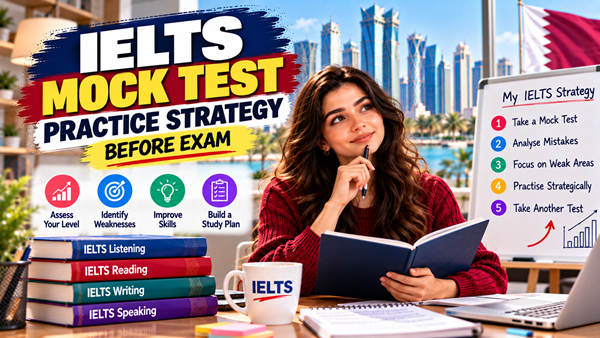
Taking IELTS practice tests is an important part of exam preparation, but completing test after test does not automatically lead to a better band score. What matters is how you use each result to identify weaknesses, improve your approach and measure your progress.
A well-planned IELTS practice test strategy helps you understand your current performance, manage time more effectively and focus on the skills that need the most attention before your official exam.
Whether you are preparing for IELTS Academic or General Training, this guide explains when to take a mock test, how to analyse your results, what to practise between tests and how to build a realistic preparation plan before exam day.
What Is an IELTS Practice Test Strategy?
An IELTS practice test strategy is a structured approach to using mock exams as part of your preparation. Instead of completing practice questions without a clear objective, you follow a cycle of testing, reviewing, targeted practice and reassessment.
A practical strategy includes five steps:
- Take a mock test under realistic conditions.
- Review your performance in Listening, Reading, Writing and Speaking.
- Identify the mistakes and weaknesses affecting your target band score.
- Practise those areas using focused exercises and feedback.
- Take another mock test to measure progress.
The purpose is not simply to achieve a high score in a practice test. It is to understand what you can currently do, what is holding you back and what you should improve before the real examination.
IELTS Practice Tests vs Regular IELTS Practice
Although both activities are useful, they serve different purposes.
| Regular IELTS practice | IELTS mock test |
|---|---|
| Focuses on a particular skill or question type | Evaluates performance across test sections |
| Can be completed without strict timing | Uses realistic time limits |
| Allows you to pause and review while learning | Requires you to work within test conditions |
| Helps develop specific skills | Helps assess readiness and identify weaknesses |
| Often provides immediate learning opportunities | Provides a benchmark for your next preparation stage |
The most effective approach combines both. Use regular practice to improve your skills and mock tests to evaluate how well you can apply them under exam conditions.
When Should You Take an IELTS Mock Test Before the Exam?
The best time to take a mock test depends on your current level, preparation schedule and target band score. There is no single number of practice tests that works for every candidate.
Take a Baseline Mock Test Early
Your first mock test should establish a starting point. It helps you identify which skills are relatively strong and which need more work.
For example, you might perform well in Listening but struggle to finish Reading on time. Another candidate might achieve a reasonable Reading score but need substantial improvement in Writing Task 2.
Without an initial assessment, you may spend too much time practising skills that are already strong while overlooking the areas that need attention.
Schedule Another Mock Test After Targeted Practice
After your first test, spend time addressing the weaknesses it reveals. Take another mock test when you have completed enough focused practice to assess whether your approach is working.
For example, if you repeatedly lose marks in Reading because you spend too long on difficult questions, practise question prioritisation and timing before reassessing your performance.
Take a Final Readiness Test Before Exam Day
A final mock test can help you evaluate your readiness before the official IELTS examination.
Complete it under realistic conditions, using the correct test format and time limits. Review the results carefully rather than focusing only on the overall score.
Avoid taking repeated full tests at the last minute if you have no time to learn from them. In the final stage, reviewing familiar mistakes, maintaining your routine and getting adequate rest may be more useful than adding another exhausting practice session.
How to Analyse Your IELTS Mock Test Results
The real value of an IELTS mock test often comes after you finish it. A score tells you how you performed on that particular test, but an error analysis helps you decide what to do next.
Review Your Performance in All Four Skills
Start by reviewing Listening, Reading, Writing and Speaking separately.
| IELTS skill | What to review | What to practise next |
|---|---|---|
| Listening | Missed answers, spelling, distractors and loss of concentration | Predicting answers, recognising paraphrases and listening for key information |
| Reading | Incorrect answers, difficult question types and time pressure | Skimming, scanning, locating evidence and managing time |
| Writing | Task response, organisation, vocabulary and grammar | Planning, paragraph development, accuracy and feedback-based revision |
| Speaking | Fluency, relevance, vocabulary, grammar and pronunciation | Timed answers, topic development and recorded speaking practice |
Do not assume that every incorrect answer has the same cause. A Listening mistake might result from unfamiliar vocabulary, while a Reading mistake might occur because you misunderstood the question or failed to locate the relevant information.
Identifying the cause is essential to choosing the right exercise.
Separate Knowledge Gaps from Strategy Problems
Not every weak result means you need to learn more English vocabulary or grammar.
Your mistakes may fall into several categories:
- Knowledge gaps: You do not understand the vocabulary, grammar or language needed for a task.
- Question-type problems: You find particular formats, such as matching headings or multiple-choice questions, difficult.
- Time-management problems: You spend too long on one question or section.
- Accuracy problems: You understand the task but make avoidable spelling, grammar or answer-selection errors.
- Performance-under-pressure problems: Your concentration or fluency changes when the test is timed.
For each recurring mistake, write down its likely cause and one action you can take to address it.
Create an IELTS Mistake Log
A mistake log makes your practice more focused. Use a simple table to record what happened and what you will do differently next time.
| Question or skill | Mistake | Likely cause | Action |
|---|---|---|---|
| Listening | Missed a number | Lost focus while reading ahead | Practise predicting the type of answer |
| Reading | Incorrect matching answer | Chose an option without checking evidence | Locate supporting information in the passage |
| Writing | Weak overview in Task 1 | Focused on individual figures | Practise identifying two main trends before writing |
| Speaking | Long pauses | Limited topic development | Practise extending answers with reasons and examples |
Review this log before every new practice session. Your aim is to reduce recurring errors, not merely complete more questions.
IELTS Practice Test Strategy for Each Skill
Your preparation plan should reflect the type of mistakes you make. A candidate who struggles with Reading timing needs a different approach from someone whose main weakness is Writing organisation.
IELTS Listening Practice Strategy
Listening requires concentration, accurate interpretation and the ability to follow a recording while identifying relevant information.
After a mock test:
- Check each incorrect answer against the transcript, when available.
- Identify whether you missed the information, misunderstood a paraphrase or selected a distractor.
- Review spelling, singular and plural forms, and word limits.
- Practise predicting whether an answer should be a name, number, noun or other type of information.
- Repeat challenging question types before attempting another full Listening test.
During your next timed practice, focus on the specific problem you identified. For example, if you regularly miss answers while transferring your attention between questions, practise following the question sequence without becoming distracted by an earlier answer.
IELTS Reading Practice Strategy
Reading performance depends on comprehension, question interpretation and effective use of time.
After your mock test:
- Identify which question types produced the most errors.
- Check the passage for evidence supporting each correct answer.
- Review why incorrect options appeared convincing.
- Practise skimming to understand the main idea and scanning to locate specific information.
- Set a time limit for difficult questions so you can move forward when necessary.
Do not rely on keyword matching alone. IELTS questions often paraphrase information from the passage, so you need to understand the relationship between the question and the supporting text.
IELTS Writing Practice Strategy
Writing requires a different type of review because a response cannot be evaluated accurately by counting correct answers alone.
After completing a mock test, review both tasks against the IELTS Writing assessment criteria.
For Task 1, check whether you selected the key features, wrote a clear overview where appropriate, supported your comparisons with accurate information and organised the response logically.
For Task 2, review whether you answered the full question, developed your ideas, organised paragraphs effectively and used accurate vocabulary and grammar.
Also consider whether your timing was appropriate. Spending too long on Task 1 can leave insufficient time for Task 2, which carries twice as much weight in the overall IELTS Writing score.
If possible, obtain qualified feedback on your writing. An external reviewer may identify recurring problems that are difficult to recognise when you assess your own work.
IELTS Speaking Practice Strategy
Speaking practice should help you produce relevant, developed answers while maintaining natural communication.
After a mock Speaking test:
- Review whether you answered the question directly.
- Identify places where you paused for too long or repeated the same words.
- Check whether you developed your ideas with explanations or examples.
- Record yourself and review pronunciation, clarity and fluency.
- Practise answering follow-up questions without memorising complete responses.
Memorising scripts is not a reliable substitute for developing speaking skills. Instead, learn how to organise your thoughts, use topic-related vocabulary and respond naturally to unfamiliar questions.
If you receive examiner-style feedback, use it to identify specific priorities for your next practice session.
How to Manage Time During an IELTS Mock Test
Time management should be practised before exam day, not improvised during the official examination.
Use the Correct Timing for Your Test
For the standard IELTS Listening, Reading and Writing components, the commonly used timings are:
| Component | Standard test timing |
|---|---|
| Listening | About 30 minutes, with additional answer-transfer time where applicable to the paper format |
| Reading | 60 minutes |
| Writing | 60 minutes |
| Speaking | Usually 11–14 minutes |
The precise experience can vary by delivery format, so follow the instructions for the version of IELTS you intend to take.
Practise Moving on from Difficult Questions
Spending too much time on one difficult question can affect your performance elsewhere.
During mock tests, practise recognising when you have spent too long on a question. Make your best decision, move on when appropriate and return to it if time permits and the test format allows.
Reproduce the Exam Conditions
For a meaningful assessment, try to:
- Use the correct test format: Academic or General Training.
- Follow the appropriate time limits.
- Avoid checking answers during the test.
- Put away distractions, including your phone.
- Complete the relevant sections in the required sequence.
- Use the computer or paper format that matches your intended test, where possible.
A practice test completed with frequent breaks and unlimited time may still be useful for learning, but it is less informative as a measure of exam readiness.
A 7-Day IELTS Practice Test Strategy Before Your Exam
If your IELTS test is approaching, a short preparation plan can help you use the available time more effectively. The following schedule is an example for a candidate who has already studied the test format and wants to review readiness.
It is not a guarantee of a particular band score. Adjust the activities to your current level and the time you have available.
Day 1: Complete a Baseline Mock Test
Take a full mock test that matches your intended IELTS format.
Follow the time limits and complete the relevant sections without checking answers midway. Record your results and note any sections you could not finish.
Goal: Establish a realistic starting point.
Day 2: Analyse Listening and Reading
Review your answers carefully. For every incorrect response, identify the likely cause and find the evidence or explanation that would have helped you answer correctly.
Practise the two or three question types that caused the most difficulty.
Goal: Understand why you lost marks.
Day 3: Review Writing
Complete a timed Writing practice session. Review Task 1 and Task 2 separately, paying attention to task achievement or response, coherence and cohesion, vocabulary, and grammatical accuracy.
If possible, obtain feedback from a qualified instructor.
Goal: Identify the writing issues most likely to affect your performance.
Day 4: Practise Speaking
Complete a Speaking practice session and record your answers if possible.
Review fluency, relevance, vocabulary, grammar and pronunciation. Practise extending answers naturally rather than memorising scripts.
Goal: Improve the specific speaking habits that weaken your responses.
Day 5: Target Your Weakest Areas
Use your mistake log to select focused exercises. Do not try to improve everything at once.
For example, if your main problem is Reading time management, practise setting limits for difficult questions. If your Writing lacks clear organisation, focus on planning and paragraph structure.
Goal: Turn your test analysis into practical improvement.
Day 6: Take Another Timed Assessment
Complete a second mock test if your preparation time and energy allow. Otherwise, complete a timed assessment of your weakest skill.
Compare the results with your earlier performance, looking for improvements in accuracy, timing and consistency.
Goal: Check whether your practice strategy is working.
Day 7: Review and Prepare for Test Day
Review your mistake log, useful strategies and the instructions for your test format.
Avoid trying to learn a large amount of new material at the last minute. Prepare the identification document required for your test, confirm the date and location or online requirements, and make sure you know what to expect.
Goal: Arrive prepared, organised and rested.
How Many IELTS Mock Tests Should You Take Before the Exam?
There is no universal number of mock tests that every candidate needs. The right amount depends on your current level, target band, preparation time and how consistently you perform.
A practical approach is to take a baseline test, practise your weaknesses and then take another assessment to measure progress. A further full mock test may be useful before the exam if you have enough time to review the results.
Taking several tests without analysing your mistakes can produce little improvement. One carefully reviewed test may be more valuable than multiple tests completed without a clear learning objective.
Should You Take a Mock Test One Day Before IELTS?
A full mock test the day before your official exam is not essential for everyone. If you are already familiar with the format, a lighter review may be more useful than another demanding session.
Consider reviewing your common mistakes, practising a few manageable questions, checking your test arrangements and getting enough sleep.
If you do choose to complete a practice test, avoid letting one disappointing result undermine your confidence at the last minute. A mock score is a preparation indicator, not a guarantee of your official result.
How to Choose the Right IELTS Mock Test
Not all practice tests provide the same level of preparation value. Before booking an assessment, consider whether it will help you make better decisions about your study plan.
Check the Test Format
Make sure the mock test matches the IELTS version you intend to take. Academic and General Training share the Listening and Speaking components, but their Reading and Writing components differ.
If you are taking IELTS on computer, practising on a computer can also help you become familiar with the way you read, type and navigate the test.
Look for Realistic Timing and Question Types
A useful mock test should reflect the format and time constraints relevant to your intended exam. Completing questions without a time limit can be helpful for learning, but it does not fully assess how you perform under exam conditions.
Consider the Feedback Available
An overall score alone may not tell you what to do next.
Look for an assessment that helps you identify your weaker areas and, where available, provides useful feedback on Writing and Speaking. These skills benefit from more detailed evaluation than simply checking fixed answers.
Choose an Assessment That Supports Your Next Step
The best mock test is one that helps you make a practical decision: whether to continue independent practice, focus on a specific skill, seek expert feedback or follow a more structured preparation programme.
If you are uncertain about your current readiness, an appropriately selected mock test can provide a useful starting point.
Frequently Asked Questions About IELTS Practice Test Strategy
What is the best IELTS practice test strategy before the exam?
Start with a realistic mock test, analyse your mistakes, practise the weakest skills and take another assessment when you have had time to improve. Use the results to guide your next steps rather than focusing only on your overall score.
How often should I take an IELTS mock test?
The frequency depends on your preparation stage and available time. Take tests at meaningful checkpoints, with focused practice between them. Avoid repeating full tests so frequently that you have no time to analyse or correct your mistakes.
Can an IELTS mock test predict my actual band score?
A mock test can provide an indication of your current performance, but it cannot guarantee your official IELTS score. The usefulness of the estimate depends on the test quality, assessment method and how closely the practice conditions match the real examination.
Should I take an IELTS mock test before booking the real exam?
A mock test can help you assess your readiness before committing to an exam date. However, your decision should also consider your target score, application deadlines, preparation progress and the requirements of the institution or organisation you are applying to.
Is an online IELTS mock test effective?
An online mock test can be useful if it provides relevant question types, appropriate timing and meaningful ways to review your answers. A structured assessment with feedback may be particularly helpful when you need to understand weaknesses in Writing or Speaking.
What should I do if my IELTS mock test score is lower than my target?
Do not immediately repeat the same test. Analyse the mistakes, identify the skills or question types responsible for the gap, and create a focused practice plan. Reassess your performance after completing the relevant work.
Is one IELTS mock test enough?
One mock test can establish a baseline, but it may not provide enough information to show consistent progress. A further assessment after targeted practice can help you understand whether your performance is improving.
Is a mock test useful for IELTS Band 7 or higher?
Yes. Candidates aiming for Band 7 or higher can use mock tests to identify specific issues with accuracy, time management, task response, vocabulary, grammar or speaking performance. The key is to use detailed results to guide focused practice.
Assess Your IELTS Readiness with IFI Qatar
A strong IELTS preparation plan is based on evidence, not guesswork. A mock test can help you understand your current performance, identify the areas that need attention and decide how to use your remaining preparation time.
If you are preparing for IELTS in Qatar, consider taking a structured mock test before your official exam. IFI Qatar offers IELTS mock-test options for candidates who want to practise the test format and assess their readiness.
Book an IELTS Mock Test with IFI Qatar to take a more informed next step in your preparation. Use the experience to identify your priorities, review your performance and build a focused plan around your target band score.
Your goal is not simply to complete more practice tests. It is to learn from each one and arrive at the real IELTS exam better prepared.