

Currently Empty: ر.ق 0,00


IELTS
Best Ways to Learn English for IELTS: A Practical Guide
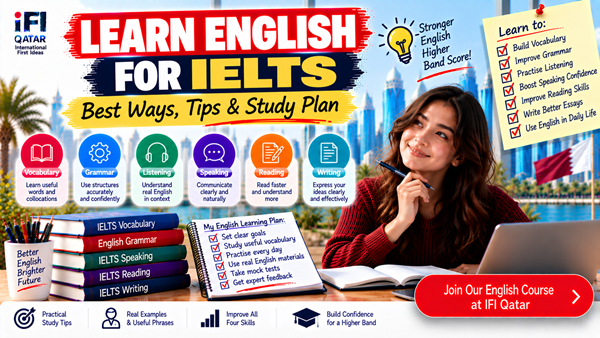
If you want a higher IELTS score, improving your English is just as important as learning IELTS strategies. Understanding question types can help you perform better on test day, but strong English skills give you the foundation you need to understand texts, follow conversations, express ideas clearly, and communicate confidently.
The good news is that you do not need to become fluent overnight. With the right study routine, you can steadily improve your vocabulary, grammar, listening, speaking, reading, and writing skills while preparing specifically for IELTS.
This guide explains the best ways to learn English for IELTS, including what to practise, how to structure your study time, and how to avoid common mistakes that slow down progress.
What Does It Mean to Learn English for IELTS?
Learning English for IELTS means developing the language skills you need to communicate effectively in an academic, professional, or everyday English environment.
IELTS assesses four skills:
- Listening
- Reading
- Writing
- Speaking
Each skill requires a combination of language knowledge and practical ability. For example, memorising vocabulary can help you understand a reading passage, but you also need to recognise synonyms, understand context, and identify the writer’s meaning.
Similarly, knowing grammar rules is useful for IELTS Writing, but you also need to use grammatical structures accurately and naturally when expressing your ideas.
The most effective approach is therefore to improve your general English ability while applying it to IELTS-style tasks.
Why Improving Your English Is Important for IELTS
IELTS is not simply a test of how many words or grammar rules you can remember.
Your score depends on how effectively you can use English in realistic communication situations.
English helps across all four IELTS skills
A stronger level of English can improve your performance in every section of the test.
| IELTS Skill | English Skills You Need |
|---|---|
| Listening | Vocabulary, pronunciation, concentration, understanding different accents |
| Reading | Vocabulary, grammar, skimming, scanning, paraphrasing |
| Writing | Grammar, vocabulary, organisation, coherence, academic language |
| Speaking | Fluency, pronunciation, vocabulary, grammar, confidence |
This is why spending all your preparation time completing practice tests may not produce the improvement you expect.
If your vocabulary is limited or your grammar is inaccurate, repeating IELTS tests without addressing those weaknesses can simply reinforce the same mistakes.
Best Ways to Learn English for IELTS
There is no single method that works for every learner. However, combining several effective habits can make your preparation more consistent and productive.
1. Build Your English Vocabulary in Context
Vocabulary is one of the most important foundations for IELTS.
However, learning long lists of isolated words is rarely the best approach.
Instead, learn new words through sentences, topics, collocations, and real examples.
For example, rather than memorising only:
significant = important
learn the word through useful combinations:
- a significant increase
- a significant difference
- a significant impact
- a significant proportion
This helps you understand how the word is naturally used.
Focus on high-value IELTS vocabulary
You do not need to memorise thousands of complicated words.
Focus on vocabulary connected to common IELTS topics such as:
- Education
- Technology
- Environment
- Health
- Work
- Society
- Transportation
- Globalisation
- Government
- Science
- Culture
- Communication
The goal is not to use difficult words simply to sound advanced. The goal is to use accurate and appropriate vocabulary.
Learn synonyms and paraphrases
IELTS frequently tests your ability to recognise the same idea expressed in different words.
For example:
- increase → rise, grow, climb
- important → significant, essential, crucial
- problem → issue, challenge, difficulty
- reduce → decrease, lower, minimise
- advantage → benefit, positive aspect
Understanding paraphrasing is particularly useful for IELTS Reading and Listening.
2. Improve Your English Grammar
Grammar affects your ability to communicate clearly and accurately.
You do not need to use complicated grammar in every sentence. Instead, focus on mastering the structures that allow you to express different relationships between ideas.
Important areas include:
- Verb tenses
- Articles
- Prepositions
- Subject-verb agreement
- Countable and uncountable nouns
- Modal verbs
- Conditionals
- Relative clauses
- Passive voice
- Complex sentences
- Comparative structures
- Linking structures
Move from simple to more flexible sentences
Consider this example:
Many people use technology.
This sentence is grammatically correct, but you can develop the idea:
Many people use technology because it makes communication faster and more convenient.
You can then create a more advanced structure:
Although technology has made communication faster and more convenient, excessive reliance on digital devices may reduce face-to-face interaction.
The objective is not to make every sentence complicated. IELTS candidates should aim for variety, accuracy, and clarity.
3. Read English Every Day
Regular reading is one of the most effective ways to improve your English for IELTS.
Reading exposes you to:
- New vocabulary
- Grammar patterns
- Sentence structures
- Paraphrasing
- Academic language
- Different writing styles
- Ideas and arguments
You do not have to spend hours reading every day.
Even 20–30 minutes of focused reading can be useful when done consistently.
What should you read?
Choose material that is slightly challenging but still understandable.
Useful sources include:
- News articles
- Magazine articles
- Educational websites
- Science and technology articles
- Opinion articles
- Short academic texts
- Books written for English learners
When reading, do more than look up every unfamiliar word.
Ask yourself:
- What is the main idea?
- What is the writer’s opinion?
- What evidence is presented?
- Which words are repeated or paraphrased?
- How are the paragraphs connected?
These habits also support IELTS Reading preparation.
4. Listen to English Every Day
Listening practice should be part of your daily English routine.
IELTS Listening requires more than recognising individual words. You need to understand connected speech, follow changes in topic, identify important information, and deal with different speakers and accents.
Use different types of English audio
Try listening to:
- Interviews
- Podcasts
- News programmes
- Educational videos
- Lectures
- Conversations
- Documentaries
Do not always rely on subtitles.
A useful progression is:
- Listen without subtitles.
- Identify the main idea.
- Listen again and note important details.
- Check the transcript if available.
- Listen again and notice pronunciation and connected speech.
This helps train your ear rather than simply testing your memory.
5. Practise Speaking English Every Day
Many IELTS candidates understand English reasonably well but struggle to speak because they rarely use the language actively.
The solution is simple: speak more often.
You can practise even when you do not have a speaking partner.
Use the 2-minute speaking technique
Choose a familiar topic and speak about it for two minutes.
For example:
Describe a useful piece of technology you use every day.
Try to explain:
- What it is
- How you use it
- Why it is useful
- How it has changed your life
Record yourself and listen to the recording afterwards.
Look for:
- Long pauses
- Repeated words
- Grammar mistakes
- Unclear pronunciation
- Limited vocabulary
- Ideas that are difficult to follow
Then repeat the task and try to improve.
Think in English instead of translating
One common problem is mentally translating every sentence from your first language into English.
Instead, gradually train yourself to think directly in English.
Start with simple situations:
I need to leave at eight.
Then develop the habit during everyday activities:
I need to finish this task before I go to work.
The more frequently you think and speak in English, the easier it becomes to produce language naturally.
6. Improve Your English Pronunciation
Good pronunciation is not about having a particular accent.
For IELTS Speaking, the important goal is to communicate clearly so that the examiner can understand you easily.
Focus on:
- Word stress
- Sentence stress
- Individual sounds
- Intonation
- Connected speech
- Clear endings
- Rhythm
For example, saying individual words correctly is useful, but understanding how words connect in natural speech is also important for both Listening and Speaking.
Record and compare your speech
Choose a short English recording and repeat a few sentences.
Then compare:
- Pronunciation
- Stress
- Rhythm
- Pausing
- Intonation
This technique, often called shadowing, can help you become more comfortable with natural English pronunciation.
7. Write in English Regularly
Writing practice is essential if you want to improve your IELTS Writing score.
However, do not only write full IELTS essays.
Start with smaller exercises.
For example:
Daily writing practice
Write 5–10 sentences about:
- Your daily routine
- A recent experience
- A news story
- A social issue
- Your opinion about technology
- Your plans for the future
Then check:
- Verb tense
- Articles
- Prepositions
- Sentence structure
- Word choice
- Spelling
- Punctuation
Once you become more comfortable, move to paragraphs and then complete IELTS tasks.
8. Learn English Through Common IELTS Topics
One efficient way to combine English learning with IELTS preparation is to study language by topic.
For example, if your topic is the environment, learn:
Vocabulary
- carbon emissions
- renewable energy
- climate change
- environmental damage
- natural resources
Collocations
- reduce carbon emissions
- protect natural resources
- tackle climate change
- invest in renewable energy
Useful grammar
If governments invest more in renewable energy, they may reduce their dependence on fossil fuels.
You are therefore learning vocabulary, grammar, sentence structures, and ideas at the same time.
9. Learn Collocations, Not Just Individual Words
Collocations are words that naturally occur together.
Learning them can make your English sound more natural and can improve your ability to express ideas accurately.
For example:
Instead of learning only decision, learn:
- make a decision
- reach a decision
- an important decision
- a difficult decision
Instead of learning only impact, learn:
- have an impact
- significant impact
- positive impact
- negative impact
This is particularly useful for IELTS Writing and Speaking.
10. Use English in Your Daily Life
You do not have to limit English practice to your study desk.
Create an English-speaking environment around you.
You can:
- Change your phone language to English.
- Write your shopping list in English.
- Describe your day in English.
- Watch English videos.
- Listen to English podcasts.
- Read English news.
- Write notes in English.
- Speak English with classmates or colleagues.
- Keep a short English diary.
The objective is to make English part of your daily routine rather than something you study only before an exam.
11. Combine General English With IELTS Practice
This is one of the most important principles for IELTS preparation.
General English improves your underlying language ability.
IELTS practice teaches you how to apply that ability to the exam.
You need both.
For example, if you have difficulty understanding reading passages because you do not know enough vocabulary, completing another IELTS Reading test may not solve the underlying problem.
Instead:
- Identify the vocabulary problem.
- Study relevant vocabulary.
- Read English regularly.
- Practise paraphrasing.
- Complete IELTS Reading exercises.
- Review your mistakes.
This creates a much more effective learning cycle.
12. Get Feedback on Your English
Self-study can be highly effective, but it has limitations.
You may not always recognise your own grammar mistakes, pronunciation problems, or weaknesses in writing organisation.
Feedback from an experienced English teacher can help you identify:
- Repeated grammar errors
- Vocabulary problems
- Pronunciation issues
- Weak sentence structures
- Writing organisation problems
- Speaking fluency issues
- Areas that need more practice
The key is to use feedback actively.
Do not simply correct a mistake once and move on. Record the mistake and look for it again in your future speaking and writing.
How to Create an Effective English Learning Routine for IELTS
A good study routine should be realistic enough to maintain consistently.
You do not necessarily need several hours every day.
A focused 60–90 minute routine could look like this:
| Activity | Suggested Time |
|---|---|
| Vocabulary and collocations | 15 minutes |
| Reading | 15 minutes |
| Listening | 15 minutes |
| Speaking | 15 minutes |
| Grammar or writing | 20–30 minutes |
If you have more time, increase the amount of practice rather than trying to study everything at once.
Example weekly IELTS English plan
| Day | Main Focus |
|---|---|
| Monday | Vocabulary + Reading |
| Tuesday | Grammar + Speaking |
| Wednesday | Listening + Vocabulary |
| Thursday | Writing + Grammar |
| Friday | Speaking + Listening |
| Saturday | Reading + Writing |
| Sunday | Review + IELTS practice test |
The most important factor is consistency.
How Long Does It Take to Improve English for IELTS?
The answer depends on your current English level, target IELTS score, study time, and learning habits.
Someone starting at an intermediate level may need less time to reach their target than a beginner.
Your progress also depends on how actively you use English.
For example, studying vocabulary for 30 minutes without using it is generally less productive than learning a smaller number of words and then using them in speaking and writing.
Track progress instead of relying on feelings
Every few weeks, assess:
- Vocabulary range
- Grammar accuracy
- Reading speed
- Listening comprehension
- Speaking fluency
- Pronunciation
- Writing quality
Keep examples of your previous speaking recordings and writing tasks.
This makes improvement easier to measure.
Common Mistakes When Learning English for IELTS
Many students work hard but do not see the expected results because their study method is inefficient.
Memorising vocabulary without using it
Knowing the definition of a word does not guarantee that you can use it correctly.
Always learn words in context and practise creating your own sentences.
Trying to use difficult words everywhere
Advanced vocabulary is useful only when it is accurate and appropriate.
A simple word used correctly is better than an impressive word used incorrectly.
Studying grammar rules without practising
Grammar knowledge needs to become active language ability.
After learning a grammar structure, use it in your own sentences, speaking practice, and writing.
Doing practice tests too frequently
Practice tests are valuable, but they should not replace English development.
Use your mistakes to identify what you need to improve.
Avoiding speaking because you feel nervous
Speaking becomes easier through practice.
Waiting until your English is “perfect” before speaking can slow your progress.
Studying inconsistently
Studying for five hours once a week is often less sustainable than studying for one hour regularly.
Consistency matters.
Should You Learn English Alone or Take an English Course?
Self-study can work well for motivated learners who can identify their weaknesses and maintain a structured routine.
However, an English course can provide several advantages:
- Structured lessons
- Teacher feedback
- Speaking practice
- Grammar correction
- Guided vocabulary development
- Regular progress checks
- Interaction with other learners
- A clear learning plan
For IELTS candidates, the ideal approach may be a combination of independent English practice and structured classroom learning.
How IFI Qatar Can Help You Improve Your English for IELTS
If you are preparing for IELTS in Qatar, improving your general English alongside your exam skills can make your preparation more effective.
At IFI Qatar, English learners can develop the language skills needed for stronger communication while working toward their IELTS goals.
A structured course can help you identify your current level, work on your weaknesses, practise English consistently, and develop greater confidence before taking the exam.
If you are not sure which type of English training is right for your current level, speaking with an experienced instructor can help you choose a suitable starting point.
A Simple 30-Day Plan to Learn English for IELTS
If you want to start immediately, use the following four-week plan.
Week 1: Build the foundation
Focus on:
- Common vocabulary
- Basic grammar accuracy
- Daily reading
- Short listening exercises
- Speaking for 2 minutes each day
Week 2: Develop vocabulary and fluency
Focus on:
- IELTS topic vocabulary
- Collocations
- Paraphrasing
- Speaking without translating
- Short writing exercises
Week 3: Connect English skills to IELTS
Focus on:
- IELTS Reading passages
- IELTS Listening exercises
- Speaking questions
- Writing paragraphs
- Reviewing recurring mistakes
Week 4: Apply and review
Focus on:
- Full IELTS practice tasks
- Speaking recordings
- Timed writing
- Vocabulary review
- Grammar correction
- Identifying your weakest skill
At the end of the month, compare your work with your first-week results.
Frequently Asked Questions About Learning English for IELTS
What is the best way to learn English for IELTS?
The best approach is to combine daily English exposure with targeted IELTS practice. Read and listen to English regularly, build vocabulary in context, practise speaking and writing, study grammar, and review your mistakes.
How can I improve my English for IELTS at home?
You can practise English at home by reading English articles, listening to podcasts, recording yourself speaking, writing short paragraphs, learning vocabulary in context, and completing IELTS practice exercises.
How many hours a day should I study English for IELTS?
There is no universal number of hours. A consistent 60–90 minute daily routine can be effective when it includes active practice across several skills. Your ideal study time depends on your current level and target score.
Can I improve my English without taking a course?
Yes. Self-study can be effective, especially when you have a structured plan. However, teacher feedback can be valuable for identifying mistakes in speaking, writing, grammar, and pronunciation that you may not notice yourself.
Should I learn English or focus only on IELTS?
You should do both. General English improves your underlying language ability, while IELTS preparation teaches you how to apply those skills to the specific exam format.
How can I improve my IELTS vocabulary?
Learn vocabulary by topic and in context. Focus on synonyms, collocations, word forms, and common academic expressions, then use new words in your own speaking and writing.
How can I improve my English speaking for IELTS?
Speak English regularly, record yourself, practise common topics, work on pronunciation and fluency, and review your grammar and vocabulary mistakes. Speaking with a teacher or study partner can also provide useful feedback.
Is reading English every day useful for IELTS?
Yes. Regular reading can expand your vocabulary, improve your understanding of grammar and sentence structures, expose you to paraphrasing, and strengthen your reading comprehension.
Start Improving Your English for IELTS Today
A higher IELTS score starts with stronger English.
Instead of relying only on practice tests or memorising lists of difficult words, build a balanced routine that develops vocabulary, grammar, reading, listening, speaking, and writing together.
If you want structured guidance and professional support, explore an English course at IFI Qatar and take the next step toward stronger English and better IELTS performance.