

Currently Empty: ر.ق 0,00


IELTS
IELTS vs TOEFL: Which English Test Should You Take in 2026?
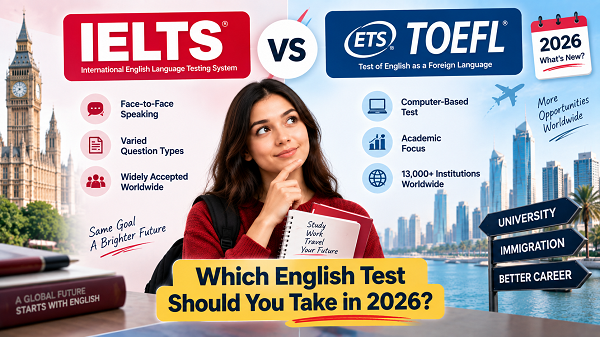
If you are planning to study abroad, apply to a university, or prove your English proficiency for an international application, you may be deciding between two of the world’s best-known English language tests: IELTS and TOEFL.
So, IELTS vs TOEFL—which test should you take?
There is no universal answer. The right choice depends on where you are applying, which tests your institution accepts, your preferred test format, your speaking style, and the type of testing environment in which you perform best.
There is another important reason to compare the two tests carefully in 2026: TOEFL iBT changed significantly in January 2026. ETS introduced a revised test design and a new 1–6 score scale, while a comparable 0–120 overall score is being provided during the transition period.
This means that some older IELTS vs TOEFL comparison articles and score-conversion tables may no longer provide an accurate picture of the current TOEFL.
In this guide, we compare IELTS Academic and TOEFL iBT, explain the major differences between them, and help you decide which English test may be the better fit for your goals.
IELTS vs TOEFL: The Quick Answer
Both IELTS and TOEFL are internationally recognised English proficiency tests, and both assess four core language skills:
- Reading
- Listening
- Speaking
- Writing
However, the two tests differ in several important ways, including:
- Test format
- Speaking experience
- Question types
- Writing tasks
- Score reporting
- Test delivery
- Academic focus
- Testing environment
The best test is not necessarily the one someone describes as “easier.”
Instead, choose the test that:
- Your university, organisation or authority accepts.
- Meets your required score.
- Matches your preferred testing style.
- Gives you enough time to prepare properly.
- Fits your application deadline.
For university applicants, the most relevant comparison is generally IELTS Academic vs TOEFL iBT.
IELTS vs TOEFL: What’s the Difference?
At a broad level, both tests measure English proficiency, but they approach assessment differently.
IELTS Academic is widely used for higher education, university admission and certain professional registration purposes.
TOEFL iBT is primarily designed around academic English and is widely used for higher education admissions.
IELTS also offers Academic and General Training versions. Listening and Speaking are shared between the two versions, while Reading and Writing differ.
For students applying to universities, the comparison is therefore usually:
IELTS Academic vs TOEFL iBT
IELTS vs TOEFL Comparison Table
| Feature | IELTS Academic | TOEFL iBT |
|---|---|---|
| Main purpose | Higher education and some professional purposes | Higher education |
| Skills tested | Reading, Listening, Writing, Speaking | Reading, Listening, Writing, Speaking |
| Score system | Band 0–9 | 1–6 from 2026 |
| Previous TOEFL scale | N/A | Comparable 0–120 score during transition |
| Speaking | Interview with an examiner | Computer-delivered speaking tasks |
| Test environment | Computer-based options | Computer-based |
| Academic focus | Yes | Yes |
| Writing | Academic Task 1 + Task 2 | Current TOEFL academic writing tasks |
| Reading | Academic texts with varied question types | Academic reading tasks |
| Best choice | Depends on requirements and candidate | Depends on requirements and candidate |
Because TOEFL changed in January 2026, candidates should use current preparation materials and current institutional requirements rather than relying entirely on older comparison guides.
IELTS vs TOEFL Score Comparison in 2026
One of the biggest changes candidates need to understand is the new TOEFL scoring system.
From January 21, 2026, TOEFL score reports use a 1–6 scale in half-point increments.
Candidates receive:
- An overall score
- Four section scores
- Scores reported using the new 1–6 scale
During a two-year transition period, ETS is also providing a comparable overall score using the previous 0–120 scale.
IELTS continues to use its familiar 0–9 Band Score system.
Can You Still Use Old IELTS vs TOEFL Conversion Tables?
Be careful.
You may still find online tables showing comparisons such as:
IELTS 7.0 = TOEFL 94–101
These tables were created using the previous TOEFL scoring system.
They should not automatically be used to interpret a TOEFL test taken under the revised 2026 system.
If your university gives you an IELTS requirement and you are considering TOEFL instead, check the institution’s current English-language requirements rather than relying on an old conversion table.
Is IELTS Easier Than TOEFL?
This is one of the most common questions candidates ask.
The short answer is: not necessarily.
Test difficulty is partly subjective.
One candidate may find IELTS easier because they are comfortable having a conversation with an examiner.
Another may prefer TOEFL because they are comfortable completing the test in a computer-based environment.
Your experience can also depend on:
- English proficiency
- Typing ability
- Speaking confidence
- Familiarity with computers
- Reading habits
- Knowledge of question types
- Time-management skills
- Previous test experience
Instead of asking, “Which test is easier?”, a better question is:
Which test format allows me to demonstrate my English ability most effectively?
IELTS vs TOEFL Speaking
Speaking is one of the clearest differences between IELTS and TOEFL.
In IELTS, the Speaking test is conducted as an interview with an examiner.
IELTS Speaking consists of three parts and lasts approximately 11–14 minutes.
This creates a direct conversational environment.
You interact with another person, answer questions and discuss topics with the examiner.
For many candidates, this feels natural. For others, speaking directly to an examiner can create additional pressure.
TOEFL approaches Speaking differently, with responses completed through the computer-based testing environment.
IELTS Speaking May Suit You If You:
- Feel comfortable speaking face-to-face
- Enjoy conversations
- Can respond naturally to questions
- Prefer interacting with an examiner
- Are comfortable developing spoken answers spontaneously
TOEFL Speaking May Suit You If You:
- Are comfortable speaking through a computer
- Prefer a digital testing environment
- Perform well without face-to-face interaction
- Prefer structured computer-based tasks
If speaking is your strongest skill, the testing environment itself may influence your decision.
IELTS vs TOEFL Reading
Both IELTS and TOEFL assess your ability to understand written English, but their task formats are different.
IELTS Academic Reading uses academic-style texts and a wide variety of question types.
You may encounter:
- Multiple choice
- Matching headings
- Matching information
- Sentence completion
- Summary completion
- Diagram labelling
- Other task formats
This means IELTS Reading requires you to adapt your strategy depending on the question type.
TOEFL also assesses academic reading ability, but its tasks and digital testing environment are different.
Which Reading Test Is Better for You?
IELTS may feel more comfortable if you:
- Like varied question types
- Are good at scanning and locating information
- Prefer a mixture of task formats
TOEFL may suit you if you:
- Prefer a computer-based academic environment
- Are comfortable reading extensively on screen
- Prefer structured digital tasks
Neither approach is universally better. The important question is which format matches your strengths.
IELTS vs TOEFL Listening
Listening is another area where the tests differ in their approach.
IELTS Listening includes different contexts and question types. You may hear:
- Conversations
- Monologues
- Discussions
- Educational situations
- Everyday situations
You also need to move between different question formats while listening.
TOEFL has a stronger academic orientation and places greater emphasis on processing information within academic contexts.
How Should You Prepare for IELTS Listening?
If you choose IELTS, practise the actual IELTS question formats rather than simply listening to English podcasts or lectures.
Your preparation should include:
- Full IELTS Listening tests
- Note-taking
- Prediction
- Identifying keywords
- Understanding distractors
- Following different accents
- Practising under timed conditions
How Should You Prepare for TOEFL Listening?
If you choose TOEFL, become comfortable processing academic information in a computer-based environment.
Focus on:
- Academic listening
- Note-taking
- Identifying main ideas
- Recognising supporting details
- Understanding relationships between ideas
- Completing current TOEFL task types
IELTS vs TOEFL Writing
Both tests require candidates to communicate ideas clearly in written English, but their writing tasks are structured differently.
IELTS Academic Writing
IELTS Academic Writing includes two tasks.
IELTS Academic Writing Task 1
You are generally asked to describe, summarise or explain visual information.
This may include:
- Graphs
- Charts
- Tables
- Diagrams
- Processes
You need to identify important features and present them clearly and accurately.
IELTS Academic Writing Task 2
You write an essay responding to a question or issue.
Depending on the question, you may need to:
- Give your opinion
- Discuss different views
- Explain causes
- Suggest solutions
- Discuss advantages and disadvantages
- Answer two related questions
For many IELTS candidates, Task 2 is particularly important because it requires clear argument development, logical organisation, appropriate vocabulary and accurate grammar.
TOEFL Writing
The revised TOEFL iBT introduced changes to its writing tasks compared with the previous version.
Because the TOEFL changed significantly in 2026, candidates should prepare using current TOEFL materials rather than assuming that older TOEFL writing strategies and task formats remain unchanged.
IELTS vs TOEFL Test Format
Your preferred testing environment can have a significant effect on your performance.
IELTS offers computer-delivered testing, with specific delivery options depending on the test centre and session.
TOEFL iBT is computer-based.
Before choosing between IELTS and TOEFL, consider:
- Do I type comfortably?
- Do I prefer reading on a screen?
- Am I comfortable speaking through a computer?
- Can I concentrate during a digital test?
- Do I prefer interacting with an examiner?
- Which question formats feel more natural to me?
These practical factors are often overlooked when candidates compare the two tests.
IELTS vs TOEFL for University Admission
If your goal is university admission, both IELTS Academic and TOEFL iBT can be relevant.
However, your university’s requirements should always come first.
Before booking either test:
- Find your university’s official admissions page.
- Check which English tests are accepted.
- Check the minimum overall score.
- Check minimum section scores.
- Check whether your programme has additional requirements.
- Confirm any deadlines.
- Check whether online or alternative test versions are accepted.
Do not choose a test simply because you have heard that it is “more accepted.”
The important question is:
Does your specific university and programme accept the test and score you plan to submit?
IELTS vs TOEFL for International Students
International students should consider their entire application strategy.
If you are applying to several universities, compare the requirements of all of them before booking your test.
For example:
| University | IELTS | TOEFL |
|---|---|---|
| University A | Accepted | Accepted |
| University B | Accepted | Accepted |
| University C | Accepted | Not accepted |
If one test gives you greater flexibility across your application list, that may influence your decision.
Your choice should therefore be based on your actual target institutions rather than general internet advice.
IELTS vs TOEFL: Which Test Is More Accepted?
Both tests have extensive international recognition.
However, “accepted worldwide” does not mean “accepted everywhere.”
Universities, professional organisations, employers and government authorities can establish their own English-language requirements.
Therefore, avoid making decisions based on statements such as:
“TOEFL is accepted everywhere in the US.”
or:
“IELTS is accepted everywhere.”
Instead, check the exact requirements of the organisation receiving your score.
IELTS vs TOEFL for the US
Both IELTS and TOEFL are widely used for international university applications in the United States.
Many universities accept both tests, but requirements vary by institution and programme.
Before booking, check:
- Accepted English tests
- Minimum overall score
- Minimum section scores
- Application deadline
- Whether online versions are accepted
- Programme-specific requirements
If both tests are accepted, your preferred testing format can become an important deciding factor.
IELTS vs TOEFL for the UK
If you are planning to study or work in the UK, pay close attention to the specific purpose of your application.
IELTS offers different test types, and the test required can depend on your university, visa or immigration route.
Do not automatically book IELTS Academic simply because you are travelling to the UK.
Check the requirements of:
- Your university
- Your visa category
- Relevant UK authorities
- Professional organisations, if applicable
The correct English test depends on your specific purpose.
IELTS vs TOEFL in Qatar
If you are searching for IELTS vs TOEFL Qatar, there are two things to consider:
- Whether your target institution accepts the test.
- How practical it is for you to take that test in Qatar.
For candidates considering IELTS in Doha, practical factors may include:
- Available test dates
- Test location
- Academic or General Training
- Computer delivery
- Writing on Paper availability where offered
- Current fees
- Result timelines
Test availability and delivery options can change, so always check the latest information before booking.
If your university accepts IELTS Academic and you prefer the IELTS format, taking IELTS in Qatar can be a practical choice.
IELTS vs TOEFL: Which One Should You Take?
There is no universal winner.
Use the following guide to compare your personal situation.
Choose IELTS If:
- Your university accepts IELTS.
- You prefer speaking directly with an examiner.
- You are comfortable with varied Reading and Listening question types.
- You prefer the IELTS Band Score system.
- You are familiar with IELTS preparation.
- You prefer the IELTS testing environment.
- IELTS is convenient for your location and deadline.
Consider TOEFL If:
- Your university accepts TOEFL.
- You are comfortable with computer-based speaking.
- You prefer academic English contexts.
- You are comfortable with digital testing.
- You prefer the current TOEFL task structure.
- You are prepared for the revised 2026 TOEFL format and scoring system.
The final decision should be based on your actual requirements and strengths.
IELTS vs TOEFL: Which Is Better for You?
Consider two hypothetical students.
Student A: Strong Conversational Speaker
Student A communicates confidently in conversations, prefers face-to-face interaction and feels comfortable with IELTS-style tasks.
If their university accepts both tests, IELTS may be a natural fit.
Student B: Comfortable With Digital Testing
Student B is comfortable using computers, prefers structured digital tasks and does not particularly enjoy face-to-face speaking tests.
If their university accepts TOEFL, the TOEFL format may suit them better.
Neither student has chosen the universally “better” test.
They have chosen the test that fits their circumstances.
Don’t Choose IELTS or TOEFL Based on Difficulty Alone
One of the most common mistakes candidates make is choosing an English test based entirely on claims about difficulty.
You may hear:
- “IELTS is easier.”
- “TOEFL is easier.”
- “IELTS Speaking is harder.”
- “TOEFL Reading is easier.”
These statements are subjective.
Your experience can depend on your:
- English level
- Test familiarity
- Typing speed
- Speaking confidence
- Reading ability
- Computer skills
- Time-management skills
- Preparation quality
Instead of looking for the “easiest” test, look for the test that gives you the best opportunity to demonstrate your abilities.
IELTS vs TOEFL Score Conversion: What to Know in 2026
Score conversion requires extra caution in 2026 because the TOEFL scoring system has changed.
The revised TOEFL reports scores on a 1–6 scale, while a comparable overall score on the previous 0–120 scale is being provided during the transition period.
IELTS continues to use its 0–9 Band Score system.
This means an old article containing a conversion such as:
IELTS 6.5 = TOEFL 81–90
may be referring to the previous TOEFL system.
Do not automatically use an old conversion table to interpret a 2026 TOEFL result.
If you need to meet a particular English-language requirement, use the current score requirement published by the receiving institution.
How to Prepare for IELTS or TOEFL
Once you choose your English test, your preparation should become test-specific.
Preparing generally for “English” is not enough. You need to understand the actual exam format, question types and scoring criteria.
If You Choose IELTS
Your preparation should include:
- IELTS Reading practice
- IELTS Listening practice
- IELTS Academic Writing
- IELTS Speaking practice
- Timed practice tests
- Full IELTS mock tests
- Question-type strategies
- Vocabulary development
- Grammar improvement
- Time management
For IELTS Academic, pay particular attention to Writing Task 1 and Task 2.
For Speaking, practise producing natural answers rather than memorising complete responses.
If You Choose TOEFL
Use current 2026 TOEFL preparation resources.
Your preparation should reflect the revised test rather than older versions.
Focus on:
- Current Reading tasks
- Current Listening tasks
- Current Speaking tasks
- Current Writing tasks
- Digital test navigation
- Time management
- Academic English
- Full-length practice tests
Avoid relying exclusively on preparation books designed for the pre-2026 TOEFL.
IELTS vs TOEFL: What About Test Results?
Both IELTS and TOEFL provide official score reports that can be used for applications, provided the receiving organisation accepts the test and score.
Your result timeline can vary depending on the test format and test centre.
If you have an important application deadline, avoid taking your English test at the last possible moment.
Allow time for:
- Preparation
- Test booking
- Test day
- Result processing
- Score submission
- Possible retesting
Working backwards from your application deadline can help you avoid unnecessary pressure.
IELTS vs TOEFL: A Simple Decision Checklist
Before booking your English test, answer these seven questions.
1. Where Am I Applying?
List your target universities, organisations, employers or authorities.
2. Which Tests Do They Accept?
Check the official requirements of every important institution.
3. What Score Do I Need?
Look beyond the overall score.
Check whether your programme requires minimum scores in individual skills.
4. Which Test Format Suits Me?
Think about:
- Speaking
- Reading
- Writing
- Computer use
- Question types
- Testing environment
5. Which Test Can I Prepare for Effectively?
Review current practice materials before making your final choice.
6. What Is My Deadline?
Make sure you have enough time to prepare, sit the exam and receive your result.
7. Where Can I Take the Test?
Check current test-centre availability, dates, delivery format and fees.
Common Mistakes When Choosing IELTS vs TOEFL
Avoid these mistakes when making your decision.
Choosing Based on What Friends Say
Your friend’s preferred test may not be the best option for you.
Using an Outdated Score Conversion
This is particularly important in 2026 because TOEFL scoring has changed.
Ignoring Section Requirements
A university may require a minimum score in Speaking, Writing, Reading or Listening in addition to an overall score.
Booking Before Checking Your University
Always verify acceptance before paying for a test.
Preparing With Outdated Materials
This is especially important for TOEFL candidates because the test changed in 2026.
Choosing Only Based on Difficulty
Your personal strengths and test preferences matter more than online claims about which test is “easier.”
IELTS vs TOEFL: Quick Decision Table
| If you… | IELTS may suit you | TOEFL may suit you |
|---|---|---|
| Prefer face-to-face speaking | ✓ | |
| Prefer computer-based speaking | ✓ | |
| Like varied question types | ✓ | |
| Prefer a highly digital environment | ✓ | |
| Prefer the IELTS Band Score system | ✓ | |
| Are applying to a university that accepts both | Either | Either |
| Need a specific test for your programme | Follow institution requirements | Follow institution requirements |
This table is only a starting point. Your university or organisation’s official requirements should always take priority.
Frequently Asked Questions About IELTS vs TOEFL
Is IELTS easier than TOEFL?
Not universally. Difficulty depends on your English ability, preparation, familiarity with the test and preferred testing environment.
Is TOEFL harder than IELTS?
Not necessarily. The tests use different task formats and testing environments, so candidates may find one more comfortable than the other.
Which is better for university: IELTS or TOEFL?
Both can be suitable. Choose the test accepted by your target university and programme, then consider which format best matches your strengths.
Which is better for the US, IELTS or TOEFL?
Both are accepted by many US universities. However, requirements vary, so check the official admissions page of each institution.
Which is better for the UK?
Either may be relevant depending on your purpose. The correct test can depend on your university, visa route or other requirements.
Is IELTS Speaking with a real person?
Yes. IELTS Speaking is conducted as an interview with an examiner.
Has TOEFL changed in 2026?
Yes. ETS introduced a revised TOEFL iBT in January 2026, including changes to test design and a new 1–6 scoring system.
Can I use an old IELTS vs TOEFL conversion table?
Use caution. Older conversion tables were based on the previous TOEFL scoring system and should not automatically be used to interpret the revised 2026 TOEFL.
Should I take IELTS or TOEFL?
Start by checking which test your target institution accepts. If both are accepted, compare the speaking format, test environment, task types, scoring system and your own strengths.
Prepare for IELTS With IFI Qatar
If you have decided that IELTS is the right English proficiency test for your goals, the next step is effective preparation.
At IFI Qatar, you can build your IELTS skills with targeted preparation designed around the demands of the test.
Whether you need to improve Reading, Listening, Writing or Speaking, structured practice can help you identify weaknesses and develop the skills required for your target Band Score.
You can also use IELTS practice and mock testing to become more comfortable with exam conditions before your real test.
Ready to start your IELTS journey in Qatar?
Explore IELTS preparation options with IFI Qatar and choose the preparation path that matches your target score and deadline.
Final Verdict: IELTS vs TOEFL in 2026
So, IELTS vs TOEFL—which one should you take?
There is no universal winner.
IELTS may be a strong choice if you prefer face-to-face Speaking, varied question types and the IELTS Band Score system.
TOEFL may be a strong choice if you prefer a highly computer-based academic testing environment and your target institutions accept the current TOEFL iBT.
But there is one step that should always come before booking:
Check the official requirements of the university, organisation or authority that will receive your score.
If both tests are accepted, then compare the actual testing experience.
Ask yourself:
- Do I communicate better with a person or a computer?
- Am I comfortable typing?
- Do I prefer varied question types?
- Which test format feels more natural?
- Which test can I prepare for confidently?
- Which test fits my application deadline?
For candidates in Qatar who decide that IELTS is the right choice, the next step is to check current IELTS test availability, test type, location and delivery options in Doha and begin preparing specifically for the exam.
The goal is not to find the “easiest” English test.
The goal is to choose the right test—and prepare well enough to achieve the score you need.