

Currently Empty: ر.ق 0,00


IELTS
IELTS Academic vs General Training: Which IELTS Test Should You Take?
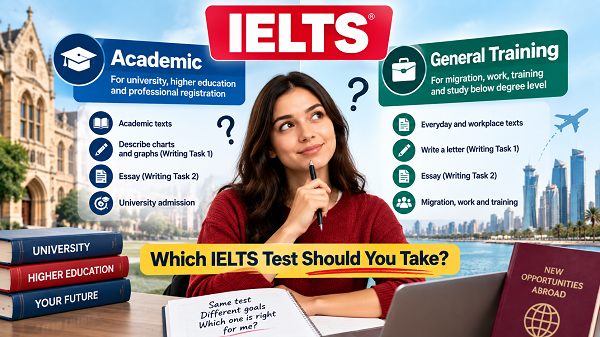
If you are planning to take an IELTS test, one of the first decisions you need to make is whether you should take IELTS Academic or IELTS General Training.
This is an important decision because the two tests are designed for different purposes.
You may need IELTS for:
- University admission
- Higher education
- Professional registration
- Immigration
- Employment
- Work-related training
- Study below degree level
The good news is that choosing the right test becomes much easier once you understand what each version is designed for.
The most important rule is simple:
Do not choose IELTS Academic or General Training based on which test you think is easier. Choose the test required for your specific purpose.
IELTS Academic is primarily designed for higher education and certain professional registration purposes. IELTS General Training is mainly intended for migration, work experience, training and study below degree level.
If you are planning to take IELTS in Qatar, this guide explains the differences between IELTS Academic and IELTS General Training, including the Reading and Writing sections, who should take each test and how to choose the right one for your goals.
IELTS Academic vs General Training: The Quick Answer
The easiest way to decide which IELTS test you need is to start with your goal.
Choose IELTS Academic If You Are:
- Applying to a university
- Planning undergraduate study
- Planning postgraduate study
- Applying for higher education
- Applying for certain professional registration purposes
- Specifically required to provide IELTS Academic by an institution
Choose IELTS General Training If You Are:
- Applying for migration
- Seeking work experience
- Completing work-related training
- Planning to study below degree level
- Applying to a programme that specifically requires IELTS General Training
However, there is one important rule:
Always check the exact English-language requirement of the organisation receiving your IELTS result.
A university, employer, professional body or immigration authority may have its own requirements.
Do not assume that every university, employer or immigration programme accepts the same IELTS test.
What Is IELTS Academic?
IELTS Academic is designed to assess whether your English ability is suitable for an academic environment.
It is generally used by people who plan to study at a university or higher-education institution where English is the language of instruction.
IELTS Academic can be relevant for:
- Undergraduate study
- Postgraduate study
- Master’s programmes
- PhD programmes
- Higher education
- Certain professional registration requirements
The test includes language and tasks designed to reflect situations you may encounter in academic study.
Who Should Take IELTS Academic?
IELTS Academic may be the appropriate choice if your university or professional organisation specifically asks for it.
For example, a university might state:
IELTS Academic overall 6.5, with no individual band below 6.0.
If that is the requirement, you need to take IELTS Academic.
Taking General Training because you believe it may be easier would not solve the problem if the institution specifically requires Academic.
IELTS Academic for University Admission
If you are applying to a university abroad, check the official English-language requirements for your specific programme before booking your IELTS test.
A university may specify:
- IELTS Academic
- Minimum overall Band Score
- Minimum score in each skill
- A programme-specific requirement
- A particular result validity period
- A deadline for submitting your result
Requirements can vary significantly between universities and even between programmes at the same university.
Therefore, check the university’s official requirements before booking IELTS in Qatar.
What Is IELTS General Training?
IELTS General Training focuses more on practical English used in everyday, workplace and social situations.
It is commonly used for:
- Immigration
- Work-related purposes
- Work experience
- Workplace training
- Study below degree level
IELTS identifies migration to countries such as Australia, Canada, New Zealand and the UK as an important use of General Training.
However, the exact IELTS requirement depends on the immigration programme or organisation.
Who Should Take IELTS General Training?
General Training may be appropriate if you:
- Need IELTS for a migration pathway
- Need English certification for certain work purposes
- Are completing work-related training
- Plan to study below degree level
- Are applying for a programme that specifically requires General Training
Before booking, confirm the exact requirement of the organisation handling your application.
IELTS Academic vs General Training: What’s the Main Difference?
Both IELTS Academic and IELTS General Training assess the same four English skills:
- Listening
- Reading
- Writing
- Speaking
However, Reading and Writing are different, while Listening and Speaking are the same.
This is one of the most important differences to understand.
| Feature | IELTS Academic | IELTS General Training |
|---|---|---|
| Main purpose | Higher education and certain professional registration | Migration, work, training and below-degree study |
| Undergraduate study | Yes, where required | Usually not the appropriate option |
| Postgraduate study | Yes, where required | Usually not the appropriate option |
| Professional registration | Yes, where required | Depends on organisation |
| Immigration | Depends on pathway | Commonly used for many migration purposes |
| Listening | Same | Same |
| Speaking | Same | Same |
| Reading | Different | Different |
| Writing | Different | Different |
| Writing Task 1 | Visual information | Letter |
| Writing Task 2 | Essay | Essay |
| Reading context | Academic-style texts | Everyday, workplace and general-interest texts |
The key point is:
You are not taking two completely different English exams.
The Reading and Writing components are adapted to reflect different language needs.
IELTS Academic vs General Training Listening
The Listening test is the same for IELTS Academic and General Training.
This means you do not need to prepare for a completely different Listening test depending on which version you take.
IELTS Listening contains four parts and 40 questions.
You hear the recordings once and answer the questions based on the information you hear.
The test can include a range of English accents, so your preparation should expose you to different varieties of spoken English.
How to Prepare for IELTS Listening
Whether you take Academic or General Training, practise:
- Identifying key information
- Following conversations
- Understanding different accents
- Predicting possible answers
- Recognising paraphrasing
- Checking spelling
- Following instructions carefully
- Managing concentration throughout the recording
Because Listening is the same in both versions, you can use the same core preparation strategies.
IELTS Academic vs General Training Speaking
The Speaking test is also the same for Academic and General Training.
IELTS Speaking is conducted as a live interview with an examiner and lasts approximately 11–14 minutes.
The test has three parts and assesses your ability to communicate effectively in English.
What Should You Practise for IELTS Speaking?
Your preparation should focus on:
- Fluency
- Vocabulary
- Grammar
- Pronunciation
- Developing answers
- Expressing opinions
- Describing experiences
- Responding naturally
One common misconception is that Academic Speaking is significantly more academic because Academic IELTS is designed for university applicants.
That is not the case.
Listening and Speaking are shared between IELTS Academic and General Training.
The major differences are in Reading and Writing.
IELTS Academic vs General Training Reading
Reading is where the difference becomes much more noticeable.
Both tests contain 40 questions and have a 60-minute Reading section, but the texts and contexts differ.
IELTS Academic Reading
Academic Reading uses texts suitable for an academic environment.
You may encounter:
- Descriptive texts
- Explanatory texts
- Arguments
- Academic-style articles
- Research-related topics
- Texts adapted from books, journals and other sources
The purpose is to assess whether your reading ability is suitable for academic study.
IELTS General Training Reading
General Training Reading focuses more on practical and everyday contexts.
Texts can include:
- Notices
- Advertisements
- Timetables
- Workplace documents
- Job descriptions
- Training information
- General-interest articles
The General Training Reading test moves from practical everyday texts toward workplace material and longer general-interest texts.
Is IELTS Academic Reading Harder Than General Training?
This is one of the most common IELTS questions.
You may hear people say:
“General Training Reading is easier than Academic Reading.”
There is a reason some candidates perceive it this way: the texts are designed for different purposes and General Training includes more everyday and practical material.
However, you should not use perceived difficulty to decide which IELTS test to take.
Academic Reading is designed around the demands of academic study, while General Training Reading is designed around practical and workplace contexts.
The important question is:
Which IELTS test does your organisation require?
If your university requires Academic, General Training is not a substitute.
IELTS Academic vs General Training Writing
Writing is the other major difference between the two IELTS versions.
Both tests contain two Writing tasks, and the Writing test lasts 60 minutes.
However, Task 1 is different.
IELTS Academic Writing
Academic Writing Task 1
In Academic Writing Task 1, you are generally asked to describe, summarise or explain visual information.
This may include:
- Graphs
- Charts
- Tables
- Diagrams
- Processes
You need to identify the most important information, make relevant comparisons and organise your response clearly.
Academic Writing Task 1 requires at least 150 words.
Academic Writing Task 2
Academic Writing Task 2 requires an essay.
You may be asked to:
- Discuss an issue
- Give your opinion
- Discuss advantages and disadvantages
- Explain causes and solutions
- Discuss different views
Task 2 requires at least 250 words.
It also carries greater weight in the overall Writing score than Task 1.
IELTS General Training Writing
General Training Writing Task 1
General Training Writing Task 1 is different from Academic Task 1.
Instead of describing a graph or chart, you write a letter based on a given situation.
The letter may be:
- Personal
- Semi-formal
- Formal
You may need to:
- Request information
- Explain a situation
- Make a complaint
- Give advice
- Respond to a specific circumstance
General Training Writing Task 1 requires at least 150 words.
General Training Writing Task 2
General Training Writing Task 2 is an essay.
It requires at least 250 words and contributes more to the Writing score than Task 1.
IELTS Academic vs General Writing: Quick Comparison
| Writing Feature | IELTS Academic | IELTS General Training |
|---|---|---|
| Task 1 | Graph, chart, table, diagram or process | Letter |
| Minimum Task 1 length | 150 words | 150 words |
| Task 2 | Essay | Essay |
| Minimum Task 2 length | 250 words | 250 words |
| Task 2 weighting | Higher | Higher |
| Main context | Academic | Everyday and workplace |
This difference is extremely important during preparation.
If you accidentally prepare for the wrong test, you could spend weeks practising the wrong Writing Task 1.
IELTS Academic vs General Training for University
If your goal is university admission, IELTS Academic is generally the relevant choice.
It is designed for candidates entering higher education, including undergraduate and postgraduate study.
However, you should never rely only on general advice.
Before booking your test, check:
- Required IELTS test type
- Overall Band Score
- Minimum score in each skill
- Whether the university accepts your chosen IELTS delivery format
- Programme-specific requirements
- Application deadline
For example, one university may require:
Overall 6.5 with no individual component below 6.0.
Another university or programme may require a different score.
The institution determines the requirement.
IELTS Academic vs General Training for Immigration
For immigration, IELTS General Training is commonly used, but the correct test depends on the specific country and immigration pathway.
Different programmes can have different requirements concerning:
- IELTS test type
- Overall Band Score
- Individual skill scores
- Approved test centres
- Test validity
- Visa category
- English-language level
Some routes may require a particular IELTS format or an approved test specifically for immigration purposes.
Therefore, never assume that every immigration application requires General Training.
Check the official requirements for your exact visa or migration programme before booking.
IELTS Academic vs General Training for Work
If you are taking IELTS for employment, the correct test depends on what your employer or professional organisation requires.
General Training can be relevant for workplace and practical English purposes.
However, Academic may be required for certain professional registration processes.
This is particularly important for regulated professions.
If you are applying for professional registration, licensing or membership, check the requirements of the relevant professional body before booking.
Do not assume that General Training is automatically sufficient simply because your goal involves work.
IELTS Academic vs General Training for Professional Registration
Professional registration is an area where choosing the wrong IELTS test can create significant problems.
Some professional organisations require IELTS Academic because they need evidence of English proficiency appropriate to a professional or academic environment.
If you need IELTS for professional registration:
- Identify the organisation responsible for registration.
- Check which IELTS test it accepts.
- Confirm the required overall Band Score.
- Check minimum scores for individual skills.
- Confirm any validity requirements.
- Check the result deadline.
- Book the correct IELTS test.
Do this before you start preparing for the exam.
Can You Use IELTS General Training Instead of Academic?
Sometimes, but not when the organisation specifically requires Academic.
For example, if a university states:
“IELTS Academic required”
you should not assume that a high General Training score will be accepted instead.
The same principle applies to professional registration and other applications.
The safest approach is to check directly with the organisation receiving your IELTS result.
Is IELTS General Training Easier Than Academic?
This is a common question, but it is important to understand what “easier” really means.
General Training Reading contains more practical and everyday texts, while Academic Reading focuses more on academic-style material.
This can make General Training feel more familiar to some candidates.
However, the tests are designed for different purposes and have different requirements.
You should not choose General Training simply because you believe it will be easier.
If your university requires Academic, you need Academic.
If your migration pathway requires General Training, you need to meet that requirement.
The correct test is more important than perceived difficulty.
Can You Switch from Academic to General Training?
Do not assume that you can change your IELTS test type after booking.
Transfer and cancellation policies depend on the test provider and the circumstances of your booking.
If you realise that you selected the wrong IELTS test:
- Contact the test centre as soon as possible.
- Explain your situation.
- Ask whether a transfer is possible.
- Confirm any applicable conditions or fees.
The best approach is to verify your test type before completing the booking.
IELTS Academic vs General Training in Qatar
If you are looking for an IELTS test in Qatar, both Academic and General Training are available depending on the test centre and session.
Before booking IELTS in Qatar, confirm:
- Which IELTS test you need
- Required Band Score
- Available test dates
- Test centre location
- Current test fee
- Test delivery format
- Result timeline
- Identification requirements
Do not assume that every test centre offers every IELTS test type on every date.
Availability can vary by centre and session.
IELTS Academic in Doha
If you are applying to a university or higher-education programme, you will often need IELTS Academic.
Before booking at an IELTS test centre in Doha, check your university’s requirements first.
IELTS General Training in Doha
If you need IELTS for migration, work or another practical purpose, confirm whether General Training is the required test.
Then compare the available test centres and dates in Doha or elsewhere in Qatar.
IELTS Academic vs General Training: What About Computer IELTS?
The choice between Academic and General Training is separate from the choice of test delivery format.
You are essentially making two decisions.
Decision 1: Which IELTS Test?
- IELTS Academic
- IELTS General Training
Decision 2: Which Available Delivery Option?
Depending on the centre and current availability, you may have computer-based options and other delivery arrangements.
This is particularly important in Qatar because IELTS test delivery has changed significantly in 2026.
Always check the current test options offered by your selected centre before booking.
How Should You Prepare for IELTS Academic?
Once you know you need Academic, your preparation should focus on the Academic test format.
Spend significant preparation time on:
- Academic Reading
- Academic Writing Task 1
- IELTS Writing Task 2
- Academic vocabulary
- Complex texts
- Listening
- Speaking
- Time management
- Full IELTS practice tests
Academic Reading Practice
Practise identifying:
- Main ideas
- Supporting details
- Specific information
- Writer’s views
- Paraphrasing
- Relationships between ideas
Academic Writing Practice
Pay particular attention to:
- Task 1 structure
- Overview writing
- Data comparison
- Academic vocabulary
- Essay organisation
- Coherence and cohesion
- Grammar
- Task response
Do not prepare for Academic Writing Task 1 by practising General Training letters.
How Should You Prepare for IELTS General Training?
If you need General Training, your preparation should match its specific Reading and Writing formats.
Focus on:
- General Training Reading
- Letter writing
- IELTS Writing Task 2
- Everyday vocabulary
- Workplace English
- Listening
- Speaking
- Time management
- Full practice tests
General Training Reading Practice
Practise with:
- Notices
- Advertisements
- Instructions
- Workplace texts
- Job-related information
- General-interest articles
General Training Writing Practice
Spend time practising different types of letters, including:
- Formal letters
- Semi-formal letters
- Informal letters
Also practise IELTS Writing Task 2 essays because Task 2 remains an important part of the General Training Writing test.
How to Know Which IELTS Test You Need
If you are still unsure, follow these steps.
Step 1: Identify Your Goal
Ask yourself:
- Am I applying to university?
- Am I applying for immigration?
- Do I need professional registration?
- Do I need IELTS for work?
- Am I completing training?
- Am I studying below degree level?
Step 2: Identify the Organisation
Find the organisation responsible for your application.
This could be:
- A university
- Government authority
- Employer
- Professional body
- Immigration authority
- Training institution
Step 3: Check the Official Requirement
Look specifically for the IELTS test type.
Do not stop at the required Band Score.
Step 4: Check Individual Skill Requirements
You may need minimum scores in:
- Listening
- Reading
- Writing
- Speaking
Step 5: Check Your Deadline
Make sure you have enough time to prepare, take IELTS and receive your result.
Step 6: Book the Correct Test
Only after confirming the requirements should you book your IELTS test.
Common Mistakes When Choosing IELTS Academic vs General Training
Choosing the Test You Think Is Easier
Perceived difficulty should not determine your test choice.
Assuming General Training Is Accepted Everywhere
It is not automatically accepted for university or professional applications.
Assuming Academic Is Accepted for Every Immigration Route
Immigration requirements depend on the specific pathway.
Preparing for the Wrong Writing Task 1
Academic Task 1 and General Training Task 1 are completely different formats.
Booking Before Checking the Requirement
Always verify the IELTS test type before making your booking.
Ignoring Individual Band Requirements
A university or organisation may require a minimum score in each skill, not just an overall Band Score.
IELTS Academic vs General Training: Quick Decision Table
| Your Goal | Likely IELTS Test |
|---|---|
| Undergraduate university study | IELTS Academic |
| Master’s degree | IELTS Academic |
| PhD | IELTS Academic |
| Higher education | IELTS Academic |
| Professional registration | IELTS Academic where required |
| Migration | IELTS General Training commonly used, depending on pathway |
| Work-related training | IELTS General Training where required |
| Study below degree level | IELTS General Training where required |
| Employer requirement | Whichever test the employer specifies |
Always verify the exact requirement with the organisation receiving your result.
FAQ: IELTS Academic vs General Training
Is IELTS Academic harder than General Training?
The tests are designed for different purposes. Academic Reading and General Training Reading use different types of texts, so one may feel more difficult depending on your background. However, you should choose the test required for your purpose rather than based on perceived difficulty.
Is IELTS General Training easier to get a high score?
Not necessarily. Your score depends on your performance, preparation and familiarity with the test. General Training should not be chosen simply because you believe it is easier.
Can I use IELTS General Training for university?
This depends on the university and programme, but many higher-education applications require IELTS Academic. Always check the official admission requirement.
Can I use IELTS Academic for immigration?
That depends on the country, visa category and immigration pathway. Check the official requirements for your specific application.
Is IELTS Speaking different between Academic and General Training?
No. The Speaking test is the same for both versions.
Is IELTS Listening different between Academic and General Training?
No. Listening is the same for both Academic and General Training.
Which IELTS sections are different?
The Reading and Writing sections are different. Listening and Speaking are the same.
Is IELTS Writing Task 1 the same for Academic and General Training?
No. Academic Task 1 generally requires you to describe or summarise visual information. General Training Task 1 requires you to write a letter.
Is IELTS Writing Task 2 the same for Academic and General Training?
Both versions include an essay-based Task 2, although the topics and task wording can differ.
Which IELTS test should I take for university?
IELTS Academic is generally the appropriate test for higher education, but you should always confirm your university’s specific requirement.
Which IELTS test should I take for immigration?
The answer depends on your country and immigration pathway. General Training is commonly used for migration, but you must check the exact requirement.
Which IELTS test should I take for work?
It depends on your employer, profession and purpose. General Training can be relevant for work-related purposes, while some professional registration bodies require Academic.
Can I change my IELTS test type after booking?
This depends on the test provider and booking conditions. If you think you selected the wrong test, contact your test centre as soon as possible.
Book Your IELTS Test in Qatar With IFI
Once you know whether you need IELTS Academic or IELTS General Training, the next step is choosing a suitable test date and test centre.
If you are planning to take IELTS in Qatar, make sure you confirm:
- Your IELTS test type
- Target Band Score
- Test date
- Test centre
- Delivery format
- Current fee
- Result deadline
If you are looking for an IELTS test centre in Doha, IFI can help you take the next step toward your IELTS goal.
Ready to take IELTS in Qatar?
Confirm the IELTS test required for your application, choose a suitable test date and start preparing for your target Band Score.
Final Verdict: IELTS Academic or General Training?
So, IELTS Academic vs General Training—which test should you take?
The answer depends on your goal.
Choose IELTS Academic if you need IELTS for:
- University
- Higher education
- Undergraduate study
- Postgraduate study
- Professional registration where Academic is required
Choose IELTS General Training if you need IELTS for:
- Migration
- Work-related purposes
- Training
- Study below degree level
- A programme that specifically requires General Training
The most important thing to remember is that Listening and Speaking are the same in both tests, while Reading and Writing are different.
Do not choose your IELTS test because you think one version is easier.
Instead:
- Identify your goal.
- Find the organisation responsible for your application.
- Check its official IELTS requirement.
- Confirm the required test type.
- Check the required Band Score.
- Book the correct test.
- Prepare specifically for that version of IELTS.
If you are planning to take IELTS in Qatar, confirm your test type before booking and then choose the test centre, date and preparation strategy that fit your goals.
The right IELTS test is the one that meets your actual requirement—and the right preparation is what helps you achieve the score you need.