

Currently Empty: ر.ق 0,00


IELTS
100 Essential IELTS Vocabulary Words for Band 7 and Above
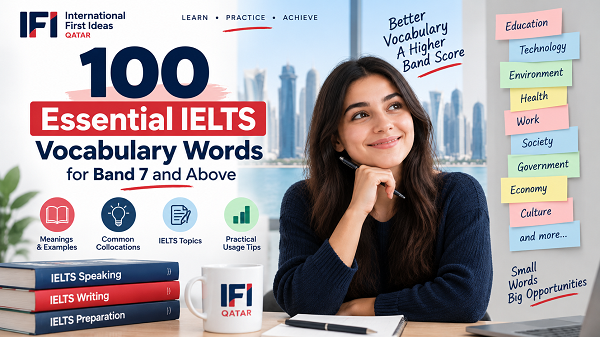
Building a strong vocabulary is an important part of IELTS preparation, especially if you are aiming for Band 7 or higher. However, achieving a high IELTS score does not mean memorising hundreds of complicated words.
What matters is your ability to use vocabulary accurately, naturally, flexibly, and appropriately.
A candidate who uses a common word correctly can perform better than someone who uses an advanced word incorrectly or out of context. Effective IELTS vocabulary preparation should therefore focus on meaning, context, collocations, paraphrasing, and practical usage.
In this guide, you will find 100 essential IELTS vocabulary words organised around common IELTS topics, including education, technology, environment, health, work, society, government, economy, culture, and academic English.
Use this list as a starting point for your IELTS vocabulary practice, but remember that memorising words is only the first step. To make new vocabulary part of your active English, you need to use it regularly in IELTS Speaking and Writing practice.
What Vocabulary Do You Need for IELTS Band 7?
IELTS Writing and Speaking assess your Lexical Resource, which includes the range, accuracy, flexibility, and appropriateness of your vocabulary.
For a strong Band 7 performance, you should be able to:
- Use a sufficient range of vocabulary
- Choose words precisely
- Use less common vocabulary appropriately
- Use natural collocations
- Avoid excessive repetition
- Adapt vocabulary to different contexts
- Demonstrate awareness of style and meaning
- Make only occasional errors in word choice or word formation
This does not mean that every sentence needs an advanced word.
For IELTS Band 7 and above, precision is more important than complexity. Your goal should be to communicate ideas clearly and naturally rather than trying to make every sentence sound complicated.
100 Essential IELTS Vocabulary Words
The following IELTS vocabulary words are organised by common topics that frequently appear in IELTS Speaking and Writing.
Each word includes a definition and an example sentence so you can understand how it is used in context.
IELTS Vocabulary for Education
Education is one of the most common IELTS topics. These words can help you discuss schools, universities, learning, academic achievement, and educational policy.
1. Academic
Meaning: Related to education, study, or schools and universities.
Example:
“Students need strong academic skills to succeed at university.”
2. Curriculum
Meaning: The subjects, topics, and content included in an educational programme.
Example:
“Schools should regularly update their curriculum to meet the changing needs of students.”
3. Assessment
Meaning: The process of evaluating someone’s knowledge, skills, or ability.
Example:
“Continuous assessment can provide a more accurate picture of student progress.”
4. Literacy
Meaning: The ability to read and write.
Example:
“Improving literacy should be a major priority in developing countries.”
5. Tuition
Meaning: The cost of instruction, particularly at a college or university.
Example:
“High tuition fees can prevent talented students from attending university.”
6. Scholarship
Meaning: Financial support given to a student to help pay for education.
Example:
“She received a scholarship to study engineering abroad.”
7. Vocational
Meaning: Related to education or training for a particular occupation.
Example:
“Vocational education can prepare young people for practical careers.”
8. Compulsory
Meaning: Required by law or by a rule.
Example:
“Some countries make secondary education compulsory.”
9. Institution
Meaning: An organisation established for a particular purpose, especially education.
Example:
“Students should carefully research an educational institution before applying.”
10. Attainment
Meaning: The level of achievement reached, particularly in education.
Example:
“Parental support can have a significant effect on educational attainment.”
IELTS Vocabulary for Technology
Technology is another common IELTS topic, particularly in questions about artificial intelligence, communication, employment, education, and modern life.
11. Innovation
Meaning: A new idea, method, product, or technology.
Example:
“Technological innovation has transformed the way people communicate.”
12. Automation
Meaning: The use of technology to perform tasks with little human involvement.
Example:
“Automation could replace some repetitive jobs in the future.”
13. Artificial
Meaning: Made or produced by humans rather than occurring naturally.
Example:
“Artificial intelligence is changing many aspects of modern life.”
14. Digital
Meaning: Relating to technology that uses electronic data.
Example:
“Digital services have made banking much more convenient.”
15. Cybersecurity
Meaning: The protection of computer systems, networks, and information from digital attacks.
Example:
“Companies need to invest more in cybersecurity to protect customer data.”
16. Connectivity
Meaning: The ability to connect to or communicate through a network.
Example:
“Improved internet connectivity can create educational opportunities in remote areas.”
17. Accessible
Meaning: Easy to reach, use, obtain, or understand.
Example:
“Online courses have made education more accessible to people around the world.”
18. Disrupt
Meaning: To significantly change or interrupt an existing system, industry, or activity.
Example:
“New technologies can disrupt traditional industries.”
19. Emerging
Meaning: Beginning to exist, develop, or become widely known.
Example:
“Governments need to prepare for emerging technologies.”
20. Transform
Meaning: To change something significantly.
Example:
“Technology has transformed the modern workplace.”
IELTS Vocabulary for the Environment
Environmental topics are common in IELTS Writing Task 2 and Speaking. These words can help you discuss climate change, pollution, energy, wildlife, and natural resources.
21. Sustainable
Meaning: Able to continue over the long term without causing unacceptable environmental or social damage.
Example:
“Governments should encourage sustainable forms of transportation.”
22. Ecosystem
Meaning: A community of living organisms and their physical environment.
Example:
“Plastic pollution can seriously damage marine ecosystems.”
23. Biodiversity
Meaning: The variety of plants, animals, and other living organisms in a particular environment.
Example:
“Deforestation is a major threat to biodiversity.”
24. Conservation
Meaning: The protection of nature, natural resources, or wildlife.
Example:
“Wildlife conservation requires cooperation between governments and local communities.”
25. Emission
Meaning: The release of gases or other substances into the atmosphere.
Example:
“Reducing carbon emissions is essential for addressing climate change.”
26. Renewable
Meaning: Naturally replaced and therefore unlikely to run out.
Example:
“Solar power is a renewable source of energy.”
27. Pollution
Meaning: Harmful substances or waste introduced into the environment.
Example:
“Air pollution is a serious problem in many large cities.”
28. Depletion
Meaning: A reduction in the amount of something because it has been used.
Example:
“The depletion of natural resources could create serious economic problems.”
29. Contamination
Meaning: The presence of harmful or unwanted substances in something.
Example:
“Industrial waste can cause water contamination.”
30. Climate
Meaning: The typical weather conditions of a region over a long period.
Example:
“Human activity is contributing to changes in the global climate.”
IELTS Vocabulary for Health
Health is a frequent IELTS topic, covering areas such as lifestyle, healthcare systems, nutrition, disease prevention, and public health.
31. Obesity
Meaning: A medical condition involving excessive body weight that can increase health risks.
Example:
“Governments are introducing policies to tackle childhood obesity.”
32. Nutrition
Meaning: The process of obtaining the food and nutrients necessary for health and growth.
Example:
“Schools should teach children about healthy nutrition.”
33. Sedentary
Meaning: Involving little physical activity.
Example:
“A sedentary lifestyle can increase the risk of several health problems.”
34. Well-being
Meaning: A person’s general health, happiness, and quality of life.
Example:
“Regular exercise can improve both physical and mental well-being.”
35. Prevention
Meaning: Action taken to stop something from happening.
Example:
“Prevention is often more effective and less expensive than medical treatment.”
36. Treatment
Meaning: Medical care given to deal with an illness or health condition.
Example:
“Access to affordable treatment remains a challenge in some countries.”
37. Healthcare
Meaning: Services provided to maintain or improve people’s health.
Example:
“Governments have a responsibility to provide accessible healthcare.”
38. Epidemic
Meaning: A widespread occurrence of a disease in a particular population or region.
Example:
“Public health systems must be prepared to respond quickly to an epidemic.”
39. Chronic
Meaning: Continuing for a long time or occurring repeatedly.
Example:
“Chronic diseases place significant pressure on healthcare systems.”
40. Medication
Meaning: Medicine used to treat or prevent illness.
Example:
“Some patients rely on medication to manage long-term conditions.”
IELTS Vocabulary for Work and Employment
Work and employment are common IELTS topics, particularly when discussing careers, workplace changes, technology, salaries, and productivity.
41. Employment
Meaning: The state of having paid work.
Example:
“Government policies can influence employment opportunities.”
42. Workforce
Meaning: All the people who are available to work in an organisation, industry, or country.
Example:
“A highly skilled workforce can strengthen a country’s economy.”
43. Productivity
Meaning: The amount of work or output produced during a particular period.
Example:
“Flexible working arrangements may improve employee productivity.”
44. Profession
Meaning: A job that usually requires specialised education or training.
Example:
“Medicine is a demanding but highly respected profession.”
45. Qualification
Meaning: An official achievement, skill, or certificate that makes someone suitable for a job or activity.
Example:
“Many employers require applicants to have relevant qualifications.”
46. Entrepreneur
Meaning: A person who starts and manages a business.
Example:
“Young entrepreneurs can contribute significantly to economic growth.”
47. Career
Meaning: The progression of a person’s working life.
Example:
“Internships can help students make informed career decisions.”
48. Workplace
Meaning: The place where someone works.
Example:
“Technology has changed the modern workplace considerably.”
49. Flexible
Meaning: Able to change or adapt easily.
Example:
“Flexible working hours can help employees achieve a better work-life balance.”
50. Remuneration
Meaning: Payment or financial reward for work.
Example:
“Competitive remuneration can help companies attract skilled workers.”
IELTS Vocabulary for Society
Society-related vocabulary is useful when discussing inequality, communities, population changes, culture, immigration, and social problems.
51. Inequality
Meaning: An unfair difference between people or groups.
Example:
“Education can play an important role in reducing social inequality.”
52. Poverty
Meaning: The condition of being extremely poor.
Example:
“Governments need long-term strategies to reduce poverty.”
53. Community
Meaning: A group of people living in the same area or sharing common interests.
Example:
“Local communities should be involved in decisions that affect them.”
54. Diversity
Meaning: The presence of people or things with different characteristics, backgrounds, or perspectives.
Example:
“Cultural diversity can make cities more vibrant and dynamic.”
55. Integration
Meaning: The process of becoming part of a larger group or society.
Example:
“Language education can support the integration of immigrants.”
56. Discrimination
Meaning: Unfair treatment of people based on particular characteristics.
Example:
“Employers should take stronger measures to prevent workplace discrimination.”
57. Welfare
Meaning: The health, happiness, and general well-being of people.
Example:
“Public policies should focus on the welfare of vulnerable groups.”
58. Population
Meaning: All the people living in a particular place.
Example:
“An ageing population creates new challenges for healthcare systems.”
59. Urbanisation
Meaning: The growth of cities as more people move to urban areas.
Example:
“Rapid urbanisation can put pressure on housing and public transportation.”
60. Generation
Meaning: A group of people born and living around the same period.
Example:
“Different generations may have contrasting attitudes toward technology.”
IELTS Vocabulary for Government and Politics
Government vocabulary is particularly useful for IELTS Writing Task 2 essays about laws, public services, social problems, and government responsibility.
61. Policy
Meaning: An official plan or course of action.
Example:
“The government introduced a new policy to reduce traffic congestion.”
62. Legislation
Meaning: Laws or a group of laws.
Example:
“Stricter environmental legislation could reduce industrial pollution.”
63. Regulation
Meaning: An official rule designed to control an activity.
Example:
“Effective regulations are necessary to protect consumers.”
64. Implement
Meaning: To put a plan, decision, or policy into effect.
Example:
“Governments must implement effective measures to address climate change.”
65. Allocate
Meaning: To officially give or distribute resources for a particular purpose.
Example:
“Governments should allocate more funding to public education.”
66. Public
Meaning: Relating to the government, community, or society rather than private individuals.
Example:
“Investment in public transportation can reduce traffic congestion.”
67. Authority
Meaning: The power or responsibility to make decisions or enforce rules.
Example:
“Local authorities should improve public transportation services.”
68. Reform
Meaning: A change introduced to improve a system.
Example:
“Education reform may be necessary to prepare students for future jobs.”
69. Subsidy
Meaning: Financial support provided by a government.
Example:
“Energy subsidies can encourage households to adopt renewable technologies.”
70. Governance
Meaning: The way an organisation, country, or society is controlled and managed.
Example:
“Effective governance is essential for sustainable economic development.”
IELTS Vocabulary for Economy and Development
These words are useful for essays and Speaking questions about economic growth, employment, infrastructure, business, development, and living standards.
71. Economy
Meaning: The system through which a country produces, distributes, and consumes goods and services.
Example:
“Tourism plays an important role in the local economy.”
72. Economic
Meaning: Related to the economy or financial activity.
Example:
“Education can have significant economic benefits.”
73. Prosperity
Meaning: A state of success and financial well-being.
Example:
“Economic prosperity can improve people’s quality of life.”
74. Investment
Meaning: The use of money or resources with the expectation of achieving a benefit.
Example:
“Investment in infrastructure can support long-term economic growth.”
75. Infrastructure
Meaning: The basic systems and facilities needed for a society or economy to function.
Example:
“Developing countries often require substantial investment in infrastructure.”
76. Revenue
Meaning: Money received by a government, business, or organisation.
Example:
“Tourism can generate significant revenue for local businesses.”
77. Consumer
Meaning: A person who buys or uses goods and services.
Example:
“Consumers are increasingly interested in environmentally friendly products.”
78. Industry
Meaning: A particular area of economic or commercial activity.
Example:
“The technology industry has created thousands of new jobs.”
79. Growth
Meaning: An increase in size, amount, activity, or economic output.
Example:
“Sustainable economic growth should benefit different sections of society.”
80. Development
Meaning: Growth or improvement in economic, social, or other conditions.
Example:
“Education is closely connected with social and economic development.”
IELTS Vocabulary for Communication and Culture
Culture and communication vocabulary can help you discuss globalisation, international travel, cultural identity, language, and social interaction.
81. Cultural
Meaning: Related to the customs, beliefs, traditions, and practices of a society.
Example:
“International travel provides valuable cultural experiences.”
82. Heritage
Meaning: Traditions, buildings, customs, and cultural practices passed from previous generations.
Example:
“Historic buildings are an important part of a country’s cultural heritage.”
83. Tradition
Meaning: A custom or belief passed from one generation to another.
Example:
“Globalisation can influence traditional lifestyles.”
84. Identity
Meaning: The characteristics, beliefs, and qualities that define a person or group.
Example:
“Language plays an important role in cultural identity.”
85. Multicultural
Meaning: Including people or cultures from different backgrounds.
Example:
“Doha is a multicultural city with residents from many countries.”
86. Perspective
Meaning: A particular way of viewing or understanding something.
Example:
“Travelling can give people a broader perspective on other cultures.”
87. Interaction
Meaning: Communication or activity between people or groups.
Example:
“Social media has increased interaction between people across borders.”
88. Communication
Meaning: The exchange of information, ideas, or feelings.
Example:
“Effective communication is essential in both education and the workplace.”
89. Influence
Meaning: The power to affect someone or something.
Example:
“Social media has a significant influence on consumer behaviour.”
90. Exposure
Meaning: The experience of being introduced to or coming into contact with something.
Example:
“Exposure to English-speaking environments can improve language skills.”
General Academic Vocabulary for IELTS
These words are particularly useful for IELTS Writing Task 2 because they can help you express comparisons, consequences, importance, and arguments more precisely.
91. Significant
Meaning: Important or large enough to be noticed.
Example:
“Technology has had a significant impact on education.”
92. Crucial
Meaning: Extremely important.
Example:
“Access to quality education is crucial for economic development.”
93. Beneficial
Meaning: Producing a positive result or advantage.
Example:
“Regular exercise is beneficial for both physical and mental health.”
94. Adverse
Meaning: Having a harmful or negative effect.
Example:
“Excessive screen time can have adverse effects on children’s health.”
95. Consequently
Meaning: As a result.
Example:
“Many people now work remotely; consequently, demand for traditional office space has declined.”
96. Furthermore
Meaning: In addition; used to introduce another supporting point.
Example:
“Public transport reduces traffic. Furthermore, it can lower air pollution.”
97. Whereas
Meaning: Used to compare two different facts or situations.
Example:
“Some people prefer working from home, whereas others perform better in an office.”
98. Nevertheless
Meaning: Despite what has just been said; used to introduce a contrasting point.
Example:
“The project is expensive. Nevertheless, its long-term benefits may justify the cost.”
99. Predominantly
Meaning: Mainly or mostly.
Example:
“The workforce in this industry is predominantly young.”
100. Substantial
Meaning: Large in amount, size, or importance.
Example:
“Governments need to make substantial investments in public infrastructure.”
How to Learn IELTS Vocabulary Effectively
Memorising 100 words does not automatically improve your IELTS score.
The key is turning passive vocabulary into active vocabulary.
For every new word, learn it as a complete unit:
Word → Meaning → Collocation → Example → Your Own Sentence
For example:
Word: Significant
Common Collocations:
- significant impact
- significant increase
- significant difference
- significant role
- significant challenge
Example:
“Technology has had a significant impact on the way people communicate.”
Your Own Sentence:
“Online education has had a significant impact on university students.”
This approach helps you remember not only what a word means but also how it is naturally used.
Learn IELTS Collocations, Not Just Individual Words
One of the most effective ways to improve IELTS vocabulary is to learn words together with the expressions that commonly occur with them.
For example, do not only learn:
economic
Learn:
- economic growth
- economic development
- economic stability
- economic consequences
- economic policy
Instead of learning only:
environment
Learn:
- environmental protection
- environmental damage
- environmental concerns
- environmental impact
- environmental policies
Using natural collocations can make your English more precise and fluent in both IELTS Writing and Speaking.
How to Use Advanced IELTS Vocabulary Naturally
A common IELTS vocabulary mistake is trying to use difficult words in every sentence.
For example:
“The government should ameliorate the deleterious ramifications of vehicular proliferation.”
Although this sentence contains sophisticated vocabulary, it sounds unnecessarily complicated.
A clearer alternative is:
“The government should reduce the negative effects of increasing car use.”
For Band 7 and above, accuracy and natural usage are more important than using complicated words.
Only use advanced vocabulary when it genuinely improves the meaning of your sentence.
IELTS Vocabulary for Writing vs Speaking
Vocabulary should also match the context in which you are communicating.
IELTS Writing Vocabulary
IELTS Writing generally requires a more formal and academic style.
Useful examples include:
- significant
- substantial
- consequently
- legislation
- implementation
- infrastructure
- economic development
IELTS Speaking Vocabulary
IELTS Speaking should sound natural and conversational.
For example, instead of saying:
“I predominantly consume digital media for recreational purposes.”
You could say:
“I mostly use social media and online videos to relax.”
The second sentence sounds more natural in everyday spoken English.
The goal in IELTS Speaking is not to sound like an academic essay. It is to communicate ideas clearly, naturally, and confidently.
How to Memorise IELTS Vocabulary Effectively
1. Learn 5–10 Words at a Time
Trying to memorise 50 or 100 words in one session is usually inefficient.
Choose a small group of words and practise them repeatedly.
2. Use Spaced Repetition
Review new vocabulary at increasing intervals, such as:
- One day later
- Three days later
- One week later
- Two weeks later
3. Create Personal Examples
Use situations from your own life when creating example sentences.
Personal associations can make vocabulary easier to remember.
4. Practise Speaking With New Vocabulary
Choose five new words and speak for two minutes about an IELTS topic.
Try to use the words naturally rather than forcing them into every sentence.
5. Use New Vocabulary in IELTS Writing
Use newly learned vocabulary in IELTS Writing Task 2 paragraphs and essays.
After writing, check whether each word is accurate and appropriate for the context.
A 7-Day IELTS Vocabulary Study Plan
You can use the 100 words in this guide as a one-week starting point.
| Day | Focus | Practice |
|---|---|---|
| Day 1 | Education | Learn 10 words + write example sentences |
| Day 2 | Technology | Learn 10 words + speaking practice |
| Day 3 | Environment | Learn 10 words + write a Task 2 paragraph |
| Day 4 | Health | Learn 10 words + speaking practice |
| Day 5 | Work & Society | Learn 20 words + practise collocations |
| Day 6 | Government & Economy | Learn 20 words + essay practice |
| Day 7 | Review | Test yourself on all 100 words |
After the first week, continue using these words in Speaking and Writing practice rather than simply reviewing the list.
IELTS Vocabulary Mistakes to Avoid
Don’t Use Words You Do Not Fully Understand
Always check the meaning, context, word form, and typical usage before using unfamiliar vocabulary.
Don’t Overuse Synonyms
Replacing every repeated word with a synonym can sometimes make your writing less natural or even change the meaning.
Don’t Memorise Long Lists Without Practice
Recognising a word does not mean that you can use it correctly.
Active vocabulary requires regular production.
Don’t Use Informal Vocabulary in Academic Writing
Words such as “kids,” “stuff,” “a lot of,” and “things” may sometimes be appropriate in conversation, but more precise alternatives are often preferable in formal IELTS Writing.
Don’t Force Advanced Vocabulary
If you are not completely confident that a word is appropriate, use a simpler word that you can use accurately.
Accuracy is more valuable than unnecessary complexity.
Frequently Asked Questions About IELTS Vocabulary
How Many Vocabulary Words Do I Need for IELTS Band 7?
There is no official number of vocabulary words you must know to achieve Band 7.
What matters is your ability to use a sufficient range of vocabulary accurately, appropriately, and flexibly.
What Is the Best Way to Learn IELTS Vocabulary?
Learn vocabulary in context rather than memorising isolated definitions.
Study words with their common collocations, create your own sentences, and use them regularly in IELTS Speaking and Writing practice.
Is Advanced Vocabulary Necessary for IELTS Band 7?
You need a good range of vocabulary, including some less common and precise language, but simply using difficult words does not guarantee a high IELTS score.
Accuracy, flexibility, and natural usage are essential.
How Can I Improve My IELTS Vocabulary Quickly?
Focus on common IELTS topics, learn vocabulary in groups, study collocations, and actively use new words in sentences, essays, and Speaking practice.
Should I Memorise IELTS Vocabulary Lists?
Vocabulary lists can be useful for discovering and reviewing new words, but memorisation alone is not enough.
You need to practise using each word in realistic IELTS contexts.
Which Vocabulary Topics Are Common in IELTS?
Common IELTS topics include:
- Education
- Technology
- Environment
- Health
- Work
- Society
- Government
- Transportation
- Culture
- Globalisation
- Economy
- Development
How Can I Improve My Vocabulary for IELTS Speaking?
Practise discussing common IELTS Speaking topics and focus on expressing your ideas naturally.
Record yourself, identify repeated words, and gradually replace them with more precise expressions where appropriate.
How Can I Improve My Vocabulary for IELTS Writing?
Read high-quality English texts, study topic-specific vocabulary and collocations, and use new words in your own IELTS Writing practice.
After writing, check whether your vocabulary is accurate, relevant, and appropriate for the topic.
Build Your IELTS Vocabulary With IFI Qatar
Developing a strong IELTS vocabulary requires more than memorising lists of difficult words.
You need to know how to use vocabulary naturally in real IELTS tasks, particularly when developing ideas in Writing and Speaking.
At IFI Qatar, our IELTS preparation programmes can help you develop practical English skills while preparing for the specific demands of the IELTS test.
With structured practice and professional guidance, you can work on:
- Topic-specific IELTS vocabulary
- Natural collocations
- IELTS Writing vocabulary
- IELTS Speaking vocabulary
- Paraphrasing skills
- Vocabulary accuracy
- Common IELTS vocabulary mistakes
- Effective IELTS test strategies
If you are aiming for Band 7 or higher, building an active vocabulary should be part of a broader IELTS preparation strategy.
Ready to Improve Your IELTS Vocabulary?
Do not just memorise more words. Learn how to use them effectively.
Join an IELTS Preparation Course with IFI Qatar and develop the vocabulary, language skills, and exam strategies you need to work toward your target IELTS band score.