

Currently Empty: ر.ق 0,00


IELTS
IELTS Speaking Technology Topics: Questions and Sample Answers
Introduction
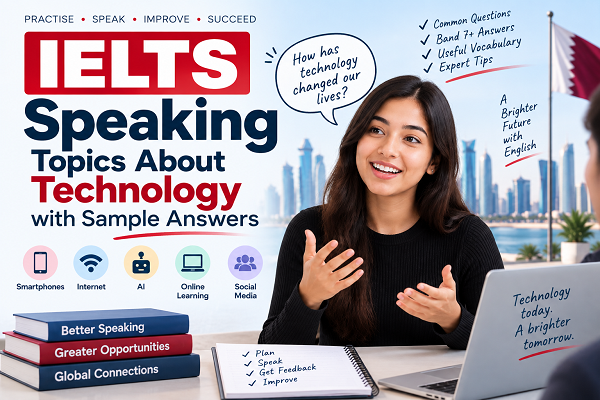
Technology is one of the most useful subjects to prepare for when studying for the IELTS Speaking test. Questions about smartphones, social media, artificial intelligence, the internet, online learning, and digital communication can appear in different forms across the Speaking test.
Preparing for IELTS speaking technology topics does not mean memorising complicated vocabulary or learning perfect answers. Instead, you should develop the ability to talk naturally about technology, explain your opinions, compare advantages and disadvantages, and support your ideas with relevant examples.
In this guide, you will find common IELTS Speaking technology questions, Band 7+ style sample answers, useful vocabulary, and practical strategies to help you discuss technology confidently.
Why Technology Is a Common IELTS Speaking Topic
Technology affects almost every part of modern life. People use it to:
- Communicate
- Work
- Study
- Travel
- Shop
- Access information
- Spend their free time
- Interact with businesses and services
Because technology is familiar to most candidates, it provides IELTS examiners with many opportunities to ask natural questions.
The same general topic can also be adapted to all three parts of the IELTS Speaking test.
IELTS Speaking Part 1 Technology Questions
Part 1 questions usually focus on your personal experiences.
Example:
How often do you use your smartphone?
IELTS Speaking Part 2 Technology Questions
Part 2 may ask you to describe a device, invention, or technological development.
Example:
Describe a piece of technology that you use regularly.
IELTS Speaking Part 3 Technology Questions
Part 3 questions are more abstract and may require you to discuss social changes, advantages, disadvantages, or future developments.
Example:
How has technology changed the way people communicate?
IELTS Speaking Part 1 Technology Questions and Answers
IELTS Speaking Part 1 focuses on familiar topics and personal experiences. Technology questions are usually straightforward, but you should still develop your answers rather than responding with only “yes” or “no.”
How Often Do You Use Technology?
Sample Answer:
I use technology every day, mainly for work, communication, and entertainment. My smartphone is probably the device I use most because I rely on it for messaging, checking information, and managing my daily activities.
What Piece of Technology Do You Use the Most?
Sample Answer:
I probably use my smartphone more than anything else. It’s incredibly convenient because I can use it to communicate with people, check emails, browse the internet, and even study English whenever I have some free time.
Do You Think You Use Your Smartphone Too Much?
Sample Answer:
Sometimes, yes. I try to control how much time I spend on it, but it’s difficult because so many everyday activities depend on smartphones. I particularly notice that I spend too much time on social media when I’m supposed to be studying or working.
What Technology Could You Not Live Without?
Sample Answer:
I would probably choose my laptop. I use it for work, studying, watching videos, and storing important files, so losing access to it would make my daily routine much more difficult.
Did You Use Technology a Lot When You Were a Child?
Sample Answer:
Not nearly as much as children do today. When I was younger, I mostly used technology for watching television or playing simple computer games. Nowadays, children have access to smartphones, tablets, educational apps, and online platforms from a very young age.
Do You Prefer Using a Computer or a Smartphone?
Sample Answer:
It depends on what I’m doing. I prefer using my smartphone for quick tasks such as messaging or searching for something, but I prefer a computer when I need to study, write, or work for a long time because the larger screen and keyboard are more comfortable.
IELTS Speaking Part 2 Technology Questions and Sample Answers
Part 2 requires you to speak continuously for up to two minutes about a given topic.
Technology provides many possibilities for Part 2 cue cards, particularly questions about useful devices, inventions, and technological developments.
Describe a Piece of Technology That You Use Regularly
You should say:
- What it is
- When you started using it
- What you use it for
- And explain why it is important to you
Sample Answer:
One piece of technology that I use almost every day is my smartphone. I’ve had a smartphone for several years, but the way I use it has changed considerably over time.
Initially, I mainly used it for making calls, sending messages, and taking photographs. These days, I use it for much more than that. I check my emails, read the news, use navigation applications, attend online meetings, and sometimes study English through educational applications.
The main reason it’s important to me is convenience. I can access information or communicate with someone almost immediately, regardless of where I am. It has also made certain aspects of my work and education much easier.
Of course, I think there are disadvantages to relying on smartphones too much. They can be distracting, especially when people constantly check social media. Nevertheless, I would find it extremely difficult to manage my daily routine without one.
Describe an Invention That Has Changed People’s Lives
You should say:
- What the invention is
- When it became popular
- How people use it
- And explain how it has changed people’s lives
Sample Answer:
I would probably choose the internet because it has transformed almost every aspect of modern life. Although the internet has existed for decades, its influence has grown enormously as more people have gained access to smartphones and high-speed connections.
People now use the internet for communication, education, entertainment, shopping, banking, and work. One of the biggest changes is that information has become much easier to access. In the past, people often had to visit libraries or contact organisations directly to find information, whereas today they can find answers within seconds.
I think the internet has also changed the workplace. Many people can now work remotely and communicate with colleagues in different countries. However, there are disadvantages, such as misinformation and privacy concerns.
Overall, I think the internet has had a profound impact on society because it has changed not only what people do but also how they interact with the world.
IELTS Speaking Part 3 Technology Questions and Answers
Part 3 questions are more abstract than Part 1 questions. You may need to explain causes, discuss consequences, compare different perspectives, or predict future developments.
How Has Technology Changed the Way People Communicate?
Sample Answer:
Technology has made communication much faster and more convenient. People can now communicate instantly through messaging applications, video calls, and social media, even when they are living in different countries. However, I think there is also a downside because people sometimes rely on digital communication instead of having meaningful face-to-face conversations.
Do You Think Technology Has Made People’s Lives Easier?
Sample Answer:
Overall, yes. Technology has simplified many everyday tasks. People can shop online, use digital banking, work remotely, and access information without leaving home. That said, technology can also create new problems, such as information overload and constant digital distractions, so I think its impact depends largely on how responsibly people use it.
Is Technology Making People Less Social?
Sample Answer:
To some extent, I think it is. Social media allows people to stay connected, but online interaction isn’t always as meaningful as face-to-face communication. For example, someone may have hundreds of online contacts but still have very few close relationships. However, technology can also help people maintain relationships when they live far apart, so I wouldn’t say that it necessarily makes everyone less social.
How Has Technology Changed Education?
Sample Answer:
Technology has made education more accessible and flexible. Students can attend online classes, access digital libraries, watch educational videos, and communicate with teachers remotely. It has also made it easier for learners to study at their own pace. However, technology should complement good teaching rather than completely replace teachers.
Do You Think Artificial Intelligence Will Change the Workplace?
Sample Answer:
Absolutely. Artificial intelligence is likely to automate some repetitive tasks and change the skills that employers value. At the same time, it could create new types of jobs and allow employees to focus on more creative or complex activities. I think the biggest challenge will be helping workers adapt by developing new skills.
Will People Depend More on Technology in the Future?
Sample Answer:
I think so. As technology becomes integrated into areas such as healthcare, transport, education, and finance, people will probably rely on it even more. The challenge will be maintaining a balance between convenience and independence. If people become too dependent on technology, they could struggle when systems fail or when they need to solve problems without digital assistance.
Common IELTS Speaking Technology Topics to Practise
When preparing for technology questions, don’t focus only on smartphones. Build ideas around a wider range of related subjects.
| Technology Topic | Questions You Could Practise |
|---|---|
| Smartphones | How often do you use your phone? |
| Social Media | Has social media changed communication? |
| Artificial Intelligence | How will AI affect jobs? |
| Internet | How important is the internet today? |
| Online Learning | Is online education effective? |
| Computers | Do you prefer computers or phones? |
| Digital Communication | Do people communicate differently now? |
| Online Shopping | Why do people shop online? |
| Technology at Work | Has technology improved productivity? |
| Technology and Children | Should children have smartphones? |
| Privacy | Is personal information safe online? |
| Automation | Will machines replace human workers? |
| Future Technology | What technology will become important? |
| Video Games | Are video games beneficial or harmful? |
| Smart Devices | Are smart homes a good idea? |
Useful IELTS Speaking Technology Vocabulary
You don’t need extremely complicated vocabulary to achieve a strong Speaking score. The key is using words accurately, naturally, and in the right context.
Digital Device
A piece of electronic equipment such as a smartphone, tablet, or computer.
Example:
Most people own several digital devices nowadays.
Artificial Intelligence
Computer systems that can perform tasks that normally require human intelligence.
Example:
Artificial intelligence is becoming increasingly important in the workplace.
Automation
The use of technology to perform tasks with limited human involvement.
Example:
Automation could make some manufacturing processes much more efficient.
Social Media
Online platforms where people communicate and share content.
Example:
Social media has completely changed the way people consume news.
Data Privacy
The protection of personal information.
Example:
Data privacy has become a major concern as people spend more time online.
Screen Time
The amount of time someone spends using a screen-based device.
Example:
Parents are increasingly concerned about their children’s screen time.
Digital Literacy
The ability to use digital technologies effectively and responsibly.
Example:
Digital literacy is becoming an essential skill for students.
Technological Advancement
Progress or development in technology.
Example:
Technological advancements have transformed the healthcare industry.
Useful Technology Collocations for IELTS Speaking
Learning collocations can make your answers sound more natural and precise.
| Collocation | Example |
|---|---|
| Technological advancement | Technological advancements have changed healthcare. |
| Digital technology | Digital technology is now part of everyday life. |
| Online platform | Students can learn through online platforms. |
| Social media platform | Each social media platform serves a different purpose. |
| Artificial intelligence | Artificial intelligence could transform many industries. |
| Internet access | Internet access is essential for modern education. |
| Data privacy | Data privacy is a growing concern. |
| Online communication | Online communication is convenient but sometimes impersonal. |
| Digital skills | Digital skills are important in the modern workplace. |
| Technological innovation | Technological innovation can improve productivity. |
How to Answer IELTS Speaking Technology Questions
Don’t Memorise Complete Answers
Memorising an entire answer can make your speech sound unnatural.
Instead, prepare:
- Useful vocabulary
- Common ideas
- Personal examples
- Flexible sentence structures
For example, don’t memorise a complete answer about smartphones.
Prepare ideas about:
- Convenience
- Communication
- Entertainment
- Education
- Distraction
- Privacy
Then adapt those ideas to different questions.
Use the Point, Explain and Example Method
One of the easiest ways to develop your IELTS Speaking answers is:
Point → Explanation → Example
Question:
Has technology improved education?
Point:
Yes, I think it has.
Explanation:
Students now have access to a much wider range of learning resources.
Example:
For example, they can take online courses or watch lectures from universities in other countries.
Complete Answer:
Yes, I think technology has significantly improved education because students now have access to a much wider range of learning resources. For example, they can take online courses or watch lectures from universities in other countries without having to travel.
Compare the Past and Present
Technology questions frequently invite comparisons.
Useful structures include:
- “In the past…, whereas nowadays…”
- “Compared with previous generations…”
- “Unlike in the past…”
- “These days…”
- “Over the last few decades…”
Example:
In the past, people had to visit a library to find information, whereas nowadays they can access thousands of sources online within seconds.
Discuss Advantages and Disadvantages
For Part 3, showing that you can consider different perspectives can help you develop a stronger response.
Example:
Technology has made communication considerably faster, which is a major advantage. However, excessive reliance on digital communication may reduce face-to-face interaction.
Give Personal Examples in Part 1
Part 1 is about familiar topics, so personal examples can make your answers sound natural.
Instead of:
I use my phone every day.
Try:
I use my phone every day, particularly for checking emails and communicating with my colleagues. I also use it to practise English when I have some free time.
Useful Technology Idioms and Expressions for IELTS Speaking
Idioms can be useful when they fit naturally, but you should not force them into every answer.
At the Touch of a Button
Something can happen very easily or quickly using technology.
Example:
Nowadays, people can order almost anything at the touch of a button.
A Double-Edged Sword
Something that has both positive and negative effects.
Example:
I think social media is a double-edged sword because it connects people but can also create problems with privacy.
Keep Up With the Times
To adapt to modern developments.
Example:
Companies need to keep up with the times if they want to remain competitive.
Common Mistakes in IELTS Speaking Technology Questions
Giving Very Short Answers
Question: Do you use social media?
Weak:
Yes, I do.
Better:
Yes, I use social media fairly regularly, mainly to keep in touch with friends and follow current events. However, I try to limit my usage because it can be quite distracting.
Using Technology Vocabulary Incorrectly
Don’t use words such as “artificial intelligence,” “automation,” or “digitalisation” simply because they sound advanced.
Only use vocabulary that you understand and can use accurately.
Turning Every Answer Into a Debate
Part 1 is conversational.
If the examiner asks:
What technology do you use at home?
You don’t need to give a detailed discussion about the social consequences of technology.
Answer the question naturally and stay focused.
Repeating the Same Words
Avoid:
Technology is good because technology is useful and technology makes life easier.
Instead:
Modern technology has made everyday life considerably more convenient. Digital tools allow people to complete tasks faster and communicate more efficiently.
How to Practise IELTS Speaking Technology Topics at Home
A useful practice routine is to choose one technology topic each day.
Step 1: Choose a Technology Topic
For example:
Artificial Intelligence
Step 2: Learn Useful Vocabulary
For example:
- Automation
- Productivity
- Innovation
- Employment
- Efficiency
- Data privacy
Step 3: Answer Questions From All Three Parts
Part 1:
How often do you use technology?
Part 2:
Describe a technological invention that you find useful.
Part 3:
How might artificial intelligence change people’s jobs?
Step 4: Record Yourself
Listen for:
- Long pauses
- Repeated words
- Grammar mistakes
- Pronunciation problems
- Unnatural expressions
Step 5: Answer Again
Try to improve your answer without memorising it.
This process helps you become more flexible and spontaneous.
IELTS Speaking Technology Practice Questions
Part 1 Practice Questions
- How often do you use your smartphone?
- What technology do you use every day?
- Do you enjoy using new technology?
- What was the first piece of technology you owned?
- Is there any technology you dislike?
- Do you think you spend too much time online?
- Do you prefer communicating by phone or in person?
Part 2 Practice Questions
- Describe a piece of technology that you use regularly.
- Describe a useful electronic device.
- Describe an invention that has changed your life.
- Describe a technological development that interests you.
- Describe a time when technology helped you solve a problem.
Part 3 Practice Questions
- How has technology changed people’s lifestyles?
- Is technology making people more or less social?
- How has technology affected education?
- Will artificial intelligence replace human workers?
- Should children be allowed to use smartphones at school?
- What are the disadvantages of relying heavily on technology?
- How might technology change people’s lives in the future?
- Should governments regulate social media platforms?
How to Improve Your IELTS Speaking Score
Preparing technology vocabulary is useful, but vocabulary alone will not guarantee a high Speaking score.
You also need to work on the four areas assessed in IELTS Speaking:
- Fluency and Coherence
- Lexical Resource
- Grammatical Range and Accuracy
- Pronunciation
A strong preparation routine should therefore combine vocabulary development with regular speaking practice and feedback.
If you frequently pause, repeat words, make the same grammar mistakes, or struggle to develop your answers, working with an experienced IELTS Speaking coach can help you identify these patterns and improve them.
Improve Your IELTS Speaking with IFI Qatar
Practising IELTS speaking technology topics on your own is a useful way to build confidence, but targeted feedback can take your preparation further.
With IELTS Speaking coaching, you can practise under realistic conditions and receive guidance on:
- Fluency
- Pronunciation
- Grammar
- Vocabulary
- Answer development
- Part 2 long turns
- Part 3 discussions
- Common speaking mistakes
Instead of simply learning model answers, you can learn how to build your own answers naturally and confidently.
Start Your IELTS Speaking Preparation
If you want to speak more fluently, develop stronger answers, and feel more confident on test day, professional coaching can give your preparation a clear direction.
Practise smarter with IFI Qatar’s IELTS Speaking Coaching and work toward your target band score.
Frequently Asked Questions About IELTS Speaking Technology Topics
What Are Common IELTS Speaking Technology Topics?
Common topics include smartphones, social media, artificial intelligence, computers, online learning, the internet, digital communication, online shopping, technology at work, and future technology.
How Should I Answer IELTS Speaking Questions About Technology?
Give a direct answer, explain your idea, and support it with a relevant example when appropriate. For Part 3, develop your answer further by discussing reasons, consequences, comparisons, or different perspectives.
Do I Need Advanced Technology Vocabulary for IELTS Speaking?
No. You do not need complicated words to achieve a high score. Accurate, natural, and appropriately used vocabulary is more important than using difficult words simply to sound advanced.
Can I Memorise Answers for IELTS Speaking Technology Questions?
It is better to avoid memorising complete answers. Instead, learn useful vocabulary, ideas, collocations, and flexible structures that you can adapt to different questions.
How Can I Practise IELTS Speaking Technology Topics at Home?
Choose a technology topic, prepare several useful words, answer Part 1, Part 2, and Part 3 questions, record yourself, identify mistakes, and repeat the exercise while improving your weaknesses.
Can Technology Questions Appear in All Three Parts of IELTS Speaking?
Yes. Technology can be discussed in different ways across all three parts. Part 1 usually focuses on personal experiences, Part 2 may ask you to describe a device or technological development, and Part 3 can explore broader social issues.
How Can IELTS Speaking Coaching Help Me?
A qualified IELTS Speaking coach can provide personalised feedback on fluency, pronunciation, vocabulary, grammar, and answer development. This can help you understand what is limiting your performance and how to improve.
Final Thoughts
Technology is one of the most versatile subjects to include in your IELTS Speaking preparation. From smartphones and social media to artificial intelligence and online education, the topic gives you opportunities to practise personal experiences, descriptions, opinions, comparisons, and future predictions.
The key is not to memorise hundreds of IELTS speaking technology topics answers.
Instead:
Learn useful language → Develop ideas → Practise spontaneously → Record yourself → Get feedback → Improve
With regular practice and targeted guidance, you can become more confident discussing technology and many other IELTS Speaking topics.
Keep practising, speak naturally, and focus on communicating your ideas clearly rather than trying to sound complicated.