

Currently Empty: ر.ق 0,00


IELTS
IELTS Test Report Form Explained: What It Contains and How to Use It
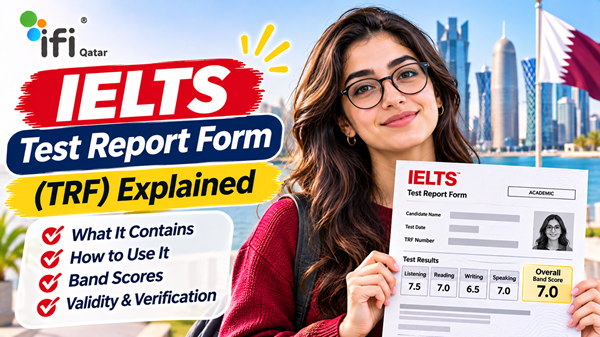
After completing your IELTS exam, receiving your result is an important step towards your academic, professional or immigration goals. However, understanding the score is only part of the process. You also need to know what your official result document contains, how institutions verify it and how to submit it correctly.
The IELTS Test Report Form (TRF) is the official document confirming your IELTS test results. It records your performance in Listening, Reading, Writing and Speaking, together with your overall band score and relevant candidate information.
Whether you are applying to a university, submitting an immigration application or providing evidence of your English proficiency to an employer, understanding your TRF can help you avoid unnecessary delays and mistakes.
In this guide, we explain what an IELTS Test Report Form contains, how to read your scores, how to use your TRF and what candidates in Qatar should know after receiving their results.
What Is an IELTS Test Report Form (TRF)?
An IELTS Test Report Form, commonly called a TRF, is the official record of your IELTS examination results.
It confirms the band scores you achieved in the four IELTS components:
- Listening
- Reading
- Writing
- Speaking
It also displays your overall IELTS band score, which represents your overall English language proficiency based on your performance across these four skills.
The TRF is used as evidence of your English language ability when applying to organisations that recognise IELTS, including:
- Universities and higher education institutions
- Immigration authorities
- Professional registration bodies
- Employers
- Scholarship providers
- Other organisations with English language requirements
Unlike an informal practice test result or an online score preview, an official IELTS Test Report Form is designed to allow receiving organisations to verify your result.
Important: An IELTS TRF confirms your test performance, but it does not automatically mean you meet the admission, immigration or employment requirements of every organisation. Each organisation sets its own minimum IELTS score and acceptance conditions.
What Information Does an IELTS Test Report Form Contain?
Your IELTS Test Report Form contains several important pieces of information. You should review them carefully after receiving your result to make sure your personal details and scores are correct.
1. Candidate Personal Information
The TRF includes identifying information associated with your IELTS registration.
Depending on the form format, this may include:
- Your full name
- Candidate identification details
- Your photograph
- Other information used to identify your test record
Your name and identification details should be consistent with the documents you use for university applications, professional registration or immigration procedures.
If you notice a spelling error or a difference between your TRF and official identification, contact your test centre as soon as possible. Do not assume that an organisation will accept a document containing incorrect personal information.
2. IELTS Test Type
Your TRF identifies the IELTS test you completed.
The main IELTS test types include:
- IELTS Academic: Generally intended for candidates applying for higher education or professional registration where an Academic English assessment is required.
- IELTS General Training: Commonly used for migration, employment and other purposes where General Training is accepted.
- IELTS for UKVI: A version of IELTS taken under specific UK Visas and Immigration requirements.
- IELTS Life Skills: A separate test designed to assess Speaking and Listening for certain UK visa and immigration purposes.
The test type matters because universities, immigration authorities and other organisations may require a particular IELTS version.
For example, a university may request IELTS Academic, while a migration pathway may accept IELTS General Training or require a specific approved test.
Always check the exact test requirement of the organisation receiving your result. A high band score in the wrong IELTS test type may not satisfy its requirements.
3. IELTS Test Date
Your Test Report Form records the date on which you took the IELTS examination.
This date is particularly important because organisations commonly apply a two-year validity period to IELTS results.
For example, if you took your IELTS test on 10 November 2026, an organisation applying the usual two-year validity rule would generally expect your result to be no more than two years old when you submit it.
However, acceptance policies can differ. Some organisations may have their own rules about when the test must have been taken, so always check the relevant application requirements.
4. Listening Band Score
The Listening section measures your ability to understand spoken English in different contexts.
Your TRF displays a Listening band score on the IELTS 0–9 scale, including whole or half bands.
For example:
- Listening: 6.0
- Listening: 6.5
- Listening: 7.0
- Listening: 8.0
A higher Listening score generally indicates stronger ability to understand spoken information, follow discussions and identify important details.
5. Reading Band Score
The Reading score measures your ability to understand written English.
Your result reflects your performance in tasks that assess skills such as:
- Identifying main ideas
- Locating specific information
- Understanding arguments
- Recognising the writer’s position
- Interpreting vocabulary in context
IELTS Academic and General Training use different Reading materials and scoring conversion systems. Therefore, you should interpret your Reading result in the context of the test type you took.
6. Writing Band Score
The Writing band score represents your performance in the IELTS Writing section.
Examiners assess your writing using four main criteria:
- Task Achievement or Task Response
- Coherence and Cohesion
- Lexical Resource
- Grammatical Range and Accuracy
The exact task requirements differ between IELTS Academic and General Training.
Your TRF displays the final Writing band score, not a detailed breakdown of your performance in each assessment criterion.
If you want to understand why you received a particular Writing score, you may need additional preparation support or an appropriate score review process.
7. Speaking Band Score
The Speaking score reflects your ability to communicate in English during the IELTS Speaking test.
The assessment considers four criteria:
- Fluency and Coherence
- Lexical Resource
- Grammatical Range and Accuracy
- Pronunciation
Your TRF displays your final Speaking band score.
It does not normally provide a detailed explanation of every speaking mistake or a transcript of your interview.
8. Overall IELTS Band Score
One of the most important parts of your IELTS Test Report Form is the overall band score.
This score represents your combined performance across Listening, Reading, Writing and Speaking.
The overall score is calculated by taking the average of the four component scores and rounding it to the nearest whole or half band according to IELTS scoring rules.
For example:
| IELTS Component | Band Score |
|---|---|
| Listening | 7.0 |
| Reading | 6.5 |
| Writing | 6.0 |
| Speaking | 7.0 |
| Average | 6.625 |
| Overall IELTS Band | 6.5 |
Your overall band score is useful when comparing your result with the minimum requirements of universities, employers or immigration programmes.
However, remember that some organisations also require a minimum score in each individual component.
A candidate with an overall IELTS score of 7.0, for example, may still be unsuccessful if the institution requires at least 6.5 in every skill and the candidate has a 6.0 in Writing.
What Is the Difference Between a Paper TRF and an Electronic TRF (eTRF)?
IELTS results may be issued in paper or electronic form, depending on the test arrangement and the policies of the test provider and centre.
Both formats provide official confirmation of your IELTS result, but the way you receive and share them may differ.
Paper IELTS Test Report Form
A paper TRF is a physical document issued by the test centre or delivered according to its result collection procedure.
Candidates who receive a paper TRF should:
- Check all personal details.
- Confirm that the four component scores are correct.
- Keep the document in a safe place.
- Follow the receiving organisation’s instructions when submitting it.
- Contact their test centre if they need help sending official results to another organisation.
A paper TRF should not be treated as an ordinary document that can simply be copied and submitted everywhere. Many institutions require results to be sent or verified through an approved process.
Electronic IELTS Test Report Form (eTRF)
An electronic Test Report Form, or eTRF, is the digital version of your official IELTS result.
Where available, candidates can access and download their eTRF through the relevant test provider’s online portal.
An eTRF can make it easier to share your IELTS result with universities and other organisations, particularly when they accept electronic submission or use the IELTS Results Service.
Depending on the provider and test arrangement, candidates may be able to:
- Download their electronic result.
- Save a copy for their records.
- Share the document with an institution when accepted.
- Arrange direct electronic result sharing through the available portal.
Remember: The availability of a paper TRF or eTRF is not identical for every IELTS test arrangement or test centre. Check the instructions provided by the organisation that administered your exam.
How to Read Your IELTS Test Report Form
Understanding your TRF is easier when you know which sections matter most.
Here is a practical example of how to interpret the main score information:
| Component | Example Score | What It Represents |
|---|---|---|
| Listening | 7.5 | Understanding spoken English |
| Reading | 7.0 | Understanding written English |
| Writing | 6.5 | Producing written English |
| Speaking | 7.0 | Communicating verbally |
| Overall Band Score | 7.0 | Combined English proficiency result |
In this example, the candidate achieved an overall IELTS band score of 7.0.
However, the result should not be interpreted without considering the requirements of the organisation receiving it.
For instance:
- A university may require an overall band of 7.0 with no component below 6.5.
- Another university may accept an overall band of 6.5 with no component below 6.0.
- A professional body may require a higher score in Speaking or Writing.
- An immigration authority may use specific language requirements that depend on the visa category.
The correct score is therefore the one that meets the requirements of your intended application, not simply the highest overall band you can achieve.
How to Use Your IELTS Test Report Form
After receiving your IELTS result, the next step is to use it for your application.
The process depends on the organisation you are applying to and the result submission methods it accepts.
Step 1: Check the Organisation’s IELTS Requirements
Before submitting your TRF, confirm:
- Whether IELTS Academic or General Training is required.
- The minimum overall band score.
- The minimum score required in each component.
- Whether the organisation accepts your test format.
- Whether there are additional conditions for IELTS results.
Do not rely only on general IELTS score recommendations. Always check the latest requirements published by the university, immigration authority or professional body.
Step 2: Confirm How the Organisation Accepts IELTS Results
Different organisations may have different result submission procedures.
Some may accept electronic results through an approved IELTS verification service. Others may require the test provider to send the result directly.
Before submitting your document, find out whether the organisation accepts:
- An electronic Test Report Form.
- Direct electronic result sharing.
- A result sent directly by the test centre.
- A paper Test Report Form delivered through an approved method.
A screenshot of your online score or a photocopy may not be accepted as official evidence.
Step 3: Arrange Official Result Sharing
If the receiving organisation requires an official result submission, follow the procedure provided by your test centre or test provider.
Depending on the available service, this may involve:
- Logging in to your candidate portal.
- Selecting the institution you are applying to.
- Providing the institution’s correct details.
- Submitting a request for official result sharing.
- Confirming whether the result has been successfully sent.
Some providers allow candidates to request additional Test Report Forms or send results electronically to recognising organisations.
The number of available copies, processing time and any applicable fees depend on the test provider and local arrangements.
Step 4: Keep a Copy of Your Result
Even when your result is shared directly with an institution, keep a secure copy of your TRF or eTRF for your personal records.
You may need it when:
- Applying to another university.
- Preparing a professional registration application.
- Completing an immigration application.
- Responding to a request for additional documents.
- Checking your IELTS result details.
Avoid sharing your personal result document publicly because it contains identifying information.
What Is an IELTS TRF Number and Why Is It Important?
The IELTS TRF number is a unique reference associated with your Test Report Form.
It helps authorised organisations verify the authenticity of an IELTS result through the relevant IELTS verification service.
If an institution asks for your TRF number, make sure you provide it exactly as displayed on your official result document.
When entering the number:
- Check every letter and digit carefully.
- Do not confuse similar-looking characters.
- Avoid adding spaces or changing the sequence.
- Use the number from your official TRF or eTRF.
The TRF number is particularly useful when a university or other recognising organisation needs to confirm that a candidate’s submitted IELTS result matches the official test record.
Important: A TRF number alone does not replace the institution’s verification procedure. The receiving organisation must use the appropriate verification method.
How Can Universities and Institutions Verify an IELTS Test Report Form?
IELTS results can be checked through the IELTS Results Service, which allows authorised organisations to verify candidates’ test results.
This process helps institutions confirm that the result submitted by an applicant is genuine.
A university or organisation may use the relevant IELTS verification service to check information such as:
- The candidate’s test result.
- The overall band score.
- Individual component scores.
- The authenticity of the reported result.
If an organisation asks you to provide a TRF number or arrange direct result sharing, follow its instructions carefully.
Do not assume that uploading a scanned copy of your TRF to an application portal automatically completes official verification.
How Long Is an IELTS Test Report Form Valid?
IELTS results are generally treated as valid for two years from the test date.
This is the standard validity period commonly applied by universities, employers and immigration authorities.
For example, if you take IELTS on 15 December 2026, many organisations will expect you to use your result within the following two years.
However, the final decision belongs to the organisation receiving your application.
Some organisations may have their own rules about older IELTS results. IELTS partners also cannot confirm the validity of results more than two years old.
If you are planning to apply for a university programme, visa or professional registration, check the validity requirements before booking your exam.
Can You Use an IELTS Result After Two Years?
In most cases, organisations will not accept an IELTS result that is more than two years old.
Some may consider older results if you can provide evidence that you have actively maintained or improved your English language skills since taking the test.
However, this is not guaranteed.
If your IELTS result is approaching its two-year anniversary, contact the organisation receiving your application and ask whether it will still accept the result.
Do not assume that an old TRF remains acceptable simply because you still have the original document.
What Should You Do If You Lose Your IELTS Test Report Form?
Losing your TRF can be stressful, particularly if you need to submit your result for an upcoming application.
However, you may still be able to arrange official result sharing through your test centre or test provider.
The correct procedure depends on the type of IELTS test you took and the centre’s current policies.
If you lose your TRF:
- Contact the test centre where you completed IELTS.
- Provide the identification and test details requested.
- Explain whether you need access to your result or official delivery to an institution.
- Ask whether an additional TRF or electronic result-sharing option is available.
- Confirm any administrative fees and processing times.
Keep in mind that replacement documents are not necessarily issued in the same way by every provider. Some centres may arrange additional copies to be sent directly to recognising organisations rather than issue another personal copy.
For this reason, it is better to contact your test centre before making assumptions about replacement procedures.
Common IELTS Test Report Form Mistakes to Avoid
Even after achieving the required IELTS score, candidates can experience unnecessary delays because of mistakes when using their TRF.
Here are some common issues to avoid.
1. Submitting the Wrong IELTS Test Type
A university or organisation may require IELTS Academic, while your TRF shows IELTS General Training.
Always confirm the required test type before registering for IELTS.
2. Ignoring Individual Band Requirements
An overall score that meets the required threshold may not be enough if one of your component scores is below the minimum.
Review all four component scores before submitting your application.
3. Assuming Every Organisation Accepts a Printed eTRF
Some institutions accept electronic results, while others require official result sharing through the relevant IELTS service.
Check the submission instructions before uploading or printing your document.
4. Waiting Until the Last Minute to Send Your Result
Universities and immigration authorities may need time to receive and verify IELTS results.
Arrange official result sharing early enough to meet your application deadline.
5. Entering the Wrong TRF Number
An incorrect character can make it difficult for an organisation to locate or verify your result.
Always copy the TRF number carefully from your official document.
6. Forgetting the Two-Year Validity Period
A result that was accepted for a previous application may no longer meet the validity requirements of a new application.
Check the test date and the receiving organisation’s current policy.
7. Assuming Your IELTS Score Guarantees Acceptance
Meeting an organisation’s English language requirement does not guarantee admission, employment or visa approval.
IELTS is only one part of the relevant application process.
IELTS Test Report Form in Qatar: What Should Candidates Know?
If you take IELTS in Qatar, your result collection and document submission procedures will depend on the test provider and the centre where you registered.
Before or after your examination, make sure you understand:
- How and when your results will be released.
- Whether you will receive a paper TRF or an electronic eTRF.
- How to access your result through the candidate portal.
- Whether your chosen university or organisation accepts electronic result sharing.
- How to request additional result copies, if necessary.
- Whether any administrative or delivery fees apply.
For example, the British Council’s published IELTS results information for Qatar explains that candidates taking IELTS on computer receive an electronic result and can download their eTRF through the Test Taker Portal. Its published procedures also describe how candidates can arrange result sharing with recognising organisations.
These arrangements should not automatically be assumed to apply to every IELTS test centre in Qatar.
At IFI Qatar, candidates should confirm the applicable result collection and official document submission procedures with the centre when arranging their IELTS test.
If you are planning to take IELTS in Doha, understanding these practical details before test day can help you prepare for the steps that follow your examination.
How to Prepare for IELTS Before Booking Your Test
Understanding your TRF is important, but the best way to avoid problems later is to prepare carefully before registering for IELTS.
Before confirming your booking, consider the following:
- Identify the purpose of your IELTS test.
- Confirm whether you need Academic or General Training.
- Check the minimum overall and component scores required.
- Choose a test date that gives you enough preparation time.
- Practise all four IELTS skills.
- Complete realistic IELTS mock tests.
- Make sure your registration details match your identification document.
A structured preparation plan can help you understand your current level, identify areas that need improvement and approach the official examination with greater confidence.
At IFI Qatar, candidates can enquire about IELTS test arrangements and available preparation support before deciding on their next step.
Frequently Asked Questions About the IELTS Test Report Form
What is an IELTS Test Report Form?
An IELTS Test Report Form (TRF) is the official document confirming your IELTS examination result. It includes your personal information, test details, individual band scores for Listening, Reading, Writing and Speaking, and your overall band score.
Is the IELTS Test Report Form the same as an IELTS certificate?
The terms are sometimes used interchangeably, but the official IELTS document is called the Test Report Form. It is the recognised record of your IELTS test result.
How many scores are shown on an IELTS TRF?
Your TRF shows five main scores: one for Listening, one for Reading, one for Writing, one for Speaking and one overall band score.
What is an eTRF?
An eTRF is an electronic Test Report Form. It is the digital version of your official IELTS result and can be accessed through the relevant candidate portal where this option is available.
Where can I find my IELTS TRF number?
Your TRF number is printed on your official Test Report Form. It is used by authorised organisations to verify your IELTS result through the relevant IELTS verification service.
How long is an IELTS Test Report Form valid?
IELTS results are generally accepted for two years from the test date. However, the organisation receiving your result makes the final decision about whether it will accept it.
Can I send my IELTS TRF directly to a university?
Yes. Depending on the test provider and the institution’s arrangements, you may be able to request direct electronic result sharing or have your test centre send an official copy to the university.
Can I use a photocopy of my IELTS TRF?
Not necessarily. Some organisations require results to be sent directly by the test provider or verified through an official IELTS service. Always check the institution’s submission requirements.
Can I get another copy of my IELTS Test Report Form?
The procedure depends on your test provider and centre. You may be able to request additional result copies to be sent directly to recognising organisations. Contact the centre where you took IELTS for the current procedure.
Does a higher overall IELTS score guarantee university admission?
No. Universities may consider other admission requirements, including minimum scores in individual IELTS components, academic qualifications and programme-specific conditions.
Can I use my IELTS TRF for immigration purposes?
Yes, if the relevant immigration authority accepts your IELTS test type and result. However, immigration programmes may have specific requirements concerning the approved test version, minimum scores and result validity.
What should I do if my IELTS TRF contains incorrect personal details?
Contact your test centre as soon as possible. Provide the relevant identification and registration information and ask how the correction can be arranged.
Take the Next Step Towards Your IELTS Goal with IFI Qatar
Your IELTS Test Report Form is more than a record of your examination. It is an important document that can support your university applications, professional plans and international opportunities.
Understanding your scores, checking your personal details and following the correct result submission procedure can help you avoid unnecessary complications after the exam.
If you are planning to take IELTS in Qatar, IFI Qatar can help you take the next step. Contact our team to enquire about IELTS test arrangements, registration and available preparation support.
Prepare with confidence, choose the right IELTS test and plan your next step towards your target band score.