

Currently Empty: ر.ق 0,00


IELTS
IELTS Test Format Explained: Question Types, Timing and Test Sections
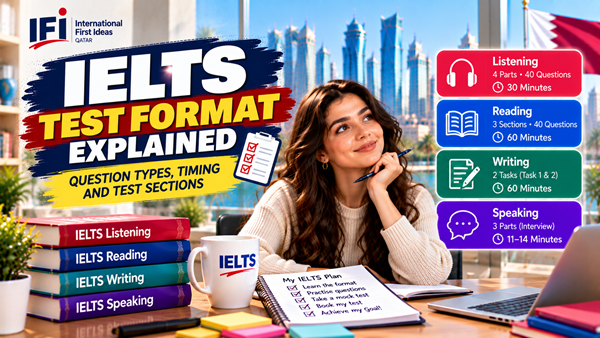
If you are planning to take the IELTS exam, understanding the IELTS test format is one of the most important steps in your preparation. Knowing how the test is structured, how much time you have for each section, and what types of questions to expect can help you prepare more effectively and avoid unnecessary mistakes on test day.
IELTS assesses four essential English language skills: Listening, Reading, Writing and Speaking. Although these skills are tested in both IELTS Academic and IELTS General Training, the Reading and Writing sections differ depending on the test you choose.
In this guide, you will learn how each IELTS section works, how long it takes, which question types you may encounter, and how to practise under realistic exam conditions. You will also find practical advice to help you decide when to book your official test and whether you would benefit from an IELTS mock test before exam day.
What Is the IELTS Test Format?
The IELTS test format consists of four sections: Listening, Reading, Writing and Speaking. Together, these sections assess how effectively you understand and use English in academic, professional and everyday situations.
The Listening, Reading and Writing sections take approximately 2 hours and 40 minutes when completed together. The Speaking test lasts 11–14 minutes and may be scheduled on the same day or on a different day, depending on the test centre’s arrangements.
Here is a quick overview of the IELTS exam structure.
| Test section | Duration | Number of questions or parts |
|---|---|---|
| Listening | Approximately 30 minutes | 40 questions across 4 parts |
| Reading | 60 minutes | 40 questions across 3 sections |
| Writing | 60 minutes | 2 tasks |
| Speaking | 11–14 minutes | 3 parts |
The Listening, Reading and Writing sections are completed without breaks between them. Exact delivery arrangements, including the available test format and any Writing on Paper option, should be confirmed when booking.
IELTS Listening Test Format: Question Types and Timing
The IELTS Listening test assesses your ability to understand spoken English in different situations. You will hear conversations and individual speakers discussing everyday, educational or training-related topics.
The test contains four parts and 40 questions. Each recording is played once, so you need to listen carefully and identify the information required by each question.
How Is the IELTS Listening Test Structured?
The four parts gradually move from everyday conversations to more complex educational or academic discussions.
- Part 1: A conversation between two people in an everyday situation, such as arranging an appointment or booking accommodation.
- Part 2: One speaker talking about a general topic, such as local facilities or an event.
- Part 3: A conversation involving two or more speakers in an educational or training context, such as students discussing an assignment.
- Part 4: A single speaker presenting information on an academic subject.
The recordings may feature different English accents, including British, Australian, New Zealand and North American accents.
What Question Types Appear in IELTS Listening?
You may encounter several question types during the Listening test:
- Multiple-choice questions
- Matching information
- Map, plan or diagram labelling
- Form completion
- Note completion
- Table completion
- Flow-chart completion
- Summary completion
- Sentence completion
- Short-answer questions
For example, you might listen to a conversation about a course and complete a form with the course name, starting date and fee.
How Can You Prepare for IELTS Listening?
Successful Listening preparation requires more than understanding the general meaning of a conversation. You must also recognise specific details, follow changes in information and identify paraphrased expressions.
Use these practical strategies:
- Read the questions before the recording begins and identify the information you need.
- Underline keywords that indicate names, dates, prices, locations or other details.
- Practise recognising synonyms and paraphrases rather than listening only for exact keywords.
- Check spelling, singular and plural forms, and the permitted number of words.
- Review every incorrect answer to understand whether the problem was vocabulary, concentration or timing.
Regular timed practice can help you become more familiar with the structure and pace of the test.
IELTS Reading Test Format: Sections and Question Types
The IELTS Reading test lasts 60 minutes and contains 40 questions. It measures your ability to understand written English, identify important information, recognise relationships between ideas and interpret an author’s arguments.
The Reading section differs between IELTS Academic and IELTS General Training. Choosing the correct test is therefore essential before you begin preparing.
IELTS Academic Reading Format
IELTS Academic Reading is designed for candidates who need English for higher education or certain professional registration requirements.
You will read three long texts taken from sources such as books, journals, magazines and newspapers. The texts may be descriptive, factual, analytical or argumentative.
Questions may assess your ability to:
- Identify the main idea of a passage.
- Locate specific facts and details.
- Understand the writer’s opinions and claims.
- Recognise relationships between sentences and paragraphs.
- Follow an argument or explanation.
- Understand vocabulary from context.
IELTS General Training Reading Format
IELTS General Training Reading focuses more on everyday and workplace-related English.
The section contains three parts, with texts that may include advertisements, notices, workplace documents, informational materials and longer passages.
You may need to locate information quickly, understand instructions, identify the purpose of a text or interpret details relevant to daily life.
Common IELTS Reading Question Types
Both versions can include several different question formats:
- Multiple choice
- True / False / Not Given
- Yes / No / Not Given
- Matching headings
- Matching information to paragraphs
- Matching sentence endings
- Sentence completion
- Summary, note or table completion
- Short-answer questions
- Diagram labelling
Not every question type appears in every test.
One important distinction is the difference between True / False / Not Given and Yes / No / Not Given. True / False / Not Given focuses on factual information in a text, while Yes / No / Not Given generally focuses on the writer’s views or claims.
How Can You Manage Time in IELTS Reading?
Time management is particularly important because you have only 60 minutes to answer all 40 questions.
A practical starting point is to allocate approximately 20 minutes to each passage or section, then adjust your approach according to your strengths and the difficulty of the questions.
Try the following techniques:
- Skim the passage to understand its structure before reading every sentence closely.
- Scan for names, dates, figures and keywords when locating specific information.
- Read the instructions carefully, especially word limits.
- Avoid spending too long on one difficult question.
- Practise under timed conditions to discover which question types slow you down.
Remember that effective Reading preparation is not simply about reading faster. It is about finding relevant information accurately and making decisions within the available time.
IELTS Writing Test Format: Tasks, Word Counts and Timing
The IELTS Writing test lasts 60 minutes and contains two tasks. Your performance is assessed on criteria that include how well you address the task, organise ideas, use vocabulary and demonstrate grammatical range and accuracy.
The tasks differ between IELTS Academic and IELTS General Training.
IELTS Academic Writing Task 1
In Academic Writing Task 1, you are given visual information, such as a graph, chart, table, diagram or process.
You must describe, summarise or explain the key information in your own words. Depending on the task, you may need to compare figures, describe a process, explain stages or summarise changes over time.
You should write at least 150 words.
A strong response typically includes:
- An introduction that paraphrases the task.
- An overview highlighting the main trends or features.
- Relevant details and comparisons that support the overview.
Avoid describing every figure without explaining which information is most significant.
IELTS General Training Writing Task 1
General Training Task 1 requires you to write a letter. The situation may be formal, semi-formal or informal.
You might need to request information, explain a problem, make a complaint, invite someone or respond to a particular situation.
You should write at least 150 words and address all the points included in the task.
Pay attention to the purpose of the letter, the intended reader and the appropriate tone.
IELTS Writing Task 2
Writing Task 2 requires you to write an essay in response to a question, issue, opinion or argument.
You should write at least 250 words. Depending on the question, you may need to:
- Present and justify your opinion.
- Discuss two different views.
- Explain the causes of a problem and suggest solutions.
- Discuss advantages and disadvantages.
- Answer a question about a particular issue.
Task 2 carries more weight than Task 1 in the Writing score, so it deserves careful preparation.
How Should You Allocate Your IELTS Writing Time?
A useful starting point is:
| Task | Suggested time | Minimum word count |
|---|---|---|
| Academic or General Training Task 1 | 20 minutes | 150 words |
| Task 2 essay | 40 minutes | 250 words |
These are recommended time allocations rather than separate official timers.
Before writing, spend a short time analysing the question and planning your response. Leave a few minutes at the end to check grammar, spelling, punctuation and whether you have answered every part of the task.
Do not assume that writing more words automatically earns a higher score. Clear, relevant and well-organised writing is more valuable than unnecessary length.
IELTS Speaking Test Format: Three Parts Explained
The IELTS Speaking test lasts 11–14 minutes and is conducted as an interview with an examiner. It assesses your ability to communicate in English through responses to familiar questions, a longer individual talk and a more detailed discussion.
The Speaking format is the same for IELTS Academic and IELTS General Training.
Speaking Part 1: Introduction and Interview
Duration: 4–5 minutes
The examiner introduces themselves, checks your identity and asks questions about familiar subjects.
Common topics include:
- Home and hometown
- Work or studies
- Family and friends
- Hobbies and interests
- Daily routines
- Food, travel or free-time activities
The goal is to answer naturally and clearly. You do not need to memorise elaborate responses to simple questions.
Practise giving a direct answer and adding a relevant explanation or example when appropriate.
Speaking Part 2: Individual Long Turn
Duration: 3–4 minutes, including preparation
The examiner gives you a task card describing a topic to speak about. You have one minute to prepare and can make notes before speaking for up to two minutes.
The card includes prompts to help you organise your response.
For example, you might be asked to describe a memorable journey, an important person or a skill you would like to learn.
A useful structure is:
- Introduce the person, place, event or experience.
- Explain the relevant background.
- Develop the details in the prompts.
- Finish by explaining why the topic matters to you.
You do not need a complicated story. Focus on relevant details, logical organisation and maintaining your speech without long, unnecessary pauses.
Speaking Part 3: Discussion
Duration: 4–5 minutes
Part 3 develops the topic from Part 2 into a broader discussion. The examiner may ask you to explain opinions, compare situations, analyse social issues or speculate about future changes.
For example, if Part 2 concerns a memorable journey, Part 3 might explore tourism, transport or the impact of travel on local communities.
To prepare, practise supporting your opinions with reasons and examples. You should also learn to compare perspectives, discuss causes and consequences, and acknowledge different points of view.
How Is IELTS Speaking Assessed?
Speaking is assessed using four criteria:
- Fluency and coherence: How smoothly you speak and organise your ideas.
- Lexical resource: The range and appropriate use of vocabulary.
- Grammatical range and accuracy: Your ability to use different grammatical structures accurately.
- Pronunciation: How clearly and effectively you communicate spoken English.
A strong accent is not automatically a problem. The key is whether your pronunciation allows the examiner to understand you without undue effort.
IELTS Academic vs General Training: What Is the Difference?
Both IELTS Academic and IELTS General Training assess Listening, Reading, Writing and Speaking. However, they are intended for different purposes and have different Reading and Writing tasks.
| Feature | IELTS Academic | IELTS General Training |
|---|---|---|
| Common purpose | Higher education and some professional registration | Migration, work-related purposes and below-degree-level study or training |
| Listening | Same test format | Same test format |
| Reading | Academic texts | Everyday, workplace and general-interest texts |
| Writing Task 1 | Describe visual information or a process | Write a letter |
| Writing Task 2 | Essay | Essay |
| Speaking | Same three-part interview | Same three-part interview |
Your choice should depend on the requirements of the university, employer, professional body or immigration authority receiving your results.
Do not choose a test solely because you think one version is easier. Check the exact test requirement before booking. If your application specifies IELTS for UKVI or another particular test, confirm that requirement as well.
Is the IELTS Test Format Different on Computer?
IELTS test delivery has been moving towards computer-based testing, with implementation timelines varying by market. IELTS has announced that paper-based testing will be phased out from mid-2026, while a Writing on Paper option is being introduced in selected markets.
The assessed skills, task types and core test structure remain comparable. However, the way you interact with the test can affect your experience.
For computer-delivered IELTS, you should practise:
- Reading questions and passages on a screen.
- Typing Writing responses within the time limit.
- Navigating between questions efficiently.
- Reviewing and editing typed answers.
- Using the available on-screen tools confidently.
If handwriting your Writing responses is important to you, check whether Writing on Paper is offered for your chosen test in Qatar. Availability can vary, so verify the current options before booking.
How Can an IELTS Mock Test Help You Prepare?
Understanding the IELTS test format is a good first step, but reading about the exam is not the same as completing it under timed conditions.
An IELTS mock test allows you to practise the sections, question types and time limits in a structured assessment. It can help you identify areas that need more attention before your official exam.
A mock test may help you:
- Understand how the test progresses from one section to another.
- Practise answering questions under time pressure.
- Identify recurring mistakes in Listening and Reading.
- Evaluate your Writing and Speaking performance.
- Decide which skills deserve more preparation time.
- Build familiarity with the test environment.
For the most useful experience, choose a mock test that matches the IELTS version you intend to take. If you are preparing for Academic IELTS, for example, an Academic mock test will help you practise the relevant Reading and Writing tasks.
After completing the mock test, review your mistakes rather than focusing only on your score. Look for patterns: perhaps you miss answers because you read too slowly, misunderstand paraphrases, struggle to organise essays or hesitate when speaking.
Use those findings to create a focused study plan.
IELTS Test Format Checklist: What to Know Before Exam Day
Before booking or attending your IELTS test, make sure you understand the following:
-
I know whether I need IELTS Academic, General Training or a specific test such as IELTS for UKVI.
-
I understand the timing and structure of all four sections.
-
I have practised the main question types in my chosen test.
-
I can manage the Writing tasks within 60 minutes.
-
I have practised Speaking Part 2 with one minute of preparation.
-
I know the current test delivery format available at my chosen centre.
-
I have checked the identification and arrival instructions provided for my booking.
-
I have assessed my readiness with timed practice or a suitable mock test.
If you cannot confidently check several of these items, consider completing more practice before choosing your test date.
Frequently Asked Questions About the IELTS Test Format
How long does the IELTS test take?
The Listening, Reading and Writing sections take approximately 2 hours and 40 minutes in total. The Speaking test lasts 11–14 minutes. The scheduling of the Speaking test and the overall time you spend at the test centre may vary.
How many questions are there in IELTS?
Listening contains 40 questions and Reading contains 40 questions. Writing consists of two tasks, while Speaking has three parts. The total number of questions across the exam is not usually presented as one combined figure because the sections use different task formats.
Are IELTS Academic and General Training the same?
No. Listening and Speaking are the same in both versions, but Reading and Writing differ. Choose the test that meets the requirements of the organisation receiving your results.
Which IELTS section is the most difficult?
This depends on your English proficiency, experience and study habits. Some candidates find Writing challenging because it requires clear organisation and accurate language under time pressure. Others struggle with Listening concentration, Reading timing or Speaking fluency.
A timed practice test can help you identify your personal weaknesses.
Can I practise the IELTS test format before booking?
Yes. You can use official IELTS sample questions and structured mock tests to become familiar with the task types and timing. A full mock test is particularly useful when you want to assess all four skills together.
Should I take an IELTS mock test before the real exam?
A mock test is useful if you want to understand your current performance, practise time management and identify areas for improvement. It can also help you decide whether you need additional preparation before your test date.
Can I take IELTS on paper?
IELTS has announced a transition away from paper-based testing from mid-2026, with exact timelines varying by market. A Writing on Paper option is being introduced in selected markets for candidates who prefer handwriting that component. Check the current arrangements in Qatar before booking.
Book Your IELTS Test or Assess Your Readiness with IFI Qatar
Now that you understand the IELTS test format, the next step is to match your preparation to your target score and intended test date.
If you are planning to take IELTS in Qatar, IFI Qatar can help you explore the available test and mock-test options.
Ready to take the official test? Review the available IELTS test dates, confirm the required test type and check the current registration instructions before completing your booking.
Would you like to assess your readiness first? Consider an IELTS mock test covering Listening, Reading, Writing and Speaking. Use your performance to identify weaknesses and focus your remaining preparation where it can make the greatest difference.
Understand the format. Practise with purpose. Take your next step towards your IELTS goal.