

Currently Empty: ر.ق 0,00


IELTS
IELTS Synonyms List to Improve Your Writing and Speaking Score
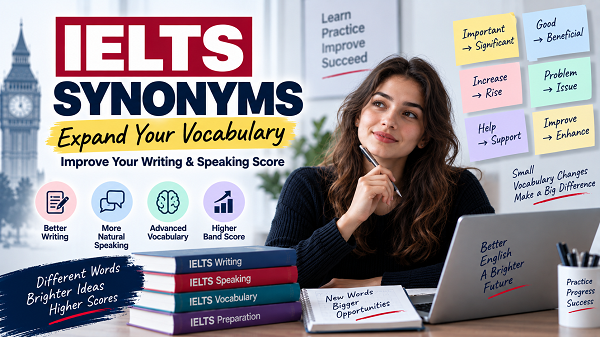
Using a wider range of vocabulary can help you communicate your ideas more precisely in the IELTS test. However, improving your vocabulary does not mean replacing every simple word with a more complicated one.
The real goal is to understand IELTS synonyms, know the differences between similar words, and use them naturally in the right context.
For example, instead of repeatedly using important, you might use significant, essential, crucial, or valuable depending on the meaning you want to express.
This guide provides a practical IELTS synonyms list for Writing and Speaking, together with example sentences, common mistakes, and strategies for learning and using synonyms effectively.
What Are IELTS Synonyms?
IELTS synonyms are words or expressions that have the same or a similar meaning to another word and can be used appropriately in IELTS Speaking or Writing.
For example:
- Important → significant
- Difficult → challenging
- Increase → rise
- Help → assist
- Problem → issue
- Improve → enhance
- Advantage → benefit
- Show → demonstrate
However, synonyms are not always completely interchangeable.
For example, big, large, major, and significant can have related meanings, but they are used differently depending on the sentence.
Therefore, learning synonyms as isolated vocabulary lists is not enough. You should also learn meaning, context, collocation, grammar, and common usage.
Why Are Synonyms Important for IELTS?
Vocabulary plays an important role in both IELTS Writing and Speaking.
Using appropriate synonyms can help you:
- Avoid unnecessary repetition
- Express ideas more precisely
- Demonstrate vocabulary range
- Make your writing more varied
- Develop more natural Speaking answers
- Describe information more accurately
- Communicate your meaning more effectively
However, using a synonym simply because it sounds more advanced can have the opposite effect.
A natural and accurate word is generally more useful than an unnecessarily complicated word.
IELTS Synonyms for Common Words
The following list includes common words that IELTS candidates frequently use, together with useful alternatives.
IELTS Synonyms for “Important”
| Common Word | Useful Synonyms |
|---|---|
| Important | Significant |
| Important | Essential |
| Important | Crucial |
| Important | Vital |
| Important | Major |
| Important | Key |
Example:
Education plays an important role in economic development.
Possible alternatives:
Education plays a significant role in economic development.
Education plays a crucial role in economic development.
Education is essential for long-term economic development.
Choose the synonym based on the meaning and context rather than simply replacing the word automatically.
IELTS Synonyms for “Important” in Speaking
In Speaking, natural expressions are often more useful than highly formal alternatives.
You could say:
- really important
- extremely important
- very significant
- essential
- a key part of
- a major factor
Example:
“Family is a really important part of my life.”
This is often more natural in Speaking than using an unnecessarily formal expression.
IELTS Synonyms for “Good”
| Common Word | Useful Synonyms |
|---|---|
| Good | Positive |
| Good | Beneficial |
| Good | Effective |
| Good | Valuable |
| Good | Useful |
| Good | Advantageous |
Example:
Regular exercise has a good effect on people’s health.
Better alternatives include:
Regular exercise has a positive effect on people’s health.
Regular exercise is beneficial for people’s health.
Regular exercise can have valuable health benefits.
The best choice depends on the sentence.
IELTS Synonyms for “Bad”
| Common Word | Useful Synonyms |
|---|---|
| Bad | Negative |
| Bad | Harmful |
| Bad | Damaging |
| Bad | Unfavorable |
| Bad | Problematic |
| Bad | Detrimental |
Example:
Excessive screen time can have negative effects on children.
For a more specific context:
Excessive screen time can be harmful to children’s health.
Avoid using detrimental simply because it appears more advanced. If you are not comfortable using it naturally, harmful or negative may be a better choice.
IELTS Synonyms for “Increase”
| Common Word | Useful Synonyms |
|---|---|
| Increase | Rise |
| Increase | Grow |
| Increase | Climb |
| Increase | Go up |
| Increase | Expand |
| Increase | Surge |
These words are particularly useful in IELTS Academic Writing Task 1.
Examples:
The number of international students increased significantly.
The number of international students rose significantly.
The number of international students climbed significantly.
The number of international students surged significantly.
The choice should reflect the degree and nature of the change.
IELTS Synonyms for “Decrease”
| Common Word | Useful Synonyms |
|---|---|
| Decrease | Fall |
| Decrease | Decline |
| Decrease | Drop |
| Decrease | Reduce |
| Decrease | Diminish |
| Decrease | Decline significantly |
Examples:
The percentage of users fell from 60% to 45%.
The figure declined steadily over the period.
The number of visitors dropped sharply in 2024.
For IELTS Writing Task 1, learning different verbs for upward and downward trends can make your descriptions more precise.
IELTS Synonyms for “Show”
| Common Word | Useful Synonyms |
|---|---|
| Show | Illustrate |
| Show | Demonstrate |
| Show | Indicate |
| Show | Reveal |
| Show | Present |
| Show | Display |
These are especially useful for IELTS Academic Writing.
Example:
The graph shows the percentage of people who used public transport.
You could write:
The graph illustrates the percentage of people who used public transport.
Or:
The graph indicates the percentage of people who used public transport.
IELTS Synonyms for “Help”
| Common Word | Useful Synonyms |
|---|---|
| Help | Assist |
| Help | Support |
| Help | Aid |
| Help | Facilitate |
| Help | Enable |
| Help | Contribute to |
Examples:
Technology can help students learn more effectively.
Technology can assist students in their learning.
Technology can enable students to access educational resources more easily.
Technology can facilitate independent learning.
The grammar around each synonym can be different, so always check how the word is normally used.
IELTS Synonyms for “Problem”
| Common Word | Useful Synonyms |
|---|---|
| Problem | Issue |
| Problem | Challenge |
| Problem | Difficulty |
| Problem | Concern |
| Problem | Obstacle |
| Problem | Complication |
Examples:
Traffic congestion is a major problem in many cities.
Traffic congestion is a major issue in many cities.
Traffic congestion presents a significant challenge for urban planners.
Notice that the best synonym depends on the context.
A challenge is not always exactly the same as a problem.
IELTS Synonyms for “Solution”
| Common Word | Useful Synonyms |
|---|---|
| Solution | Answer |
| Solution | Approach |
| Solution | Measure |
| Solution | Strategy |
| Solution | Remedy |
Examples:
Governments need to find a solution to the housing shortage.
Governments need to develop an effective strategy to address the housing shortage.
Increasing the supply of affordable housing could be an effective measure.
IELTS Synonyms for “Improve”
| Common Word | Useful Synonyms |
|---|---|
| Improve | Enhance |
| Improve | Develop |
| Improve | Strengthen |
| Improve | Upgrade |
| Improve | Boost |
| Improve | Refine |
Examples:
Governments should invest in education to improve literacy rates.
Governments should invest in education to enhance literacy rates.
Students can improve their communication skills through regular practice.
Students can develop their communication skills through regular practice.
IELTS Synonyms for “Think”
| Common Word | Useful Synonyms |
|---|---|
| Think | Believe |
| Think | Consider |
| Think | Feel |
| Think | Argue |
| Think | Maintain |
| Think | Suggest |
These are particularly useful for expressing opinions in IELTS Writing and Speaking.
Examples:
I think governments should invest more in public transport.
I believe governments should invest more in public transport.
I would argue that governments should invest more in public transport.
I feel that governments should invest more in public transport.
The level of formality should match the situation.
IELTS Synonyms for “Many”
| Common Word | Useful Synonyms |
|---|---|
| Many | Numerous |
| Many | A large number of |
| Many | A considerable number of |
| Many | A wide range of |
| Many | Plenty of |
Example:
Many people use social media every day.
More formal Writing alternatives include:
Numerous people use social media every day.
A large number of people use social media every day.
However, many is not a weak word. There is no need to replace it every time.
IELTS Synonyms for “Different”
| Common Word | Useful Synonyms |
|---|---|
| Different | Various |
| Different | Diverse |
| Different | Distinct |
| Different | Alternative |
| Different | Contrasting |
Examples:
People have different opinions about online education.
People have various opinions about online education.
The study compares different approaches to education.
The study compares alternative approaches to education.
IELTS Synonyms for “Large”
| Common Word | Useful Synonyms |
|---|---|
| Large | Big |
| Large | Significant |
| Large | Substantial |
| Large | Considerable |
| Large | Extensive |
| Large | Massive |
Examples:
The company experienced a large increase in sales.
Better alternatives could include:
The company experienced a substantial increase in sales.
The company experienced a considerable increase in sales.
Again, the correct choice depends on what you are describing.
IELTS Synonyms for “Small”
| Common Word | Useful Synonyms |
|---|---|
| Small | Minor |
| Small | Limited |
| Small | Slight |
| Small | Modest |
| Small | Minimal |
These are particularly useful when describing changes in IELTS Writing Task 1.
Example:
There was a small increase in the number of visitors.
You could write:
There was a slight increase in the number of visitors.
IELTS Synonyms for “Important” Academic Expressions
For IELTS Writing, you can also use more precise academic expressions such as:
- a key factor
- a significant factor
- a major consideration
- a crucial aspect
- an essential component
- a central issue
- a fundamental element
Example:
Cost is an important factor when choosing a university.
Better:
Cost is a significant factor when choosing a university.
Or:
Cost is a key consideration when choosing a university.
IELTS Synonyms for Writing
Synonyms are particularly useful in IELTS Writing because repetition can make your language less flexible.
However, you should not replace every repeated word mechanically.
Useful Synonyms for IELTS Writing Task 2
| Common Word | Useful Alternatives |
|---|---|
| Important | Significant, crucial, essential |
| Problem | Issue, challenge, concern |
| Solution | Approach, strategy, measure |
| Increase | Rise, growth, growth in |
| Decrease | Decline, reduction, fall |
| Cause | Lead to, result in, contribute to |
| Effect | Impact, consequence, outcome |
| Advantage | Benefit, positive aspect |
| Disadvantage | Drawback, limitation, negative aspect |
| Help | Assist, support, facilitate |
| Improve | Enhance, strengthen, develop |
| Change | Transform, alter, shift |
| Need | Require, demand |
| Think | Believe, argue, maintain |
| People | Individuals, members of the public, citizens |
| Government | Authorities, policymakers |
| Children | Young people, younger generations |
| Use | Utilize, employ, make use of |
| Important part | Key component, essential element |
IELTS Synonyms for Writing Task 2
Synonyms for “People”
Instead of repeating people, consider the exact group you mean.
You could use:
- individuals
- citizens
- residents
- consumers
- employees
- students
- young people
- older adults
- members of the public
Example:
Many people believe that public transport should be free.
Depending on the context:
Many citizens believe that public transport should be free.
Or:
Many members of the public believe that public transport should be free.
Do not use individuals simply because it sounds more academic. People is perfectly acceptable when it is the most natural choice.
Synonyms for “Government”
Depending on the context, you can use:
- authorities
- policymakers
- public authorities
- government agencies
- local authorities
- national governments
Example:
Governments should invest more in public transport.
A more specific alternative might be:
Local authorities should invest more in public transport.
The second sentence is appropriate only when you are actually referring to local government.
Synonyms for “Effect”
Useful alternatives include:
- impact
- consequence
- outcome
- result
- influence
Example:
Social media has had a significant effect on communication.
You could write:
Social media has had a significant impact on communication.
IELTS Synonyms for Speaking
In IELTS Speaking, your vocabulary should sound natural.
You do not need to use highly formal academic words in everyday answers.
Natural Alternatives for “Like”
Depending on the context:
- enjoy
- be fond of
- be interested in
- be keen on
- be into
- prefer
Example:
I like photography.
Natural alternatives include:
I enjoy photography.
I’m really into photography.
I’m quite fond of photography.
Natural Alternatives for “Good”
You might say:
- great
- excellent
- enjoyable
- useful
- effective
- impressive
- convenient
Example:
It was a great experience.
It was a really enjoyable experience.
Natural Alternatives for “Interesting”
Useful choices include:
- fascinating
- engaging
- enjoyable
- thought-provoking
- exciting
- intriguing
Example:
I found the documentary fascinating because it presented a completely different perspective.
Synonyms for IELTS Writing Task 1
IELTS Academic Writing Task 1 requires vocabulary for describing data, trends, comparisons, and changes.
Words for Upward Trends
Use:
- increase
- rise
- grow
- climb
- go up
- surge
- soar
Examples:
The figure rose gradually.
The number of visitors increased significantly.
Sales soared during the final quarter.
Words for Downward Trends
Use:
- decrease
- fall
- decline
- drop
- decrease
- go down
- plunge
Examples:
The figure declined steadily.
The percentage fell slightly.
The number of users dropped sharply.
Words for Stability
Use:
- remain stable
- remain unchanged
- stay constant
- level off
- plateau
- remain steady
Example:
The figure remained relatively stable throughout the period.
Words for Comparison
Useful expressions include:
- higher than
- lower than
- greater than
- less than
- similar to
- comparable to
- considerably higher
- slightly lower
- approximately the same as
These expressions can help you describe charts and graphs more precisely.
Common IELTS Synonym Mistakes
Learning synonyms can improve your vocabulary, but incorrect synonym use can reduce the clarity of your writing.
Using a Synonym That Does Not Have Exactly the Same Meaning
Similar words can have different meanings.
For example:
Problem and challenge are related, but they are not always interchangeable.
A challenge can describe something difficult that needs to be overcome, while a problem generally refers to something that causes difficulty or requires a solution.
Using the Wrong Part of Speech
For example:
Governments should improvement education.
This is incorrect.
The correct form is:
Governments should improve education.
You need to learn vocabulary together with its grammatical form.
Ignoring Collocations
Some words naturally occur together.
For example:
- make a decision
- heavy traffic
- strong argument
- significant increase
- deeply concerned
You should learn vocabulary as phrases and collocations rather than isolated words whenever possible.
Using Unnecessarily Advanced Vocabulary
Do not replace every simple word with an unusual alternative.
For example:
“I utilized a pen to inscribe my name.”
This is grammatically possible, but unnatural.
“I used a pen to write my name.”
is much more natural.
IELTS rewards effective communication, not complicated vocabulary for its own sake.
How to Learn IELTS Synonyms Effectively
A long vocabulary list is only useful if you can actually use the words.
Learn Synonyms in Groups
Instead of memorizing:
important → significant
Build a vocabulary group:
important → significant → crucial → essential → vital → key
Then learn how each word behaves in real sentences.
Learn Synonyms With Examples
Do not memorize:
improve = enhance
Instead, learn:
Exercise can improve your physical health.
Regular exercise can enhance overall physical well-being.
Learn Collocations
For example:
Significant
- significant increase
- significant difference
- significant impact
- significant role
- significant improvement
This makes your vocabulary more natural and useful.
Practice Using Synonyms in Context
Choose a simple sentence and rewrite it.
Original:
Technology has changed the way people communicate.
Possible alternative:
Technology has transformed the way people communicate.
Another:
Technology has significantly influenced the way people communicate.
The goal is to understand how the meaning changes slightly with each choice.
How Many Synonyms Should You Learn for IELTS?
There is no fixed number of synonyms you need to memorize to achieve a particular IELTS band score.
Quality is more important than quantity.
It is better to confidently use 100 useful words and expressions accurately than to memorize hundreds of difficult synonyms that you cannot use naturally.
Focus on:
- High-frequency vocabulary
- Topic-specific vocabulary
- Collocations
- Word families
- Useful expressions
- Accurate synonyms
- Natural usage
How to Use IELTS Synonyms Without Repeating Yourself
Consider this example:
Many people believe that technology has a positive impact on education. Technology helps students access information and technology also helps teachers provide learning materials.
The repeated use of technology and helps makes the paragraph less varied.
A better version could be:
Many people believe that technology has a positive impact on education. Digital tools enable students to access information more easily and support teachers in providing learning materials.
The second version varies the vocabulary while keeping the meaning clear.
IELTS Synonyms: A Practical Daily Study Method
You can build your synonym vocabulary with a simple 15-minute routine.
Minutes 1–5: Learn Five Word Groups
Choose five common IELTS words.
For example:
- important
- increase
- problem
- improve
- advantage
Find two or three useful alternatives for each.
Minutes 6–10: Write Example Sentences
Create one sentence for each synonym.
Focus on natural usage rather than complicated sentences.
Minutes 11–15: Speak Using the Words
Choose an IELTS Speaking topic and try to use some of the new vocabulary naturally.
This connects vocabulary knowledge with active Speaking ability.
IELTS Synonyms Practice Exercise
Try replacing the repeated words in the following sentences.
Sentence 1
Governments should take action to solve this important problem.
Possible answer:
Governments should take action to address this significant issue.
Sentence 2
The number of students increased significantly.
Possible answer:
The number of students rose considerably.
Sentence 3
Exercise is good for people’s health.
Possible answer:
Exercise is beneficial for people’s health.
Sentence 4
Technology helps students learn.
Possible answer:
Technology enables students to learn more effectively.
Sentence 5
Many people think that online education is useful.
Possible answer:
Many individuals believe that online education is beneficial.
Remember that these are examples, not mandatory replacements. Several answers may be grammatically and contextually appropriate.
Frequently Asked Questions About IELTS Synonyms
What are the best synonyms for IELTS?
There is no single list of “best” synonyms for IELTS. The most useful words are those that you understand, can pronounce correctly, and can use naturally and accurately in context.
Are synonyms important for IELTS Writing?
Yes. Appropriate vocabulary variation can help you avoid unnecessary repetition and express ideas more precisely. However, accuracy and natural usage are more important than simply using advanced synonyms.
Should I use synonyms in IELTS Speaking?
Yes, but prioritize natural language. IELTS Speaking requires you to communicate spontaneously, so use synonyms that you can use confidently rather than forcing formal vocabulary into your answers.
How can I improve my IELTS vocabulary?
Learn vocabulary in topic-based groups, study collocations, practice synonyms in context, write example sentences, and actively use new words in Speaking and Writing practice.
Can using too many synonyms hurt my IELTS score?
Using inappropriate or unnatural synonyms can make your communication less clear and may lead to vocabulary errors. You should use synonyms when they accurately express your intended meaning, not simply to avoid repeating a word.
What are useful synonyms for “important” in IELTS?
Common alternatives include significant, crucial, essential, vital, major, and key. The correct choice depends on the context.
What are useful synonyms for “increase” in IELTS?
Depending on the context, you can use rise, grow, climb, go up, expand, surge, or soar. In Academic Writing Task 1, the choice should reflect the size and speed of the change.
What are useful synonyms for “problem” in IELTS?
Useful alternatives include issue, challenge, difficulty, concern, obstacle, and complication. These words have slightly different meanings, so choose the one that best matches your idea.
Build a Stronger IELTS Vocabulary
Learning IELTS synonyms is not about replacing every simple English word with a more complicated one.
The most effective approach is to build a flexible vocabulary that allows you to:
- Avoid unnecessary repetition
- Express ideas precisely
- Use natural collocations
- Adapt your language to different topics
- Communicate confidently in Speaking
- Write more accurately and flexibly
Start with common IELTS vocabulary, learn useful synonyms in context, and practice using them in real Writing and Speaking tasks.
If you want structured practice to expand your vocabulary and use new words confidently in the IELTS test, IELTS vocabulary training can help you turn passive vocabulary knowledge into active language skills.
Build your vocabulary. Use it naturally. Prepare for a higher IELTS score.