

Currently Empty: ر.ق 0,00


IELTS
IELTS Cue Cards: Part 2 Topics, Strategies & Model Answers
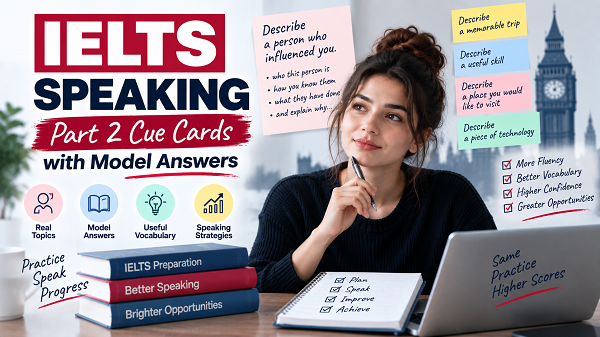
IELTS Speaking Part 2 is the section where you need to speak continuously about a specific topic for up to two minutes. You receive a cue card, have one minute to prepare, and then speak about the topic while the examiner listens.
For many IELTS candidates, this is one of the most challenging parts of the Speaking test. The difficulty is not simply knowing English. You also need to organize ideas quickly, develop your answer, use appropriate vocabulary, maintain fluency, and speak naturally under time pressure.
Practicing IELTS cue cards can help you become more comfortable with this format and develop the skills needed for a stronger Speaking performance.
This guide covers how IELTS Speaking Part 2 works, how to structure your answers, common cue card topics, model answers, useful vocabulary, preparation strategies, common mistakes, and effective ways to practice.
What Are IELTS Cue Cards?
IELTS cue cards are the topic prompts used during IELTS Speaking Part 2.
The examiner gives you a topic followed by several points that guide your response. You have one minute to prepare your ideas and make notes before speaking.
A typical IELTS cue card includes:
- A main topic
- Several points to cover
- One minute of preparation time
- Up to two minutes of speaking time
For example:
Describe a person who has influenced you.
You should say:
- Who this person is
- How you know this person
- What this person has done
And explain why this person has influenced you.
The bullet points are designed to help you develop your response. You do not need to answer each point as if it were a separate question.
How Does IELTS Speaking Part 2 Work?
Understanding the format is essential before practicing IELTS cue cards.
IELTS Speaking Part 2 Preparation Time
You receive one minute to prepare your answer.
During this time, you can:
- Identify the main topic
- Choose a specific example
- Organize your ideas
- Write keywords
- Think about useful vocabulary
- Decide how to finish your answer
You should avoid writing complete sentences because you have very limited preparation time.
How Long Should You Speak in Part 2?
You are expected to speak continuously for up to two minutes.
The examiner will control the timing and will normally stop you when the speaking period ends.
Your goal should not be to speak as quickly as possible. Instead, focus on developing your ideas clearly and naturally.
What Is Assessed in IELTS Speaking Part 2?
Your performance contributes to the four IELTS Speaking assessment criteria:
- Fluency and coherence
- Lexical resource
- Grammatical range and accuracy
- Pronunciation
This means that having good ideas is not enough. You also need to communicate those ideas effectively.
How to Structure an IELTS Cue Card Answer
A clear structure can make IELTS Speaking Part 2 much easier.
One flexible structure is:
Introduction → Background → Main Details → Example → Feelings or Opinion → Conclusion
You do not need to follow this formula mechanically. Use it as a framework for organizing your thoughts.
Start by Introducing the Topic
Clearly tell the examiner what you are going to talk about.
For example:
“I’d like to talk about a teacher who had a significant influence on me.”
This gives your answer a clear starting point.
Add Background Information
Explain who, what, where, or when.
For example:
“Her name was Sara, and she was my English teacher during my final two years of high school.”
Develop Your Main Ideas
This should be the largest part of your answer.
Add:
- Specific details
- Reasons
- Examples
- Descriptions
- Personal experiences
- Consequences
Explain Your Feelings or Opinion
Explain why the topic is important to you.
For example:
“Looking back, I think she influenced me because she changed the way I viewed learning English.”
Finish Naturally
You can summarize the importance of the experience or explain how you feel about it now.
For example:
“That’s why she remains one of the most influential people I’ve met.”
IELTS Cue Card Model Answers
Model answers can help you understand how to develop ideas, organize a response, and use natural vocabulary.
However, you should use them as examples rather than memorizing them word for word.
IELTS Cue Card: Describe a Person Who Influenced You
Cue Card Topic
Describe a person who has influenced you.
You should say:
- Who this person is
- How you know this person
- What this person has done
And explain why this person has influenced you.
Model Answer
I’d like to talk about one of my high school teachers who had a significant influence on me.
Her name was Sara, and she was my English teacher during my final two years of high school. At that time, I wasn’t particularly confident when speaking English. I understood quite a lot, but I was always worried about making mistakes.
What made her different from some of my other teachers was the way she encouraged us to express our opinions instead of simply memorizing information. She often organized discussions in class and gave us interesting topics to talk about. Whenever someone made a mistake, she didn’t make them feel embarrassed. Instead, she corrected the mistake and encouraged them to try again.
Over time, I became much more confident about speaking English. I also started reading English books and watching English-language programs outside school.
I think she influenced me because she changed the way I viewed learning English. Before meeting her, I thought English was mainly a school subject. Afterward, I started seeing it as a practical skill that could create opportunities for education, travel, and communication.
Useful Vocabulary
- have a significant influence on
- build confidence
- express an opinion
- encourage someone to
- over time
- change the way I view something
- create opportunities
IELTS Cue Card: Describe a Memorable Trip
Cue Card Topic
Describe a memorable trip you have taken.
You should say:
- Where you went
- Who you went with
- What you did
And explain why the trip was memorable.
Model Answer
One of the most memorable trips I’ve ever taken was a short trip to Istanbul with two of my close friends.
We went there during the spring because we wanted to take a break from our usual routine and explore a different culture. It was my first time visiting the city, so I was particularly excited about seeing the historical buildings and trying local food.
During the trip, we visited several famous places, walked around different neighborhoods, and spent quite a lot of time exploring the city on foot. One of my favorite experiences was sitting in a small café in the evening and watching people go about their daily lives.
What made the trip particularly memorable was the combination of the places we visited and the people I shared the experience with. We didn’t have a very strict schedule, so we had plenty of opportunities to discover things unexpectedly.
I also think the trip was memorable because it helped me take a break from work and everyday responsibilities. When I returned home, I felt refreshed and motivated.
Useful Vocabulary
- a memorable experience
- take a break from
- explore a different culture
- explore a city on foot
- have a strict schedule
- discover something unexpectedly
- everyday responsibilities
- feel refreshed
IELTS Cue Card: Describe a Skill You Would Like to Learn
Cue Card Topic
Describe a skill you would like to learn.
You should say:
- What the skill is
- Why you want to learn it
- How you would learn it
And explain how this skill could be useful.
Model Answer
A skill I’d really like to learn is photography.
I’ve always enjoyed taking pictures when I travel, but I usually use my phone and don’t know much about the technical side of photography. I’d like to understand how professional photographers use lighting, composition, and camera settings to create better images.
One of the main reasons I want to learn photography is that I travel quite often, and I’d like to be able to capture memorable moments in a more creative way.
If I decided to learn it seriously, I would probably start with an online course and then practice regularly. I could also watch tutorials and follow experienced photographers to learn from their techniques.
I think photography would be useful because it is both a creative and practical skill. It would allow me to document important experiences and perhaps even develop a hobby that I could continue for many years.
Useful Vocabulary
- technical side of
- lighting and composition
- capture memorable moments
- learn from someone’s techniques
- develop a hobby
- creative skill
- practical skill
IELTS Cue Card: Describe a Useful Piece of Technology
Cue Card Topic
Describe a piece of technology that you use regularly.
You should say:
- What it is
- When you started using it
- How you use it
And explain why it is useful.
Model Answer
A piece of technology that I use almost every day is my laptop.
I started using laptops regularly when I was at university because I needed one for studying and completing assignments. Since then, it has become an essential part of both my professional and personal life.
I use it for a wide range of activities. For example, I work on documents, attend online meetings, research information, watch educational videos, and communicate with other people.
What makes my laptop particularly useful is its versatility. Instead of needing several different devices, I can use one machine for most of my daily tasks.
Another reason I value it is that it allows me to work from almost anywhere. As long as I have an internet connection, I can access my files and communicate with colleagues.
Overall, I would say my laptop has become an essential tool because it saves me time and makes many everyday tasks more convenient.
Useful Vocabulary
- an essential part of
- a wide range of activities
- daily tasks
- particularly useful
- versatile
- access my files
- save time
- make something more convenient
IELTS Cue Card: Describe a Place You Would Like to Visit
Cue Card Topic
Describe a place you would like to visit in the future.
You should say:
- Where it is
- Why you want to go there
- What you would like to do
And explain why you are interested in visiting it.
Model Answer
A place I’d really like to visit in the future is Japan.
I’ve been interested in Japanese culture for several years, particularly because of the combination of traditional culture and modern technology. Japan seems to offer a very different experience from many of the countries I’ve visited before.
If I had the opportunity to go there, I’d like to spend time in Tokyo, but I would also like to visit some smaller towns and historical areas. I’d be particularly interested in trying traditional Japanese food, visiting temples, and experiencing the country’s public transportation system.
Another reason I’d like to visit Japan is that I enjoy learning about different cultures. I think traveling there would give me the opportunity to experience aspects of Japanese life that are difficult to understand through books or videos.
Overall, Japan is high on my travel list because I think it would be both an enjoyable and educational experience.
Useful Vocabulary
- I’ve been interested in
- traditional culture
- modern technology
- have the opportunity to
- experience a different culture
- historical areas
- high on my travel list
- an educational experience
How to Prepare for an IELTS Cue Card in One Minute
The one-minute preparation period is one of the most important parts of IELTS Speaking Part 2.
You should use it to organize your ideas rather than trying to write your complete answer.
Use Keywords Instead of Full Sentences
For a topic about a memorable trip, your notes could look like this:
Istanbul → friends → spring → food → walking → unexpected discoveries → relaxed → unforgettable
These keywords are enough to remind you what you want to discuss.
Use the Cue Card Points as Your Framework
If the topic asks:
- Where?
- Who with?
- What did you do?
- Why memorable?
Your notes might be:
Where: Istanbul
Who: Two friends
Activities: Food, sightseeing, walking
Why memorable: Friendship, new experiences, relaxation
This gives you a basic roadmap for your two-minute response.
How to Extend Your IELTS Speaking Part 2 Answer
Many candidates understand the topic but finish their answer too quickly.
The easiest way to extend your answer is to add meaningful details.
Give a Reason
Instead of:
“I enjoyed the trip.”
Say:
“I really enjoyed the trip because it gave me an opportunity to take a break from my normal routine.”
Give an Example
Instead of:
“The city was interesting.”
Say:
“The city was particularly interesting. For example, I remember walking through one of the older neighborhoods and seeing traditional buildings alongside modern cafés.”
Describe Your Feelings
Explain your personal reaction.
“At first, I was a little nervous, but after a few hours I became much more comfortable and started enjoying the experience.”
Make a Comparison
Comparisons can help you develop an idea naturally.
“It was quite different from the city where I live because public transportation was much more extensive.”
Talk About the Past and Present
When appropriate, explain how your perspective has changed.
“At the time, I didn’t realize how important the experience was. Looking back, I think it taught me a lot about…”
Useful Language for IELTS Cue Cards
You do not need to use complicated expressions to achieve a strong Speaking performance.
The priority should be natural, accurate, and appropriate language.
Phrases for Starting an Answer
- I’d like to talk about…
- The first thing that comes to mind is…
- One experience that I remember particularly well is…
- I’m going to talk about…
Phrases for Adding Details
- Another thing worth mentioning is…
- What I particularly remember is…
- On top of that…
- Another reason is that…
Phrases for Giving Examples
- For example…
- For instance…
- A good example of this is…
Phrases for Explaining Reasons
- The main reason is that…
- One of the reasons why I feel this way is…
- This is mainly because…
Phrases for Expressing Feelings
- I was really excited because…
- I remember feeling…
- It made me feel…
- Looking back, I realize that…
Phrases for Concluding
- Overall, I’d say…
- Looking back, it was…
- That’s why this experience stands out to me.
- For these reasons, it remains a memorable experience for me.
Common IELTS Cue Card Topics to Practice
Practicing different topic categories can help you become more flexible when you encounter an unfamiliar question.
IELTS Cue Card Topics About People
Practice topics such as:
- Describe a person who influenced you.
- Describe a helpful person you know.
- Describe someone you would like to meet.
- Describe a person you admire.
IELTS Cue Card Topics About Places
Practice topics such as:
- Describe a place you enjoy visiting.
- Describe a place you would like to visit.
- Describe a memorable place you have been to.
- Describe a place where you like to relax.
IELTS Cue Card Topics About Experiences
Practice topics such as:
- Describe a memorable trip.
- Describe a time you helped someone.
- Describe a difficult decision you made.
- Describe a time when you learned something important.
IELTS Cue Card Topics About Objects
Practice topics such as:
- Describe a useful piece of technology.
- Describe something you bought recently.
- Describe an object that is important to you.
- Describe a gift you received.
IELTS Cue Card Topics About Activities
Practice topics such as:
- Describe a hobby you enjoy.
- Describe an activity you would like to try.
- Describe something you do to relax.
- Describe an activity you enjoyed as a child.
IELTS Cue Card Topics About Skills and Learning
Practice topics such as:
- Describe a skill you would like to learn.
- Describe something useful you learned.
- Describe a subject you enjoyed studying.
- Describe a skill you taught someone else.
Should You Memorize IELTS Cue Card Answers?
You should practice model answers, but memorizing complete answers is generally not the most useful approach.
IELTS Speaking topics can vary, and a memorized answer may not fit the exact question you receive.
Instead, focus on developing:
- Useful vocabulary
- Natural linking phrases
- Flexible answer structures
- Storytelling techniques
- Ways to explain reasons
- Ways to give examples
- Ways to express opinions and feelings
- Fluency under time pressure
The goal is to become capable of adapting your language to different IELTS cue cards.
Common IELTS Cue Card Mistakes
Giving Answers That Are Too Short
If you finish your response very quickly, you may not demonstrate your ability to develop ideas.
Add reasons, examples, descriptions, and personal reactions.
Memorizing Complete Answers
Memorized answers can sound unnatural and may not directly answer the question you receive.
Writing Too Much During Preparation
You only have one minute.
Writing complete sentences can waste valuable preparation time.
Ignoring the Cue Card Prompts
The points on the cue card provide a useful framework for developing your response.
Using Complicated Vocabulary Incorrectly
Advanced vocabulary is useful when it is accurate and natural.
Do not use difficult words simply to make your answer sound more advanced.
Stopping Every Time You Make a Mistake
A small mistake does not mean you need to stop completely.
If necessary, correct yourself naturally and continue speaking.
Using the Same Answer for Every Topic
Flexible preparation is more useful than memorizing one story and forcing it into different questions.
How to Practice IELTS Cue Cards Effectively
Reading model answers is useful, but speaking practice is essential.
Practice With a One-Minute Timer
Choose a cue card and give yourself exactly one minute to prepare.
Write only keywords.
Speak for Up to Two Minutes
Start the timer and speak continuously.
Try to develop the topic instead of rushing through the bullet points.
Record Your Speaking
Listen to your recording and identify:
- Long pauses
- Repeated words
- Grammar errors
- Pronunciation problems
- Unnatural expressions
- Weak idea development
Repeat the Same Cue Card
Practice the same topic again after a few days.
You may find that you can organize your ideas more quickly and speak with greater confidence.
Practice Adapting One Story to Different Topics
One personal experience can sometimes be adapted to several related topics.
For example, one travel experience could help you practice:
- A memorable trip
- A place you visited
- A person you traveled with
- Something interesting you did
- A difficult experience
- A place you would like to visit again
The objective is not to memorize one answer. It is to develop your ability to adapt ideas naturally.
How to Improve Your IELTS Speaking Part 2 Score
Improving your Part 2 performance requires more than collecting additional cue cards.
Improve Fluency and Coherence
Practice speaking continuously while organizing your ideas logically.
Build a Flexible Vocabulary
Learn useful vocabulary by topic, but practice using it in complete sentences and real speaking situations.
Improve Grammar Accuracy
Work on common grammar mistakes while gradually developing your ability to use a wider range of structures.
Improve Pronunciation
Record yourself and listen for problems with individual sounds, word stress, sentence stress, and intonation.
Develop Your Ideas
Practice answering follow-up questions such as:
- Why?
- How?
- What happened next?
- How did you feel?
- What was the result?
- What would you do differently?
These questions can help you move beyond short, basic answers.
Get Professional Feedback
Self-practice can help you identify some problems, but an experienced IELTS teacher can provide more specific feedback on fluency, vocabulary, grammar, pronunciation, and answer development.
Frequently Asked Questions About IELTS Cue Cards
What are IELTS cue cards?
IELTS cue cards are topic prompts used in IELTS Speaking Part 2. They provide a main topic and several points to help candidates organize a one- to two-minute response.
How long do I have to prepare an IELTS cue card?
You have one minute to prepare your answer and make notes before you begin speaking.
How long should I speak for IELTS Speaking Part 2?
You should aim to speak continuously for up to two minutes. The examiner controls the timing and will stop you when the speaking period ends.
What should I write during IELTS cue card preparation?
Write short keywords rather than complete sentences. Focus on important details, examples, reasons, feelings, and vocabulary that will help you remember your ideas.
Should I memorize IELTS cue card answers?
No. It is more useful to practice flexible structures, vocabulary, ideas, and speaking strategies. Memorized answers may sound unnatural and may not match the exact topic you receive.
How can I speak for two minutes in IELTS Part 2?
Develop your answer by adding specific details, reasons, examples, comparisons, personal reactions, and relevant background information. Practicing with a timer can also help.
How can I improve my IELTS Speaking Part 2 performance?
Practice cue cards regularly, use one-minute preparation drills, record your answers, review your mistakes, build topic-related vocabulary, and get feedback on fluency, grammar, vocabulary, and pronunciation.
Are IELTS cue cards difficult?
They can be challenging because you need to organize ideas quickly and speak continuously under time pressure. Regular practice can make the format more familiar and help you respond more naturally.
Improve Your IELTS Speaking With Structured Practice
IELTS cue cards become easier when you develop the skills behind them rather than simply memorizing answers.
An effective IELTS Speaking Part 2 preparation plan should combine:
- Regular cue card practice
- One-minute preparation drills
- Timed speaking practice
- Vocabulary development
- Grammar improvement
- Pronunciation practice
- Self-recording
- Professional feedback
If you are preparing for IELTS and want to improve your fluency, vocabulary, pronunciation, grammar, and ability to develop answers, structured instruction can help you prepare more effectively.
Join the IELTS Speaking Course at IFI Qatar and develop the skills you need to approach IELTS Speaking Part 2 with greater confidence.
Practice smarter. Speak more naturally. Prepare with purpose.