

Currently Empty: ر.ق 0,00


IELTS
IELTS Vocabulary for Speaking Topics
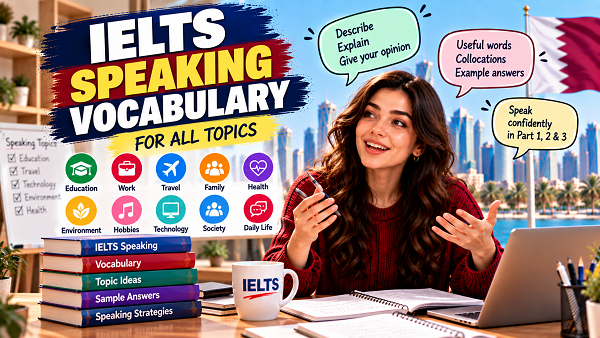
Building a strong vocabulary is one of the most effective ways to improve your IELTS Speaking performance, but learning random lists of difficult words is not the best strategy.
In the IELTS Speaking test, you need to communicate naturally about familiar topics, describe experiences, explain opinions and discuss more abstract ideas. Your vocabulary needs to be varied, accurate, appropriate and flexible.
The official IELTS Speaking test lasts 11–14 minutes and consists of three parts. Part 1 focuses on familiar topics, Part 2 requires a longer individual response, and Part 3 develops a more general and abstract discussion. Speaking is assessed on four criteria, including Lexical Resource, which looks at the range, accuracy and appropriacy of your vocabulary.
This guide provides practical IELTS Speaking vocabulary for common topics, including education, work, technology, travel, food, health, the environment, hobbies, social media, family and society.
The goal is not to memorise every word.
The goal is to learn vocabulary that you can actually use when speaking.
How Does Vocabulary Affect Your IELTS Speaking Score?
Vocabulary is assessed under the Lexical Resource criterion.
This means the examiner is not simply counting how many “advanced” words you know.
Your performance also depends on whether you can:
- Choose appropriate words
- Express your meaning precisely
- Avoid excessive repetition
- Paraphrase when necessary
- Use vocabulary naturally
- Use collocations correctly
- Discuss different topics with enough flexibility
- Use less common and idiomatic language appropriately at higher levels
Official IELTS guidance explains that Lexical Resource considers the range and precision of vocabulary used to express meaning.
The Band 7 descriptors also expect candidates to use some less common and idiomatic vocabulary, show awareness of style and collocation, and demonstrate the ability to paraphrase effectively.
Why “Advanced Vocabulary” Is Not Enough
Consider these two answers.
Basic answer:
I like my city because it is very nice and there are many good places.
More flexible answer:
I like my city because it has a lively atmosphere, plenty of entertainment options and a good balance between modern facilities and traditional areas.
The second answer is stronger not simply because the vocabulary is more advanced.
It is stronger because the speaker uses vocabulary precisely and naturally to communicate a clear idea.
How to Learn IELTS Speaking Vocabulary by Topic
Instead of memorising isolated words, learn vocabulary in groups.
For each new word, learn:
- Meaning
- Pronunciation
- Common collocations
- Example sentence
- Related words
- A personal example
For example:
Word: convenient
Collocations: convenient location, convenient transport, convenient option
Example:
Online courses are a convenient option for people who have busy schedules.
Personal example:
I prefer studying online because it is more convenient for me after work.
This makes the vocabulary much easier to retrieve during a Speaking test.
IELTS Speaking Vocabulary for Education
Education is a common area for IELTS Speaking questions, particularly in Part 1 and Part 3.
Useful Education Vocabulary
| Vocabulary | Meaning | Example |
|---|---|---|
| academic performance | how well a student performs | My academic performance improved after I changed my study routine. |
| higher education | education at university level | Higher education can open up more career opportunities. |
| educational background | a person’s education history | My educational background is mainly related to business. |
| learning environment | the conditions where learning takes place | A positive learning environment can motivate students. |
| practical skills | skills useful in real situations | Universities should teach more practical skills. |
| critical thinking | analysing information carefully | Education should encourage critical thinking. |
| study habits | regular ways of studying | Good study habits are essential before an important exam. |
| academic pressure | stress related to education | Many students experience academic pressure before exams. |
| lifelong learning | continuing to learn throughout life | I believe lifelong learning is important in a changing job market. |
| vocational training | training for a particular occupation | Vocational training can help young people develop practical skills. |
Useful Education Collocations
- pursue higher education
- gain practical experience
- develop critical thinking
- improve academic performance
- attend university
- acquire new skills
- meet academic requirements
- face academic pressure
- achieve educational goals
- develop good study habits
Example IELTS Speaking Answer
I think education should focus on both academic knowledge and practical skills. Students need theoretical knowledge, but they also need to know how to apply what they learn in real-life situations.
IELTS Speaking Vocabulary for Work and Careers
Work is another important Speaking topic, especially for candidates who are asked about their current job, career plans or workplace.
Useful Work Vocabulary
| Vocabulary | Example |
|---|---|
| job satisfaction | I get a high level of job satisfaction from helping people. |
| career progression | There are good opportunities for career progression in my company. |
| work-life balance | A healthy work-life balance is important to me. |
| professional development | I take online courses for professional development. |
| job security | Job security has become increasingly important to employees. |
| working environment | I prefer a friendly and supportive working environment. |
| career prospects | The profession offers excellent career prospects. |
| flexible working hours | Flexible working hours would make my routine easier. |
| challenging position | I enjoy having a challenging position because it keeps me motivated. |
| professional experience | My previous job gave me valuable professional experience. |
Useful Work Collocations
- build a career
- gain experience
- develop professional skills
- meet deadlines
- work under pressure
- take on responsibility
- pursue a career
- earn a living
- achieve career goals
- maintain a work-life balance
Example
What I like most about my job is the opportunity for professional development. I am constantly learning new skills, and there is also a clear path for career progression.
IELTS Speaking Vocabulary for Technology
Technology is particularly useful for Part 3 discussions because it can lead to questions about social change, communication, education and employment.
Useful Technology Vocabulary
- technological advancement
- digital technology
- artificial intelligence
- online platforms
- digital devices
- social networking
- internet access
- technological innovation
- digital skills
- online communication
- data privacy
- cybersecurity
- screen time
- automation
- remote working
Useful Technology Collocations
- rely on technology
- adopt new technology
- improve digital access
- transform the way people communicate
- increase productivity
- protect personal data
- reduce screen time
- automate routine tasks
- access information instantly
- keep up with technological change
Example
Technology has completely transformed the way people communicate. We can now contact someone almost instantly, regardless of where they live.
IELTS Speaking Vocabulary for Travel and Holidays
Travel is especially useful for Part 1 and Part 2.
Useful Travel Vocabulary
| Vocabulary | Example |
|---|---|
| tourist attraction | The city has several famous tourist attractions. |
| breathtaking scenery | The region is known for its breathtaking scenery. |
| cultural experience | Travelling gives people a valuable cultural experience. |
| local cuisine | I always try the local cuisine when I travel. |
| tourist destination | It has become a popular tourist destination. |
| travel itinerary | I usually prepare a basic travel itinerary. |
| public transport | I prefer using public transport when visiting large cities. |
| memorable trip | It was one of the most memorable trips I’ve ever taken. |
| travel experience | Travelling has given me a lot of valuable experiences. |
| natural landscape | The area has a beautiful natural landscape. |
Useful Travel Collocations
- go sightseeing
- explore a new destination
- experience local culture
- try local cuisine
- travel abroad
- take a short break
- visit tourist attractions
- travel on a budget
- make travel arrangements
- broaden your horizons
Example
I enjoy travelling because it allows me to experience different cultures. I particularly like exploring local markets and trying traditional food because it gives me a better understanding of everyday life in another country.
IELTS Speaking Vocabulary for Food and Cooking
Food is a familiar topic that can appear in Part 1 and can also lead to broader discussions in Part 3.
Vocabulary for Describing Food
- delicious
- nutritious
- filling
- spicy
- mild
- savoury
- sweet
- bitter
- refreshing
- homemade
- traditional
- flavourful
- healthy
- processed
- balanced
Vocabulary for Cooking
- prepare a meal
- follow a recipe
- chop vegetables
- fry ingredients
- bake a dish
- boil vegetables
- add seasoning
- prepare ingredients
- cook from scratch
- experiment with recipes
Useful Food Collocations
- balanced diet
- healthy eating habits
- traditional cuisine
- processed food
- fast food
- home-cooked meal
- eating habits
- nutritional value
- food preferences
- unhealthy snacks
Example
I generally prefer home-cooked meals because they tend to be healthier and more nutritious. I can also control the amount of salt and oil I use.
IELTS Speaking Vocabulary for Health and Fitness
Health questions can involve both personal experiences and broader social issues.
Useful Health Vocabulary
- healthy lifestyle
- balanced diet
- physical activity
- regular exercise
- mental well-being
- public health
- healthcare system
- medical treatment
- sedentary lifestyle
- health-conscious
- nutritious food
- stress management
- preventive healthcare
- fitness routine
- healthy habits
Useful Health Collocations
- maintain a healthy lifestyle
- get regular exercise
- follow a balanced diet
- improve physical fitness
- reduce stress
- prevent health problems
- improve mental well-being
- lead a sedentary lifestyle
- raise health awareness
- develop healthy habits
Example
I think maintaining a healthy lifestyle is mainly about consistency. People do not necessarily need to follow an extreme fitness routine; regular exercise and a balanced diet can make a significant difference.
IELTS Speaking Vocabulary for the Environment
Environmental topics are particularly useful for Part 3 because they allow you to discuss causes, consequences and possible solutions.
Useful Environment Vocabulary
- environmental protection
- climate change
- global warming
- air pollution
- water pollution
- plastic waste
- renewable energy
- fossil fuels
- carbon emissions
- natural resources
- endangered species
- environmental awareness
- sustainable development
- recycling
- conservation
Useful Environment Collocations
- reduce carbon emissions
- protect natural resources
- tackle climate change
- promote renewable energy
- raise environmental awareness
- reduce plastic waste
- protect endangered species
- conserve natural habitats
- adopt sustainable practices
- reduce environmental damage
Example
I think governments and individuals both have a role to play in environmental protection. Governments can introduce effective regulations, while individuals can reduce waste and make more sustainable choices.
IELTS Speaking Vocabulary for Hobbies and Free Time
Hobbies are especially useful for IELTS Speaking Part 1.
Useful Vocabulary
- leisure activity
- spare time
- creative outlet
- social activity
- outdoor activity
- indoor activity
- personal interest
- recreational activity
- relaxing pastime
- productive hobby
Useful Expressions
- spend time doing
- take up a hobby
- get into something
- unwind after work
- keep myself occupied
- develop a new skill
- spend time outdoors
- pursue a personal interest
- meet like-minded people
- take a break from work
Example
In my spare time, I enjoy photography. I find it quite relaxing, and it gives me a creative outlet after a busy day.
IELTS Speaking Vocabulary for Family and Relationships
Family questions often involve personal experiences, relationships and responsibilities.
Useful Family Vocabulary
- immediate family
- extended family
- close-knit family
- family member
- family tradition
- family gathering
- generation gap
- mutual support
- family values
- childhood memories
Useful Collocations
- spend quality time together
- maintain close relationships
- support one another
- share family responsibilities
- keep in touch
- grow up together
- celebrate special occasions
- pass down traditions
- have a close relationship
- spend time with relatives
Example
I come from a fairly close-knit family. We may all have busy schedules, but we try to spend quality time together, particularly during important celebrations.
IELTS Speaking Vocabulary for Hometown and Cities
Your hometown can appear in Part 1, while cities and urban development can become broader Part 3 topics.
Useful Hometown Vocabulary
- residential area
- neighbourhood
- city centre
- suburban area
- urban area
- local community
- public facilities
- shopping district
- residential development
- green space
Useful City Vocabulary
- bustling city
- lively atmosphere
- modern infrastructure
- public transport network
- urban development
- traffic congestion
- population growth
- affordable housing
- recreational facilities
- quality of life
Example
My hometown has changed considerably over the last decade. There has been a lot of urban development, including new residential areas and improved public facilities.
IELTS Speaking Vocabulary for Social Media
Social media is useful for questions about communication, technology and modern lifestyles.
Useful Vocabulary
- social media platform
- online community
- digital communication
- social networking
- online interaction
- content creator
- online presence
- privacy concerns
- misinformation
- digital footprint
- social media addiction
- viral content
Useful Collocations
- share content
- stay connected
- interact with others
- follow influencers
- spread information
- raise awareness
- protect online privacy
- consume digital content
- build an online presence
- spend time on social media
Example
Social media makes it much easier to stay connected with people who live far away. However, excessive use can reduce face-to-face interaction and create privacy concerns.
IELTS Speaking Vocabulary for Books and Reading
Useful Vocabulary
- fiction
- non-fiction
- novel
- biography
- educational book
- reading habit
- literary work
- author
- storyline
- main character
- plot
- page-turner
Useful Expressions
- get absorbed in a book
- broaden my knowledge
- develop a reading habit
- learn something new
- enjoy a compelling storyline
- read for pleasure
- read on a regular basis
- discover new ideas
Example
I enjoy reading non-fiction because it allows me to learn about subjects that I would not normally encounter in my daily life.
IELTS Speaking Vocabulary for Movies and Entertainment
Useful Vocabulary
- film genre
- comedy
- documentary
- thriller
- science fiction
- action film
- leading actor
- storyline
- special effects
- streaming platform
- box-office success
- entertaining
Useful Collocations
- watch a film
- follow a series
- stream a movie
- play the leading role
- receive critical acclaim
- have a strong storyline
- keep the audience engaged
- watch something for entertainment
Example
I usually watch documentaries because I find them both entertaining and educational. They often introduce me to ideas and subjects that I know very little about.
IELTS Speaking Vocabulary for Shopping
Useful Vocabulary
- shopping centre
- local market
- online shopping
- customer service
- shopping habits
- consumer behaviour
- reasonable price
- good value for money
- brand loyalty
- impulse buying
- essential item
- luxury product
Useful Collocations
- compare prices
- make a purchase
- shop online
- look for bargains
- get good value for money
- buy something on impulse
- check customer reviews
- return an item
- make an informed decision
Example
I usually compare prices online before making a purchase. I also check customer reviews because I want to make sure I am getting good value for money.
IELTS Speaking Vocabulary for Money and Spending
Useful Vocabulary
- monthly budget
- living expenses
- cost of living
- financial security
- disposable income
- savings
- household expenses
- financial responsibility
- spending habits
- unnecessary expenses
Useful Collocations
- save money
- manage a budget
- cover living expenses
- reduce unnecessary spending
- plan a budget
- build up savings
- make a financial decision
- live within your means
Example
I try to manage my monthly budget carefully because the cost of living has increased considerably. I usually prioritise essential expenses and save whatever I can.
IELTS Speaking Vocabulary for the Future and Ambitions
Future plans are common in Speaking and can also lead to Part 3 discussions about career development and society.
Useful Vocabulary
- long-term goal
- short-term goal
- career ambition
- future plans
- personal development
- professional growth
- future prospects
- career path
- achieve an objective
- pursue a goal
Useful Expressions
- in the long term
- in the near future
- over the next few years
- I am hoping to
- I would like to
- I am planning to
- I am considering
- my main goal is
- I would eventually like to
Example
In the long term, I would like to develop my professional skills and move into a position with greater responsibility.
IELTS Speaking Vocabulary for Government and Society
This vocabulary becomes especially useful in Part 3, where questions can become more abstract.
Useful Vocabulary
- government policy
- public services
- social responsibility
- public awareness
- government funding
- social inequality
- living standards
- public safety
- community development
- social change
Useful Collocations
- introduce new policies
- provide public services
- allocate government funding
- improve living standards
- address social problems
- reduce inequality
- raise public awareness
- support local communities
- protect public safety
- promote social development
Example
Governments have an important role in improving public services, particularly in areas such as healthcare, education and public transport.
IELTS Speaking Vocabulary for Transport
Useful Vocabulary
- public transportation
- private vehicle
- traffic congestion
- rush hour
- commuting
- public transport network
- transport infrastructure
- pedestrian
- cycling infrastructure
- environmentally friendly transport
Useful Collocations
- commute to work
- use public transport
- reduce traffic congestion
- improve transport infrastructure
- expand public transport
- encourage cycling
- reduce car dependency
- travel during rush hour
Example
Improving public transportation could reduce traffic congestion because it would encourage more people to leave their cars at home.
IELTS Speaking Vocabulary for Weather and Seasons
Useful Vocabulary
- mild climate
- humid weather
- extreme temperatures
- scorching hot
- freezing cold
- pleasant weather
- heavy rainfall
- weather forecast
- seasonal changes
- outdoor activities
Example
I prefer mild weather because it makes it much easier to spend time outdoors and take part in activities such as walking or cycling.
IELTS Speaking Vocabulary for the Internet
Useful Vocabulary
- internet access
- online services
- search engine
- reliable source
- online learning
- digital platform
- internet connection
- online information
- cybersecurity
- personal data
Useful Collocations
- access information
- browse the internet
- search for information
- take an online course
- use online services
- protect personal information
- verify information
- stay informed
Example
The internet has made access to information much easier. However, people need to develop digital literacy so they can distinguish reliable sources from misleading information.
IELTS Speaking Vocabulary for Culture and Traditions
Useful Vocabulary
- cultural heritage
- traditional customs
- cultural identity
- local traditions
- traditional ceremony
- cultural diversity
- national identity
- cultural values
- generation
- traditional practices
Useful Collocations
- preserve cultural heritage
- maintain traditions
- pass traditions down
- celebrate cultural events
- promote cultural awareness
- respect cultural differences
- protect cultural identity
- experience different cultures
Example
I think preserving cultural heritage is important because traditions give people a sense of identity and help younger generations understand their history.
IELTS Speaking Vocabulary for Describing People
You may need to describe people in Part 1, Part 2 or Part 3.
Positive Personality Vocabulary
- outgoing
- sociable
- reliable
- ambitious
- hardworking
- generous
- open-minded
- supportive
- patient
- easy-going
- confident
- creative
- determined
- thoughtful
Useful Personality Expressions
- easy to get along with
- have a positive attitude
- be willing to help
- take responsibility
- remain calm under pressure
- have a strong work ethic
- see things from another person’s perspective
Example
One of my closest friends is extremely open-minded. She is always willing to listen to different opinions, even when she disagrees with them.
IELTS Speaking Vocabulary for Describing Places
Useful Vocabulary
- picturesque
- peaceful
- lively
- crowded
- spacious
- modern
- historic
- scenic
- convenient
- well-developed
- residential
- tourist-friendly
Useful Expressions
- located in the heart of
- within walking distance of
- surrounded by
- famous for
- known for
- close to the city centre
- easily accessible
- worth visiting
Example
The area is known for its lively atmosphere and convenient location. It is within walking distance of several restaurants, shops and public transport stations.
IELTS Speaking Vocabulary for Feelings and Experiences
Being able to describe emotions precisely can make personal answers much more interesting.
Useful Vocabulary
- delighted
- frustrated
- relieved
- overwhelmed
- fascinated
- disappointed
- excited
- nervous
- satisfied
- embarrassed
- proud
- grateful
- surprised
Useful Expressions
- I was genuinely surprised
- I felt extremely relieved
- it was a memorable experience
- I was particularly impressed by
- I found it quite challenging
- it made me realise that
- it was a rewarding experience
Example
I was initially quite nervous about the experience, but once I became familiar with the situation, I started to feel much more confident.
IELTS Speaking Vocabulary for Opinions
Part 3 often requires you to express and justify an opinion.
Instead of repeating “I think” in every answer, use a range of natural expressions.
Giving Your Opinion
- In my view…
- Personally, I believe…
- From my perspective…
- I would argue that…
- As far as I am concerned…
- I tend to think that…
- I would say that…
Expressing a Balanced Opinion
- It depends on the situation.
- There are arguments on both sides.
- To some extent, I agree.
- I can understand why people think that.
- There are both advantages and disadvantages.
- It largely depends on how it is used.
Example
From my perspective, technology has had a largely positive impact on education, although its effectiveness depends on how responsibly it is used.
IELTS Speaking Vocabulary for Comparing Ideas
Comparison language is particularly useful in Part 3.
Useful Expressions
- compared with
- in contrast
- whereas
- while
- on the other hand
- significantly more
- considerably less
- relatively
- to a greater extent
- to a lesser extent
Example
Younger people tend to rely more heavily on digital communication, whereas older generations may prefer face-to-face conversations.
IELTS Speaking Vocabulary for Cause and Effect
These expressions help you explain your ideas instead of simply stating them.
Cause
- because of
- due to
- as a result of
- one reason is
- this is mainly because
- this can be attributed to
Effect
- as a result
- consequently
- therefore
- this can lead to
- this may result in
- this can have an impact on
Example
More people are working remotely because of improvements in digital technology. As a result, companies can recruit employees from a much wider geographical area.
IELTS Speaking Vocabulary for Advantages and Disadvantages
Advantages
- benefit
- advantage
- positive aspect
- major strength
- opportunity
- potential benefit
Disadvantages
- drawback
- disadvantage
- limitation
- negative aspect
- potential risk
- concern
Example
One major advantage of online learning is flexibility. However, a potential drawback is that students may have fewer opportunities for face-to-face interaction.
IELTS Speaking Vocabulary for Giving Examples
Examples make your answers more specific.
Useful expressions include:
- for example
- for instance
- such as
- to give you an example
- a good example would be
- one example that comes to mind is
- in my own experience
Example
There are several ways technology has improved education. For instance, students can now take online courses from universities in other countries without having to travel abroad.
IELTS Speaking Vocabulary for Part 1
Part 1 focuses on familiar topics and everyday experiences.
Your vocabulary should therefore sound natural and conversational.
Useful categories include:
- Home
- Hometown
- Family
- Work
- Studies
- Food
- Hobbies
- Friends
- Travel
- Shopping
- Sports
- Weather
- Books
- Music
- Movies
- Daily routines
Do not try to turn a simple Part 1 question into a formal academic speech.
Example
Question: Do you like cooking?
Yes, I do. I actually find cooking quite relaxing, especially at weekends. I enjoy trying new recipes, although I usually prefer simple dishes that don’t take too long to prepare.
This answer uses useful vocabulary without sounding memorised.
IELTS Speaking Vocabulary for Part 2
Part 2 requires you to speak about a topic after a short preparation period. The official IELTS format gives you one minute to prepare and asks you to speak for around one to two minutes.
Vocabulary can help you describe:
- People
- Places
- Events
- Objects
- Experiences
- Activities
- Memories
Useful Part 2 Language
To introduce the topic:
The first thing that comes to mind is…
I’d like to talk about…
One experience that I remember particularly well is…
To add details:
What I particularly remember is…
Another thing worth mentioning is…
What made it special was…
To explain feelings:
I remember feeling…
I was quite surprised by…
It was an incredibly rewarding experience.
To finish:
Overall, it was an experience that I will probably never forget.
These are frameworks, not scripts. Adapt them to your own experience.
IELTS Speaking Vocabulary for Part 3
Part 3 involves a longer discussion and can require more abstract thinking.
Useful vocabulary includes language for:
- Opinions
- Causes
- Effects
- Comparisons
- Predictions
- Advantages
- Disadvantages
- Social change
- Government
- Education
- Technology
- Environment
Useful Part 3 Expressions
Giving an opinion:
I would argue that…
Explaining a reason:
One of the main reasons is that…
Discussing consequences:
This could potentially lead to…
Making a prediction:
I suspect that this trend will continue because…
Adding a qualification:
That said, it depends largely on…
Giving a balanced answer:
There are benefits to this approach, but there are also some significant drawbacks.
IELTS Speaking Vocabulary: Natural Alternatives to Common Words
You do not need to replace every simple word with an unusual synonym.
However, having a flexible vocabulary can help you avoid repetition.
Instead of “Good”
Try:
- beneficial
- effective
- enjoyable
- valuable
- positive
- useful
- impressive
Example:
It was a very enjoyable experience.
Instead of “Bad”
Try:
- harmful
- negative
- ineffective
- disappointing
- problematic
- inconvenient
Instead of “Important”
Try:
- essential
- significant
- valuable
- crucial
- influential
- particularly relevant
Instead of “Big”
Try:
- major
- considerable
- significant
- substantial
- widespread
Instead of “Very Difficult”
Try:
- challenging
- demanding
- complicated
- stressful
- time-consuming
The best word depends on the context.
IELTS Speaking Collocations You Should Learn
Collocations are combinations of words that naturally occur together.
They are particularly useful because IELTS Speaking assesses not only vocabulary range but also the appropriacy and precision of vocabulary use. The official Band 7 descriptors specifically refer to awareness of style and collocation.
Education
- academic performance
- higher education
- practical skills
- academic pressure
- learning environment
Work
- career progression
- job satisfaction
- professional development
- work-life balance
- job security
Environment
- carbon emissions
- renewable energy
- environmental protection
- natural resources
- climate change
Health
- balanced diet
- physical activity
- healthy lifestyle
- mental well-being
- public health
Technology
- digital technology
- technological advancement
- online platform
- data privacy
- digital skills
Society
- social inequality
- public services
- living standards
- government policy
- social responsibility
Learning these as complete combinations is usually more useful than memorising individual words.
IELTS Speaking Idioms: Should You Use Them?
Idioms can be useful, particularly for higher-band performance, but they should be used naturally.
Official IELTS guidance notes that Band 7 and above includes the use of some less common and idiomatic vocabulary, together with awareness of style and collocation.
However, this does not mean you should put an idiom into every answer.
For example:
I was over the moon when I received the news.
This can sound natural when talking about something genuinely exciting.
But forcing an idiom into an unrelated answer can make your speech sound memorised.
Better Rule for Idioms
Use an idiom when:
- You know its exact meaning
- You understand the context
- It fits naturally
- You can pronounce it confidently
- You would realistically use it in conversation
Natural language is more important than showing off.
How to Paraphrase When You Forget a Word
One valuable Speaking skill is the ability to explain something when you do not know the exact word.
For example, if you forget “thermometer”, you could say:
It’s a device that you use to measure someone’s temperature.
This is paraphrasing.
Official IELTS Speaking assessment recognises the ability to paraphrase as part of Lexical Resource.
Useful phrases include:
- It’s a kind of…
- It’s something that…
- It’s a device used for…
- It’s basically…
- What I mean is…
- It’s similar to…
- It’s a place where…
- It’s someone who…
This skill can help you keep speaking instead of becoming completely stuck.
Common IELTS Speaking Vocabulary Mistakes
Memorising Long Lists
Knowing 500 words does not help if you cannot use them naturally.
Using Words You Do Not Fully Understand
Never use a word simply because it looks advanced.
Repeating the Same Adjectives
Try to develop a flexible range of descriptive vocabulary.
Using Informal Language in Every Situation
Speaking can be conversational, but your vocabulary should still be appropriate to the topic and context.
Overusing Idioms
One natural idiom is better than five forced expressions.
Learning Synonyms Without Collocations
Two words may have similar meanings but cannot always be used in the same sentence.
Translating Directly From Your First Language
English expressions do not always follow the same patterns as your native language.
Focusing Only on Vocabulary
Speaking is assessed using four criteria. Vocabulary is important, but fluency and coherence, grammatical range and accuracy, and pronunciation also contribute to your Speaking score.
How to Use IELTS Speaking Vocabulary in Practice
Vocabulary becomes useful when you actively use it.
Try this five-step method.
Step 1: Choose One Topic
For example:
Technology
Step 2: Learn 10 Useful Words
Choose vocabulary such as:
- technological advancement
- digital platform
- online communication
- data privacy
- automation
Step 3: Learn Five Collocations
For example:
- rely on technology
- protect personal data
- improve productivity
- access information
- adopt new technology
Step 4: Answer Five Speaking Questions
Do not look at your vocabulary list while speaking.
Step 5: Record Yourself
Listen for:
- Repetition
- Incorrect word choice
- Long pauses
- Pronunciation problems
- Unnatural expressions
- Grammar mistakes
Then repeat the answers using improved vocabulary.
A 7-Day IELTS Speaking Vocabulary Study Plan
You do not need to learn dozens of topics every day.
Use one topic at a time.
Day 1: Education and Work
Learn 15–20 words and collocations.
Practise five Part 1 questions.
Day 2: Hometown, Family and People
Learn descriptive vocabulary.
Record two-minute answers about people and places.
Day 3: Technology and Social Media
Practise explaining advantages, disadvantages and changes.
Day 4: Travel, Food and Hobbies
Practise personal experiences and Part 2 topics.
Day 5: Health and Environment
Practise cause-and-effect vocabulary.
Day 6: Society and the Future
Focus on Part 3 vocabulary and abstract ideas.
Day 7: Full Speaking Practice
Complete:
- Part 1
- Part 2
- Part 3
Record the entire session and identify your five most common vocabulary problems.
How Many IELTS Speaking Words Should You Learn?
There is no official number of vocabulary words you need to memorise to achieve a particular IELTS Speaking band.
The quality of your vocabulary matters more than simply counting words.
You should aim to develop vocabulary that allows you to:
- Describe familiar experiences
- Express opinions
- Explain reasons
- Compare ideas
- Discuss advantages and disadvantages
- Describe people and places
- Talk about change
- Discuss abstract topics
- Paraphrase when necessary
- Communicate precisely
A smaller vocabulary that you can use accurately and flexibly is much more useful than a huge list of words that you cannot retrieve naturally.
How to Build Your Personal IELTS Speaking Vocabulary Bank
Create a vocabulary bank organised by topic.
For every word, record:
| Word/Phrase | Meaning | Collocation | Your Example |
|---|---|---|---|
| job satisfaction | enjoyment from your work | high job satisfaction | I get high job satisfaction from my work. |
| carbon emissions | gases released into the atmosphere | reduce carbon emissions | Public transport can help reduce carbon emissions. |
| cultural heritage | traditions and history of a culture | preserve cultural heritage | Tourism can help preserve cultural heritage. |
| work-life balance | balance between work and personal life | maintain a healthy work-life balance | I try to maintain a healthy work-life balance. |
Your own examples are particularly important because they make the vocabulary easier to retrieve during spontaneous speaking.
IELTS Speaking Vocabulary Practice Questions
Use these questions to practise the vocabulary from this article.
Education
Do you enjoy studying?
What would you like to study in the future?
Do you think education has changed in recent years?
Work
What do you like about your job?
What kind of job would you like in the future?
What makes a good working environment?
Technology
How often do you use technology?
Has technology changed the way people communicate?
Do you think people rely too much on technology?
Travel
Do you enjoy travelling?
What kind of places do you like visiting?
Why do people enjoy travelling abroad?
Environment
What environmental problems are common in your country?
What can individuals do to protect the environment?
Should governments do more to tackle climate change?
Health
Do you exercise regularly?
What can people do to maintain a healthy lifestyle?
Why are some people less healthy than they were in the past?
Society
What is the most important social problem in your country?
Should governments provide more public services?
How might society change in the future?
IELTS Speaking Vocabulary Checklist
Before your exam, make sure you can use vocabulary for:
-
Education
-
Work and careers
-
Hometown
-
Family
-
Friends
-
Hobbies
-
Travel
-
Food
-
Health
-
Environment
-
Technology
-
Social media
-
Shopping
-
Money
-
Transport
-
Books
-
Movies
- [Culture and traditions
-
Future plans
-
Society
-
Government
-
Opinions
-
Comparisons
-
Causes and effects
-
Advantages and disadvantages
More importantly, make sure you can use the vocabulary in complete sentences without sounding memorised.
Frequently Asked Questions About IELTS Speaking Vocabulary
What is the best vocabulary for IELTS Speaking?
The best IELTS Speaking vocabulary is language that you can use accurately, naturally and appropriately to express your ideas. Topic-specific vocabulary, collocations, paraphrasing and some less common language can all be useful.
How can I improve my IELTS Speaking vocabulary?
Learn vocabulary by topic, study collocations, create your own example sentences, practise answering Speaking questions and record yourself regularly.
How many words should I learn for IELTS Speaking?
There is no official number of words required for a particular Speaking band. Focus on building a flexible vocabulary that allows you to discuss different topics clearly and precisely.
Should I use difficult words in IELTS Speaking?
Not necessarily. Difficult words can be useful when they are accurate and natural, but using complicated vocabulary incorrectly can weaken your performance.
Should I use idioms in IELTS Speaking?
You can use idiomatic language when it fits naturally. Official IELTS guidance indicates that less common and idiomatic vocabulary is relevant at higher Speaking bands, but forced idioms are not a good strategy.
Is vocabulary important for Band 7 in IELTS Speaking?
Yes. Band 7 includes expectations around flexible vocabulary use, some less common and idiomatic vocabulary, awareness of collocation and effective paraphrasing.
How can I stop repeating the same words in IELTS Speaking?
Build topic-based synonym groups and practise using different expressions in context. However, do not replace every repeated word with a synonym if the alternative sounds unnatural.
How can I remember IELTS Speaking vocabulary?
Learn words in phrases and collocations, create personal examples, practise speaking them aloud and review them regularly instead of memorising isolated lists.
Can I use the same vocabulary in Part 1, Part 2 and Part 3?
Some vocabulary can be used across all three parts, but the language you need changes with the task. Part 1 usually involves familiar topics, while Part 3 can require more abstract discussion.
What should I do if I forget a word during the Speaking test?
Try to paraphrase it. Explain what the thing is, what it does, where you find it or what it is similar to. The ability to paraphrase is relevant to Lexical Resource.
Is IELTS Speaking vocabulary the same for Academic and General Training?
Yes. The IELTS Speaking test is the same for Academic and General Training.
Improve Your IELTS Speaking With Structured Practice
Building a strong IELTS Speaking vocabulary is only one part of improving your score.
You also need to develop:
- Fluency and coherence
- Grammar
- Pronunciation
- Idea development
- Paraphrasing
- Confidence
- The ability to respond spontaneously
The official IELTS Speaking test assesses four equally important criteria, so vocabulary should be developed alongside the other speaking skills.
A structured IELTS Speaking course can help you practise vocabulary in context, receive feedback on your answers and identify the language problems that are difficult to notice when you study alone.
If you want to improve your IELTS Speaking performance with guided practice and expert feedback, explore IFI Qatar’s IELTS Speaking and preparation programmes.
Final Tips for Learning IELTS Speaking Vocabulary
Do not try to memorise hundreds of complicated words before your IELTS test.
Instead:
- Learn vocabulary by topic.
- Study collocations rather than isolated words.
- Create your own examples.
- Use new vocabulary in Speaking answers.
- Practise paraphrasing.
- Record yourself and identify repetition.
- Use idioms only when they sound natural.
- Focus on accuracy as well as range.
- Learn vocabulary for both personal and abstract topics.
- Practise using vocabulary spontaneously rather than memorising complete answers.
The strongest IELTS speakers do not sound like they have memorised a vocabulary list.
They sound like they have enough language to express their ideas naturally, precisely and confidently.
That is the skill your vocabulary practice should ultimately build.