

Currently Empty: ر.ق 0,00


IELTS
IELTS Speaking Topics 2026 with Answers: Part 1, 2 and 3 Practice
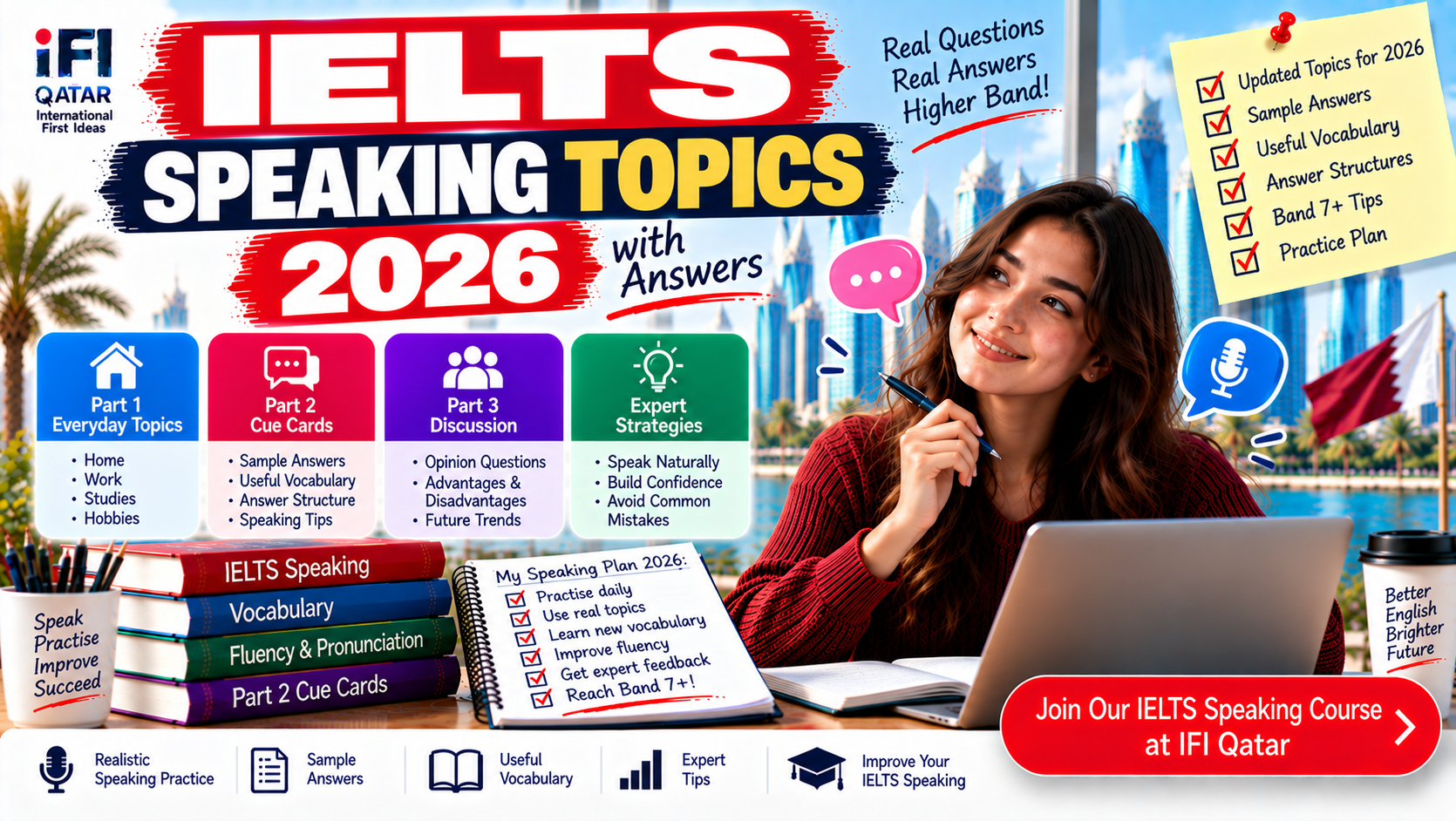
Preparing for the IELTS Speaking test can feel difficult when you do not know what kinds of questions you may be asked.
The good news is that you do not need to memorise hundreds of answers.
A better approach is to practise a wide range of IELTS Speaking topics, learn how to develop ideas naturally, and become comfortable answering unexpected follow-up questions.
This guide provides IELTS Speaking topics for 2026 with sample answers for Parts 1, 2 and 3. The questions are designed for realistic practice and cover common areas such as work, studies, technology, travel, food, health, education, the environment and daily life.
These are practice questions, not leaked or guaranteed IELTS questions. The actual questions you receive depend on the examiner, test version and test day.
The goal is to help you become more flexible, confident and natural when speaking English.
What Are the IELTS Speaking Topics for 2026?
IELTS does not publish a guaranteed list of future Speaking questions.
However, the Speaking test continues to follow a clear structure:
- Part 1: Familiar topics and personal questions
- Part 2: A topic card requiring a longer individual response
- Part 3: A deeper discussion connected to the Part 2 topic
The complete Speaking test lasts 11–14 minutes.
Part 1 lasts around 4–5 minutes, Part 2 takes 3–4 minutes including preparation, and Part 3 lasts approximately 4–5 minutes.
You receive one minute to prepare for Part 2 and then speak for up to two minutes.
This means your preparation should focus not only on individual topics but also on your ability to develop ideas, explain opinions and respond naturally.
How Are IELTS Speaking Answers Scored?
IELTS Speaking is assessed using four criteria:
- Fluency and Coherence
- Lexical Resource
- Grammatical Range and Accuracy
- Pronunciation
Each area contributes to your Speaking performance.
This means a strong answer is not simply an answer containing difficult vocabulary.
You need to:
- Speak with reasonable fluency
- Organise your ideas clearly
- Use appropriate vocabulary
- Demonstrate grammatical range and accuracy
- Pronounce words clearly enough to be understood
- Develop your answers rather than giving extremely short responses
For this reason, memorising a perfect answer for every possible topic is not an effective strategy.
IELTS Speaking Part 1 Topics 2026
Part 1 focuses on familiar topics and everyday experiences.
The examiner may ask about areas such as:
- Home
- Hometown
- Work
- Studies
- Family
- Friends
- Hobbies
- Food
- Travel
- Technology
- Shopping
- Daily routines
- Free time
- Weather
- Sports
- Books
- Music
The best way to prepare is to practise answering naturally in two or three sentences rather than memorising long speeches.
IELTS Speaking Topic 1: Your Hometown
Question 1: Where are you from?
Sample Answer:
I’m from Doha, Qatar. It’s a modern and rapidly developing city, but it still has a strong connection with Qatari culture and traditions. I particularly like the fact that there are so many different communities living here.
Question 2: What do you like about your hometown?
Sample Answer:
I really like the combination of modern facilities and traditional culture. There are excellent shopping centres, restaurants and public spaces, but you can also find traditional markets and cultural attractions.
Question 3: Has your hometown changed much in recent years?
Sample Answer:
Yes, quite significantly. There have been many new buildings, roads and public facilities, and the city has become much more international. I think the pace of development has been particularly noticeable over the last few years.
Question 4: Would you like to live there in the future?
Sample Answer:
Yes, I think so. I’m comfortable with the lifestyle there, and I like having access to both modern facilities and cultural activities. However, I would also enjoy living abroad for a few years to experience a different environment.
IELTS Speaking Topic 2: Work and Studies
Question 1: Do you work or are you a student?
Sample Answer:
I’m currently working. My job involves communicating with different people and solving problems, so it can be challenging at times, but I enjoy the variety.
Question 2: What do you enjoy about your work?
Sample Answer:
I enjoy learning new things and working on different projects. I also like the fact that my work gives me opportunities to improve my communication and professional skills.
Question 3: What would you like to change about your work?
Sample Answer:
I would probably like to have a little more flexibility in my schedule. Having greater control over my working hours would make it easier to balance professional responsibilities with personal activities.
IELTS Speaking Topic 3: Technology
Question 1: How often do you use technology?
Sample Answer:
I use technology every day. I rely on my phone and computer for work, communication, entertainment and learning, so it is an important part of my daily routine.
Question 2: What piece of technology do you use the most?
Sample Answer:
Probably my smartphone. I use it to communicate with people, check information, manage my schedule and sometimes study. It is difficult to imagine my daily routine without it.
Question 3: Has technology changed the way people communicate?
Sample Answer:
Definitely. Communication has become much faster and more convenient because people can contact each other instantly through messaging apps and video calls. However, I think this convenience can sometimes reduce face-to-face interaction.
IELTS Speaking Topic 4: Food
Question 1: What kind of food do you like?
Sample Answer:
I enjoy a variety of foods, but I particularly like traditional Middle Eastern dishes. I also enjoy trying international cuisine because it gives me an opportunity to experience different flavours and cooking styles.
Question 2: Do you prefer eating at home or in restaurants?
Sample Answer:
It depends on the situation. I usually prefer eating at home during the week because it is more convenient, but I enjoy going to restaurants at weekends or when I want to spend time with friends.
Question 3: Do you think people’s eating habits are changing?
Sample Answer:
Yes, I think they are. Many people are becoming more aware of nutrition and are trying to reduce processed food. At the same time, busy lifestyles have increased the popularity of convenient meals and food delivery services.
IELTS Speaking Topic 5: Free Time
Question 1: What do you usually do in your free time?
Sample Answer:
I usually watch films, listen to music or meet friends. If I have more time, I like going somewhere outdoors because it helps me relax after a busy week.
Question 2: Do you have enough free time?
Sample Answer:
Not always. My schedule can be quite busy, so I sometimes have to plan my free time carefully. I think having some time to relax is important because it helps me maintain a healthy balance.
IELTS Speaking Topic 6: Travel
Question 1: Do you enjoy travelling?
Sample Answer:
Yes, definitely. I enjoy visiting new places because travelling gives me the opportunity to experience different cultures, try new food and meet people with different backgrounds.
Question 2: What kind of places do you like visiting?
Sample Answer:
I usually prefer places that offer a combination of nature and culture. I enjoy visiting historical areas, but I also like spending time outdoors and exploring natural landscapes.
Question 3: Do you prefer travelling alone or with other people?
Sample Answer:
I generally prefer travelling with other people because sharing experiences makes the trip more enjoyable. However, travelling alone can also be interesting because it gives you more freedom to decide what you want to do.
IELTS Speaking Topic 7: Health and Exercise
Question 1: Do you exercise regularly?
Sample Answer:
I try to exercise several times a week. I usually choose activities that are easy to fit into my schedule, such as walking or going to the gym.
Question 2: Why is exercise important?
Sample Answer:
Exercise is important because it can improve both physical and mental well-being. It can also help people manage stress and maintain a healthier lifestyle.
Question 3: Are people healthier now than in the past?
Sample Answer:
I think there are advantages and disadvantages. People have better access to medical information and treatment, but modern lifestyles can also involve more stress, less physical activity and unhealthy eating habits.
IELTS Speaking Topic 8: Books and Reading
Question 1: Do you enjoy reading?
Sample Answer:
Yes, although the amount I read depends on how busy I am. I usually prefer books or articles related to subjects that I am interested in because I find them more engaging.
Question 2: Do you prefer printed books or digital books?
Sample Answer:
I prefer printed books because I find them easier to concentrate on. However, digital books are much more convenient when travelling because you can carry many books on one device.
IELTS Speaking Topic 9: Weather
Question 1: What kind of weather do you like?
Sample Answer:
I prefer mild and slightly cool weather. It is much easier to spend time outdoors when the temperature is comfortable, especially if I want to exercise or meet friends.
Question 2: Does the weather affect your mood?
Sample Answer:
Yes, to some extent. Pleasant weather usually makes me feel more energetic and motivates me to go outside, while extremely hot or unpleasant weather can make me prefer staying indoors.
IELTS Speaking Topic 10: Social Media
Sample Answer:
Yes, I use it regularly, mainly to stay in touch with people and follow topics that interest me. I also think it can be useful for discovering information and keeping up with current trends.
Sample Answer:
Some people probably do. Social media is designed to keep users engaged, so it can be easy to spend more time on it than intended. I think setting limits can help people use it more responsibly.
IELTS Speaking Part 2 Topics 2026
Part 2 is different from Part 1 because you need to speak for a longer period.
You receive a task card with a topic and several points to cover.
You have one minute to prepare.
A useful strategy is to create a simple structure:
What → When/Where → Details → Why → Result/Feeling
Do not try to write complete sentences during your preparation time.
Write keywords that will help you remember your ideas.
IELTS Speaking Part 2 Topic 1: Describe a Person Who Influenced You
Cue Card:
Describe a person who has had a positive influence on you.
You should say:
- Who this person is
- How you know them
- What they have done
- And explain why they influenced you
Sample Answer:
One person who has had a significant influence on me is one of my former teachers. I met this person when I was studying at school, and although I had several good teachers, this particular teacher had a strong impact on the way I approached learning.
What I appreciated most was the way they encouraged students to ask questions instead of simply memorising information. They also gave me useful advice when I was uncertain about my future plans.
I think this person influenced me because they helped me become more independent and confident. They showed me that making mistakes is a normal part of learning, which is something I still remember today.
IELTS Speaking Part 2 Topic 2: Describe a Useful Piece of Technology
Cue Card:
Describe a piece of technology that you use regularly.
You should say:
- What it is
- When you started using it
- What you use it for
- And explain why it is useful
Sample Answer:
I’d like to talk about my smartphone, which is probably the piece of technology I use most frequently. I’ve had smartphones for many years, but the functions they offer have become much more advanced.
I use mine for communication, work, navigation, entertainment and learning. For example, I can quickly search for information, attend online meetings and use educational applications whenever I have some free time.
The main reason it is useful is convenience. Instead of carrying several separate devices, I can do many different things using one small device. Of course, I think it is important to avoid becoming too dependent on technology, but overall it has made many parts of my daily life easier.
IELTS Speaking Part 2 Topic 3: Describe a Place You Would Like to Visit
Cue Card:
Describe a place you would like to visit.
You should say:
- Where it is
- What you know about it
- Why you want to visit
- And explain what you would like to do there
Sample Answer:
A place I would really like to visit is Japan. I’ve always been interested in its combination of modern technology, traditional culture and natural scenery.
If I had the opportunity to go there, I would like to visit Tokyo because of its modern city life, but I would also like to explore some smaller towns and historical areas.
One of the main reasons I want to visit is that the culture is quite different from what I am familiar with. I think travelling there would give me the chance to experience a different way of life rather than simply visiting tourist attractions.
IELTS Speaking Part 2 Topic 4: Describe a Skill You Would Like to Learn
Cue Card:
Describe a skill you would like to learn.
You should say:
- What the skill is
- Why you want to learn it
- How you would learn it
- And explain how it would benefit you
Sample Answer:
One skill I would like to improve is public speaking. I think it is useful in both professional and personal situations because being able to communicate ideas clearly can make a big difference.
I would probably learn through a combination of courses, practical experience and regular practice. I could start by speaking in front of small groups and gradually become more comfortable with larger audiences.
I think the main benefit would be increased confidence. It would also help me communicate more effectively at work and explain complex ideas in a clearer way.
IELTS Speaking Part 2 Topic 5: Describe an Important Decision You Made
Cue Card:
Describe an important decision you made.
You should say:
- What the decision was
- When you made it
- Why you made it
- And explain how you felt about it
Sample Answer:
One important decision I made was to focus more seriously on my professional development. At the time, I realised that simply continuing with the same routine would not necessarily help me achieve my long-term goals.
I spent some time considering my options and eventually decided to invest more time in learning new skills. It was not an easy decision because it required me to change my routine and give up some free time.
Looking back, I think it was a positive decision because it encouraged me to become more disciplined and think more carefully about my future.
IELTS Speaking Part 2 Topic 6: Describe a Memorable Trip
Cue Card:
Describe a trip that you remember well.
You should say:
- Where you went
- Who you went with
- What you did
- And explain why you remember it
Sample Answer:
One trip I remember particularly well was a holiday I took with some close friends. We visited a city that I had never been to before, so almost everything felt new.
We spent our time exploring different neighbourhoods, trying local food and visiting several interesting attractions. We also spent quite a lot of time simply walking around and talking.
What made the trip memorable was not one particular attraction but the overall experience. We were able to relax, spend quality time together and experience a completely different environment.
IELTS Speaking Part 2 Topic 7: Describe a Useful Website or App
Cue Card:
Describe a website or application that you find useful.
You should say:
- What it is
- How often you use it
- What you use it for
- And explain why it is useful
Sample Answer:
One application I find particularly useful is a navigation app. I use it several times a week, especially when I need to travel somewhere unfamiliar.
It helps me find the quickest route, check traffic conditions and estimate how long a journey will take. I also use it when I am exploring a new area because it allows me to find restaurants, shops and other places nearby.
I find it useful mainly because it saves time. Instead of asking for directions or trying to understand a complicated map, I can get the information almost immediately.
IELTS Speaking Part 3 Topics 2026
Part 3 requires a different type of preparation.
The examiner asks broader and more abstract questions connected to the Part 2 topic.
You may need to:
- Explain causes
- Discuss consequences
- Compare different perspectives
- Predict future developments
- Analyse social issues
- Justify your opinion
- Discuss advantages and disadvantages
A strong Part 3 answer often follows this structure:
Opinion → Explanation → Example → Result
IELTS Speaking Part 3 Topic: Technology and Society
Question: How has technology changed people’s lives?
Sample Answer:
Technology has changed people’s lives in several major ways. First, communication has become much faster because people can contact each other almost instantly. It has also changed the way people work, study and access information.
For example, many people can now work remotely or take online courses without travelling to another location. However, increased dependence on technology can also create problems, particularly if people spend too much time online.
Question: Do you think technology will make life easier in the future?
Sample Answer:
I think it probably will in many areas, particularly healthcare, transportation and communication. Artificial intelligence and automation may reduce the amount of time people spend on repetitive tasks.
However, I don’t think technological development will solve every problem. New technologies can also create challenges related to employment, privacy and security, so society will need to adapt to these changes.
Question: Should children spend less time using technology?
Sample Answer:
I think balance is more important than simply reducing screen time. Technology can be extremely useful for education and communication, but children also need physical activity and face-to-face interaction.
Parents should therefore focus on how children use technology rather than treating all screen time as equally harmful.
IELTS Speaking Part 3 Topic: Education
Question: What makes a good teacher?
Sample Answer:
I think a good teacher needs both strong subject knowledge and effective communication skills. They should be able to explain difficult concepts clearly and adapt their teaching methods to different students.
A good teacher should also encourage students to think independently rather than simply memorising information.
Question: Is online education as effective as classroom education?
Sample Answer:
It can be effective, but it depends on the student and the subject. Online education offers flexibility and allows learners to access courses from almost anywhere.
However, classroom learning can provide more direct interaction and immediate communication with teachers and other students. For that reason, I think a combination of both approaches can sometimes be particularly effective.
IELTS Speaking Part 3 Topic: Environment
Question: What are the biggest environmental problems facing cities?
Sample Answer:
Air pollution, traffic congestion and waste management are among the major problems. Rapid population growth can put pressure on infrastructure and increase demand for energy and transportation.
Governments can address these issues through better public transport, stricter environmental regulations and investment in cleaner energy.
Question: What can individuals do to protect the environment?
Sample Answer:
Individuals can make relatively small changes that become significant when large numbers of people adopt them. For example, they can reduce unnecessary consumption, use public transportation more often and avoid wasting energy.
However, I think individual action should be supported by effective government policies because many environmental problems require large-scale solutions.
IELTS Speaking Part 3 Topic: Work
Question: What skills will be important for workers in the future?
Sample Answer:
I think adaptability will become increasingly important because technology is changing the workplace rapidly. Employees may need to learn new skills several times throughout their careers.
Communication, problem-solving and digital skills will probably remain valuable as well, because employers need people who can work effectively with both technology and other employees.
Question: Is job satisfaction more important than salary?
Sample Answer:
I think both are important, but their importance can change depending on a person’s circumstances. A good salary provides financial security, while job satisfaction can affect motivation and long-term well-being.
Ideally, people should look for a career that offers reasonable financial stability as well as opportunities for growth and a healthy working environment.
IELTS Speaking Part 3 Topic: Travel
Question: Why do people travel more today than in the past?
Sample Answer:
One major reason is that international travel has become more accessible. Air transportation has expanded, and people can easily find information about destinations online.
Another factor is that travelling has become an important form of leisure for many people. Social media may also encourage people to visit places they see online.
Question: Can tourism have negative effects?
Sample Answer:
Yes, excessive tourism can put pressure on local infrastructure and natural environments. Popular destinations may experience overcrowding, increased waste and rising living costs.
However, tourism can also generate employment and income, so the goal should be to manage tourism sustainably rather than eliminate it.
How to Give Better Answers to IELTS Speaking Questions
Knowing the topic is only part of your preparation.
You also need to know how to develop an answer.
Avoid One-Sentence Answers
If the examiner asks:
Do you enjoy reading?
Do not simply say:
Yes, I do.
Instead:
Yes, I do, especially when I have enough free time. I usually read articles about subjects that interest me because I enjoy learning new information.
You have answered the question directly and added a reason.
Use the “Answer + Reason + Example” Method
For many Part 1 questions, this simple structure works well.
Answer:
Yes, I enjoy travelling.
Reason:
I like experiencing different cultures.
Example:
For example, I particularly enjoy visiting places where I can try local food and learn about the history of the area.
This gives your answer more substance without making it unnecessarily long.
Use “Point + Explanation + Example” for Part 3
Part 3 requires more developed answers.
For example:
Point:
I think public transport should receive more government investment.
Explanation:
Reliable public transportation can reduce traffic congestion and make commuting more affordable.
Example:
For example, an efficient metro system can encourage people to leave their cars at home.
This structure helps you develop your ideas logically.
Useful Vocabulary for IELTS Speaking Topics in 2026
You do not need to use extremely complicated vocabulary.
Instead, build flexible vocabulary around common topics.
Education
- academic performance
- learning environment
- higher education
- practical skills
- educational opportunities
- lifelong learning
Technology
- technological development
- artificial intelligence
- digital communication
- online platforms
- digital literacy
- technological innovation
Environment
- climate change
- environmental protection
- renewable energy
- carbon emissions
- natural resources
- sustainable development
Health
- healthy lifestyle
- physical activity
- mental well-being
- healthcare services
- balanced diet
- public health
Work
- career prospects
- job satisfaction
- professional development
- working conditions
- work-life balance
- employment opportunities
Society
- social inequality
- public awareness
- community development
- social responsibility
- cultural diversity
- quality of life
How to Avoid Memorised IELTS Speaking Answers
Memorisation is one of the biggest traps in Speaking preparation.
If you memorise an entire answer and the examiner changes the question slightly, you may struggle to adapt.
Instead, memorise:
- Useful vocabulary
- Topic ideas
- Flexible sentence structures
- Linking expressions
- Personal examples
- Ways to explain and justify opinions
For example, instead of memorising:
Technology has revolutionised our lives in numerous unprecedented ways…
learn flexible language such as:
One major advantage is…
Another important factor is…
This is particularly noticeable when…
For example…
From my perspective…
However, there is also a downside…
These expressions can be adapted to many different topics.
How to Practise IELTS Speaking Topics in 2026
Use a three-stage practice system.
Stage 1: Prepare
Choose a topic and spend a few minutes brainstorming ideas.
Do not write a complete answer.
Stage 2: Speak
Record yourself answering the question.
For Part 2, give yourself one minute to prepare and then speak for up to two minutes.
Stage 3: Review
Listen to your recording and check:
- Did I answer the question?
- Did I hesitate too much?
- Did I repeat words?
- Did I use appropriate vocabulary?
- Did I explain my ideas?
- Were my sentences grammatically accurate?
- Was my pronunciation clear?
- Could I speak for longer?
Then repeat the answer.
The second attempt should be more natural than the first.
IELTS Speaking Practice: 15-Minute Daily Routine
A short daily routine can make a significant difference.
5 Minutes: Part 1
Choose five familiar questions and answer each naturally.
5 Minutes: Part 2
Choose one cue card.
Take one minute to prepare and speak for up to two minutes.
5 Minutes: Part 3
Answer two or three deeper questions related to your Part 2 topic.
Record yourself whenever possible.
After several weeks, you will have a useful collection of recordings that can help you identify recurring problems.
IELTS Speaking Topics 2026: Weekly Practice Plan
Monday: Personal Topics
Practise:
- Hometown
- Family
- Work
- Studies
- Daily routine
Tuesday: Lifestyle
Practise:
- Food
- Exercise
- Free time
- Shopping
- Hobbies
Wednesday: Technology
Practise:
- Smartphones
- Social media
- Artificial intelligence
- Online learning
- Digital communication
Thursday: Society
Practise:
- Education
- Work
- Public services
- Communities
- Young people
Friday: Environment
Practise:
- Climate change
- Pollution
- Recycling
- Public transport
- Renewable energy
Saturday: Part 2
Complete three cue cards under realistic conditions.
Sunday: Full Speaking Practice
Complete:
- Part 1
- Part 2
- Part 3
Record the entire session and evaluate your performance.
Common IELTS Speaking Mistakes to Avoid
Giving Very Short Answers
Part 1 answers should not normally be limited to one-word responses.
Memorising Complete Answers
Prepared answers can sound unnatural and may not fit the actual question.
Using the Same Vocabulary Repeatedly
If every answer contains “good”, “bad”, “interesting” and “important”, your vocabulary may sound limited.
Speaking Too Quickly
Fluency does not mean speaking as fast as possible.
Aim for a natural pace that allows you to communicate clearly.
Stopping After Making a Grammar Mistake
A small mistake does not mean you should stop speaking completely.
Correct yourself naturally when necessary and continue.
Ignoring Part 3
Part 3 requires deeper thinking and more abstract discussion.
Practising only Part 1 will not prepare you fully for the Speaking test.
Trying to Sound Too Advanced
Use vocabulary and grammar that you can control.
Natural, accurate English is more valuable than complicated language used incorrectly.
IELTS Speaking Band 7+: What Should You Focus On?
If your target is Band 7 or higher, focus on four areas.
Fluency and Coherence
Work on:
- Speaking at a natural pace
- Developing answers
- Linking ideas logically
- Reducing unnecessary hesitation
Lexical Resource
Work on:
- Topic-specific vocabulary
- Collocations
- Paraphrasing
- Using alternative words naturally
- Avoiding excessive repetition
Grammatical Range and Accuracy
Work on:
- Complex sentences
- Relative clauses
- Conditionals
- Comparisons
- Accurate verb tenses
- Sentence variety
Pronunciation
Focus on:
- Word stress
- Sentence stress
- Intonation
- Individual sounds
- Connected speech
- Overall intelligibility
Remember that the goal is not to eliminate every accent.
The goal is to speak clearly enough that the examiner can understand you without undue effort.
IELTS Speaking Topics 2026: Final Practice Checklist
Before your IELTS test, make sure you can:
- Answer familiar Part 1 questions naturally
- Speak for up to two minutes in Part 2
- Organise a Part 2 answer quickly
- Discuss abstract ideas in Part 3
- Give reasons for your opinions
- Provide relevant examples
- Compare different viewpoints
- Talk about advantages and disadvantages
- Explain causes and effects
- Discuss possible future developments
- Paraphrase when you forget a word
- Continue speaking after making a small mistake
- Use a range of vocabulary
- Use different grammatical structures
- Speak clearly and naturally
The more flexible you become, the less you need to worry about predicting the exact question.
Frequently Asked Questions About IELTS Speaking Topics 2026
What are the IELTS Speaking topics for 2026?
There is no official guaranteed list of IELTS Speaking questions for 2026. Candidates should prepare for a broad range of familiar Part 1 topics, individual Part 2 topics and more abstract Part 3 discussions.
Are these IELTS Speaking questions guaranteed to appear in 2026?
No. The questions in this guide are practice questions designed around common IELTS Speaking themes. They should not be treated as guaranteed or leaked exam questions.
What topics are common in IELTS Speaking Part 1?
Part 1 commonly focuses on familiar areas such as home, hometown, work, studies, interests and everyday experiences.
What happens in IELTS Speaking Part 2?
You receive a task card with a topic and points to cover. You have one minute to prepare and then speak for up to two minutes. The examiner may ask one or two short questions afterwards.
What kind of questions are asked in IELTS Speaking Part 3?
Part 3 questions are connected to the Part 2 topic but usually become more general and abstract. You may need to explain opinions, analyse issues, compare ideas, discuss causes and effects, or speculate about the future.
How long is the IELTS Speaking test?
The IELTS Speaking test lasts approximately 11–14 minutes and consists of three parts.
Is IELTS Speaking the same for Academic and General Training?
Yes. IELTS states that the Speaking test is the same for Academic and General Training.
Should I memorise IELTS Speaking answers?
No. Memorising complete answers can make your speech sound unnatural and may leave you unprepared when the examiner changes the question. Learn flexible vocabulary, structures and ideas instead.
How can I improve my IELTS Speaking score?
Practise speaking regularly, record yourself, develop answers instead of giving very short responses, improve vocabulary and grammar, work on pronunciation and practise all three parts under realistic conditions.
Can I prepare for IELTS Speaking by myself?
Yes, you can make significant progress through self-study, especially by recording yourself and practising a wide range of questions. However, professional feedback can help you identify pronunciation, fluency, vocabulary and grammar problems that may be difficult to notice independently.
Improve Your IELTS Speaking With Professional Practice
Preparing for IELTS Speaking is not about predicting one perfect list of questions.
The strongest candidates are prepared to discuss a wide range of topics and can adapt their answers naturally when the examiner asks an unexpected question.
Use the topics in this guide to practise:
- Part 1 familiar questions
- Part 2 cue cards
- Part 3 discussion questions
- Topic-specific vocabulary
- Idea development
- Fluency
- Grammar
- Pronunciation
If you want more structured support, professional IELTS Speaking training can help you practise with realistic questions, receive feedback and develop the confidence to respond naturally.
Join an IELTS Speaking course at IFI Qatar and turn your daily practice into a structured preparation plan for your target band score.