

Currently Empty: ر.ق 0,00


IELTS
IELTS Speaking Mock Test: How It Works and Why You Need One
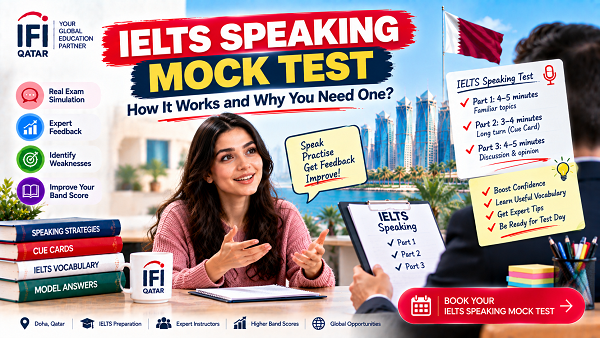
The IELTS Speaking test is very different from practising English by yourself.
You can study vocabulary, watch IELTS videos and answer hundreds of Speaking questions, but none of these activities completely reproduces the experience of sitting in front of an examiner and responding in real time.
That is where an IELTS Speaking mock test can help.
A realistic mock test gives you an opportunity to practise the three parts of the IELTS Speaking test, work under realistic conditions, identify weaknesses and receive feedback before your official examination.
The real IELTS Speaking test lasts 11–14 minutes and consists of three parts. It is conducted as a face-to-face interview and is assessed using four criteria: Fluency and Coherence, Lexical Resource, Grammatical Range and Accuracy, and Pronunciation.
In this guide, you will learn how an IELTS Speaking mock test works, what happens in Parts 1, 2 and 3, what you should practise, how feedback can help and when you should book a mock test before your real IELTS exam.
What Is an IELTS Speaking Mock Test?
An IELTS Speaking mock test is a practice session designed to simulate important aspects of the real IELTS Speaking examination.
Instead of simply answering questions from a book or practising with a friend, you complete a structured Speaking session that follows the three-part IELTS format.
A good Speaking mock test should give you an opportunity to practise:
- Part 1 questions
- Part 2 long turns
- Part 3 discussions
- Answer development
- Speaking under time pressure
- Expressing opinions
- Giving reasons and examples
- Using appropriate vocabulary
- Maintaining fluency
- Pronouncing words clearly
- Responding naturally to questions
The purpose is not to predict your exact official IELTS score.
Instead, the goal is to answer a more useful question:
How well can I perform in an IELTS Speaking environment right now?
A mock test can then help you identify what you need to improve before test day.
How Does the IELTS Speaking Test Work?
The official IELTS Speaking test has three parts and normally takes 11–14 minutes. The same Speaking format is used for both IELTS Academic and IELTS General Training.
| Part | Approximate Time | Main Focus |
|---|---|---|
| Part 1 | 4–5 minutes | Familiar topics and personal information |
| Part 2 | 3–4 minutes | Individual long turn |
| Part 3 | 4–5 minutes | Discussion and more abstract questions |
A realistic mock test should reproduce this overall structure as closely as practical.
IELTS Speaking Part 1
Part 1 is an introduction and interview.
The examiner asks questions about familiar subjects such as:
- Home
- Hometown
- Family
- Work
- Studies
- Hobbies
- Daily life
- Interests
Part 1 lasts approximately 4–5 minutes.
The purpose is not simply to test whether you know advanced vocabulary.
You need to respond naturally, answer the question directly and develop your answers sufficiently.
IELTS Speaking Part 2
Part 2 is the individual long turn.
You receive a task card with a topic and points that you should cover. You have one minute to prepare, including making notes, and then you speak for up to two minutes.
For example, you might be asked to describe:
- A memorable trip
- A person who influenced you
- A useful object
- A place you enjoy visiting
- An important decision
- A skill you would like to learn
A mock test should reproduce this preparation period rather than allowing you unlimited time to formulate your answer.
IELTS Speaking Part 3
Part 3 is a more detailed discussion connected to the Part 2 topic.
The questions become more general, analytical and abstract.
You may need to:
- Express an opinion
- Explain reasons
- Compare ideas
- Discuss advantages and disadvantages
- Predict future developments
- Analyse social issues
- Give examples
- Justify your position
Part 3 lasts approximately 4–5 minutes.
This part can be particularly challenging for candidates who are comfortable answering personal questions but struggle to discuss broader issues.
What Is Assessed in an IELTS Speaking Mock Test?
The official IELTS Speaking assessment uses four equally weighted criteria:
- Fluency and Coherence
- Lexical Resource
- Grammatical Range and Accuracy
- Pronunciation
Understanding these criteria is important because simply “speaking more English” does not necessarily address the specific problems affecting your performance.
Fluency and Coherence
Fluency is about how effectively you maintain your speech, while coherence involves organising your ideas so that they are easy to follow.
A candidate may have good vocabulary but still struggle with fluency because of:
- Frequent pauses
- Excessive hesitation
- Repetition
- Restarting sentences
- Difficulty extending answers
- Losing the main point
A mock test can make these patterns easier to notice.
Lexical Resource
Lexical Resource refers to the range, accuracy and appropriacy of your vocabulary.
You should be able to express your meaning accurately and use alternative vocabulary when necessary.
A Speaking mock test can reveal whether you:
- Repeat the same words
- Use vocabulary too generally
- Struggle to paraphrase
- Choose unnatural expressions
- Use advanced words incorrectly
Grammatical Range and Accuracy
This criterion considers both the range of grammatical structures you use and how accurately you use them.
During a mock test, an instructor may identify recurring problems with:
- Verb tenses
- Articles
- Prepositions
- Subject-verb agreement
- Sentence structure
- Complex sentences
- Conditionals
The goal is not to eliminate every minor error.
The goal is to communicate clearly while demonstrating appropriate grammatical range and control.
Pronunciation
Pronunciation assesses how easily the listener can understand your speech.
A mock test can help identify issues involving:
- Individual sounds
- Word stress
- Sentence stress
- Intonation
- Rhythm
- Connected speech
- Overall intelligibility
The objective is not to sound like a native English speaker.
Your pronunciation needs to be sufficiently clear for the listener to understand you without excessive effort.
Why Do You Need an IELTS Speaking Mock Test?
Practising Speaking questions alone can be useful, but it does not reproduce the complete interaction of the IELTS Speaking test.
A mock test can help you discover problems that may not be obvious during self-study.
1. You Experience the Three-Part Test Structure
Many candidates know the Speaking format theoretically but have never experienced it as a continuous interview.
A mock test lets you practise moving from:
Part 1 → Part 2 → Part 3
without stopping to study between sections.
This helps you become familiar with the rhythm of the test.
2. You Practise Speaking Without Preparing Every Answer
One important part of IELTS Speaking is responding to questions naturally.
You cannot know every question you will receive.
The official IELTS Speaking test is designed so that candidates cannot simply rehearse fixed responses in advance.
A mock test therefore gives you an opportunity to practise thinking and speaking at the same time.
3. You Can Identify Your Real Weaknesses
You may believe your main weakness is vocabulary.
After a mock test, however, you might discover that the bigger issue is actually:
- Hesitation
- Limited answer development
- Grammar accuracy
- Pronunciation
- Repetition
- Weak Part 3 responses
This distinction matters.
You cannot create an effective preparation plan if you do not know what is actually holding you back.
4. You Practise Under Pressure
Speaking English with a friend is not the same as answering an examiner’s questions under test conditions.
A mock test creates a more focused environment where you have to:
- Listen carefully
- Understand the question
- Think quickly
- Form an answer
- Continue speaking
- Respond to follow-up questions
This can help you become more comfortable with the demands of the actual test.
5. You Receive Professional Feedback
One of the biggest advantages of a structured mock test is feedback.
Instead of simply finishing the test and moving on, you can analyse your performance according to the four IELTS Speaking criteria.
For example:
Fluency: You pause frequently when searching for vocabulary.
Vocabulary: You rely on the same basic adjectives.
Grammar: You make recurring errors with complex sentences.
Pronunciation: Some word endings are unclear.
This gives you a practical starting point for your next stage of preparation.
6. You Can Track Progress
A mock test becomes even more useful when you compare performance over time.
For example:
Mock Test 1
Fluency: inconsistent
Vocabulary: limited range
Grammar: frequent errors
Pronunciation: generally clear
↓
Targeted practice
↓
Mock Test 2
Fluency: improved
Vocabulary: more varied
Grammar: fewer recurring errors
Pronunciation: more consistent
This gives you evidence of progress instead of relying only on how confident you feel.
What Happens During an IELTS Speaking Mock Test?
A well-structured mock test should feel like a genuine Speaking practice session rather than a casual conversation.
Before the Mock Test
You should know:
- Which IELTS test you are preparing for
- When your official test is scheduled
- Your target band
- Whether you have taken IELTS before
- Which areas you currently find difficult
You do not need to memorise answers before the session.
In fact, doing so can make the mock test less useful because the purpose is to observe how you respond naturally.
During Part 1
The instructor or assessor asks questions about familiar topics.
You should:
- Listen carefully
- Answer directly
- Give enough detail
- Avoid one-word answers
- Avoid extremely long responses
- Speak naturally
During Part 2
You receive a cue card and have one minute to prepare.
Use your preparation time to organise ideas rather than writing a complete script.
You can note:
- Main idea
- Key details
- Example
- Reason
- Personal experience
Then speak continuously for the required period.
During Part 3
You discuss broader questions related to the Part 2 topic.
Focus on:
Opinion → Reason → Explanation → Example
For example:
Opinion: I think public transport will become more important in large cities.
Reason: One reason is that urban populations are increasing.
Explanation: If more people use private cars, congestion and pollution may become more serious.
Example: Cities can encourage public transport by improving reliability and affordability.
This structure can help you develop ideas without memorising complete answers.
After the Mock Test
The most valuable stage is often the review.
You should identify:
- What you did well
- What caused problems
- Which mistakes appeared repeatedly
- Which criterion needs the most attention
- What you should practise next
IELTS Speaking Mock Test vs Practising at Home
Both approaches have a place in IELTS preparation, but they serve different purposes.
| Self-Practice | IELTS Speaking Mock Test |
|---|---|
| Convenient | Structured |
| Easy to repeat | Simulates interaction |
| Useful for vocabulary | Tests spontaneous responses |
| Good for topic practice | Provides external feedback |
| Can be done alone | Creates examiner-style interaction |
| Difficult to assess objectively | Allows performance analysis |
For example, recording yourself answering 20 Part 1 questions can be excellent practice.
But it may not reveal how you respond when someone unexpectedly asks a follow-up question.
That is where a mock test adds another layer of preparation.
How to Prepare for an IELTS Speaking Mock Test
You do not need to memorise dozens of answers.
Instead, focus on developing flexible Speaking skills.
Review the IELTS Speaking Format
Know what happens in Parts 1, 2 and 3.
Understanding the structure reduces unnecessary uncertainty.
Practise Common Topics
Useful topics include:
- Hometown
- Accommodation
- Work
- Studies
- Family
- Friends
- Technology
- Travel
- Food
- Hobbies
- Education
- Environment
- Health
- Daily routines
Practise Extending Answers
Instead of:
“Yes, I like travelling.”
Try:
“Yes, I really enjoy travelling because it gives me an opportunity to experience different cultures. I particularly enjoy visiting places where I can explore local food and meet people from different backgrounds.”
The second response gives the listener more information and creates opportunities to demonstrate vocabulary and grammar.
Record Yourself
Recording your answers can help you notice:
- Pauses
- Repetition
- Pronunciation problems
- Overused words
- Incomplete sentences
- Weak answer development
Practise Without Scripts
Prepare ideas and vocabulary, but avoid memorising complete answers.
Your goal is to develop the ability to respond naturally.
How to Use Your IELTS Speaking Mock Test Results
A mock test is only useful if you act on the feedback.
Use this process:
Step 1: Identify Your Lowest-Performing Area
Look across the four criteria.
Which one needs the most attention?
Step 2: Find the Specific Problem
For example:
Fluency problem: Too many long pauses.
Vocabulary problem: Repeating basic words.
Grammar problem: Frequent errors with complex structures.
Pronunciation problem: Certain sounds are consistently unclear.
Step 3: Create a Targeted Practice Routine
If fluency is the problem:
- Speak for two minutes every day.
- Practise without stopping.
- Use familiar topics.
- Record your responses.
If vocabulary is the problem:
- Learn topic-based vocabulary.
- Practise collocations.
- Use new words in original sentences.
- Avoid memorising unnatural phrases.
If grammar is the problem:
- Identify recurring errors.
- Practise the relevant structures.
- Use them in Speaking answers.
If pronunciation is the problem:
- Record yourself.
- Identify unclear sounds.
- Practise word and sentence stress.
- Focus on intelligibility.
Step 4: Take Another Mock Test
After targeted practice, another mock test can help you see whether your performance has changed.
The objective is not simply to take more tests.
It is to test → analyse → improve → test again.
When Should You Take an IELTS Speaking Mock Test?
There is no single perfect time for every candidate.
However, a Speaking mock test can be useful at several stages.
Before Starting Intensive Preparation
A diagnostic Speaking session can help you understand your starting point.
During Your Preparation
A mid-course mock test can show whether your preparation is addressing your weaknesses.
A Few Weeks Before Your Exam
This can be useful if you want to identify remaining problems before test day.
Shortly Before Your Exam
A final realistic practice session can help you review your strategy and become familiar with the interview experience.
The exact timing should depend on your current level, target band and exam date.
How Many IELTS Speaking Mock Tests Should You Take?
There is no official number that every candidate needs.
Taking several mock tests without analysing them may be less useful than taking fewer tests and carefully reviewing the results.
A practical approach is:
First mock test: Establish your baseline.
Targeted practice: Work on the biggest weaknesses.
Second mock test: Measure progress.
Further practice: Address remaining problems.
Final mock test: Check readiness and confidence before the official exam.
The quality of the feedback and the actions you take afterwards matter more than simply counting the number of tests.
Should You Take an IELTS Speaking Mock Test in Doha?
If you are preparing for IELTS in Qatar, an in-person Speaking mock test can give you an opportunity to practise direct interaction in a structured environment.
IFI Qatar currently offers Speaking Partner programmes in both online and face-to-face formats. The current programme is designed around real-exam-style Speaking practice, with one-to-one mentoring and feedback on areas such as fluency, pronunciation and coherence.
The current IFI Speaking Partner programme lists three 60-minute sessions for both online and face-to-face formats, with the face-to-face option delivered one-to-one with an expert mentor. Current prices and availability should be confirmed with IFI when booking because these details can change.
For candidates who want a broader IELTS readiness assessment, IFI Qatar also offers mock-test options covering the four IELTS skills, including Speaking.
What Should You Look for in an IELTS Speaking Mock Test?
Not every Speaking practice session provides the same value.
Before booking, check whether the session includes:
Realistic Test Structure
The session should reflect the three-part IELTS Speaking format.
Timed Practice
You should practise within realistic time limits rather than stopping whenever you need more time.
Examiner-Style Interaction
The person conducting the session should ask questions naturally rather than simply reading a list of questions and waiting.
Performance Feedback
You should receive feedback on the areas that matter for IELTS Speaking.
Individual Weakness Analysis
The feedback should tell you what to work on next.
Practical Recommendations
Ideally, you should leave the session knowing what you need to practise before your next mock test or official examination.
IELTS Speaking Mock Test Checklist
Before booking, ask:
- Does the mock test include Parts 1, 2 and 3?
- Is the session timed?
- Is it conducted as an interactive interview?
- Will my performance be assessed?
- Will I receive feedback?
- Is feedback based on the IELTS Speaking criteria?
- Will I receive advice on improving my weaknesses?
- Is the session suitable for my target IELTS test?
- Is it available online or face-to-face?
- Can I book additional practice if needed?
The answers to these questions can help you distinguish between simple Speaking practice and a more structured mock-test experience.
IELTS Speaking Mock Test in Qatar: Who Is It For?
A Speaking mock test can be useful if you:
- Are taking IELTS for the first time
- Have taken IELTS before and want to improve
- Need a specific Speaking band score
- Feel nervous about the interview
- Struggle to speak spontaneously
- Give very short answers
- Pause frequently
- Repeat the same vocabulary
- Find Part 2 difficult
- Struggle with Part 3 questions
- Want professional feedback
- Have an IELTS test date approaching
It can also be useful if you feel confident when practising alone but become less comfortable when another person asks unexpected questions.
Frequently Asked Questions About IELTS Speaking Mock Tests
What is an IELTS Speaking mock test?
An IELTS Speaking mock test is a structured practice session designed to simulate important aspects of the real IELTS Speaking test, including Parts 1, 2 and 3. It can help candidates practise under realistic conditions and identify areas that need improvement.
How long is an IELTS Speaking mock test?
The official IELTS Speaking test lasts 11–14 minutes. A mock test may follow a similar structure, although the total session can be longer if it includes feedback and performance analysis.
Is the IELTS Speaking test the same for Academic and General Training?
Yes. The Speaking test is the same for IELTS Academic and IELTS General Training.
What are the three parts of IELTS Speaking?
Part 1 is an interview about familiar topics, Part 2 is an individual long turn based on a task card, and Part 3 is a more general and abstract discussion related to Part 2.
What does the IELTS Speaking test assess?
Speaking is assessed using four criteria: Fluency and Coherence, Lexical Resource, Grammatical Range and Accuracy, and Pronunciation. The criteria carry equal weighting in the Speaking assessment.
Can an IELTS Speaking mock test predict my exact score?
No. A mock test can provide an indication of your current performance, but it cannot guarantee your official IELTS result.
Is an IELTS Speaking mock test worth taking?
It can be particularly useful if you want to experience the Speaking format, practise spontaneous responses, identify weaknesses and receive feedback before your official test.
Should I memorise answers before a Speaking mock test?
No. Prepare useful vocabulary and ideas, but avoid memorising complete answers. The IELTS Speaking test is designed to assess natural spoken language rather than rehearsed responses.
How often should I take an IELTS Speaking mock test?
There is no fixed number. A useful approach is to take a mock test, analyse the feedback, practise your weaknesses and then use another mock test to measure progress.
Can I take an IELTS Speaking mock test in Doha?
Yes. IFI Qatar currently offers face-to-face and online Speaking Partner sessions that include simulated IELTS Speaking conditions, one-to-one mentoring and feedback.
Book an IELTS Speaking Mock Test with IFI Qatar
If you are preparing for IELTS in Qatar and want to know how you perform in a realistic Speaking environment, a mock test can be a practical next step.
Instead of asking yourself:
“Am I ready for IELTS Speaking?”
you can collect more useful information by actually testing your performance.
A structured mock test can help you:
- Experience Parts 1, 2 and 3
- Practise spontaneous responses
- Identify Speaking weaknesses
- Receive targeted feedback
- Understand which criteria need attention
- Build a more focused preparation plan
- Become more comfortable with the interview format
IFI Qatar currently provides one-to-one Speaking Partner options in online and face-to-face formats, with simulated exam conditions and practical feedback.
Ready to test your IELTS Speaking performance?
Book your IELTS Speaking practice with IFI Qatar and turn your next Speaking session into a focused step toward your target band.
Final Thoughts
Preparing for IELTS Speaking is more than memorising questions and learning advanced vocabulary.
You need to be able to listen, think, organise your ideas and communicate naturally when someone asks you a question.
An IELTS Speaking mock test gives you the opportunity to practise that experience before the official exam.
The most effective process is simple:
Take the mock test → Analyse your performance → Identify your weaknesses → Practise strategically → Test again.
If you are preparing for IELTS in Doha or elsewhere in Qatar, consider using a structured Speaking mock test as a checkpoint in your preparation.
Knowing exactly what you need to improve is much more useful than simply practising more.