

Currently Empty: ر.ق 0,00


IELTS
IELTS Writing Task 2 Environment Topics and Vocabulary
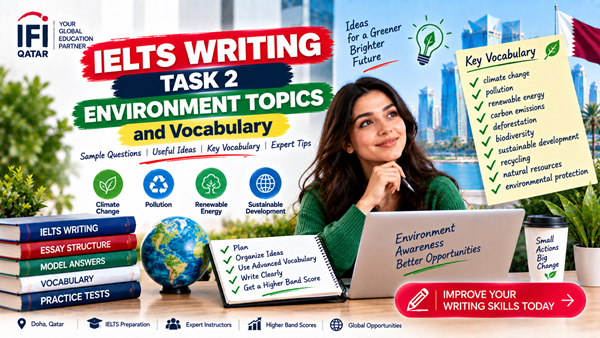
Environmental issues are among the most useful topics to prepare for in IELTS Writing Task 2. Questions can cover pollution, climate change, recycling, renewable energy, wildlife protection, deforestation, public transport, individual responsibility and the role of governments.
However, preparing for an IELTS environment essay is not simply about memorising a list of environmental words.
You need to be able to understand the exact question, generate relevant ideas, explain cause-and-effect relationships, support your arguments with examples and use environmental vocabulary accurately.
In IELTS Writing Task 2, you have approximately 40 minutes to write at least 250 words. Your response is assessed on Task Response, Coherence and Cohesion, Lexical Resource, and Grammatical Range and Accuracy. Task 2 also carries more weight than Task 1 in the Writing score.
This guide covers the most common IELTS environment essay topics, useful vocabulary and collocations, question types, ideas, essay structures and practical strategies for preparing for environmental questions.
Why Is the Environment a Common IELTS Writing Topic?
The environment is a broad topic that allows IELTS test takers to discuss a wide range of social, economic and technological issues.
For example, an IELTS environment question may ask you to discuss:
- Air pollution
- Water pollution
- Plastic waste
- Climate change
- Global warming
- Recycling
- Renewable energy
- Fossil fuels
- Deforestation
- Loss of biodiversity
- Endangered species
- Environmental laws
- Public transportation
- Sustainable development
- Individual responsibility
- Government responsibility
- Environmental education
- Industrial pollution
- Overpopulation
- Sustainable consumption
Official IELTS materials also identify environmental problems and solutions as examples of topics that may appear in General Training Writing Task 2.
The key is not to memorise one essay for every topic.
Instead, you should develop a flexible set of ideas, vocabulary and argument structures that can be adapted to different questions.
How IELTS Environment Essay Questions Work
An environment-related Task 2 question may present an opinion, problem or argument and ask you to respond in a particular way.
Common question types include:
- Opinion essays
- Advantages and disadvantages essays
- Discuss both views essays
- Problem and solution essays
- Cause and solution essays
- Two-part questions
- Questions about effects or consequences
You should always identify exactly what the question is asking before planning your answer.
IELTS specifically advises candidates to read the prompt carefully, identify all parts of the question, express their position clearly and support their ideas with relevant examples. Memorised essays that do not directly answer the question can negatively affect Task Response.
Example: Opinion Question
Some people believe that governments should be entirely responsible for protecting the environment, while others believe individuals should also take responsibility. To what extent do you agree or disagree?
You need to give a clear position and explain why.
Example: Problem and Solution Question
Many countries are experiencing serious environmental problems. What are the main causes of these problems, and what solutions can governments and individuals adopt?
This question requires both causes and solutions.
Example: Advantages and Disadvantages Question
Some people believe that using renewable energy sources is the best way to protect the environment. Discuss the advantages and disadvantages.
You need to address both sides rather than simply writing about renewable energy generally.
The Most Common IELTS Environment Essay Topics
Understanding the major environmental subtopics will make it easier to generate ideas during the exam.
Climate Change and Global Warming
Climate change is one of the most common environmental themes.
Possible questions may focus on:
- Causes of climate change
- Effects of global warming
- Government policies
- Individual responsibility
- International cooperation
- Renewable energy
- Reducing greenhouse gas emissions
Useful ideas include:
- Burning fossil fuels increases greenhouse gas emissions.
- Rising temperatures can affect agriculture and water supplies.
- Governments can encourage cleaner energy sources.
- Individuals can reduce unnecessary energy consumption.
- International cooperation may be necessary because climate-related problems cross national borders.
Air Pollution
Air pollution questions often focus on cities, transport and industry.
Possible causes include:
- Vehicle emissions
- Factory emissions
- Burning fossil fuels
- Construction activity
- Open burning
- Rapid urbanisation
Possible solutions include:
- Improving public transport
- Promoting electric vehicles
- Enforcing emissions standards
- Expanding green spaces
- Encouraging cleaner industrial processes
Water Pollution
Water pollution can be connected to both human health and environmental damage.
Potential causes include:
- Industrial waste
- Agricultural chemicals
- Untreated sewage
- Plastic waste
- Oil spills
- Poor waste management
Possible solutions include stronger regulations, improved wastewater treatment and better monitoring of industrial activities.
Plastic Waste
Plastic pollution is another useful topic for IELTS preparation.
Questions may ask whether governments should ban single-use plastics or whether individuals should change their consumption habits.
Useful arguments include:
- Plastic can take a long time to break down.
- Single-use products contribute to unnecessary waste.
- Recycling systems can reduce the amount of waste sent to landfill.
- Consumers can reduce their use of disposable products.
- Governments can regulate certain types of plastic packaging.
Recycling and Waste Management
Recycling questions may focus on whether individuals, businesses or governments should be responsible for reducing waste.
Possible solutions include:
- Household recycling systems
- Separate waste collection
- Public awareness campaigns
- Deposit-return schemes
- Restrictions on unnecessary packaging
- Better waste-sorting facilities
A strong essay should explain how a proposed solution would work rather than simply listing solutions.
Renewable Energy
Renewable energy is particularly useful because it can be connected to climate change, energy security, economics and technological development.
Examples include:
- Solar power
- Wind power
- Hydropower
- Geothermal energy
- Other low-carbon energy technologies
Possible arguments include:
Advantages
- Lower dependence on fossil fuels
- Potential reduction in greenhouse gas emissions
- Greater energy diversification
- Long-term energy security
Challenges
- High initial investment
- Infrastructure requirements
- Variable output for some sources
- Storage and grid-management challenges
Fossil Fuels
Fossil fuels can be discussed in relation to:
- Coal
- Oil
- Natural gas
- Energy production
- Transport
- Industrial development
- Carbon emissions
An essay could examine whether governments should reduce fossil-fuel consumption or whether economic considerations justify continued use.
Deforestation
Deforestation questions can involve:
- Agricultural expansion
- Logging
- Urban development
- Infrastructure projects
- Loss of habitats
- Soil degradation
- Climate effects
Possible solutions include stronger land-use regulations, reforestation programmes and sustainable forestry practices.
Wildlife and Endangered Species
IELTS questions may ask whether governments should spend money protecting endangered animals or whether resources should be prioritised for human needs.
Useful arguments include:
- Biodiversity supports healthy ecosystems.
- Habitat destruction can threaten species.
- Some ecosystems provide important resources for human communities.
- Governments can establish protected areas.
- Public education can encourage conservation.
Public Transport and the Environment
Transport is closely connected to air pollution, traffic congestion and carbon emissions.
Possible solutions include:
- Expanding public transport
- Improving rail networks
- Creating cycling infrastructure
- Encouraging walking
- Supporting lower-emission vehicles
- Introducing urban transport policies
This topic is especially useful because it allows you to connect environmental and social arguments.
Environmental Education
Another common angle is whether environmental education should be introduced more strongly in schools.
Possible benefits include:
- Developing environmentally responsible behaviour
- Teaching students about waste reduction
- Encouraging sustainable consumption
- Increasing awareness of climate issues
- Influencing long-term habits
Useful IELTS Environment Vocabulary
Using accurate vocabulary is more important than using complicated words simply to sound advanced.
The following vocabulary can help you discuss environmental issues naturally.
| Vocabulary | Meaning / Use |
|---|---|
| Environmental degradation | Damage to the natural environment |
| Climate change | Long-term changes in climate patterns |
| Global warming | Long-term increase in global average temperatures |
| Greenhouse gases | Gases that contribute to the greenhouse effect |
| Carbon emissions | Release of carbon-containing gases, especially CO₂ |
| Carbon footprint | Amount of greenhouse gases associated with an activity or person |
| Air pollution | Harmful substances in the air |
| Water pollution | Contamination of rivers, lakes, oceans or other water sources |
| Plastic waste | Discarded plastic materials |
| Waste management | Collection, treatment and disposal of waste |
| Renewable energy | Energy from sources that are naturally replenished |
| Fossil fuels | Coal, oil and natural gas |
| Deforestation | Removal of forests |
| Reforestation | Replanting trees in areas where forests have been removed |
| Biodiversity | Variety of living organisms in an ecosystem |
| Ecosystem | Community of organisms and their environment |
| Endangered species | Species at serious risk of extinction |
| Conservation | Protection of nature and natural resources |
| Sustainable development | Development that considers long-term environmental and social needs |
| Natural resources | Materials and resources obtained from nature |
| Sustainable consumption | Using resources in ways that reduce long-term environmental damage |
| Environmental policy | Government rules and strategies concerning environmental issues |
| Emissions | Gases or substances released into the atmosphere |
| Landfill | Site where waste is buried |
| Ecological impact | Effect of an activity on the environment |
IELTS Environment Vocabulary for Causes and Problems
When explaining environmental problems, use vocabulary that clearly describes causes and consequences.
Useful expressions include:
- contribute to environmental damage
- result in increased pollution
- lead to habitat destruction
- cause long-term damage
- accelerate climate change
- increase carbon emissions
- place pressure on natural resources
- threaten biodiversity
- damage fragile ecosystems
- contaminate water supplies
- reduce air quality
- contribute to global warming
Example Sentences
The continued use of fossil fuels contributes significantly to carbon emissions.
Rapid urbanisation can place considerable pressure on natural resources.
Industrial waste can contaminate rivers and threaten aquatic ecosystems.
Deforestation can lead to habitat loss and a decline in biodiversity.
IELTS Environment Vocabulary for Solutions
Environmental essays often require you to propose solutions.
Useful phrases include:
- introduce stricter regulations
- enforce environmental laws
- invest in renewable energy
- improve public transportation
- promote recycling
- reduce reliance on fossil fuels
- encourage sustainable consumption
- protect natural habitats
- establish protected areas
- impose penalties on polluting companies
- raise public awareness
- introduce environmental education
- provide financial incentives
- improve waste-management systems
Example Sentences
Governments could introduce stricter regulations on industrial emissions.
Greater investment in public transportation could reduce the number of private vehicles on urban roads.
Environmental education could encourage young people to adopt more sustainable lifestyles.
Useful IELTS Environment Collocations
Collocations can make your writing more natural and precise.
Environment and Climate
- environmental protection
- environmental damage
- environmental problems
- environmental awareness
- environmental regulations
- environmental sustainability
- climate change
- climate crisis
- climate-related problems
- global temperatures
Pollution
- air pollution
- water pollution
- industrial pollution
- vehicle emissions
- carbon emissions
- toxic waste
- plastic pollution
- noise pollution
- pollution levels
- reduce emissions
Energy
- renewable energy
- clean energy
- fossil fuels
- energy consumption
- energy efficiency
- energy transition
- solar power
- wind power
- sustainable energy sources
Nature and Wildlife
- natural habitats
- endangered species
- wildlife protection
- biodiversity loss
- natural resources
- protected areas
- fragile ecosystems
- habitat destruction
- conservation efforts
Waste
- household waste
- plastic waste
- waste disposal
- waste management
- recycling facilities
- recycling programmes
- single-use plastics
- landfill sites
- waste reduction
IELTS Environment Essay Ideas: Causes, Effects and Solutions
One of the easiest ways to prepare for environment questions is to organise ideas using a cause → effect → solution framework.
Environmental Problem
Problem: Air pollution in major cities
Causes:
- Heavy traffic
- Vehicle emissions
- Industrial activity
- Dependence on fossil fuels
Effects:
- Poor air quality
- Health problems
- Environmental degradation
- Reduced quality of life
Solutions:
- Improve public transport
- Introduce stricter emissions standards
- Encourage cleaner vehicles
- Expand green spaces
This approach helps you develop ideas instead of simply listing them.
How to Develop Ideas in an IELTS Environment Essay
A common problem is writing an idea without explaining it.
For example:
Governments should improve public transport.
This is a reasonable idea, but it is not sufficiently developed.
A stronger version explains the mechanism and consequence:
Governments should invest in reliable public transportation systems because affordable and convenient buses and rail services can encourage commuters to leave their cars at home. This could reduce traffic congestion and vehicle emissions in densely populated cities.
The second version provides:
Idea → Explanation → Result
That is much more useful for Task Response.
Official IELTS guidance emphasises that Task 2 responses should develop and support relevant ideas with explanations and examples.
Common IELTS Environment Essay Question Types
Opinion: To What Extent Do You Agree or Disagree?
Example:
Some people believe that individuals cannot do much to protect the environment and that only governments and large companies can make a real difference. To what extent do you agree or disagree?
A strong approach is:
Introduction
- Paraphrase the question
- Give a clear position
Body Paragraph 1
- First reason supporting your position
- Explanation
- Example
Body Paragraph 2
- Second reason
- Explanation
- Example
Conclusion
- Restate your position
Discuss Both Views
Example:
Some people believe that governments should be responsible for solving environmental problems, while others believe that individuals should take responsibility. Discuss both views and give your own opinion.
Structure:
Introduction
Body Paragraph 1: Government responsibility
Body Paragraph 2: Individual responsibility + your position
Conclusion
Make sure both sides are actually discussed.
Problem and Solution
Example:
Many countries are facing serious environmental problems. What are the main causes of these problems, and what solutions can be introduced?
Structure:
Introduction
Body Paragraph 1: Main causes
Body Paragraph 2: Practical solutions
Conclusion
Advantages and Disadvantages
Example:
Many countries are investing heavily in renewable energy. Do the advantages of this development outweigh the disadvantages?
Structure:
Introduction
Body Paragraph 1: Advantages
Body Paragraph 2: Disadvantages
Conclusion: Clear overall judgement
Two-Part Question
Example:
Plastic pollution is increasing in many parts of the world. Why is this happening? What can governments and individuals do to reduce it?
This requires two distinct answers:
Part 1: Why is plastic pollution increasing?
Part 2: What can be done?
Do not answer only one part.
A Strong IELTS Environment Essay Structure
A simple four-paragraph structure can work well for many Task 2 questions.
Introduction
Your introduction should:
- Paraphrase the topic.
- Give your position or explain what the essay will discuss.
Example:
Environmental degradation has become a major concern in many countries, particularly as urban populations and industrial activity continue to expand. Although both governments and individuals have important roles to play, I believe that governments should take the leading role by creating effective regulations and investing in sustainable infrastructure.
Body Paragraph 1
Start with one clear main idea.
One of the most effective ways for governments to reduce environmental damage is to regulate activities that produce high levels of pollution.
Then explain:
Industrial facilities and transport systems can generate significant emissions, particularly in rapidly growing cities.
Then develop the result:
Stricter emissions standards and effective enforcement could therefore encourage businesses to adopt cleaner technologies.
Body Paragraph 2
Introduce another distinct idea.
Governments can also reduce environmental damage by investing in sustainable infrastructure.
Explain how:
For example, efficient public transportation systems can provide commuters with an alternative to private cars.
Then explain the consequence:
If public transport is affordable, reliable and convenient, fewer people may depend on private vehicles, reducing both congestion and transport-related emissions.
Conclusion
Summarise your position without introducing a completely new argument.
In conclusion, although individuals can make more sustainable choices, governments have greater capacity to create large-scale environmental change through regulation and investment. A combination of effective environmental policies and responsible individual behaviour is therefore likely to produce the most sustainable results.
How to Get Better Ideas for an IELTS Environment Essay
If you struggle to generate ideas, ask five questions.
1. What Is Causing the Problem?
Think about:
- Government policy
- Industry
- Consumers
- Population growth
- Urbanisation
- Technology
- Transport
- Energy use
2. Who Is Affected?
Consider:
- Individuals
- Families
- Businesses
- Governments
- Local communities
- Future generations
- Wildlife
3. What Are the Short-Term Effects?
For example:
- Higher pollution
- Increased waste
- Traffic congestion
- Health problems
- Loss of natural habitats
4. What Are the Long-Term Effects?
For example:
- Climate-related changes
- Resource shortages
- Biodiversity loss
- Environmental degradation
- Higher economic costs
5. Who Can Solve the Problem?
Think about:
- Governments
- Businesses
- Individuals
- Schools
- International organisations
- Local communities
This framework can help you generate relevant ideas quickly during the planning stage.
IELTS Environment Essay: Useful Grammar Structures
Vocabulary is only one part of Lexical Resource. You also need accurate and varied grammatical structures.
Cause and Effect
Excessive use of fossil fuels can contribute to climate change.
Industrial pollution can result in serious environmental damage.
Conditionals
If governments invest in public transport, fewer people may rely on private vehicles.
If plastic waste continues to increase, many ecosystems could face further damage.
Relative Clauses
Renewable energy is an alternative source of power that can reduce dependence on fossil fuels.
Passive Voice
Stricter environmental regulations should be introduced.
Plastic waste can be reduced through improved recycling systems.
Comparisons
Public transport is generally more environmentally friendly than private car use.
Complex Sentences
Although individuals can reduce their environmental impact through everyday choices, governments are able to introduce policies that influence entire populations.
Common Mistakes in an IELTS Environment Essay
Using Memorised Essays
Do not prepare one essay and attempt to adapt it mechanically to every environmental question.
IELTS explicitly warns that formulaic or memorised responses may fail to address the actual task.
Writing About the Environment Too Generally
If the question asks about plastic pollution, do not spend most of your essay discussing climate change.
Stay focused on the exact issue in the prompt.
Listing Ideas Without Explaining Them
Avoid:
Governments should recycle waste, use renewable energy and improve public transport.
This is simply a list.
Instead, explain how one solution works and why it would help.
Using Advanced Vocabulary Incorrectly
Words such as mitigate, sustainable, biodiversity and degradation are useful only when they are used accurately.
A precise common word is better than an impressive but incorrect word.
Inventing Statistics
You do not need to invent statistics to make your environmental essay sound academic.
IELTS guidance recommends using relevant examples from your own knowledge and experience rather than made-up statistics and research.
Using the Same Words Repeatedly
Instead of repeating environmental problems, you may sometimes use:
- environmental challenges
- ecological damage
- environmental degradation
- pollution-related problems
However, only use alternatives when they genuinely fit the context.
IELTS Environment Essay Practice Questions
Use these questions to practise different Task 2 formats.
Opinion Questions
Some people believe that protecting the environment should be the responsibility of governments rather than individuals. To what extent do you agree or disagree?
Governments should ban all forms of private car ownership in large cities to reduce pollution. To what extent do you agree or disagree?
Discuss Both Views Questions
Some people believe that companies should be responsible for reducing environmental damage, while others believe that consumers should change their behaviour. Discuss both views and give your own opinion.
Problem and Solution Questions
Many cities are experiencing increasing levels of air pollution. What are the main causes of this problem, and what solutions can be introduced?
Plastic waste has become a major environmental problem. What are the reasons for the increase in plastic waste, and what can be done to reduce it?
Advantages and Disadvantages Questions
Many countries are replacing fossil fuels with renewable energy sources. Do the advantages of this development outweigh the disadvantages?
Two-Part Questions
Many natural habitats are being destroyed by human activity. Why is this happening? What can governments do to protect these areas?
Climate change is affecting many aspects of modern life. What are the main causes of climate change? What can individuals do to reduce its effects?
A 7-Day IELTS Environment Vocabulary Study Plan
You do not need to memorise hundreds of words.
Instead, build a smaller vocabulary set and practise using it.
Day 1: Pollution
Study:
- air pollution
- water pollution
- emissions
- industrial waste
- contamination
- air quality
Write five original sentences.
Day 2: Climate Change
Study:
- climate change
- global warming
- greenhouse gases
- carbon emissions
- carbon footprint
- climate-related problems
Write one paragraph about causes.
Day 3: Energy
Study:
- renewable energy
- fossil fuels
- solar power
- wind power
- energy consumption
- energy efficiency
Write one advantages-and-disadvantages paragraph.
Day 4: Waste
Study:
- plastic waste
- recycling
- landfill
- waste management
- single-use plastics
- waste reduction
Write a problem-and-solution paragraph.
Day 5: Nature
Study:
- biodiversity
- endangered species
- habitat destruction
- conservation
- natural resources
- protected areas
Write one paragraph about wildlife protection.
Day 6: Collocations
Review common combinations such as:
- reduce carbon emissions
- protect natural habitats
- promote renewable energy
- improve waste management
- introduce environmental regulations
- reduce dependence on fossil fuels
Then write 10 sentences.
Day 7: Full IELTS Environment Essay
Choose one of the practice questions above.
Spend:
- 5 minutes planning
- 30 minutes writing
- 5 minutes checking
During your final review, check:
- Did I answer every part of the question?
- Is my position clear?
- Does each paragraph have one main idea?
- Did I explain my ideas?
- Did I provide relevant examples?
- Did I use vocabulary accurately?
- Did I check grammar?
- Did I check spelling?
IELTS Environment Essay: Band 7+ Checklist
Before submitting your essay, ask yourself:
Task Response
- Did I answer exactly what the question asks?
- Did I address every part of the prompt?
- Is my position clear?
- Are my main ideas relevant?
- Did I develop and support my ideas?
Coherence and Cohesion
- Is each paragraph focused?
- Are ideas logically organised?
- Do sentences connect naturally?
- Have I used linking devices appropriately?
Lexical Resource
- Did I use relevant environmental vocabulary?
- Are my word choices accurate?
- Did I avoid unnecessary repetition?
- Did I use collocations naturally?
Grammar
- Did I use a range of sentence structures?
- Are my complex sentences accurate?
- Did I check subject-verb agreement?
- Did I check articles and prepositions?
- Did I check verb tenses?
These areas directly correspond to the IELTS Writing assessment criteria.
Frequently Asked Questions About IELTS Environment Essays
What is an IELTS environment essay?
An IELTS environment essay is a Writing Task 2 response dealing with an environmental issue such as pollution, climate change, recycling, renewable energy, deforestation or conservation.
What are the most common IELTS environment essay topics?
Common themes include pollution, climate change, recycling, plastic waste, renewable energy, fossil fuels, deforestation, wildlife protection, public transport and individual responsibility.
What vocabulary should I learn for an IELTS environment essay?
Useful vocabulary includes carbon emissions, renewable energy, environmental degradation, biodiversity, natural resources, waste management, fossil fuels, sustainable development, habitat destruction and environmental regulations.
How can I get better ideas for an environmental essay?
Use a cause-effect-solution framework. Identify the main cause of the problem, explain its effects and then consider practical solutions involving governments, businesses and individuals.
Should I memorise an IELTS environment essay?
No. You should prepare ideas, vocabulary and structures, but avoid memorising complete essays. IELTS advises candidates to respond directly to the specific question rather than using formulaic responses.
How many words do I need for IELTS Writing Task 2?
You must write at least 250 words for Task 2 and should spend approximately 40 minutes on the task.
Is environmental vocabulary enough to get a high IELTS Writing score?
No. Vocabulary is only one part of the assessment. Task Response, Coherence and Cohesion, Lexical Resource, and Grammatical Range and Accuracy all contribute to your Task 2 performance.
Can I use examples from my own experience?
Yes. Relevant examples from your own knowledge or experience can be used when appropriate. The important point is that the example should support the argument rather than replace the explanation.
Improve Your IELTS Writing with Professional Preparation
Knowing environmental vocabulary is a useful starting point, but a strong IELTS Writing score requires much more than memorising words.
You need to learn how to:
- Analyse Task 2 questions
- Generate relevant ideas
- Build logical arguments
- Develop explanations
- Use vocabulary accurately
- Improve sentence structures
- Organise paragraphs effectively
- Manage the 40-minute time limit
- Review and correct your writing
- Understand IELTS assessment criteria
If you regularly struggle with IELTS Writing Task 2, structured preparation and expert feedback can help you identify recurring problems and practise the areas that need the most attention.
Explore IFI Qatar’s IELTS preparation options and get support with your Writing skills, including Task 2 structure, vocabulary, idea development and exam strategies.
Ready to improve your IELTS Writing? Start your IELTS preparation with IFI Qatar and build the skills you need for test day.
Final Tips for IELTS Environment Essays
The environment is a broad IELTS topic, but you do not need to memorise hundreds of environmental facts.
Focus on building a flexible toolkit:
Understand the major environmental topics.
Learn useful vocabulary and collocations.
Practise cause-and-effect relationships.
Prepare ideas for government, business and individual responsibility.
Practise different Task 2 question types.
Learn how to develop an idea rather than simply listing it.
Most importantly, always answer the specific question in front of you.
A well-organised essay with relevant ideas, accurate vocabulary and clear development is more valuable than an essay filled with complicated environmental terminology that does not directly answer the prompt.