

Currently Empty: ر.ق 0,00


IELTS
How to Get Band 8 in IELTS Speaking
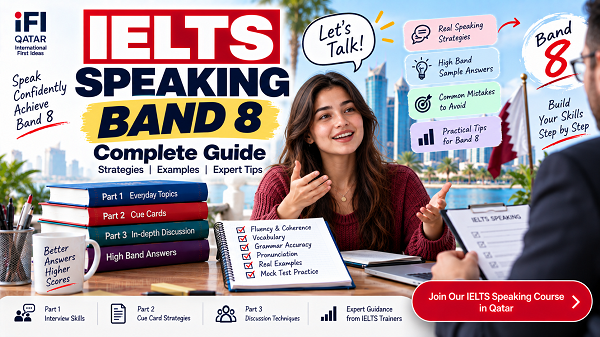
Getting Band 8 in IELTS Speaking requires more than knowing a large number of English words or speaking without an accent. A Band 8 candidate needs to communicate fluently, develop ideas clearly, use a wide range of vocabulary and grammar, and remain easy to understand throughout the test.
The IELTS Speaking test is assessed using four criteria: Fluency and Coherence, Lexical Resource, Grammatical Range and Accuracy, and Pronunciation. Each criterion plays an important role in your Speaking performance.
If your current score is around Band 6 or 7, reaching Band 8 usually requires a shift from simply answering questions correctly to communicating with greater flexibility, precision and control.
This guide explains exactly what you need to work on, how to approach each part of the IELTS Speaking test, and how to build a practical IELTS Speaking Band 8 preparation plan.
What Does IELTS Speaking Band 8 Mean?
A Band 8 Speaking performance demonstrates a high level of spoken English.
According to the IELTS Speaking Band Descriptors, a Band 8 candidate is generally fluent, can discuss a wide range of topics using vocabulary flexibly, uses a wide range of grammatical structures, and can be easily understood throughout the test.
However, Band 8 does not mean that your English must be perfect.
The official Band 8 descriptors allow for occasional inaccuracies, including some errors in word choice or collocation, occasional grammatical errors and occasional pronunciation lapses. What matters is that these issues do not prevent you from communicating effectively.
The four areas you need to develop are:
- Fluency and Coherence
- Lexical Resource
- Grammatical Range and Accuracy
- Pronunciation
Your preparation should therefore address all four areas rather than focusing only on vocabulary.
What Are the IELTS Speaking Band 8 Criteria?
Understanding the assessment criteria is one of the most important steps toward achieving Band 8.
Fluency and Coherence
For Band 8, you need to speak fluently with only occasional repetition or self-correction.
Some hesitation is possible, but it should not regularly happen because you cannot find basic words or grammar. Most of your hesitation should be related to thinking about what you want to say.
Your answers should also develop logically.
For example, instead of giving a series of disconnected sentences:
I like studying online. It is convenient. I use my laptop. I have more time. It is good.
A stronger response develops one idea:
I prefer studying online because it gives me much more flexibility. For example, I can organise my study schedule around my other responsibilities, which means I don’t necessarily have to spend several hours travelling to a classroom.
The second answer is easier to follow because the idea is developed rather than simply listed.
Lexical Resource
Band 8 requires a wide vocabulary that you can use flexibly to discuss different topics and express precise meanings.
You should also be able to use:
- less common vocabulary
- natural collocations
- appropriate idiomatic expressions
- topic-specific language
- paraphrasing
Importantly, using unusual words simply to sound advanced is not the goal.
Compare:
Technology is very good for education.
with:
Digital technology has significantly expanded students’ access to educational resources.
The second sentence is more precise because the vocabulary communicates a specific meaning.
Grammatical Range and Accuracy
Band 8 requires a wide range of grammatical structures used flexibly.
You should be comfortable using:
- simple sentences
- compound sentences
- complex sentences
- relative clauses
- conditionals
- passive structures
- modal verbs
- different verb tenses
- comparative structures
You do not need every sentence to be grammatically complex.
In fact, forcing complex grammar into every sentence can make your speech less natural.
A better approach is to combine different structures naturally:
I started learning English when I was at school, but I didn’t really take it seriously at first. If I had realised how important English would become for my education and career, I would probably have spent much more time practising it.
This demonstrates variety without making the language unnecessarily complicated.
Pronunciation
For Band 8, you need to be easily understood throughout the test.
You should work on:
- word stress
- sentence stress
- rhythm
- intonation
- connected speech
- individual sounds
- appropriate pauses
Having a particular accent does not automatically prevent you from achieving Band 8.
The key issue is intelligibility.
Your examiner should not have to make significant effort to understand what you are saying.
How Long Is the IELTS Speaking Test?
The IELTS Speaking test lasts approximately 11–14 minutes and consists of three parts.
Part 1: Introduction and Interview
Part 1 lasts approximately 4–5 minutes and focuses on familiar topics such as your home, studies, work, interests and everyday life.
Part 2: Individual Long Turn
In Part 2, you receive a task card and have one minute to prepare. You then speak for up to two minutes about the topic.
Part 3: Discussion
Part 3 lasts approximately 4–5 minutes and involves a deeper discussion connected to the Part 2 topic. Questions are generally more abstract and require you to explain, analyse and discuss ideas.
These three parts test different aspects of your spoken communication, so your preparation should cover all of them.
How to Get Band 8 in IELTS Speaking Part 1
Part 1 may appear easy because the questions are familiar. However, many candidates lose potential marks by giving extremely short answers or repeating memorised responses.
Give Developed but Natural Answers
If the examiner asks:
Do you enjoy reading?
Avoid:
Yes, I do.
Instead, develop your answer naturally:
Yes, definitely. I usually read in the evening because it’s a good way to relax after work. I particularly enjoy books about psychology and personal development because I can usually apply some of the ideas to my daily life.
You have answered the question directly and then added relevant details.
Use Personal Examples
Part 1 is about familiar topics, so personal examples can make your answers more natural.
For example:
I enjoy cooking, especially at weekends. During the week I’m usually too busy, but on Friday evenings I sometimes try a new recipe with my family.
This sounds more natural than a memorised paragraph about the advantages of cooking.
Avoid Over-Extending Simple Questions
You do not need to give a one-minute speech for every Part 1 question.
The goal is to answer naturally, develop your idea and then stop.
A useful pattern is:
Answer → Reason → Example
For example:
Yes, I enjoy travelling because it gives me an opportunity to experience different cultures. Last year, for instance, I visited Turkey and really enjoyed exploring the historical areas.
How to Get Band 8 in IELTS Speaking Part 2
Part 2 is often challenging because you need to speak continuously for up to two minutes.
The biggest problem for many candidates is running out of ideas.
Use the One-Minute Preparation Time Effectively
You have one minute to prepare, so do not try to write complete sentences.
Instead, write short keywords.
Suppose the topic is:
Describe a memorable trip you took.
Your notes might look like:
Turkey → last summer → family → Istanbul → first international trip → food → historical places → learned about culture
These keywords are enough to help you structure your answer.
Follow a Simple Story Structure
A useful structure for Part 2 is:
- Introduce the topic.
- Explain when and where it happened.
- Describe what happened.
- Explain how you felt.
- Explain why it was memorable.
For example:
I’d like to talk about a trip I took to Istanbul last summer. I travelled there with my family, and it was actually my first time visiting Turkey. We spent several days exploring the city, including some historical sites and local markets. What I particularly remember is trying traditional Turkish food for the first time. I found the whole experience fascinating because I was able to learn about a culture that was quite different from my own. Looking back, I think the trip was memorable mainly because it combined relaxation with the opportunity to discover somewhere completely new.
This structure helps you maintain coherence while giving you enough material to speak at length.
Add Specific Details
Specific details make your answers easier to develop.
Instead of:
I went to a restaurant and had a nice meal.
Try:
We found a small family-run restaurant near the old town, and I ordered a traditional dish that I’d never tried before.
You do not need extraordinary experiences. You need enough detail to communicate naturally.
Do Not Memorise Complete Part 2 Answers
Memorising complete answers is risky because:
- the topic may be different
- the examiner may interrupt or redirect you
- memorised language can sound unnatural
- you may forget part of the script
- it limits your ability to respond spontaneously
Instead, practise flexible structures and topic vocabulary.
How to Get Band 8 in IELTS Speaking Part 3
Part 3 is particularly important for candidates targeting Band 8 because it requires you to discuss broader and more abstract ideas.
The examiner may ask you to:
- explain an opinion
- compare ideas
- discuss causes
- discuss consequences
- analyse social changes
- speculate about the future
- evaluate different perspectives
Give Extended Answers
Avoid answering Part 3 questions with one sentence.
A useful structure is:
Opinion → Explanation → Example → Consequence
For example:
I think universities should place more emphasis on practical skills. The main reason is that academic knowledge alone does not always prepare students for the workplace. For example, graduates may have excellent theoretical knowledge but struggle with communication or problem-solving in professional situations. As a result, combining academic study with practical experience could make the transition into employment much easier.
This gives the examiner a clear and developed response.
Discuss Both Sides When Appropriate
Some Part 3 questions ask about controversial or complex issues.
Instead of giving an extreme answer immediately, show that you can recognise different perspectives.
For example:
There are advantages to both approaches. Online education provides flexibility and allows students to study from almost anywhere, whereas traditional classrooms offer more direct interaction. Personally, I think a combination of the two can be more effective because students can benefit from both flexibility and face-to-face communication.
This demonstrates flexibility in discussing an issue.
Speculate About the Future
Part 3 may require you to discuss future developments.
Useful structures include:
I expect that…
It is likely that…
There is a possibility that…
I would not be surprised if…
In the long term…
For example:
I expect artificial intelligence to play a much greater role in education over the next decade. It could personalise learning by identifying individual weaknesses, although teachers will probably remain essential for motivation and human interaction.
How to Improve Vocabulary for IELTS Speaking Band 8
Vocabulary is one of the biggest areas separating Band 7 from Band 8 performance.
However, simply memorising advanced words is not enough.
Learn Topic-Based Vocabulary
Build vocabulary around common IELTS topics such as:
- education
- technology
- environment
- health
- transport
- employment
- society
- media
- culture
- cities
- travel
For each topic, learn:
- nouns
- verbs
- adjectives
- collocations
- useful phrases
- examples
For example, for education:
- academic performance
- higher education
- tuition fees
- learning outcomes
- practical skills
- educational resources
- vocational training
- academic qualifications
Learn Collocations
Collocations help you sound more natural.
Instead of learning:
impact
learn:
have a significant impact on
Instead of:
decision
learn:
make an informed decision
Instead of:
research
learn:
conduct research
This approach helps you produce vocabulary naturally during the test.
Learn to Paraphrase
Band 8 candidates should be able to express an idea in different ways.
For example:
Question:
Why do people move to cities?
You could say:
People move to cities because they often have better employment opportunities.
Or:
One major reason for urban migration is the wider range of jobs available in large cities.
The ability to reformulate an idea is extremely useful when you cannot immediately remember a particular word.
How to Improve Grammar for IELTS Speaking Band 8
You do not need to eliminate every grammatical mistake.
Instead, aim to use a wide range of structures accurately and naturally.
Use Complex Sentences Naturally
For example:
Although studying abroad can be expensive, I think it is a worthwhile investment because students can gain international experience and develop greater independence.
This combines:
- concession
- cause and effect
- complex sentence structure
Use Conditionals
Conditionals are useful when discussing hypothetical situations.
If universities offered more flexible schedules, more working adults might be able to pursue higher education.
Use Relative Clauses
Students who have access to high-quality educational resources are generally in a better position to develop their academic skills.
Use Modal Verbs
Modal verbs are particularly useful in Part 3:
- may
- might
- could
- should
- would
- must
For example:
Governments could provide financial incentives for companies that invest in renewable energy.
Do Not Force Complex Grammar
A common mistake is trying to use advanced grammar in every sentence.
Natural variation is better:
I live in Doha, and I really enjoy it. Although the city can be quite busy, there are plenty of places where you can relax. If I had to choose one thing I would change, it would probably be the traffic during peak hours.
This sounds more natural than filling every sentence with unnecessary complexity.
How to Improve Pronunciation for Band 8
Pronunciation is not about eliminating your accent.
Your priority should be clear and effortless communication.
Practise Word Stress
Compare:
PHOtograph
and:
phoTOGraphy
Changing stress can affect how easily a word is understood.
Practise Sentence Stress
Important words usually receive greater emphasis.
For example:
I really enjoyed the experience because it was completely different from what I expected.
Stress can help communicate meaning more clearly.
Improve Intonation
Avoid speaking every sentence with exactly the same pitch.
Use natural changes in intonation to communicate:
- emphasis
- contrast
- certainty
- uncertainty
- interest
Practise Connected Speech
Natural English often connects sounds between words.
Rather than trying to imitate an accent, focus on speaking smoothly and clearly.
How to Speak More Fluently for IELTS Band 8
Fluency does not mean speaking extremely fast.
In fact, speaking too quickly can reduce clarity and increase grammatical mistakes.
Stop Translating Everything
If you mentally construct every sentence in your first language before speaking English, your response may become slow and hesitant.
Instead, practise thinking directly in English.
For example, when you see a familiar object, describe it mentally:
This is my laptop. I use it almost every day for work. It’s quite old, but it still works well.
This simple exercise helps make English production more automatic.
Use Natural Thinking Time
You are allowed to think.
The important thing is to avoid long, disruptive pauses.
Useful expressions include:
That’s an interesting question.
I’d say…
Let me think about that for a moment.
I suppose the main reason is…
Use these naturally rather than repeating the same filler in every answer.
Record Yourself
Recording your answers is one of the most effective ways to identify problems that you do not notice while speaking.
After recording, check:
- How often did I pause?
- Did I repeat words?
- Did I restart sentences?
- Did I use the same vocabulary repeatedly?
- Did I answer the question directly?
- Did I develop my ideas?
- Were my grammatical errors systematic?
- Was my pronunciation clear?
How to Answer Difficult IELTS Speaking Questions
You will not necessarily receive questions about topics you know well.
If you do not have much knowledge about a subject, you can still give a good answer.
Use Reasoning Instead of Memorised Knowledge
Suppose you are asked about an unfamiliar social issue.
You can say:
I’m not particularly familiar with this issue, but I would imagine that one of the main factors is…
Then develop a logical explanation.
The Speaking test is assessing your spoken language, not whether you are an expert on the topic.
Give a Qualified Opinion
You do not always need to make an absolute statement.
Useful language includes:
In most cases…
To some extent…
It depends on the situation…
Generally speaking…
In my experience…
From my perspective…
This can help you express more precise ideas.
Band 7 vs Band 8 in IELTS Speaking
Understanding the difference between Band 7 and Band 8 can help you identify what you need to improve.
| Area | Band 7 | Band 8 |
|---|---|---|
| Fluency | Can speak at length with some hesitation | Generally fluent with only occasional hesitation |
| Vocabulary | Flexible vocabulary with some less common language | Wide vocabulary used flexibly and precisely |
| Paraphrasing | Can generally paraphrase effectively | Uses paraphrasing effectively when required |
| Grammar | Wide range with some errors | Wide range used flexibly; most sentences are error-free |
| Pronunciation | Generally clear | Easily understood throughout |
| Development | Ideas are generally developed | Ideas are coherent, relevant and appropriately developed |
The difference is not simply “more difficult English.”
Band 8 is about greater control, flexibility, precision and consistency.
Common Mistakes That Prevent Band 8
Memorising Model Answers
Memorised answers can sound unnatural and may not fit the question.
Build flexible language instead.
Using Advanced Vocabulary Incorrectly
An unusual word used incorrectly is not better than a common word used accurately.
Speaking Too Fast
Fast speech does not automatically mean fluent speech.
Prioritise clarity and control.
Giving Short Answers
Short answers make it difficult to demonstrate your range of vocabulary, grammar and ideas.
Giving Long but Unfocused Answers
Speaking for a long time is not enough.
Your answer should remain relevant to the question.
Repeating the Same Vocabulary
If you repeatedly use:
good
bad
very
nice
interesting
your lexical range may sound limited.
Learn precise alternatives and topic-specific vocabulary.
Ignoring Pronunciation
Good grammar and vocabulary cannot compensate completely for speech that is difficult to understand.
Trying to Sound Like a Native Speaker
You do not need to imitate a British, American or Australian accent.
Aim for clear, intelligible pronunciation.
A 4-Week IELTS Speaking Band 8 Study Plan
A structured plan can make your preparation much more effective.
Week 1: Fluency and Basic Accuracy
Focus on:
- Part 1 questions
- common topics
- reducing hesitation
- basic grammar accuracy
- recording yourself
Daily task:
Answer five Part 1 questions for two minutes and review your recordings.
Week 2: Vocabulary and Part 2
Focus on:
- topic vocabulary
- collocations
- paraphrasing
- Part 2 cue cards
- storytelling
Daily task:
Choose one cue card, prepare for one minute and speak for two minutes.
Then listen to your recording and identify repeated words.
Week 3: Part 3 and Complex Ideas
Focus on:
- opinions
- comparisons
- causes and effects
- advantages and disadvantages
- future predictions
- abstract topics
Daily task:
Answer five Part 3 questions and develop each answer using an explanation and example.
Week 4: Full Speaking Tests
Complete full 11–14-minute practice tests.
After each test, evaluate yourself according to:
- Fluency and Coherence
- Lexical Resource
- Grammatical Range and Accuracy
- Pronunciation
Then focus your next practice session on your weakest area.
A Daily IELTS Speaking Band 8 Practice Routine
If you have limited time, a focused 45-minute routine can still be useful.
10 Minutes: Vocabulary
Review topic-specific vocabulary and collocations.
10 Minutes: Part 1
Answer familiar-topic questions naturally.
10 Minutes: Part 2
Complete one cue card using one-minute preparation time.
10 Minutes: Part 3
Practise developing abstract ideas.
5 Minutes: Self-Review
Write down:
- three vocabulary problems
- three grammar problems
- one pronunciation problem
- one fluency problem
Then use these observations to plan your next session.
How Can an IELTS Speaking Course Help You Reach Band 8?
Self-study can help you build vocabulary and practise common question types, but reaching a high Speaking score can be difficult if you cannot accurately evaluate your own performance.
A structured IELTS Speaking course can provide:
- regular speaking practice
- individual feedback
- pronunciation guidance
- vocabulary development
- grammar correction
- mock Speaking tests
- Part 2 and Part 3 strategies
- personalised study plans
- feedback based on IELTS assessment criteria
One of the biggest benefits of expert feedback is identifying problems that you may not notice yourself.
For example, you may believe that your main weakness is vocabulary when the bigger issue is actually hesitation, pronunciation or insufficient idea development.
How to Know If You Are Ready for IELTS Speaking Band 8
Before booking your test, ask yourself:
- Can I speak at length without frequent hesitation?
- Can I explain and develop my ideas?
- Can I discuss unfamiliar topics?
- Can I paraphrase when I forget a word?
- Do I use a wide range of vocabulary naturally?
- Do I use collocations accurately?
- Can I use complex grammar without losing control?
- Are most of my sentences grammatically accurate?
- Can the examiner understand me easily?
- Can I use stress and intonation effectively?
- Can I answer Part 3 questions with depth?
- Can I maintain my performance throughout the entire Speaking test?
If several answers are “no”, targeted preparation and expert feedback can help you identify exactly what needs improvement.
Frequently Asked Questions About IELTS Speaking Band 8
Is IELTS Speaking Band 8 difficult to achieve?
Band 8 requires a high level of control across fluency, vocabulary, grammar and pronunciation. The exact preparation time depends on your current English level, weaknesses and amount of practice.
What vocabulary do I need for IELTS Speaking Band 8?
You need a wide range of vocabulary that you can use accurately and flexibly. Focus on topic-specific vocabulary, collocations, paraphrasing and natural expressions rather than memorising difficult words.
Do I need perfect grammar for Band 8?
No. The official Band 8 descriptor allows occasional grammatical errors and some basic errors. However, most sentences should be error-free and you should demonstrate a wide range of structures.
Do I need a native English accent to get Band 8?
No. The focus of pronunciation is intelligibility and effective use of pronunciation features. You should be easy to understand throughout the test.
How long should my IELTS Speaking answers be?
There is no universal number of seconds that guarantees a particular band score. Your answers should be appropriately developed for the question. Part 2 requires you to speak for up to two minutes after one minute of preparation, while Part 3 requires more developed discussion.
How can I improve my IELTS Speaking fluency?
Practise speaking regularly, record yourself, reduce unnecessary pauses, develop answers rather than giving short responses, and practise thinking in English.
Should I memorise IELTS Speaking answers?
No. Memorising complete answers is risky because the questions can vary and memorised responses may sound unnatural. Practise flexible structures, vocabulary and ideas instead.
Can I get Band 8 if I make mistakes?
Yes. Band 8 does not require completely error-free English. The official descriptors allow occasional inaccuracies, provided your overall performance demonstrates the required range and control.
What is the best way to prepare for IELTS Speaking Band 8?
Combine independent practice with realistic Speaking tests and detailed feedback. Work systematically on fluency, vocabulary, grammar and pronunciation rather than focusing on only one area.
Final Thoughts: How to Get Band 8 in IELTS Speaking
Getting IELTS Speaking Band 8 is not about trying to sound like a native speaker or filling your answers with complicated vocabulary.
It is about becoming a confident and flexible communicator who can:
- speak fluently
- develop ideas logically
- use vocabulary precisely
- paraphrase effectively
- use a wide range of grammar
- maintain strong grammatical control
- speak clearly and naturally
- handle both familiar and abstract topics
The most effective preparation combines regular speaking practice, realistic mock tests, detailed error analysis and expert feedback.
If Band 8 is your target, don’t simply practise more. Practise more strategically.
Ready to take your Speaking to the next level? Join an IELTS Speaking course with IFI Qatar and get structured practice, expert feedback and targeted preparation for your target band score.