

Currently Empty: ر.ق 0,00


IELTS
IELTS Reading True False Not Given Explained: Complete Guide
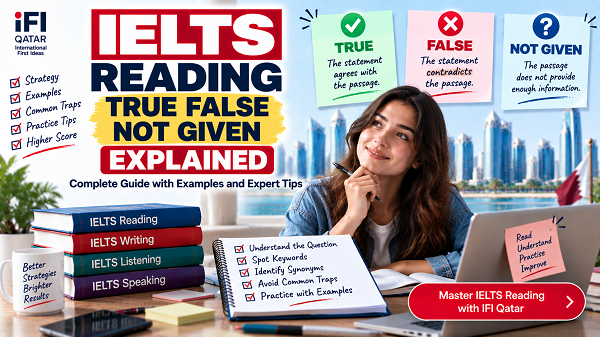
The IELTS Reading True False Not Given question type is one of the most challenging parts of the IELTS Reading test. Many students lose marks because they confuse False with Not Given, rely on their general knowledge, or look only for exact words instead of comparing the meaning of the statement with the passage.
The good news is that this question type becomes much easier when you understand exactly what each answer means and follow a consistent strategy.
In this guide, you will learn how True, False and Not Given questions work, how to identify the correct answer, how to avoid common traps, and how to practise effectively for a higher IELTS Reading score.
What Is IELTS Reading True False Not Given?
In this IELTS Reading question type, you are given several statements and must decide whether each statement agrees with the information in the reading passage.
There are three possible answers:
- TRUE – the statement agrees with the information in the passage.
- FALSE – the statement contradicts the information in the passage.
- NOT GIVEN – the passage does not provide enough information to confirm or contradict the statement.
The official IELTS description specifically warns candidates to distinguish between False and Not Given and not to use outside knowledge when answering.
What Does TRUE Mean?
Choose TRUE when the information in the statement agrees with what the passage says.
The wording does not need to be identical.
For example:
Passage:
Many university students use public transport because it is relatively inexpensive.
Statement:
Public transport is an affordable option for many university students.
Answer: TRUE
The words are different, but the meaning is the same.
What Does FALSE Mean?
Choose FALSE when the passage clearly contradicts the statement.
For example:
Passage:
Most students preferred studying in the university library rather than at home.
Statement:
Most students preferred studying at home.
Answer: FALSE
The passage provides information that directly conflicts with the statement.
What Does NOT GIVEN Mean?
Choose NOT GIVEN when the passage does not tell you whether the statement is true or false.
For example:
Passage:
Many students use online learning platforms to access course materials.
Statement:
Most students use online learning platforms every day.
Answer: NOT GIVEN
The passage says that many students use online platforms, but it does not say how frequently they use them.
This distinction is the key to mastering IELTS Reading True False Not Given questions.
True vs False vs Not Given: The Key Difference
The easiest way to understand the three answers is to ask one question:
What does the passage actually tell me?
| Answer | Meaning | What You Need to Find |
|---|---|---|
| TRUE | The statement agrees with the passage | Supporting information |
| FALSE | The statement contradicts the passage | Opposite information |
| NOT GIVEN | The passage does not provide the information | No clear evidence either way |
Think of it like this:
TRUE = Same meaning
FALSE = Opposite meaning
NOT GIVEN = No information
This simple framework can prevent many unnecessary mistakes.
How Does IELTS Reading True False Not Given Work?
True/False/Not Given is officially called Identifying Information in IELTS Reading.
The task tests your ability to recognise specific information in a reading passage. The official IELTS Academic Reading test includes this question type among several possible Reading tasks.
The IELTS Academic Reading test has:
- 60 minutes
- 3 reading sections
- 40 questions
- texts with a total length of approximately 2,150–2,750 words
Each correct Reading answer receives one mark, and the total score is converted to an IELTS band score.
The number of True/False/Not Given questions can vary because IELTS uses different combinations of question types.
How to Answer True False Not Given Questions Step by Step
A reliable strategy is more important than simply reading faster.
Use the following process for every question.
Step 1: Read the Statement Carefully
Do not immediately search for individual words.
First, understand the complete meaning of the statement.
For example:
University students who exercise regularly have better academic performance.
Identify the key ideas:
- university students
- exercise regularly
- better academic performance
You need to find information about the relationship between these ideas.
Step 2: Identify Keywords
Underline or mentally identify the most useful keywords.
Look for:
- names
- dates
- numbers
- places
- unusual nouns
- technical terms
- important verbs
- adjectives
- comparison words
For example:
University students who exercise regularly have better academic performance.
The words regularly and better academic performance may be especially important.
Step 3: Think About Synonyms
Do not expect the passage to repeat the exact words from the statement.
IELTS often paraphrases information.
For example:
Statement:
Exercise improves academic performance.
Passage:
Students who engage in physical activity tend to achieve higher grades.
The wording is different, but the underlying idea is similar.
Useful transformations may include:
- increase → rise
- reduce → decrease
- important → significant
- students → learners
- improve → enhance
- result → outcome
- problem → issue
- advantage → benefit
Step 4: Locate the Relevant Part of the Passage
Use your keywords and synonyms to scan the passage.
Once you find potentially relevant information, slow down and read the surrounding sentences carefully.
Do not choose an answer simply because you found one matching keyword.
Step 5: Compare the Meaning
Now compare the statement with the information in the passage.
Ask:
Does the passage support the statement?
If yes:
TRUE
If the passage contradicts it:
FALSE
If the passage does not give enough information:
NOT GIVEN
Step 6: Ignore Your Own Knowledge
This is extremely important.
Your answer must come from the passage, not from what you already know about the subject.
For example, suppose a passage says:
Solar energy has become more affordable in several countries.
Statement:
Solar energy is the cheapest form of energy in every country.
You may personally believe this is true or false, but that does not matter.
If the passage does not establish this claim, the correct answer is NOT GIVEN.
How to Identify TRUE Answers
A statement is TRUE when the passage provides information that agrees with it.
The wording may be completely different.
Example
Passage:
Researchers found that students who attended regular revision sessions were more likely to achieve higher examination scores.
Statement:
Regular revision may help students achieve better exam results.
Answer: TRUE
Why?
The passage says students attending revision sessions were more likely to achieve higher scores.
The statement expresses essentially the same idea.
Look for Meaning, Not Matching Words
This is one of the most important IELTS Reading skills.
Do not think:
“The word ‘help’ isn’t in the passage, so it cannot be TRUE.”
Instead, compare the meaning.
Statement:
Online courses can help students manage their study time.
Passage:
Students enrolled in online programmes often have greater flexibility in organising their schedules.
These ideas are compatible, so the statement may be TRUE if the complete context supports that relationship.
How to Identify FALSE Answers
A statement is FALSE when the passage directly contradicts it.
Look especially carefully for:
- numbers
- dates
- quantities
- comparisons
- frequency
- degree
- locations
- cause and effect
- positive versus negative statements
Example
Passage:
The survey found that approximately 40% of students preferred online classes.
Statement:
More than half of the students preferred online classes.
Answer: FALSE
The passage gives approximately 40%, while the statement claims more than 50%.
The two pieces of information contradict each other.
Watch for Small Changes
Sometimes IELTS changes only one important detail.
For example:
Passage:
The programme was introduced in 2018.
Statement:
The programme was introduced in 2020.
Answer: FALSE
The sentence may look very similar, but the date changes the meaning.
How to Identify NOT GIVEN Answers
Not Given is usually the most difficult option because students often feel that every statement must be either true or false.
That is not the case.
Choose NOT GIVEN when the passage does not provide enough information to determine whether the statement agrees with or contradicts the text.
Example
Passage:
The university introduced online lectures in 2020.
Statement:
Most students prefer online lectures.
Answer: NOT GIVEN
Why?
The passage tells us when online lectures were introduced.
It does not tell us what most students prefer.
There is no evidence to confirm or contradict the statement.
NOT GIVEN Does Not Mean “I Couldn’t Find It”
This distinction is important.
There is a difference between:
“I did not find the information.”
and:
“The passage does not provide the information.”
If you cannot locate the relevant information, continue searching before choosing NOT GIVEN.
You should select NOT GIVEN only when you have established that the passage does not provide enough information to support or contradict the statement.
The Most Common IELTS True False Not Given Traps
IELTS Reading questions are designed to test careful reading rather than simple word matching.
Here are some of the most common traps.
Trap 1: Matching Exact Words
Finding the same word in the passage does not automatically mean the answer is TRUE.
For example:
Statement:
The university introduced a new online course in 2023.
Passage:
The university introduced several new courses, although its online programme was launched in 2021.
The word online appears in both, but the information may contradict the statement.
Always compare the complete meaning.
Trap 2: Using Outside Knowledge
You may know something about the topic that is not mentioned in the passage.
Ignore it.
IELTS asks you to identify information from the text.
Trap 3: Confusing NOT GIVEN With FALSE
This is probably the most important trap.
If the passage says something different, the answer is FALSE.
If the passage says nothing about the claim, the answer is NOT GIVEN.
Trap 4: Ignoring Qualifying Words
Words such as these can completely change the meaning:
- all
- some
- many
- most
- few
- only
- always
- never
- often
- rarely
- usually
- sometimes
- mainly
- exclusively
Compare:
Some students study online.
with:
All students study online.
These statements have very different meanings.
Trap 5: Confusing Cause and Effect
Consider:
Passage:
Students with flexible schedules were more likely to use online learning platforms.
Statement:
Online learning platforms caused students to have more flexible schedules.
The passage describes a relationship but does not establish that online learning caused the flexibility.
The statement changes the relationship and may therefore be FALSE or NOT GIVEN depending on the exact passage.
Trap 6: Confusing Possibility With Certainty
Compare:
The new system may reduce costs.
with:
The new system will reduce costs.
The first expresses possibility.
The second expresses certainty.
Do not ignore modal verbs.
Important Words to Watch in True False Not Given Questions
Certain words deserve extra attention because they can change the meaning of a statement.
Quantity Words
- all
- every
- most
- many
- some
- few
- several
- a minority
- a majority
Time Words
- always
- never
- recently
- previously
- currently
- eventually
- initially
- later
- before
- after
Degree Words
- significantly
- slightly
- considerably
- completely
- partially
- mainly
- particularly
Comparison Words
- more
- less
- higher
- lower
- similar
- different
- better
- worse
Certainty Words
- must
- will
- may
- might
- could
- probably
- likely
- possibly
Paying attention to these words can help you detect subtle differences between the question statement and the passage.
True False Not Given Example With Answers
Let’s practise with a short example.
Reading Passage
Many universities have increased their use of digital learning platforms over the past decade. These platforms allow students to access lecture materials outside the classroom and can make studying more flexible. However, some students still prefer traditional classroom teaching because they value direct interaction with teachers and classmates.
Statement 1
Universities are using digital learning platforms more frequently than they did in the past.
Answer: TRUE
The passage says that many universities have increased their use of digital learning platforms.
Statement 2
All university students prefer digital learning.
Answer: FALSE
The passage says that some students still prefer traditional classroom teaching.
The word all makes the statement inconsistent with the passage.
Statement 3
Digital learning platforms are cheaper for universities than traditional teaching.
Answer: NOT GIVEN
The passage discusses flexibility and access to materials, but it does not compare the costs of digital and traditional teaching.
Statement 4
Some students value interaction with their teachers.
Answer: TRUE
The passage says that some students prefer traditional classroom teaching because they value direct interaction with teachers and classmates.
A Simple True False Not Given Decision Tree
When you are unsure, use this process:
1. Can you find relevant information in the passage?
If no → NOT GIVEN
If yes → continue.
2. Does the information agree with the statement?
If yes → TRUE
If no → continue.
3. Does the information contradict the statement?
If yes → FALSE
This creates a simple rule:
Agree = TRUE
Contradict = FALSE
No information = NOT GIVEN
Do True False Not Given Questions Follow Passage Order?
You should not assume that every Reading question type works exactly the same way.
The official IELTS Academic Reading information specifically states that some question types have answers in the same order as the information in the text, while other task types can work differently.
For True/False/Not Given questions, the safest approach is to use keywords and paraphrases to locate the relevant information rather than relying entirely on a fixed positional rule.
This is particularly useful when practising with different IELTS Reading materials.
How to Improve Your True False Not Given Score
Improvement comes from developing a repeatable reading process.
Practise With Official-Style Questions
Use reliable IELTS preparation materials and practise identifying exactly why an answer is TRUE, FALSE or NOT GIVEN.
IELTS provides official Academic Reading sample questions that include an Identifying Information task with an answer key.
Analyse Every Wrong Answer
Do not simply check the answer and move on.
For every mistake, ask:
- Did I misunderstand the statement?
- Did I miss a synonym?
- Did I overlook a qualifying word?
- Did I confuse False with Not Given?
- Did I use outside knowledge?
- Did I find the wrong part of the passage?
- Did I assume information that was not actually stated?
This analysis is often more valuable than completing another random practice test.
Build a Synonym Bank
IELTS frequently uses paraphrasing.
Create groups such as:
| Question | Possible Passage Paraphrase |
|---|---|
| increase | rise, grow, climb |
| decrease | fall, decline, drop |
| important | significant, crucial |
| improve | enhance, develop |
| problem | issue, difficulty |
| benefit | advantage |
| method | approach, technique |
| result | outcome, consequence |
| students | learners, pupils |
| research | study, investigation |
The goal is not to memorise endless synonyms. Focus on common paraphrases that you actually encounter in IELTS Reading.
A 7-Day Practice Plan for True False Not Given
If this question type is difficult for you, use a focused practice routine.
| Day | Practice |
|---|---|
| Day 1 | Learn the difference between TRUE, FALSE and NOT GIVEN |
| Day 2 | Complete 10 questions focusing only on meaning |
| Day 3 | Practise identifying paraphrases |
| Day 4 | Focus on FALSE questions and contradictions |
| Day 5 | Focus on NOT GIVEN questions |
| Day 6 | Complete a timed True/False/Not Given exercise |
| Day 7 | Review every mistake and create an error log |
Repeat the cycle with increasingly difficult passages.
Common Mistakes to Avoid
Before submitting your answers, check that you have not:
- chosen TRUE because of one matching word
- chosen FALSE simply because the statement is not clearly confirmed
- chosen NOT GIVEN without searching carefully
- used your personal knowledge
- ignored synonyms
- overlooked numbers or dates
- ignored words such as “all”, “some” or “most”
- confused possibility with certainty
- confused correlation with causation
- stopped reading after finding one matching keyword
IELTS Reading True False Not Given Strategy: Quick Checklist
Before choosing your answer, ask:
1. What exactly does the statement say?
2. What are the key words and ideas?
3. What synonyms might appear in the passage?
4. Where is the relevant information?
5. Does the passage support the statement?
6. Does it contradict the statement?
7. Or does it simply not provide the information?
Then choose:
TRUE → agrees
FALSE → contradicts
NOT GIVEN → neither
Frequently Asked Questions About IELTS Reading True False Not Given
What is True False Not Given in IELTS Reading?
True/False/Not Given is an IELTS Reading task in which you decide whether statements agree with, contradict or are not addressed by the information in the passage. IELTS officially refers to this as Identifying Information.
What is the difference between False and Not Given in IELTS Reading?
False means the passage contradicts the statement. Not Given means the passage does not provide enough information to confirm or contradict it.
How do I know if the answer is Not Given?
Choose Not Given only when you have checked the relevant information and the passage neither confirms nor contradicts the statement.
Should I use my general knowledge in True False Not Given questions?
No. Your answer should be based on information in the passage. IELTS specifically advises candidates not to use outside knowledge when answering this question type.
Are True False Not Given questions difficult?
They can be challenging because IELTS often paraphrases the information and uses small changes in meaning, quantity, time or degree. With systematic practice, however, the difference between the three answers becomes much easier to recognise.
Can I find the exact words from the question in the passage?
Sometimes, but you should not depend on exact word matching. IELTS Reading frequently requires you to recognise paraphrased information.
What is the best strategy for IELTS Reading True False Not Given?
Read the statement carefully, identify keywords, predict possible synonyms, locate the relevant information, compare the meanings and then decide whether the information agrees, contradicts or is absent.
How can I improve my IELTS Reading score?
Practise different IELTS Reading question types, build vocabulary and paraphrasing skills, complete timed practice tests, and analyse your mistakes rather than simply counting your correct answers.
Final Thoughts on IELTS Reading True False Not Given
The key to mastering IELTS Reading True False Not Given questions is understanding that you are not being asked whether a statement sounds reasonable. You are being asked whether the statement is supported, contradicted or left unanswered by the passage.
Remember the three rules:
TRUE = the passage agrees with the statement.
FALSE = the passage contradicts the statement.
NOT GIVEN = the passage does not provide enough information.
Once you stop relying on keywords alone and start comparing meaning, paraphrases and precise details, this question type becomes much more manageable.
If you want to improve your overall IELTS Reading performance, structured practice can help you develop speed, vocabulary, comprehension and question-specific strategies together.
Ready to improve your IELTS Reading score? Explore IELTS preparation courses with IFI Qatar and build the Reading skills you need for your target band.