

Currently Empty: ر.ق 0,00


IELTS
IELTS Reading Time Management: 10 Strategies to Finish All 40 Questions
Running out of time in IELTS Reading is a common problem, even for candidates who understand most of the passages. You may find the correct information, understand the question and still lose marks because you spend too long on one difficult task.
The solution is not simply to read faster. Effective IELTS Reading time management means knowing what to read, where to look for answers, how long to spend on each passage and when to move on from a difficult question.
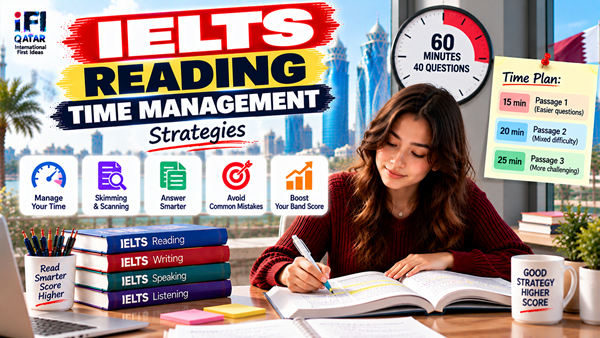
In both IELTS Academic and IELTS General Training, you have 60 minutes to answer 40 questions across three sections. There is no additional Reading time for transferring answers, so you need to manage the clock throughout the test.
This guide explains how to divide your time, use skimming and scanning, approach difficult question types and practise under realistic exam conditions.
How Much Time Do You Have for IELTS Reading?
The IELTS Reading test lasts 60 minutes and contains 40 questions. The Academic and General Training tests use different reading materials, but both require you to complete the section within the same time limit.
| IELTS Reading feature | Details |
|---|---|
| Total time | 60 minutes |
| Total questions | 40 |
| Number of sections | 3 |
| Time per question on average | 1.5 minutes |
| Extra time to transfer answers | None |
Although you have an average of 90 seconds per question, you should not treat every question equally. Some answers can be located quickly, while others require careful comparison, interpretation or reading across several paragraphs.
For this reason, an effective strategy combines a realistic passage schedule with the flexibility to spend more time on difficult tasks.
1. Follow a Practical IELTS Reading Time Schedule
One of the simplest ways to improve time management is to decide in advance how much time you will spend on each passage.
A useful starting point is the following schedule, which follows the British Council’s suggested timing for the three Reading sections.
| Passage | Suggested time | Main objective |
|---|---|---|
| Passage 1 | 15 minutes | Secure accessible marks efficiently |
| Passage 2 | 20 minutes | Maintain accuracy while handling more complex questions |
| Passage 3 | 25 minutes | Allow more time for challenging material |
| Total | 60 minutes | Complete all 40 questions |
These time limits are guidelines, not strict rules. Your ideal allocation may differ depending on your reading level, the question types and the difficulty of each passage.
Why should you spend more time on later passages?
In Academic Reading, the passages generally become more challenging as you progress. General Training Reading also moves from everyday texts towards longer and more complex material.
However, difficulty varies. If a later passage contains question types you handle confidently, you may finish it more quickly. The goal is to use your time where it is most valuable rather than follow a schedule blindly.
What if you are still answering questions when your time is nearly up?
If you have spent too long on a passage, avoid trying to recover every lost minute by rushing through the remaining text.
Instead:
- Identify the questions you can answer with reasonable confidence.
- Move past questions that require excessive searching.
- Return to unresolved questions if time remains.
- Make sure every question has an answer before the test ends.
Key takeaway: Set a time limit for each passage and monitor your progress. Do not let one difficult section consume the time needed for the rest of the test.
2. Use Skimming to Understand the Passage Quickly
Skimming means reading a text quickly to understand its overall topic, structure and main ideas without studying every sentence.
It is particularly useful when you need to understand how a passage is organised before answering questions.
How to skim an IELTS Reading passage
Follow these steps:
- Read the title, if one is provided.
- Notice any headings, subheadings, diagrams or highlighted information.
- Read the opening sentence of each paragraph.
- Pay attention to repeated concepts and changes in topic.
- Build a rough mental map of where different ideas appear.
You do not need to understand every detail during this first pass. Your objective is to know where to look when a question refers to a particular idea or piece of information.
Example of skimming
Imagine that a passage discusses renewable energy and contains paragraphs about solar panels, wind farms, battery storage and government incentives.
After skimming, you should have a rough idea of which paragraph discusses each subject. If a question asks about storing electricity, you can begin your search in the paragraph about batteries rather than rereading the entire passage.
When is skimming most useful?
Skimming is especially helpful for:
- Understanding the overall argument.
- Identifying the main idea of a paragraph.
- Preparing for Matching Headings questions.
- Locating the general area relevant to a question.
Avoid turning skimming into fast, unfocused reading. If you finish the passage quickly but cannot remember its structure, the technique has not achieved its purpose.
3. Use Scanning to Find Specific Information
Scanning is different from skimming. Instead of looking for the general meaning, you search for a particular detail.
These details may include:
- Names and surnames.
- Dates and years.
- Numbers and percentages.
- Locations.
- Technical terms.
- Distinctive words or phrases.
Scanning helps you locate a relevant part of the passage without reading every line.
How to scan effectively
First, identify the important words in the question. Then look for those words or related expressions in the passage.
For example, consider this question:
In which year did the research project begin?
Your main target is a year. Scan the passage for dates and nearby references to the research project. Once you find a likely match, read the surrounding sentence carefully to confirm that the date answers the question.
Look for synonyms, not just identical words
IELTS questions often paraphrase information from the passage. A question may use different vocabulary to express the same idea.
For example:
- Question: The company reduced its workforce.
- Passage: The organisation employed fewer people after the restructuring.
The wording differs, but the meaning is similar.
If you search only for the exact words in the question, you may miss the relevant sentence. Build your ability to recognise synonyms and paraphrases during practice.
4. Read the Questions Before Searching for Answers
Reading the questions first can make your search more purposeful. Rather than processing the entire passage in detail, you know what information you need to find.
However, the best approach depends on the question type.
For questions about specific details
Read the question and underline its key concepts. Identify whether you are looking for a name, date, reason, comparison or other detail.
Then scan the passage and read the relevant section carefully.
For Matching Headings questions
Start by understanding the overall meaning of each paragraph. You need to identify its main idea, not simply locate a word that appears in one sentence.
Read the list of headings and compare the central idea of each option with the paragraph as a whole.
For True/False/Not Given questions
Focus on the exact claim in each statement. Find the relevant part of the passage and decide whether the information agrees with, contradicts or is not addressed by the text.
Do not choose an answer based on your general knowledge or what seems logically likely.
A simple question-first routine
For most detail-based questions, use this sequence:
- Read the question carefully.
- Identify keywords and possible synonyms.
- Predict the type of information required.
- Scan the passage for a relevant section.
- Read that section closely.
- Confirm the answer before moving on.
This process reduces unnecessary reading while protecting accuracy.
5. Do Not Spend Too Long on One Difficult Question
One of the biggest IELTS Reading time-management mistakes is becoming stuck on a single question.
You may reread the same paragraph several times, compare similar options repeatedly or try to understand every unfamiliar word. Meanwhile, several easier questions remain unanswered.
Use a move-on rule
If you have searched carefully and still cannot identify the answer, make a reasonable decision and move on.
You can return to the question if you finish the other tasks early.
A practical approach is to:
- Give yourself a short, defined period to locate the answer.
- Recheck the relevant sentence once if necessary.
- Eliminate clearly incorrect options.
- Record your best answer when appropriate.
- Continue to the next question.
The exact time depends on the question and your current pace. The important point is to prevent one uncertain answer from affecting the rest of the test.
Should you guess if you are unsure?
Yes. There is no negative marking for incorrect answers in IELTS Reading, so an unanswered question offers no advantage over a reasonable guess.
If you cannot solve a question before time runs out, eliminate options that are clearly inconsistent with the passage and choose the most plausible remaining answer.
Always ensure that your final answers follow the instructions for the task, including any word limits.
6. Adapt Your Timing to Different IELTS Reading Question Types
Not all question types require the same reading strategy. Recognising the task can help you decide how to use your time.
| Question type | Recommended approach | Common time trap |
|---|---|---|
| Multiple Choice | Read the question, locate relevant evidence and compare options | Repeatedly rereading every option |
| True/False/Not Given | Check the precise claim against the passage | Using outside knowledge |
| Yes/No/Not Given | Compare the statement with the writer’s views or claims | Confusing facts with opinions |
| Matching Headings | Identify the paragraph’s main idea | Focusing on a minor detail |
| Matching Information | Scan for distinctive details and paraphrases | Reading every paragraph in full |
| Sentence Completion | Predict the required word or phrase, then locate evidence | Ignoring the word limit |
| Summary Completion | Understand the summary and search for the relevant part of the passage | Assuming answers always follow question order |
| Short Answer | Identify the requested information and verify the wording | Writing more words than permitted |
Which question types often require extra care?
Matching Headings can be challenging because you must distinguish the main idea from supporting details. True/False/Not Given and Yes/No/Not Given also require careful interpretation rather than simple keyword matching.
For these tasks, allow enough time to verify meaning. Speed is useful only when it leads to the correct answer.
7. Avoid Reading Every Word of the Passage
Reading every sentence from beginning to end before looking at the questions can waste valuable time.
IELTS Reading tests several skills, including locating details, understanding main ideas and recognising relationships between statements and text. You rarely need to understand every word to answer every question.
Use three levels of reading
Level 1: Skim
Get the general idea and understand the passage structure.
Level 2: Scan
Search for keywords, synonyms, names, dates or concepts linked to a question.
Level 3: Read intensively
Slow down when you reach the relevant section. Check the meaning, context and relationship between the passage and the question.
This approach helps you balance speed and accuracy.
What should you do when you encounter an unfamiliar word?
Do not automatically stop to analyse it. Ask yourself whether the word is essential to answering the question.
If it is not, continue reading. If the answer depends on it, use the surrounding sentence and paragraph to infer its meaning.
You can improve this skill by reading regularly and reviewing vocabulary in context rather than memorising isolated word lists.
8. Check Your Answers Without Losing Valuable Time
Answer checking is important, but it should not become an excuse to spend too long revisiting questions you have already solved.
Whenever possible, confirm an answer immediately after locating the evidence. This reduces the need to reconstruct your reasoning later.
During your final review, prioritise issues that can cost marks unnecessarily.
IELTS Reading final-check checklist
-
Have I answered all 40 questions?
-
Have I followed the word limit for completion and short-answer tasks?
-
Have I checked spelling where required?
-
Have I selected the correct number of options?
-
Have I avoided leaving any answer blank?
-
Have I reviewed questions I marked as uncertain?
For computer-delivered IELTS, enter your answers directly and use the remaining time to review them. For paper-based IELTS, complete your answer sheet within the same 60-minute Reading period; there is no separate transfer-time allowance.
9. Practise IELTS Reading Under Realistic Time Limits
Reading strategies become useful when you practise applying them under exam conditions.
If you always complete practice passages without a timer, you may become good at understanding the text but struggle to finish all 40 questions in the actual test.
A four-week time-management practice plan
| Week | Main focus | Practice task |
|---|---|---|
| Week 1 | Accuracy and question types | Complete individual question sets and review mistakes |
| Week 2 | Skimming and scanning | Practise locating evidence without reading every word |
| Week 3 | Time control | Complete timed passages using a planned schedule |
| Week 4 | Full-test performance | Complete all 40 questions within 60 minutes and analyse results |
Adapt this plan to your current English level and the time available before your exam.
Keep an IELTS Reading practice log
After each test, record:
- Your score out of 40.
- The time spent on each passage.
- The question types you found most difficult.
- The number of unanswered questions.
- The mistakes caused by rushing or misunderstanding.
- The main skill you need to improve next.
For example, if you regularly spend 25 minutes on Passage 1, the problem may be excessive rereading or difficulty locating evidence. If you finish on time but make many mistakes, you may need to improve accuracy rather than increase reading speed.
Your practice log should help you identify the actual cause of your results instead of relying on guesswork.
10. Improve Your Reading Speed Without Sacrificing Accuracy
Reading faster does not mean moving your eyes across the page as quickly as possible. Effective reading speed comes from understanding text structure, recognising vocabulary and knowing when detailed reading is necessary.
Use these habits to develop more efficient reading skills.
Read English regularly
Choose articles, reports and other texts appropriate to your level. Practise identifying the main idea and locating specific details without translating every sentence into your first language.
Build vocabulary through context
When you meet a useful word, note its meaning, common synonyms and how it is used in a sentence. This can help you recognise paraphrasing in IELTS questions.
Review every incorrect answer
Do not simply check the answer key and move on. Find the exact evidence in the passage and ask why your answer was wrong.
Was the problem a synonym you did not recognise, a misleading option, a missed detail or a misunderstanding of the question?
Repeat practice with a clear objective
Instead of taking test after test without analysis, focus on one improvement at a time. For example, spend one session on Matching Headings and another on True/False/Not Given.
Targeted practice helps you identify patterns in your mistakes and develop more reliable techniques.
A 60-Minute IELTS Reading Strategy You Can Practise
Use this routine as a starting point for a full practice test.
Before starting: Check the instructions, prepare your answer sheet or computer interface and make a conscious decision to keep moving.
Minutes 0–15: Work through Passage 1. Use skimming and targeted scanning to answer questions efficiently.
Minutes 15–35: Move to Passage 2. Pay attention to paraphrases and avoid spending excessive time on uncertain answers.
Minutes 35–60: Complete Passage 3. Read carefully where the questions demand it, and keep checking the time.
During the final minutes: Answer remaining questions and check for omissions, spelling issues and word-limit errors.
This is a flexible schedule rather than a requirement to switch passages at an exact moment. If a passage is unusually difficult, adjust your pace while protecting enough time to attempt the remaining questions.
Frequently Asked Questions About IELTS Reading Time Management
How can I manage time in IELTS Reading?
Divide the 60 minutes into a practical schedule, such as 15 minutes for Passage 1, 20 minutes for Passage 2 and 25 minutes for Passage 3. Use skimming to understand the structure, scanning to locate details and close reading to confirm answers. Adjust the schedule as you identify your strengths and weaknesses.
Is one minute enough for each IELTS Reading question?
Not necessarily. The average available time is 1.5 minutes per question, but some questions can be answered more quickly than others. Use this average as a guide rather than a fixed limit, and allow extra time for tasks that require more interpretation.
Should I read the passage first or the questions first?
It depends on the question type. For many detail-based tasks, reading the questions first helps you search efficiently. For Matching Headings, you need to understand the main idea of each paragraph, so skimming the passage structure is particularly useful.
What should I do if I cannot find an answer in IELTS Reading?
Check the relevant section once more, look for synonyms and read the surrounding sentences carefully. If you still cannot find the answer, move on and return later if time permits. Do not allow one difficult question to prevent you from answering others.
Can skimming and scanning improve my IELTS Reading score?
They can help you locate relevant information more efficiently, but they do not guarantee a higher score on their own. You must also understand the text, recognise paraphrases, interpret the questions accurately and verify your answers.
Is IELTS Reading time the same for Academic and General Training?
Yes. Both IELTS Academic Reading and IELTS General Training Reading last 60 minutes and contain 40 questions. The texts and task content differ, but the time-management challenge is similar.
Do I get extra time to transfer answers in IELTS Reading?
No. You must complete your answers within the 60-minute Reading test. This applies to both paper-based and computer-delivered formats, so do not plan on an additional transfer period.
How can an IELTS Reading course help me manage time?
A structured course can help you identify the question types that slow you down, practise skimming and scanning, review incorrect answers and develop a realistic test strategy. Guided feedback can also reveal whether your main difficulty is reading speed, vocabulary, comprehension or decision-making.
Improve Your IELTS Reading Performance with IFI Qatar
Effective time management is a skill you can develop through targeted practice. When you learn to locate evidence efficiently, recognise paraphrases and move on from difficult questions at the right moment, you can use your 60 minutes more effectively.
If you are preparing for IELTS in Qatar and want to improve your reading accuracy, speed and confidence, explore IELTS preparation courses at IFI Qatar. Structured practice and focused feedback can help you identify your weaknesses and work towards your target band score.
Ready to improve your IELTS Reading skills? Contact IFI Qatar to learn more about available IELTS preparation options.