

Currently Empty: ر.ق 0,00


IELTS
How Long Does It Take to Prepare for IELTS?
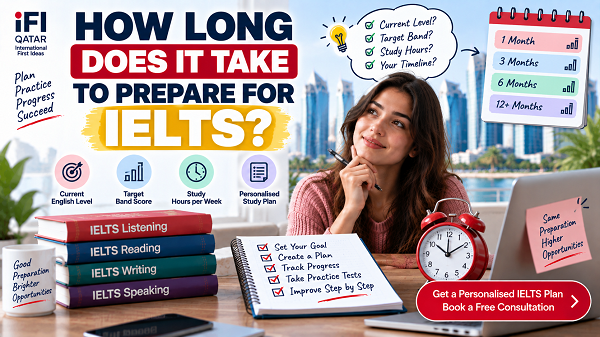
How Long Does IELTS Preparation Take?
There is no single answer to the question “How long does it take to prepare for IELTS?”
Some students may need only a few weeks to become familiar with the test format and improve their exam technique. Others may need several months because they first need to strengthen their general English skills.
Your ideal IELTS preparation time depends mainly on:
- Your current English level
- Your target IELTS band score
- The score you currently achieve in each skill
- How many hours you can study each week
- Your strengths and weaknesses
- Whether you need Academic or General Training
- How familiar you are with the IELTS test format
- Whether you study independently or with professional guidance
The most important question is therefore not simply “How many weeks do I need?”
It is:
How much improvement do I need, and how quickly can I realistically achieve it?
IELTS itself notes that preparation time varies significantly depending on the learner’s starting level, study time, motivation, learning strategies, resources and support. Official IELTS guidance also recommends understanding your current level and using practice tests to identify the skills that need improvement.
What Determines Your IELTS Preparation Time?
Your Current English Level
Your starting level is one of the biggest factors affecting IELTS preparation time.
A student who is already performing around Band 6.5 may need a very different preparation strategy from someone currently performing around Band 4.5.
For example:
| Current Level | Target | Typical Preparation Focus |
|---|---|---|
| Around Band 4.5 | Band 5.5 | Core English + IELTS fundamentals |
| Around Band 5.0 | Band 6.0 | Grammar, vocabulary + exam skills |
| Around Band 5.5 | Band 6.5 | Skill development + targeted practice |
| Around Band 6.0 | Band 7.0 | Accuracy + advanced exam strategies |
| Around Band 6.5 | Band 7.5+ | Advanced refinement + detailed feedback |
These are planning examples rather than guaranteed timelines. Your actual preparation needs should be based on a diagnostic assessment rather than your previous score alone.
Your Target IELTS Band Score
Your target score also affects how long you may need to prepare.
There is a significant difference between preparing to meet a minimum requirement and preparing for a higher target.
For example, a student targeting Band 6 may need to focus heavily on building reliable language skills and mastering the test format.
A student targeting Band 7 or above may need more detailed work on:
- Grammar accuracy
- Vocabulary range
- Writing development
- Speaking fluency
- Coherence and cohesion
- Pronunciation
- Complex language structures
- Time management
Your preparation should therefore begin with the score you actually need, not simply the highest score you would like to achieve.
Your Current Score in Each IELTS Skill
Your overall IELTS score can hide important differences between individual skills.
For example, imagine a student with:
| Skill | Current Score |
|---|---|
| Listening | 7.0 |
| Reading | 6.5 |
| Writing | 5.5 |
| Speaking | 6.0 |
This student may not need to spend equal amounts of time on all four skills.
Writing would probably require more targeted attention than Listening.
This is why taking a diagnostic test before creating your study plan is so useful.
How Many Hours You Can Study Each Week
Two students may have the same English level but require different preparation schedules because they have different amounts of available study time.
For example:
| Weekly Study Time | Suitable Approach |
|---|---|
| 3–5 hours | Slow, long-term preparation |
| 6–10 hours | Consistent part-time preparation |
| 10–15 hours | Intensive structured preparation |
| 15+ hours | Accelerated preparation with strong discipline |
These are practical planning ranges, not official IELTS requirements.
The key principle is consistency.
Studying for one hour every day is often easier to sustain than studying for seven hours once a week.
Your Previous IELTS Experience
If you have taken IELTS before, you may already understand:
- The test structure
- Question types
- Timing
- Band scores
- Common task requirements
- Your personal weaknesses
That familiarity can reduce the amount of time needed for test-specific preparation.
However, simply taking IELTS repeatedly does not automatically improve your English.
If your previous score was below your target, you need to identify why you received that score and address the underlying weaknesses.
How Many Months Should You Study for IELTS?
A practical preparation period depends on the size of the gap between your current performance and your target.
If You Need a Small Score Improvement
If your current level is already close to your target, a shorter preparation period may be enough.
Your preparation can focus on:
- Test format
- Timing
- Question types
- Exam strategies
- Writing structure
- Speaking practice
- Targeted error correction
- Full practice tests
For some students, several weeks of focused preparation may be sufficient.
If You Need a Moderate Score Improvement
If there is a larger gap between your current score and target score, you may need several months of structured preparation.
Your plan should combine:
- General English development
- IELTS-specific skills
- Vocabulary building
- Grammar improvement
- Speaking practice
- Writing feedback
- Reading strategies
- Listening practice
- Timed mock tests
If You Need a Large Score Improvement
If your current English level is significantly below your target, it is usually better to allow more time.
Trying to solve a large language gap through exam tricks alone is unlikely to be an effective long-term strategy.
You may need to work on your general English foundation before moving into intensive IELTS exam preparation.
Is One Month Enough to Prepare for IELTS?
When One Month Can Be Enough
One month can be useful if you already have a strong English foundation and your main weakness is IELTS exam technique.
For example, you may already communicate comfortably in English but need to improve:
- Writing Task 2 structure
- Speaking Part 2 development
- Reading time management
- Listening question strategies
- Understanding the marking criteria
In this situation, four weeks of focused preparation can make your practice much more targeted.
When One Month Is Probably Not Enough
One month may be unrealistic if you need a substantial improvement in your overall English ability.
This is especially true if you have persistent problems with:
- Basic grammar
- Vocabulary
- Sentence formation
- Listening comprehension
- Reading comprehension
- Speaking fluency
- Pronunciation
In these cases, you should consider a longer preparation period.
The goal should be to improve the underlying language ability, not simply memorise test strategies.
Is Three Months Enough to Prepare for IELTS?
Three months can provide a useful preparation window for many students, particularly when they already have a reasonable English foundation and can study consistently.
Official IELTS guidance has cited research in which students studying in preparation or language courses improved by up to half a band on average over approximately three months, although results varied considerably between learners.
This should not be treated as a guaranteed timeline.
Your progress may be faster or slower depending on your starting level, target score, study intensity and the quality of your preparation.
A three-month plan can be particularly useful because it provides enough time to divide preparation into clear stages.
A 3-Month IELTS Preparation Plan
Month 1: Assess and Build Your Foundation
During the first month, focus on identifying your weaknesses and strengthening the fundamentals.
Main Goals
- Take a diagnostic IELTS test
- Identify your weakest skills
- Review essential grammar
- Build topic-based vocabulary
- Learn the IELTS test format
- Begin regular Speaking practice
- Learn the structure of IELTS Writing tasks
Your first month should answer one important question:
What is currently preventing me from reaching my target band?
Month 2: Develop IELTS Skills
During the second month, move from general preparation toward more intensive IELTS practice.
Main Goals
- Complete timed Reading practice
- Complete regular Listening tests
- Write IELTS Task 1 and Task 2 responses
- Practise Speaking Part 1, Part 2 and Part 3
- Review grammar errors
- Improve vocabulary range
- Develop paraphrasing skills
- Work on time management
At this stage, feedback becomes increasingly valuable because you need to understand not only what is wrong but also how to improve it.
Month 3: Exam-Focused Practice
The final month should focus on applying everything under realistic test conditions.
Main Goals
- Complete full IELTS mock tests
- Practise under time limits
- Analyse incorrect answers
- Review recurring Writing mistakes
- Record and evaluate Speaking answers
- Strengthen weak question types
- Improve exam timing
- Build test-day confidence
The objective is to make your performance consistent before the actual test.
How Many Hours a Day Should You Study for IELTS?
There is no universal number of hours that guarantees a particular IELTS score.
Instead, choose a study schedule that you can maintain consistently.
For example:
1 Hour a Day
A one-hour schedule can work for students who have several months available.
A sample session could include:
- 15 minutes vocabulary
- 15 minutes grammar
- 15 minutes Listening or Reading
- 15 minutes Speaking or Writing
2 Hours a Day
Two hours allows you to work more deeply on individual skills.
For example:
- 30 minutes Reading
- 30 minutes Listening
- 30 minutes Writing
- 30 minutes Speaking
You can also replace some sessions with grammar and vocabulary review.
3+ Hours a Day
An intensive schedule can be useful when your test date is approaching or when you have limited time.
However, more study time does not automatically mean better results.
Quality matters.
Three hours of unfocused practice may be less useful than one hour of targeted practice followed by detailed error analysis.
Should You Take an IELTS Mock Test Before Studying?
Yes. Taking a diagnostic or practice test before beginning your preparation can help you understand where you currently stand.
Official IELTS practice materials allow candidates to become familiar with the test format, experience different task types, practise under timed conditions and review their answers.
A baseline test can help you answer:
- What is my current overall level?
- Which skill is weakest?
- Which question types cause problems?
- Am I losing marks because of English ability or exam technique?
- How far am I from my target score?
Without this information, you may spend too much time studying areas you already handle well.
How to Calculate Your IELTS Preparation Time
You can use this simple framework to estimate your preparation needs.
Step 1: Identify Your Target Score
Write down the exact score you need.
For example:
Target Overall Band: 7.0
Also check whether your university, employer, immigration authority or other organisation requires minimum scores in individual skills.
Step 2: Take a Diagnostic Test
Complete realistic IELTS practice tests under timed conditions.
Record your scores for:
- Listening
- Reading
- Writing
- Speaking
Step 3: Identify the Score Gap
For example:
Current Writing: 5.5
Target Writing: 6.5
This tells you that Writing needs focused attention.
Step 4: Calculate Your Weekly Study Time
For example:
90 minutes per day × 6 days = 9 hours per week
Step 5: Build a Preparation Plan
Divide your available time between:
- Language development
- IELTS strategy
- Skill practice
- Mock tests
- Error correction
- Feedback
Step 6: Reassess Your Progress
Do not wait until test day to discover that your strategy is not working.
Take regular practice tests and adjust your preparation plan based on your results.
What Should You Study During Your IELTS Preparation?
A balanced IELTS preparation plan should cover all four skills.
IELTS Listening
Focus on:
- Understanding different accents
- Predicting answers
- Identifying keywords
- Following conversations and lectures
- Avoiding spelling mistakes
- Managing concentration
IELTS Reading
Focus on:
- Skimming
- Scanning
- Understanding question types
- Locating information
- Managing time
- Identifying keywords and paraphrases
IELTS Writing
Focus on:
- Task requirements
- Essay structure
- Paragraph development
- Coherence and cohesion
- Vocabulary
- Grammar
- Task response
- Time management
IELTS Speaking
Focus on:
- Fluency
- Vocabulary
- Grammar
- Pronunciation
- Developing answers
- Expressing opinions
- Giving examples
- Handling follow-up questions
IELTS assesses Speaking across fluency and coherence, lexical resource, grammatical range and accuracy, and pronunciation. Writing is assessed using task achievement/task response, coherence and cohesion, lexical resource, and grammatical range and accuracy.
How Can an IELTS Course Reduce Wasted Preparation Time?
Studying alone can work well for some learners, but one common problem is not knowing what to study next.
A structured IELTS course can help you:
- Assess your current level
- Identify your weakest skills
- Follow a structured study plan
- Learn IELTS-specific strategies
- Practise under realistic conditions
- Receive feedback on Writing
- Practise Speaking with guidance
- Track your progress
- Adjust your preparation based on results
The biggest advantage is not simply having more study materials.
It is having a clearer path from your current performance to your target score.
IELTS Preparation Time: Self-Study vs IELTS Course
| Factor | Self-Study | IELTS Course |
|---|---|---|
| Flexibility | High | Structured |
| Study schedule | Self-managed | Guided |
| Speaking feedback | Limited unless arranged | Usually available |
| Writing feedback | May be limited | Can be instructor-led |
| Study materials | Self-selected | Structured resources |
| Progress tracking | Self-managed | Easier to monitor |
| Exam strategy | Self-taught | Instructor-guided |
| Accountability | Depends on the student | Regular support |
Neither approach is automatically right for every student.
The better choice depends on your current level, target score, available time and need for feedback.
What Is the Best IELTS Preparation Schedule?
A good schedule should be realistic enough to follow consistently.
Here is an example of a weekly IELTS study plan:
| Day | Main Focus | Suggested Practice |
|---|---|---|
| Monday | Reading | One timed passage + error review |
| Tuesday | Writing | Task 2 essay + feedback |
| Wednesday | Listening | Full Listening practice + review |
| Thursday | Speaking | Part 1, 2 and 3 practice |
| Friday | Grammar & Vocabulary | Topic vocabulary + grammar review |
| Saturday | Mock Test | Full or partial practice test |
| Sunday | Review | Analyse mistakes and revise weak areas |
You can adjust this schedule depending on your target score and available study time.
When Should You Book Your IELTS Test?
Do not choose your test date simply because you have completed a certain number of weeks.
Instead, consider booking when your practice results are consistently close to the score you need.
Before booking, ask:
- Am I consistently reaching my target score?
- Are my weakest skills improving?
- Can I complete each section within the required time?
- Have I completed realistic mock tests?
- Do I understand the test format?
- Have I addressed my recurring mistakes?
If your scores are still significantly below your target, more preparation may be useful.
Common IELTS Preparation Mistakes That Waste Time
Studying Without a Baseline Test
Without knowing your starting level, it is difficult to create an efficient preparation plan.
Practising Only Your Strongest Skill
If you are already good at Reading but weak in Writing, completing Reading tests every day may not move you closer to your target.
Memorising Answers
Memorising large numbers of Speaking or Writing answers can make your language sound unnatural and may not prepare you for unfamiliar questions.
Doing Practice Tests Without Reviewing Mistakes
A mock test is more valuable when you analyse why you lost marks.
Ask:
Why did I get this question wrong?
Did I misunderstand the question?
Did I run out of time?
Did I make a vocabulary or grammar error?
Did I use the wrong strategy?
Changing Study Materials Constantly
Using too many books, websites and videos can make preparation less organised.
Choose reliable resources and follow a structured plan.
Focusing Only on Exam Tricks
IELTS strategies are useful, but they cannot replace English-language development.
If your vocabulary, grammar, comprehension or fluency needs improvement, spend enough time developing those underlying skills.
How Do You Know When You Are Ready for IELTS?
You are closer to being test-ready when your practice performance becomes consistent rather than depending on one unusually good result.
Look for:
- Consistent practice scores
- Improved performance in your weakest skill
- Better time management
- Fewer repeated grammar mistakes
- More confident Speaking responses
- Better Writing structure
- Improved ability to handle unfamiliar questions
- Familiarity with the complete test format
Official IELTS preparation materials include sample tests that can help you become familiar with question types, practise under timed conditions and review your performance.
Frequently Asked Questions About IELTS Preparation Time
How long does it take to prepare for IELTS?
There is no fixed IELTS preparation time. It depends on your current English level, target band score, available study hours, previous IELTS experience and the skills you need to improve. Some students may need several weeks, while others may need several months.
Is one month enough to prepare for IELTS?
One month can be enough for some students who already have a strong English foundation and mainly need IELTS-specific preparation. It may not be enough for students who need significant improvement in their general English ability.
Is three months enough for IELTS preparation?
Three months can provide a useful preparation period for many students, particularly when they study consistently and follow a structured plan. However, individual progress varies, so a diagnostic assessment is more useful than relying on a fixed timeline.
How many hours should I study for IELTS each day?
There is no universal number of hours. A consistent schedule of around one to three hours per day can be a practical starting point, depending on your test date, current level and target score. The quality and focus of your study are more important than simply counting hours.
How long does it take to improve IELTS by one band?
There is no guaranteed timeline for improving by one band. The time required depends on your starting level, target score, study intensity and individual learning progress. A structured assessment and regular progress testing can provide a more realistic estimate.
Can I prepare for IELTS by myself?
Yes, self-study is possible, particularly if you already have a strong English foundation and can create and follow an effective study plan. However, professional feedback can be particularly useful for Writing and Speaking because these skills are harder to evaluate objectively by yourself.
Should I take a mock test before starting IELTS preparation?
Yes. A diagnostic mock test can help you identify your current level, understand your weakest skills and create a more targeted preparation plan.
When should I book my IELTS test?
Ideally, choose a test date after assessing your current performance and estimating how much preparation you need. As your test approaches, use realistic timed practice tests to determine whether your performance is consistently close to your target.
Final Thoughts: Planning Your IELTS Preparation Time
The question “How long does it take to prepare for IELTS?” does not have one answer that applies to every student.
Your preparation time should be based on four key factors:
- Where you are now
- Where you need to be
- How much time you can study
- How efficiently you are improving
A student who needs to move from Band 5.5 to Band 6.0 may need a very different plan from someone aiming to move from Band 6.5 to Band 7.5.
That is why the most effective first step is not simply choosing a test date.
It is assessing your current level and building a preparation plan around your target score.
Need Help Planning Your IELTS Preparation?
If you are unsure how much time you need, an IELTS consultation can help you identify your current level, understand your strengths and weaknesses, and create a more focused preparation strategy.
Talk to IFI Qatar about your IELTS preparation goals and find a study plan that matches your target score and available time.