

Currently Empty: ر.ق 0,00


IELTS
IELTS Writing Task 2 Opinion Essay Guide
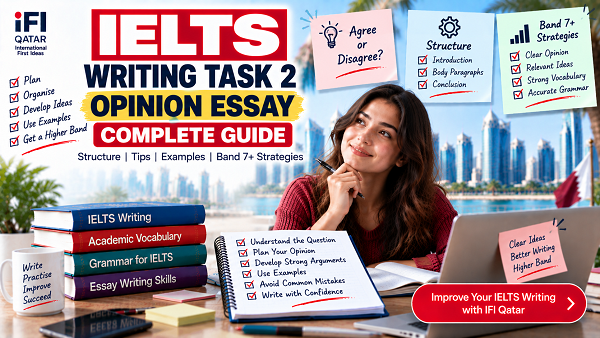
The IELTS opinion essay is one of the most common types of IELTS Writing Task 2 questions. You are given a statement or opinion and asked whether you agree or disagree with it, or to what extent you agree or disagree.
A high-scoring opinion essay is not simply a collection of ideas. You need to understand the question, take a clear position, develop relevant arguments, support your ideas with explanations and examples, and organise everything into a logical essay.
In IELTS Writing Task 2, you have 40 minutes to write at least 250 words. Your response is assessed according to four criteria: Task Response, Coherence and Cohesion, Lexical Resource, and Grammatical Range and Accuracy. Task 2 also contributes twice as much as Task 1 to your overall IELTS Writing score.
This guide explains exactly how to approach an IELTS opinion essay, including its structure, thesis statement, body paragraphs, vocabulary, examples, common mistakes and strategies for achieving a higher band score.
What Is an IELTS Opinion Essay?
An IELTS opinion essay is a Writing Task 2 essay in which you must express and support your position on a particular issue.
The question usually contains a statement followed by a question such as:
- Do you agree or disagree?
- To what extent do you agree or disagree?
- Do you agree that…?
- How far do you agree or disagree?
For example:
Some people believe that university education should be free for everyone. To what extent do you agree or disagree?
In this type of question, the examiner wants to see a clear position supported by relevant ideas and examples.
The important point is that you should not spend the entire essay discussing the topic generally. Your arguments need to answer the specific question.
How Is an IELTS Opinion Essay Scored?
Understanding the scoring criteria is essential because it tells you what the examiner is looking for.
IELTS Writing Task 2 is assessed using four criteria:
| Assessment criterion | What it measures |
|---|---|
| Task Response | How fully and appropriately you answer the question and develop your position |
| Coherence and Cohesion | How logically you organise and connect your ideas |
| Lexical Resource | The range, accuracy and appropriacy of your vocabulary |
| Grammatical Range and Accuracy | The variety and accuracy of your grammatical structures |
Each area contributes to your Task 2 performance.
Task Response
For an opinion essay, Task Response is particularly important because you must present a clear position and develop it.
According to the official band descriptors, a Band 7 response presents a clear and developed position, while higher bands require ideas to be increasingly well developed, relevant and supported. A Band 9 response presents a clear, fully developed position and explores the prompt in depth.
This means you should avoid:
- unclear opinions
- unrelated ideas
- unsupported claims
- memorised arguments
- repeating the same point
- discussing the topic without answering the question
Coherence and Cohesion
Your essay should have a clear progression from one idea to the next.
A typical structure is:
- Introduction
- Body Paragraph 1
- Body Paragraph 2
- Conclusion
Each paragraph should have a clear purpose, and the ideas within each paragraph should follow a logical sequence.
Lexical Resource
You need vocabulary that is accurate, appropriate and flexible.
Using difficult words simply to sound advanced is not a reliable strategy. A precise, natural word is usually more effective than an unnecessarily complicated one.
For example:
Less natural:
Governments should utilise substantial monetary resources to ameliorate the problem.
More natural:
Governments should invest more money to address the problem.
The second sentence is clearer and easier to control grammatically.
Grammatical Range and Accuracy
A strong IELTS opinion essay uses a variety of sentence structures while maintaining accuracy.
You can use:
- complex sentences
- relative clauses
- conditional structures
- passive structures
- concessive clauses
- cause-and-effect structures
However, complexity should never come at the expense of accuracy.
What Is the Best IELTS Opinion Essay Structure?
A clear four-paragraph structure works well for many opinion essays:
| Paragraph | Purpose |
|---|---|
| Introduction | Paraphrase the topic and state your position |
| Body Paragraph 1 | Present and develop your first main argument |
| Body Paragraph 2 | Present and develop your second main argument |
| Conclusion | Summarise your position and main reasoning |
This is not a requirement that every IELTS essay must follow exactly four paragraphs. What matters is that your response has clear organisation, logical progression and effective paragraphing. The official band descriptors specifically assess how effectively ideas are organised and developed.
How to Write the IELTS Opinion Essay Introduction
A good introduction normally has two main functions:
- Introduce the topic in your own words.
- Clearly state your position.
You do not need a long introduction. In most cases, two or three sentences are enough.
Step 1: Paraphrase the Question
Start by rewriting the question using your own words.
For example:
Question:
Some people believe that children should not be given homework because they need more time to play. To what extent do you agree or disagree?
Paraphrase:
There is an ongoing debate about whether schoolchildren should receive homework or whether their free time should be reserved mainly for recreational activities.
Notice that the meaning remains the same, but the wording has changed.
Step 2: Write a Clear Thesis Statement
Your thesis statement should make your position obvious.
For example:
I largely disagree with this view because appropriate homework can reinforce classroom learning and help children develop useful study habits.
This is much stronger than:
This essay will discuss both sides of the argument.
The second sentence does not tell the examiner what you actually think.
How to Write a Strong IELTS Opinion Essay Thesis Statement
Your thesis statement is one of the most important sentences in the essay because it establishes your position.
A useful formula is:
Position + main reasons
For example:
I agree with this view because remote working can improve employees’ work-life balance while also reducing commuting time.
Or:
I disagree with this argument because university education provides important economic and social benefits that should remain accessible to students from different backgrounds.
You can also express a qualified position:
I agree with this view to a large extent, although some traditional classroom teaching remains valuable for certain subjects.
The key is consistency. If you clearly state that you agree in the introduction but argue against the statement in the body paragraphs, your position becomes unclear.
How to Plan an IELTS Opinion Essay
Before writing, spend a few minutes analysing the question.
A simple planning process can save time later.
Identify the Topic
First, determine what the question is actually about.
For example:
Governments should spend more money on public transport than on building new roads. To what extent do you agree or disagree?
The topic is not simply “transport”.
It is specifically about:
government spending on public transport versus spending on roads.
Identify the Task
Ask yourself:
What exactly am I being asked to do?
Here, you need to give your opinion about government spending priorities.
Decide Your Position
Choose a position before you begin writing.
You could:
- completely agree
- completely disagree
- largely agree
- largely disagree
There is no need to create an artificially complicated opinion. Choose the position that allows you to develop two strong arguments clearly.
Generate Two Main Ideas
For example:
Position: Agree
Argument 1: Better public transport can reduce traffic congestion.
Argument 2: Public transport can provide affordable mobility for large numbers of people.
Then develop each argument with explanation and an example.
How to Write IELTS Opinion Essay Body Paragraphs
Each body paragraph should normally focus on one major argument.
A useful structure is:
Topic sentence → Explanation → Example → Result or implication
For example:
One major reason to invest in public transport is that it can reduce traffic congestion. When reliable buses, trains and metro services are available, commuters have a practical alternative to using private cars. For example, expanding urban rail networks can encourage thousands of people to leave their cars at home, particularly when services are frequent and affordable. As a result, cities can reduce pressure on their roads while making daily travel more efficient.
The paragraph works because the main idea is developed rather than simply mentioned.
Start With a Clear Topic Sentence
The first sentence should introduce the main idea.
Weak:
There are many things that can happen when governments spend money.
Stronger:
One major advantage of investing in public transport is its potential to reduce urban congestion.
The second sentence immediately establishes the argument.
Explain Why Your Idea Is True
Do not stop after making a claim.
Weak:
Public transport is better for cities.
Better:
Public transport can help cities manage growing populations because a single bus or train can carry many passengers without requiring additional road space for each individual traveller.
The explanation shows the relationship between the idea and the argument.
Give a Relevant Example
Examples make your argument more concrete.
You can use:
- a realistic example
- a general example
- a personal example when appropriate
- a hypothetical example
For example:
For instance, a city that expands its metro network may encourage commuters to use public transportation instead of driving to work every day.
The example does not need to contain complicated statistics.
Explain the Result
Take the idea one step further.
Consequently, investment in public transport can improve mobility while also reducing pressure on heavily congested roads.
This creates a logical chain:
Argument → Explanation → Example → Result
A Simple IELTS Opinion Essay Body Paragraph Formula
If you struggle to develop ideas, use this framework:
Point
What is your main argument?
Explain
Why does this argument matter?
Example
What situation demonstrates your point?
Result
What is the consequence?
For example:
Point: Online education provides greater flexibility.
Explain: Students can access lessons at times that fit around work or family responsibilities.
Example: A full-time employee can study an online university course in the evening rather than attending daytime classes.
Result: This makes education more accessible to people who cannot follow traditional schedules.
This approach is especially useful when your ideas are strong but your paragraphs are too short.
How Many Ideas Should You Include in an IELTS Opinion Essay?
Quality is generally more useful than quantity.
Instead of writing four weak arguments, focus on two well-developed ideas.
For example:
Weak approach:
- Public transport reduces pollution.
- It reduces traffic.
- It is cheaper.
- It is convenient.
- It creates jobs.
Five points may sound impressive, but there may not be enough time to explain any of them properly.
Better approach:
Body Paragraph 1: Reduces congestion
Body Paragraph 2: Improves affordable access to transport
Then develop both ideas fully.
The official Band 7 and Band 8 descriptors emphasise developed, relevant and supported ideas rather than simply listing many points.
Should You Discuss Both Sides in an IELTS Opinion Essay?
Not necessarily.
This is one of the most common misunderstandings about IELTS opinion essays.
If the question asks:
To what extent do you agree or disagree?
your primary responsibility is to present and support your position.
You can acknowledge an opposing view if it helps develop your argument, but you do not need to write a separate “advantages and disadvantages” essay unless the question specifically asks you to do so.
For example:
Although some people argue that working from home reduces collaboration, I believe its flexibility and potential productivity benefits make it a valuable option for many employees.
This sentence recognises the opposing argument while maintaining a clear position.
How to Write a Balanced Opinion
Sometimes you may genuinely agree with one aspect of a statement but disagree with another.
In that situation, a qualified position can be effective.
For example:
I agree with this view to some extent because technology can make education more accessible, but completely replacing face-to-face teaching would create difficulties for subjects that depend heavily on practical interaction.
The important point is not to make your position vague.
Avoid:
There are both advantages and disadvantages, and it depends on the situation.
Instead, explain exactly what you agree with and what you do not.
How to Write the IELTS Opinion Essay Conclusion
Your conclusion should be brief and clear.
A simple structure is:
Restate your position + summarise the main reasoning
For example:
In conclusion, I believe that governments should prioritise investment in public transport because it can reduce congestion and provide affordable travel for a large proportion of the population.
Do not introduce a completely new argument in the conclusion.
The conclusion should reflect the argument you have already developed.
IELTS Opinion Essay Example
Here is a complete example of an opinion essay.
IELTS Writing Task 2 Question
Some people believe that governments should invest more money in public transport than in building new roads. To what extent do you agree or disagree?
Model Answer
Many cities are experiencing increasing levels of traffic congestion, leading some people to argue that governments should prioritise public transport rather than continue building roads. I largely agree with this view because efficient public transportation can reduce dependence on private vehicles and provide affordable mobility for a large number of people.
One important reason for prioritising public transport is its potential to reduce congestion. Building additional roads may temporarily increase road capacity, but this does not necessarily address the underlying problem of growing car ownership. In contrast, reliable bus, metro and rail services can encourage commuters to leave their cars at home. For example, if a city provides frequent and affordable trains between residential areas and major employment centres, many workers may choose public transport for their daily journeys. This can reduce the number of private vehicles using busy roads and make urban travel more efficient.
Another reason is that public transport can make mobility more accessible. Not everyone can afford to own and maintain a private car, particularly students, young workers and lower-income households. A well-developed public transport system gives these groups access to workplaces, educational institutions and essential services without the financial burden associated with car ownership. This is particularly important in large cities where housing and employment opportunities are often located far apart.
Admittedly, roads remain necessary because public transport cannot meet every travel requirement. Rural communities and people travelling to locations that are not connected to public transport may continue to depend on private vehicles. Nevertheless, this does not mean that road construction should receive greater investment in urban areas where large numbers of people can benefit from shared transportation.
In conclusion, I largely agree that governments should give greater priority to public transport. Although roads will continue to play an important role, effective public transportation can reduce congestion and provide a more accessible way for people to travel around cities.
Why This Opinion Essay Works
The model answer demonstrates several useful features.
It Has a Clear Position
The writer states a clear opinion in the introduction:
I largely agree with this view…
The same position is maintained throughout the essay.
Each Body Paragraph Has One Main Idea
The first body paragraph focuses on congestion.
The second focuses on accessibility.
This makes the argument easy to follow.
Ideas Are Developed
The essay does not simply say:
Public transport reduces traffic.
It explains how and why this can happen and provides an example.
The Opposing View Is Acknowledged
The essay briefly recognises that roads remain necessary.
However, this does not weaken the writer’s overall position.
The Conclusion Matches the Introduction
The conclusion returns to the same central position without introducing a new argument.
IELTS Opinion Essay Vocabulary
Good vocabulary can help you express your ideas more precisely, but memorising long lists of advanced words is not enough.
The most useful vocabulary is language that you can use accurately in context.
Language for Giving Your Opinion
Useful expressions include:
- I believe that…
- I strongly agree that…
- I largely agree with this view because…
- I disagree with the argument that…
- In my view…
- From my perspective…
- I would argue that…
- I am convinced that…
Use these naturally rather than repeating the same expression in every essay.
Language for Adding Ideas
- Furthermore
- Moreover
- In addition
- Another important point is that…
- A further reason is that…
- Equally importantly…
Language for Giving Examples
- For example
- For instance
- A clear example of this is…
- This can be seen in…
- Consider the case of…
Language for Explaining Results
- Therefore
- Consequently
- As a result
- This can lead to…
- This means that…
- As a consequence…
Language for Contrasting Ideas
- However
- Nevertheless
- Although
- While
- In contrast
- On the other hand
- Despite this
Do not use linking words simply to make your essay look more academic. The connection between ideas should be logical.
Advanced Vocabulary for IELTS Opinion Essays
Instead of memorising isolated words, learn vocabulary in topic-based groups.
For example, for an essay about education:
Education vocabulary
- access to education
- higher education
- academic achievement
- educational opportunities
- learning environment
- practical skills
- educational resources
- teaching methods
For technology:
- technological development
- digital technology
- online platforms
- access to information
- digital literacy
- technological innovation
- online communication
- automation
For the environment:
- environmental damage
- carbon emissions
- renewable energy
- natural resources
- environmental protection
- climate change
- sustainable development
- fossil fuels
Learning collocations can help you use vocabulary more naturally.
For example:
Incorrect or unnatural:
make a strong pollution
Natural:
reduce pollution
Natural:
introduce stricter environmental regulations
Natural:
reduce carbon emissions
Grammar for a High-Scoring IELTS Opinion Essay
You do not need to use complicated grammar in every sentence.
Instead, aim for a controlled variety of structures.
Complex Sentences
Although public transport requires significant investment, it can provide long-term benefits for growing cities.
Relative Clauses
Public transport systems that are reliable and affordable are more likely to attract regular users.
Conditional Sentences
If governments improve public transport networks, fewer commuters may rely on private cars.
Cause-and-Effect Structures
Increased investment in public transport can reduce congestion because more people have an alternative to driving.
Concession Structures
Although private cars offer greater flexibility, they can contribute significantly to congestion in densely populated cities.
The goal is not to make every sentence complex. The goal is to demonstrate grammatical range while maintaining accuracy. The official Band 7 and Band 8 descriptors specifically refer to the effective use of a variety of complex structures and accuracy.
Common IELTS Opinion Essay Mistakes
Avoiding common mistakes can make your writing more effective.
1. Not Answering the Exact Question
A broad discussion of the topic is not enough.
If the question asks whether you agree or disagree, your position must be clear.
2. Giving an Unclear Opinion
Avoid changing your position halfway through the essay.
Your introduction, body paragraphs and conclusion should work together.
3. Writing Too Many Ideas
Too many undeveloped ideas can make your essay difficult to follow.
Choose fewer arguments and develop them properly.
4. Giving Examples Without Explanation
An example alone does not prove your argument.
Always explain why the example supports your point.
5. Memorising a Complete Essay
Memorised essays can easily become irrelevant to the question and may sound unnatural.
Prepare flexible language and ideas instead.
The official band descriptors also identify over-reliance on memorised or formulaic language as a potential limitation at lower performance levels.
6. Using Advanced Words Incorrectly
An inaccurate sophisticated word is often less effective than a simple word used correctly.
Prioritise:
accuracy → appropriacy → range
7. Overusing Linking Words
Using “Furthermore”, “Moreover”, “Therefore” and “Consequently” in every sentence does not automatically improve coherence.
Your ideas should connect logically even when you use fewer linking expressions.
8. Writing a Very Short Essay
Task 2 requires a minimum of 250 words. A response below the required length may not provide enough evidence of your writing ability.
9. Writing Without Planning
Starting immediately may lead to repetition, weak arguments and an unclear position.
Spend a few minutes identifying your position and main ideas before writing.
10. Not Checking Your Work
Reserve time at the end to look for:
- subject-verb agreement errors
- article errors
- spelling mistakes
- incorrect verb forms
- punctuation problems
- repeated vocabulary
- unclear sentences
IELTS Opinion Essay Time Management
You have approximately 40 minutes for Writing Task 2.
A practical approach is:
| Stage | Suggested time |
|---|---|
| Read and analyse the question | 3–5 minutes |
| Plan your position and ideas | 3–5 minutes |
| Write the introduction | 3 minutes |
| Write Body Paragraph 1 | 8 minutes |
| Write Body Paragraph 2 | 8 minutes |
| Write the conclusion | 2–3 minutes |
| Check and edit | 5 minutes |
IELTS itself recommends spending around 40 minutes on Task 2, while official preparation guidance also emphasises planning and leaving time to review your work.
Do not spend ten minutes trying to create a perfect introduction. Your time is better invested in developing your main arguments.
How to Improve Your IELTS Opinion Essays
Writing more essays is useful, but writing without feedback can allow the same mistakes to become habits.
Use a three-stage process.
Step 1: Write
Choose a Task 2 question and complete it under timed conditions.
Step 2: Analyse
After finishing, check:
- Did I answer every part of the question?
- Is my opinion clear?
- Does each paragraph have one main idea?
- Did I explain my arguments?
- Did I provide relevant examples?
- Are my ideas logically connected?
- Did I repeat vocabulary?
- What grammar mistakes did I make?
Step 3: Rewrite
Choose your weakest paragraph and write it again.
For example, if your original paragraph contains a weak explanation, rewrite it using:
Point → Explanation → Example → Result
This active rewriting process can help you understand how a stronger paragraph is constructed.
IELTS Opinion Essay Band 7+ Checklist
Before submitting your essay, ask yourself:
Task Response
- Have I answered the exact question?
- Is my opinion clear?
- Have I maintained the same position?
- Are my main ideas relevant?
- Have I explained and supported my ideas?
- Are my examples relevant?
Coherence and Cohesion
- Is the essay logically organised?
- Does each paragraph have a clear purpose?
- Does each body paragraph focus on one main idea?
- Are ideas connected naturally?
- Have I avoided excessive linking words?
Vocabulary
- Is my vocabulary appropriate for the topic?
- Have I used useful collocations?
- Have I avoided unnecessary repetition?
- Are my word choices accurate?
Grammar
- Have I used a range of sentence structures?
- Are my complex sentences accurate?
- Have I checked subject-verb agreement?
- Have I checked articles and prepositions?
- Have I checked verb forms and punctuation?
A 5-Step IELTS Opinion Essay Strategy
If you want a simple method to remember in the exam, use this:
1. Identify
Understand exactly what the question is asking.
2. Decide
Choose your position before writing.
3. Plan
Select two strong arguments and supporting examples.
4. Develop
Build each paragraph using explanation and evidence.
5. Check
Review grammar, vocabulary, coherence and task response.
This approach keeps your essay focused and reduces the risk of running out of time.
How Can IELTS Writing Training Help?
Learning the basic structure of an IELTS opinion essay is only the first step. Many students understand the structure but continue to lose marks because their ideas are not sufficiently developed, their grammar is inconsistent, or they do not receive detailed feedback on their writing.
Writing training can help you work systematically on:
- Task 2 structure
- thesis statements
- idea development
- paragraph organisation
- academic vocabulary
- grammar accuracy
- sentence variety
- coherence and cohesion
- timed essay writing
- individual writing mistakes
- examiner-style feedback
The most useful feedback is specific. Instead of simply being told that an essay is “good” or “bad”, you should understand why a paragraph works, where your argument is underdeveloped, which language errors are recurring, and how to improve them.
Frequently Asked Questions About IELTS Opinion Essays
What is an IELTS opinion essay?
An IELTS opinion essay is a type of Writing Task 2 essay that asks you to express and support your position on a particular statement or issue. Common questions use wording such as “To what extent do you agree or disagree?”
How many words should an IELTS opinion essay have?
You must write at least 250 words for IELTS Writing Task 2. The official IELTS format recommends approximately 40 minutes for the task.
How many paragraphs should an IELTS opinion essay have?
There is no single required number of paragraphs. However, a clear structure with an introduction, developed body paragraphs and a conclusion is an effective way to organise an opinion essay.
Do I need to discuss both sides of an IELTS opinion essay?
Not necessarily. If the question asks whether you agree or disagree, your main priority is to present and support your own position. You can acknowledge an opposing view when it helps develop your argument.
Can I completely agree or completely disagree?
Yes. A clear position can be completely in favour of or against the statement. You can also take a qualified position if you can explain it clearly and consistently.
How long should the introduction be?
A concise introduction of around two or three sentences is usually enough. Focus on paraphrasing the topic and clearly stating your position rather than writing a long background paragraph.
How many ideas should I include in each body paragraph?
One main argument per body paragraph is usually easier to develop effectively. Instead of listing many ideas, explain your main point, support it with an example and show its significance.
Should I memorise IELTS opinion essay templates?
It is better to understand the structure and develop flexible language rather than memorising a complete essay. Your response must directly address the specific question, and overly formulaic language can make your writing less natural.
Can I use personal examples in an IELTS opinion essay?
Relevant examples can be used to support your ideas. Official IELTS guidance notes that examples may come from your own experience where appropriate.
How can I get a higher score in IELTS Writing Task 2?
Focus on all four assessment criteria: Task Response, Coherence and Cohesion, Lexical Resource, and Grammatical Range and Accuracy. In particular, make sure your position is clear, your ideas are relevant and developed, and your language is accurate and appropriately varied.
Final Thoughts on the IELTS Opinion Essay
A strong IELTS opinion essay is not about using the most complicated vocabulary or memorising a perfect template.
It is about answering the question directly and developing a clear, logical argument.
Before you write, identify the exact task and decide your position. During the essay, focus on a small number of strong ideas and develop each one with clear explanations and relevant examples. Finally, leave enough time to check your grammar, vocabulary and overall coherence.
If you are aiming for Band 7 or higher, regular practice combined with detailed feedback can help you identify the specific weaknesses that are holding your Writing score back.
Ready to improve your IELTS Writing score?
Join IFI Qatar’s IELTS Writing Training and work on Task 2 structure, argument development, vocabulary, grammar and exam-focused writing skills with guided practice and feedback.
Start your IELTS Writing preparation with IFI Qatar today.