

Currently Empty: ر.ق 0,00


IELTS
IELTS Mock Test with Feedback vs Self-Scoring: Which Is More Useful?
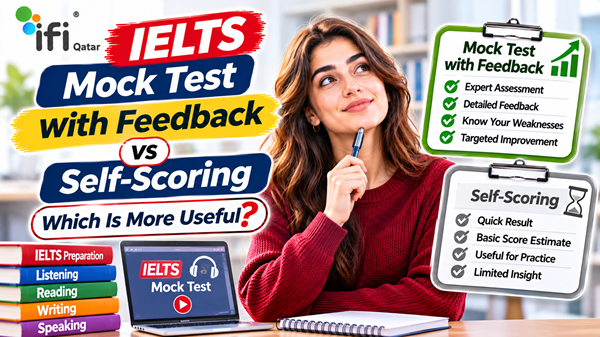
Taking an IELTS mock test is one of the most effective ways to understand your current preparation level before the official examination. However, completing a practice test is only part of the process. What happens after you finish it can make a significant difference to your progress.
Some candidates prefer to check their answers independently, calculate their estimated band score and move on to another practice test. Others choose an IELTS mock test with feedback, where their performance is assessed and they receive guidance on what they need to improve.
Both approaches have a place in IELTS preparation, but they do not provide the same level of insight.
Self-scoring can help you monitor your performance in Listening and Reading, where answers are generally objective. However, evaluating Writing and Speaking is more complicated. A candidate may understand the IELTS assessment criteria but still struggle to identify weaknesses in their own performance.
So, which option is more useful: an IELTS mock test with feedback or self-scoring?
In this guide, we compare both approaches, explain their advantages and limitations, and help you decide which type of IELTS mock test is worth choosing before your official exam.
What Is an IELTS Mock Test with Feedback?
An IELTS mock test with feedback is a practice examination in which your performance is assessed and you receive information about your strengths, weaknesses and areas that need improvement.
Unlike a basic practice test that only gives you an opportunity to answer questions, an assessed mock test focuses on understanding the quality of your performance.
Depending on the service, the assessment may cover:
- Listening performance
- Reading performance
- Writing Task 1 and Task 2
- Speaking performance
- Estimated band scores
- Common mistakes
- Areas requiring further practice
- Recommendations for improvement
The main purpose is to help you understand not only how many questions you answered correctly, but also why you may not be achieving your target IELTS band.
For example, imagine that you consistently receive an estimated Writing score of 6.0 in your practice exercises, even though your target is 7.0.
Simply knowing the score does not explain what is preventing you from reaching Band 7.
A useful assessment should help identify whether the problem is related to task response, coherence and cohesion, vocabulary, grammatical accuracy or another aspect of your writing.
This is the main value of receiving structured feedback.
What Is IELTS Self-Scoring?
IELTS self-scoring is a preparation method in which candidates complete practice questions and evaluate their own answers using answer keys, scoring guides or estimated band descriptors.
It is particularly common among candidates who use:
- IELTS preparation books
- Online practice tests
- Sample Listening and Reading tests
- Writing sample answers
- Speaking practice questions
- Band score conversion tables
For Listening and Reading, self-scoring can be relatively straightforward because the answers are generally based on specific correct responses.
For example, if you complete a Listening practice test and answer 30 out of 40 questions correctly, you can use an appropriate IELTS conversion guide to estimate your band score.
However, Writing and Speaking require a different approach.
These sections are assessed using performance criteria rather than a simple correct-or-incorrect answer key. Estimating your own performance can therefore be much more difficult.
You may recognise grammar mistakes, but that does not necessarily mean you can accurately assess your coherence, vocabulary range, task response or pronunciation.
IELTS Mock Test with Feedback vs Self-Scoring: Key Differences
Both methods can help you prepare for IELTS, but they serve different purposes.
Here is a direct comparison:
| Comparison Factor | Self-Scoring | Mock Test with Feedback |
|---|---|---|
| Listening assessment | Can be effective using answer keys | Can provide additional performance insights |
| Reading assessment | Can be effective using answer keys | Can identify patterns in incorrect answers |
| Writing assessment | Difficult to evaluate objectively | Provides an external assessment of writing performance |
| Speaking assessment | Difficult to assess independently | Provides an external evaluation of speaking performance |
| Score estimation | Depends on your interpretation and scoring method | Can provide an informed estimated assessment |
| Identifying weaknesses | Requires self-analysis | Can highlight specific areas for improvement |
| Learning from mistakes | Depends on your ability to diagnose errors | Feedback can explain areas requiring attention |
| Personalised recommendations | Usually limited | May include targeted improvement guidance |
| Best use | Regular independent practice | Performance evaluation and preparation decisions |
The biggest difference is that self-scoring depends on your ability to evaluate your own work, while an assessed mock test gives you an additional perspective on your performance.
Why Is an IELTS Mock Test with Feedback More Useful for Writing?
Writing is one of the sections where candidates can benefit significantly from external assessment.
Many IELTS candidates believe their writing is stronger than it actually is because they can understand their own ideas and follow the structure of an essay.
However, the IELTS Writing assessment involves four specific criteria.
1. Task Achievement and Task Response
For Writing Task 1, examiners assess how effectively you address the requirements of the task.
For Writing Task 2, the relevant criterion is Task Response.
This includes whether you:
- Address all parts of the question
- Present relevant ideas
- Develop your arguments
- Support your main points
- Provide an appropriate response to the task
A candidate may write a grammatically correct essay but still receive a lower score because the main question has not been fully addressed.
When scoring your own work, you may focus too heavily on grammar and vocabulary while overlooking weaknesses in the actual response.
2. Coherence and Cohesion
This criterion evaluates how logically your ideas are organised and connected.
You need to demonstrate that:
- Your ideas follow a clear structure.
- Paragraphs have logical purposes.
- Information is presented in a meaningful order.
- Linking expressions are used appropriately.
- The essay is easy to follow.
One common problem is using too many linking words without creating a genuinely logical connection between ideas.
A reader may understand your sentences individually but still find the overall argument difficult to follow.
External feedback can help you recognise these structural problems.
3. Lexical Resource
Lexical Resource evaluates your vocabulary use.
It considers factors such as:
- Vocabulary range
- Word choice
- Accuracy
- Collocations
- Appropriate use of less common vocabulary
- Ability to paraphrase
Using advanced vocabulary does not automatically result in a high IELTS Writing score.
If words are used incorrectly or unnaturally, they can weaken the quality of your writing.
A candidate who self-scores may recognise that they have used sophisticated vocabulary without noticing problems with meaning, collocation or appropriateness.
4. Grammatical Range and Accuracy
This criterion evaluates the range and accuracy of grammatical structures you use.
It includes:
- Sentence structure
- Complex grammatical forms
- Tense consistency
- Subject-verb agreement
- Articles and prepositions
- Punctuation
You may notice obvious grammatical mistakes in your own essay, but recurring problems can be harder to identify.
An external assessment can help reveal patterns that you repeatedly overlook.
Why feedback matters: A Writing mock test becomes more valuable when you understand which assessment criteria are limiting your performance and what changes are needed to improve them.
Why Is External Feedback Important for IELTS Speaking?
Speaking is another section where self-assessment has limitations.
You may feel confident while speaking English, but confidence alone does not determine your IELTS Speaking band score.
IELTS Speaking is assessed using four criteria:
- Fluency and Coherence
- Lexical Resource
- Grammatical Range and Accuracy
- Pronunciation
Fluency and Coherence
You need to communicate ideas naturally and maintain a logical flow.
Some candidates pause too frequently, repeat themselves or struggle to extend their answers.
Others speak quickly but do not develop their ideas clearly.
An external assessment can help identify these patterns.
Lexical Resource
Your vocabulary should be sufficiently varied and appropriate to the topic.
Simply using complicated words is not enough.
You need to demonstrate that you can choose vocabulary naturally and communicate your meaning accurately.
Grammatical Range and Accuracy
Speaking at length does not automatically demonstrate a strong grammatical range.
Your ability to use different sentence structures accurately is also important.
External feedback can help identify recurring grammatical problems that you may not notice during a conversation.
Pronunciation
Pronunciation is not simply about having a British, American or Australian accent.
The assessment focuses on how clearly and effectively you communicate through features such as:
- Individual sounds
- Word stress
- Sentence stress
- Rhythm
- Intonation
Many candidates find pronunciation particularly difficult to assess independently because they are accustomed to hearing their own voices.
A structured Speaking assessment can provide a more objective perspective.
Can You Accurately Self-Score IELTS Listening and Reading?
Yes. Self-scoring can be a useful method for evaluating Listening and Reading performance.
These sections have objective answers, which makes them more suitable for independent assessment.
Self-Scoring IELTS Listening
You can complete a Listening practice test, check your answers against the answer key and calculate your raw score out of 40.
For example:
| Correct Answers | General Performance |
|---|---|
| 30/40 | Can indicate performance around Band 7, depending on the test |
| 32/40 | Can indicate performance around Band 7.5, depending on the test |
| 35/40 | Can indicate performance around Band 8, depending on the test |
These are approximate examples, not guaranteed conversions. The exact raw-score conversion can vary between test versions.
Self-scoring helps you monitor your progress, but you should also analyse the reasons behind incorrect answers.
For example, are you losing marks because of:
- Spelling mistakes?
- Incorrect word limits?
- Distractors?
- Difficulty understanding accents?
- Missing specific details?
- Losing concentration?
Identifying the reason behind your mistakes is an important part of improving your Listening score.
Self-Scoring IELTS Reading
Reading is also suitable for self-scoring because answers can generally be checked against an answer key.
You can calculate the number of correct answers and estimate your band score using the appropriate Academic or General Training conversion information.
However, the score alone does not tell you which reading skills need improvement.
You should also examine whether you struggle with:
- True, False, Not Given questions
- Yes, No, Not Given questions
- Matching headings
- Matching information
- Multiple-choice questions
- Sentence completion
- Time management
A useful preparation routine combines self-scoring with a detailed review of incorrect answers.
Why Self-Scoring Can Give You a Misleading IELTS Band Estimate
One of the biggest risks of self-scoring is developing an inaccurate understanding of your current ability.
This can happen for several reasons.
1. You May Be Too Generous When Evaluating Your Writing
When you read your own essay, you already know what you intended to communicate.
This can make it difficult to recognise unclear arguments, weak explanations or problems with organisation.
You may understand the meaning of a sentence even when the sentence is not sufficiently clear to another reader.
2. You May Overestimate Your Speaking Performance
Many candidates judge their Speaking performance based on confidence and fluency.
However, speaking continuously does not necessarily mean that you are meeting the IELTS assessment criteria.
You may overlook repeated vocabulary, grammatical inaccuracies or pronunciation problems.
3. You May Focus on Your Strongest Skills
Candidates often prefer to practise the sections they find comfortable.
For example, a candidate with strong Listening and Reading skills may spend more time checking those scores because they are easier to calculate.
However, the actual limitation may be Writing or Speaking.
External assessment can help you recognise weaknesses that you might otherwise ignore.
4. You May Misinterpret IELTS Band Descriptors
IELTS band descriptors describe different levels of performance.
Understanding their wording is useful, but applying them accurately to your own performance is not always easy.
You might believe that using complex vocabulary is enough for Band 7, without considering accuracy, flexibility and appropriateness.
Similarly, writing a long essay does not automatically demonstrate strong task response or coherence.
5. You May Repeat the Same Mistakes
If you complete practice tests without understanding why you lose marks, you may continue making the same mistakes.
A score tells you the result of your performance.
Feedback helps explain what needs to change.
When Should You Choose an IELTS Mock Test with Feedback?
An assessed mock test is particularly useful when you need a clearer understanding of your performance before making important preparation decisions.
Consider choosing an IELTS mock test with feedback if:
You Have a Specific Target Band Score
If your target is Band 6.5, 7.0 or higher, you need to understand whether your current performance is close to the required level.
An assessed mock test can help identify the gap between your current performance and your target.
You Have Already Completed Several Practice Tests
If you have completed multiple practice tests but your scores are not improving, you may need more than additional questions.
An assessment can help identify why your performance has reached a plateau.
You Are Struggling with Writing or Speaking
If you are unsure why your Writing or Speaking scores remain below your target, external feedback can help identify the specific issues affecting your performance.
Your Official IELTS Exam Is Approaching
Taking an assessed mock test before your official exam can help you evaluate your readiness and decide which areas deserve attention during your remaining preparation time.
It can also help you identify whether you need more practice before confirming your exam date.
You Want to Avoid Unnecessary Retakes
An official IELTS examination requires time, money and preparation.
A mock test cannot guarantee your official result, but a realistic assessment before the exam can help you make a more informed decision about your readiness.
When Is Self-Scoring Enough?
Self-scoring is still a valuable part of IELTS preparation.
You do not need an externally assessed mock test every time you practise.
It can be particularly useful when:
- You are practising Listening question types.
- You are improving Reading speed.
- You are learning how to manage time.
- You are reviewing vocabulary and spelling.
- You are completing regular practice exercises.
- You want to monitor your raw scores over time.
For many candidates, the most effective approach is to combine both methods.
Use self-scoring for regular practice, and choose an assessed mock test at important stages of your preparation to evaluate your performance more objectively.
Which IELTS Mock Test Should You Choose?
The right option depends on what you want to achieve.
| Your Preparation Situation | Recommended Option |
|---|---|
| You want to practise individual Listening questions | Self-scoring practice |
| You want to improve Reading speed | Self-scoring practice |
| You want to understand your Writing weaknesses | Assessed Writing mock test |
| You want an external evaluation of Speaking | Assessed Speaking mock test |
| You have completed several tests without improvement | Full mock test with feedback |
| Your official IELTS exam is approaching | Realistic assessed mock test |
| You want a clearer picture of your overall readiness | Full IELTS mock test with assessment |
If your main concern is improving your Writing or Speaking band, an assessed mock test is generally more useful than relying entirely on your own judgement.
If you are practising objective Listening and Reading questions, self-scoring remains a practical and effective option.
The strongest preparation strategy uses each method for the purpose it serves best.
What Should a Good IELTS Mock Test with Feedback Include?
Not all mock tests offer the same level of assessment.
Before choosing an assessed mock test, check what is actually included.
A useful service should make it clear what you receive after completing the test.
1. A Realistic IELTS Test Experience
The mock test should reflect the structure and demands of the relevant IELTS examination.
This allows you to practise managing time, following instructions and maintaining concentration.
2. Assessment of the Relevant IELTS Skills
Find out which components are included in the assessment.
A Listening and Reading test with answer checking is different from an assessed Writing and Speaking mock test.
If your objective is to understand your performance across all four skills, confirm whether all four are covered.
3. Clear Score Information
A useful assessment should explain your performance and distinguish between objective scores and estimated assessments.
Listening and Reading scores can be calculated using correct answers.
Writing and Speaking assessments should be interpreted as estimates rather than guaranteed predictions of your official IELTS result.
4. Specific Feedback on Weaknesses
General comments such as “improve your grammar” or “practise more vocabulary” are not particularly useful.
Look for feedback that identifies the areas requiring attention.
For example:
- Your essay does not fully address all parts of the question.
- Your paragraphs need clearer development.
- You rely on repetitive vocabulary.
- Your Speaking answers contain frequent hesitation.
- Your pronunciation makes some words difficult to understand.
Specific feedback gives you a clearer direction for your next preparation stage.
5. Practical Recommendations
The assessment should help you decide what to do next.
You should be able to identify which skills deserve priority and what type of practice may help you address your weaknesses.
IELTS Mock Test with Feedback at IFI Qatar
If you are preparing for IELTS in Qatar and want more than a basic practice score, an assessed mock test can help you evaluate your preparation more effectively.
At IFI Qatar, candidates can enquire about IELTS mock test options designed to help them practise and understand their performance before taking the official examination.
The value of choosing an assessed mock test is that you can use the results to make better decisions about your preparation.
Rather than relying entirely on your own estimate, you can seek a clearer understanding of the areas that need further attention.
Who Can Benefit from an Assessed Mock Test?
An assessed IELTS mock test may be particularly useful for:
- Candidates targeting Band 6.5 or higher.
- Students preparing for university admission.
- Candidates who need to meet specific English language requirements.
- Test takers who struggle with Writing or Speaking.
- Candidates who have completed several practice tests without clear progress.
- People who want to evaluate their readiness before booking the official exam.
What Should You Check Before Booking?
Before booking your mock test, confirm the following details with the IFI Qatar team:
- Which IELTS test type is available: Academic or General Training.
- Which sections are included.
- Whether Writing and Speaking are assessed.
- Whether detailed feedback is provided.
- How and when the assessment results are delivered.
- The applicable test and assessment fees.
This helps you choose the option that matches your preparation needs.
Why Choose Assessment Instead of Just Another Practice Test?
Completing another practice test may tell you whether your score has changed.
An assessed mock test can help you understand why it has changed, where you are losing marks and which areas require more attention.
If you are serious about reaching your target band, understanding your performance is an important part of preparation.
Book Your IELTS Mock Test with Feedback at IFI Qatar
If you have been practising IELTS independently but still feel uncertain about your actual performance, it may be time to get an external assessment.
Self-scoring is useful for regular Listening and Reading practice. However, evaluating Writing and Speaking objectively can be much more challenging.
An IELTS mock test with feedback gives you an opportunity to move beyond estimated scores and gain a clearer understanding of your strengths and weaknesses.
At IFI Qatar, you can enquire about available assessed mock test options, the skills covered, feedback arrangements and applicable fees.
Ready to understand your IELTS performance more clearly? Contact IFI Qatar today to enquire about an assessed IELTS mock test and take the next step towards your target band score.