

Currently Empty: ر.ق 0,00


IELTS
IELTS Mock Exam Checklist: How to Prepare Before Exam Day
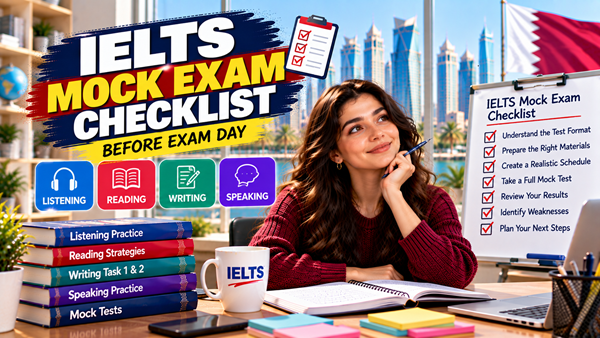
Preparing for IELTS involves more than completing practice questions and memorising vocabulary. You also need to know how well you perform under timed conditions, whether you can manage all four skills and which weaknesses still need attention before the official exam.
An IELTS mock exam checklist helps you organise this process. It gives you a practical way to prepare for a mock test, check that your practice reflects the real IELTS format, and review your performance afterwards.
Whether you are taking IELTS for the first time or aiming to improve a previous score, a mock exam can help you make more informed decisions about your remaining preparation.
This guide covers everything to check before, during and after an IELTS mock test, including the four test sections, timing, study materials, performance review and how to choose a suitable mock test in Qatar.
Why Should You Use an IELTS Mock Exam Checklist?
A mock test is most useful when you approach it with a clear purpose. Simply completing questions and checking the answers may not reveal why you lose marks or what you should do differently next time.
A structured checklist helps you:
- Confirm that your mock test matches your intended IELTS test type.
- Prepare the right materials and testing environment.
- Practise under realistic time constraints.
- Identify weaknesses across Listening, Reading, Writing and Speaking.
- Review recurring mistakes instead of repeating them.
- Decide whether you need further practice or instructor feedback.
- Assess your readiness before booking or taking the official exam.
A mock test is a preparation tool, not an official IELTS examination. Its results can help you identify areas for improvement, but they do not guarantee the band score you will receive in the real test.
IELTS Mock Exam Checklist Before You Start
Before beginning a full mock test, make sure you know what you are practising, why you are practising it and how you will evaluate the results.
Confirm Your IELTS Test Type
First, check whether you need IELTS Academic or IELTS General Training.
Both test types assess Listening, Reading, Writing and Speaking. However, the Reading and Writing components differ.
For IELTS Academic, Writing Task 1 involves describing, summarising or explaining visual information. For IELTS General Training, Writing Task 1 involves writing a letter. Writing Task 2 is an essay in both versions.
Use a mock test that matches the test you intend to take. Otherwise, your practice may not reflect the tasks you will face in the official exam.
Checklist:
-
I know whether I need IELTS Academic or General Training.
-
My Reading practice matches my intended test type.
-
My Writing practice matches my intended test type.
-
I know the target overall band score and any required minimum score for individual skills.
Check That Your Mock Test Covers the Right Skills
If you want to assess your overall readiness, choose a full mock test that covers all four skills.
| IELTS Skill | What to Check |
|---|---|
| Listening | Question types, audio instructions, answer limits and accuracy |
| Reading | Passage comprehension, question types, timing and answer accuracy |
| Writing | Task completion, organisation, vocabulary and grammar |
| Speaking | Fluency, coherence, vocabulary, grammar and pronunciation |
A short online quiz may be useful for practising a particular question type, but it cannot provide the same overview as a full four-skill assessment.
Checklist:
-
Listening is included.
-
Reading is included.
-
Writing is included.
-
Speaking is included.
-
The test uses IELTS-style tasks and appropriate timing.
-
I understand how my performance will be reviewed.
Set a Clear Goal for Your Mock Exam
Decide what you want to learn from the test before you begin.
Your goal might be to assess your current level, identify the weakest skill, improve time management or check whether your recent preparation is producing progress.
Write down your target band score and any minimum requirements set by the university, employer or other organisation requesting your results.
For example, a candidate who needs a minimum score in every skill should review individual skill performance carefully rather than focusing only on the overall result.
Checklist:
-
I know my target overall band.
-
I know any minimum individual skill requirements.
-
I have identified my main concerns.
-
I will record my results and use them to plan further practice.
IELTS Mock Test Preparation Checklist: Materials and Environment
Your testing environment can affect concentration and time management. Prepare it before the mock exam so that you can focus on the questions rather than solving avoidable problems.
Prepare Your Study Space
Choose a quiet place where you can work without unnecessary interruptions. If possible, complete the test in one sitting and avoid checking messages or switching between unrelated tasks.
For computer-based practice, make sure your computer, keyboard, mouse, headphones and internet connection are working properly. Use headphones only when appropriate for your practice setup.
If you are practising for a computer-delivered IELTS test, complete your mock test on a computer rather than relying exclusively on paper-based exercises. This helps you become familiar with reading on a screen, typing responses and navigating digital tasks.
Checklist:
-
My study space is quiet and comfortable.
-
My computer and required equipment work correctly.
-
I have a reliable internet connection if the test is online.
-
I have disabled unnecessary notifications.
-
I have a timer or a test platform with appropriate timing.
-
I have enough uninterrupted time to complete the planned test.
Use Reliable IELTS Practice Materials
Choose practice materials that reflect the IELTS test format. Official IELTS sample questions are a useful starting point for understanding the task types and instructions.
Check whether your mock test includes explanations, answer keys, performance summaries or feedback. These features can help you understand mistakes after completing the test.
Do not assume that every online quiz produces a reliable IELTS band estimate. A score from a short or unofficial practice test should not be treated as an official result.
Checklist:
-
I am using appropriate IELTS-style practice materials.
-
I have read the instructions before starting.
-
I know whether the test provides an answer key or feedback.
-
I understand the limitations of any estimated band score.
IELTS Listening Mock Test Checklist
The Listening section assesses your ability to understand spoken English in different situations. It requires concentration, attention to detail and the ability to recognise relevant information as you listen.
The standard IELTS Listening test contains four parts and 40 questions, with approximately 30 minutes of listening time. Exact arrangements can vary by delivery format.
Before the Listening Test
Read the instructions carefully and understand the type of information required in each question. If the instructions specify a word limit, follow it exactly.
For example, a question asking for no more than two words and/or a number will not accept an answer that exceeds the stated limit.
Checklist:
-
I understand the instructions and word limits.
-
I can read the questions before the relevant audio begins, where the format allows.
-
My audio equipment works correctly.
-
I am ready to listen without pausing or replaying the recording unless the practice format specifically allows it.
During the Listening Test
Focus on the meaning of the recording rather than waiting for the exact words in the question. Speakers may use paraphrases, synonyms or corrections that change the information initially mentioned.
If you miss an answer, move on to the next question instead of allowing one mistake to affect the rest of the section.
Pay attention to spelling, numbers, singular and plural forms, and the relationship between the question and the information you hear.
After the Listening Test
Review every incorrect answer and classify the reason for the mistake.
Was the problem unfamiliar vocabulary, missed information, spelling, a misleading distractor or a failure to follow the instructions?
Listening review checklist:
-
I checked all answers.
-
I identified my most frequent mistake types.
-
I reviewed unfamiliar words and paraphrases.
-
I noted whether concentration or timing affected my performance.
-
I selected a specific Listening skill to practise next.
IELTS Reading Mock Test Checklist
Reading performance depends on comprehension, vocabulary, locating relevant information and managing the available time.
The IELTS Reading section lasts 60 minutes and contains 40 questions. Academic and General Training candidates complete different Reading materials, so ensure that your practice matches your test type.
Before the Reading Test
Familiarise yourself with common question types, including multiple choice, matching headings, sentence completion and True/False/Not Given.
Remember that True, False and Not Given have different meanings. An answer should be based on the passage, not on assumptions or personal knowledge.
Checklist:
-
I am using the correct Reading test type.
-
I understand the instructions for each question type.
-
I know how to skim for the main idea and scan for specific information.
-
I am prepared to manage my time across the section.
During the Reading Test
Avoid reading every passage word by word before looking at the questions. Depending on the task, it may be more efficient to identify the main idea first and then locate the relevant evidence.
Do not spend too long on one difficult question. Make a reasoned choice when necessary and continue working through the section.
For questions involving headings or statements, make sure your answer is supported by the text.
After the Reading Test
Review incorrect answers by returning to the relevant passage and identifying the evidence.
Determine whether the problem was vocabulary, misunderstanding the question, overlooking a detail or running out of time.
Reading review checklist:
-
I checked my answers against the key.
-
I found textual evidence for incorrect answers.
-
I recorded question types that caused repeated problems.
-
I reviewed unfamiliar vocabulary in context.
-
I identified where I lost time.
-
I have a plan for improving my weakest question types.
IELTS Writing Mock Test Checklist
Writing often benefits from careful review and specific feedback. Completing an essay is only one part of the process; you also need to check whether your response answers the question, communicates ideas clearly and uses language accurately.
The IELTS Writing section lasts 60 minutes and includes two tasks. Task 2 contributes twice as much as Task 1 to the Writing score, so time management is important.
Before the Writing Test
Confirm whether you need Academic or General Training Writing.
Academic candidates should practise describing visual information in Task 1. General Training candidates should practise writing a letter appropriate to the purpose and intended reader. Both versions include an essay in Task 2.
Checklist:
-
I know which Task 1 format applies to my test.
-
I understand the question requirements.
-
I can plan a response before writing.
-
I know how to divide the available time between the two tasks.
During the Writing Test
Read the prompt carefully before writing. Identify every part of the question and decide how you will address it.
For Task 2, organise your ideas into clear paragraphs and support your main points with explanations or relevant examples. Avoid memorising an essay and trying to force it into an unrelated question.
For Task 1, make sure your response fulfils the task. Academic candidates should select and compare the main features of the visual information. General Training candidates should cover the required points in the letter and use an appropriate tone.
Leave time to review your work for grammar, spelling, punctuation and unclear sentences.
After the Writing Test
Use the official IELTS Writing assessment criteria to guide your review:
- Task Achievement or Task Response.
- Coherence and Cohesion.
- Lexical Resource.
- Grammatical Range and Accuracy.
A simple grammar checker may help you notice some errors, but it cannot reliably assess every aspect of IELTS Writing performance or provide a guaranteed band score.
If possible, ask a qualified IELTS instructor to review your responses and explain the changes that would make them clearer and more effective.
Writing review checklist:
-
I answered every part of the question.
-
My ideas are organised into clear paragraphs.
-
My examples and explanations support the main points.
-
I used vocabulary accurately and appropriately.
-
I checked grammar, spelling and punctuation.
-
I identified specific improvements for my next response.
-
I have considered getting qualified feedback.
IELTS Speaking Mock Test Checklist
The Speaking test assesses your ability to communicate in spoken English. It consists of three parts and lasts approximately 11–14 minutes.
A useful Speaking mock should give you an opportunity to answer questions spontaneously, develop ideas and practise speaking for an extended period.
Before the Speaking Test
Prepare a quiet space and, if possible, practise with a teacher or partner who can follow the test format.
If you are practising alone, record your responses so that you can review them afterwards. Avoid writing complete answers and memorising them word for word.
Checklist:
-
I understand the structure of Speaking Parts 1, 2 and 3.
-
I have a timer or recording device if needed.
-
I am ready to answer unfamiliar follow-up questions.
-
I will focus on communicating naturally rather than memorising scripts.
During the Speaking Test
In Part 1, answer familiar questions directly and add relevant detail when appropriate.
In Part 2, use the one-minute preparation period to organise your ideas into short notes. Practise speaking for up to two minutes without relying on a written script.
In Part 3, explain opinions, compare ideas and support your reasoning with relevant examples.
Focus on communicating clearly. Speaking quickly does not automatically mean speaking fluently, and using complicated vocabulary is not helpful if it makes your meaning less accurate.
After the Speaking Test
Review your recording or ask for feedback using the four assessment criteria:
- Fluency and Coherence.
- Lexical Resource.
- Grammatical Range and Accuracy.
- Pronunciation.
Notice recurring issues, such as long pauses, repeated vocabulary, unclear sounds or answers that lack development.
Speaking review checklist:
-
I practised all three parts.
-
I answered questions directly.
-
I developed ideas with relevant details and examples.
-
I identified pauses, repetitions or unclear pronunciation.
-
I reviewed grammar and vocabulary.
-
I know which speaking habits I need to improve.
-
I have considered getting feedback from an instructor.
What to Check After Completing Your IELTS Mock Exam
Your mock test is not complete from a learning perspective until you have reviewed the results and decided what to do next.
Record Your Performance in All Four Skills
Create a simple performance record after every full mock test.
| Skill | Result or Observation | Next Action |
|---|---|---|
| Listening | Record your correct answers or available assessment | Review missed details and paraphrases |
| Reading | Record your correct answers or available assessment | Practise weak question types and timing |
| Writing | Record feedback or assessment where available | Work on task completion, organisation and language |
| Speaking | Record feedback or assessment where available | Practise the specific criteria needing improvement |
For Listening and Reading, the number of correct answers can be useful for understanding your performance. For Writing and Speaking, meaningful feedback is particularly important because these skills are assessed against multiple criteria.
Do not treat a practice score as an official IELTS result.
Identify Your Three Biggest Weaknesses
Instead of trying to improve everything at once, select the three problems that have the greatest effect on your performance.
For example, you might discover that you understand Listening recordings well but regularly miss answers because of spelling errors. In that case, focused spelling and answer-checking practice may be more useful than repeating entire tests without a specific goal.
Your weaknesses may be different in each skill. Make your improvement plan specific to the evidence from your mock test.
Decide Whether You Need More Practice or Instructor Feedback
Self-study can be effective when you can identify your mistakes and consistently correct them.
However, if your Writing or Speaking performance remains unclear, feedback from a qualified IELTS instructor can help you understand which assessment criteria need attention.
Consider a structured mock test if you want to practise all four skills, work under realistic conditions and receive a clearer picture of your preparation needs.
How to Choose an IELTS Mock Test in Qatar
Not every practice test offers the same level of coverage or feedback. Before booking, check whether the mock test meets your specific preparation needs.
Questions to Ask Before Booking
Use this checklist when comparing mock-test options:
-
Does the mock test cover all four IELTS skills?
-
Is it suitable for my intended test type?
-
Does it use realistic IELTS-style tasks and timing?
-
Is Speaking included as an actual practice session?
-
Will my Writing responses be assessed?
-
Is feedback available, and what does it cover?
-
Will I receive results or useful performance observations?
-
Can I use the results to plan further preparation?
-
Are the booking instructions, session time and price clear?
The answers will help you distinguish between a short practice activity and a structured assessment designed to evaluate your readiness.
IELTS Mock Tests at IFI Qatar
If you are preparing for IELTS in Doha or elsewhere in Qatar, IFI Qatar provides mock-test options designed to help candidates practise the IELTS format and assess their readiness.
Before booking, review the available test type, included skills, session arrangements, assessment and feedback options. Confirm the current details with IFI so that the selected mock test matches your needs.
A full mock test can be especially useful if you are approaching your official test date, have a specific target band or are unsure which areas require further preparation.
Your next step: Review the available IELTS mock-test options at IFI Qatar and choose a session that fits your preparation goals.
IELTS Mock Exam Checklist: Final Review
Use the following checklist to make sure you have covered the main steps before and after your mock exam.
Before the Mock Test
-
I have confirmed Academic or General Training.
-
I know my target band and any individual skill requirements.
-
My practice covers the skills I want to assess.
-
I have selected appropriate IELTS-style materials.
-
My equipment and study environment are ready.
-
I understand the timing and instructions.
-
I have decided how I will review my performance.
During the Mock Test
-
I follow the instructions and word limits.
-
I manage time without spending too long on one question.
-
I attempt the tasks under realistic conditions.
-
I remain focused and avoid unnecessary interruptions.
-
I complete each section as planned.
After the Mock Test
-
I have checked my Listening and Reading answers.
-
I have reviewed my Writing and Speaking performance.
-
I have recorded recurring mistakes.
-
I have identified my highest-priority weaknesses.
-
I have created a plan for further practice.
-
I know whether additional feedback or another mock test would be useful.
If you cannot check several of these items, do not assume that your preparation has failed. Use the gaps to decide what to practise next.
Frequently Asked Questions About the IELTS Mock Exam Checklist
When should I take an IELTS mock test before the real exam?
Take a baseline mock test early enough to identify weaknesses and leave time to address them. Consider another full mock after targeted practice, particularly as your official exam date approaches. The right schedule depends on your current level and preparation time.
Should an IELTS mock test include all four skills?
If your goal is to assess overall readiness, a full mock test should cover Listening, Reading, Writing and Speaking. Individual skill tests are also useful when you need to focus on a specific weakness.
How long does a full IELTS mock test take?
A full mock test should reflect the structure and timing of the test it is designed to simulate. The Listening, Reading and Writing components together take approximately 2 hours and 40 minutes in the standard IELTS format. Speaking lasts approximately 11–14 minutes and may be arranged separately. Check the mock-test provider’s exact session format.
Can an IELTS mock test predict my official band score?
A mock test can provide useful evidence about your current performance, but it cannot guarantee your official IELTS score. The accuracy of an estimate depends on the quality of the test and assessment, particularly for Writing and Speaking.
Is a free online IELTS mock test enough?
Free online practice can help you understand question types and practise individual skills. However, a free quiz may not assess all four skills or provide meaningful feedback. If you need a broader assessment, look for a structured mock test with appropriate timing and clear feedback arrangements.
Should I book a mock test if I have already completed many practice questions?
Yes, it may be useful if you have not yet completed a realistic full test or reviewed your performance systematically. A mock test can reveal problems with timing, concentration and consistency that may not appear during short practice exercises.
Where can I book an IELTS mock test in Qatar?
You can review the mock-test options offered by IFI Qatar, check which skills are included and confirm the current booking arrangements. Choose an option that matches your test type and preparation goals.
Book Your IELTS Mock Test with IFI Qatar
Preparing for IELTS is more effective when you understand what you can already do well and which skills still need improvement.
Use this IELTS mock exam checklist to prepare carefully, practise under realistic conditions and review your performance with a clear purpose. If you need a more structured assessment, an IELTS mock test can help you identify your next steps before the official examination.
Ready to assess your IELTS readiness? Explore the available IELTS mock-test options at IFI Qatar, confirm the session details and book a test that suits your preparation needs.
Take the mock test. Understand your performance. Prepare for your next step with confidence.