

Currently Empty: ر.ق 0,00


IELTS
How Many Days Before Your IELTS Exam Should You Take a Final Mock Test?
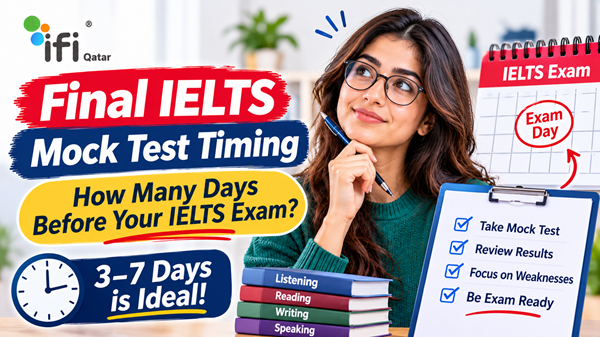
As your IELTS exam date approaches, you may start wondering whether you are fully prepared. You have practised Listening, Reading, Writing and Speaking, reviewed your mistakes, and worked towards your target band score. But how can you tell whether you are ready to perform under actual exam conditions?
One of the most useful ways to check your preparation is to take a final IELTS mock test.
However, timing matters. Take it too early, and you may not get an accurate picture of your current readiness. Leave it until the day before your exam, and you may have too little time to review your performance or address any problems you discover.
So, how many days before your IELTS exam should you take your final mock test?
For many candidates, taking the final full mock test around 3–7 days before the official exam provides a useful balance. It gives you time to assess your performance, review your mistakes and make small adjustments without leaving the test simulation until the last moment.
The ideal timing still depends on your current level, preparation history and the results of your previous practice tests.
In this guide, you will learn when to schedule your final IELTS mock test, what to do after completing it, and how to use the remaining days effectively before exam day.
When Should You Take Your Final IELTS Mock Test?
A practical recommendation is to schedule your final full IELTS mock test approximately 3–7 days before your official exam.
This is not an official IELTS requirement. It is a preparation strategy that gives you enough time to evaluate your readiness and make final adjustments.
The right timing depends on how consistently you have been performing.
Why 3–7 Days Before the Exam Can Be Effective
Taking your final mock test within this period can help you:
- Evaluate your current performance across all four skills.
- Check whether you can complete the test within the time limits.
- Identify any remaining weaknesses.
- Practise maintaining concentration throughout the examination.
- Review your performance before the official test.
- Avoid making major changes to your preparation at the last minute.
For example, if your final mock test reveals that you are consistently running out of time in Reading, you still have a few days to review your time-management strategy.
If your Writing performance is below your target, you can review your task organisation, grammar and vocabulary rather than entering the examination without understanding the problem.
Is One Week Before IELTS Too Early?
No. Taking a final mock test seven days before IELTS can be useful, particularly if you want enough time to review your results and make targeted improvements.
It may be a better option for candidates who:
- Have struggled with one or more skills.
- Need time to review Writing or Speaking feedback.
- Have not completed a full mock test recently.
- Want to make small changes to their exam strategy.
- Feel uncertain about their readiness.
If your performance is already consistent, a mock test closer to the exam may also be appropriate.
Is One Day Before IELTS Too Late?
For most candidates, taking a complete mock test just one day before the official exam is not the best strategy.
A full IELTS simulation requires concentration and can be tiring. If you discover a significant weakness, you may not have enough time to address it properly.
You may also create unnecessary stress by focusing on a disappointing practice result immediately before the examination.
The day before IELTS is generally better used for light revision, checking your test arrangements and getting enough rest.
Final IELTS Mock Test Timing: A Practical Schedule
The following schedule can help you organise your preparation during the final week.
| Time Before IELTS | Recommended Activity | Main Purpose |
|---|---|---|
| 7 days | Complete a full mock test if you need more review time | Assess overall readiness |
| 5–6 days | Review your mock results and identify weaknesses | Understand what needs attention |
| 3–4 days | Complete targeted practice | Improve specific problem areas |
| 2 days | Review strategies and practise selected questions | Maintain familiarity without overloading yourself |
| 1 day | Light revision and test-day preparation | Stay relaxed and organised |
| Exam day | Follow your planned routine | Focus on performance |
This is a flexible preparation schedule rather than a fixed rule. If you have already completed a recent full mock test and your results are consistent, you may not need another one during the final week.
The objective is to use your final mock test to make an informed decision about your readiness, not simply to complete another practice examination.
Should You Take One Final Mock Test or Several Before IELTS?
Taking more mock tests does not automatically lead to better results.
What matters is how you use each test.
If you complete several full mock tests without reviewing your mistakes, you may repeat the same problems without making meaningful progress.
A more effective approach is:
Mock Test → Results Review → Targeted Practice → Final Mock Test
For example:
- Take a full mock test to establish your current performance.
- Review the results and identify your weakest skill.
- Spend time practising the specific question types or tasks causing difficulty.
- Complete another mock test when appropriate to evaluate your progress.
When One Final Mock Test May Be Enough
One final full mock test may be sufficient if:
- You have already completed several mock tests.
- Your scores have been relatively consistent.
- You understand your main weaknesses.
- You can complete the sections within the time limits.
- You have received feedback on your Writing and Speaking.
- You feel comfortable with the examination format.
In this situation, another full test may provide limited additional value. Your remaining preparation time may be better spent reviewing specific mistakes.
When You May Need More Than One Mock Test
Additional mock tests may be useful if:
- You have not completed a full test under timed conditions.
- Your practice results vary significantly.
- You struggle to finish one or more sections.
- You are unfamiliar with the computer-based test format.
- You have not assessed your Writing or Speaking performance.
- You need to measure whether recent preparation has improved your performance.
However, avoid scheduling full mock tests too close together if you have no time to analyse the results between them.
What Should You Check During Your Final IELTS Mock Test?
Your final mock test should do more than give you a practice score. It should help you understand how you perform when the examination is treated as a complete task.
Ideally, the simulation should cover Listening, Reading, Writing and Speaking.
1. IELTS Listening: Accuracy and Concentration
During the Listening test, check whether you can:
- Follow the recordings without losing concentration.
- Identify key information.
- Recognise paraphrasing.
- Avoid common distractors.
- Follow word-limit instructions.
- Check spelling and grammatical accuracy.
A candidate may understand most of a recording but still lose marks through spelling mistakes or incorrect word forms.
Your final mock test can help reveal whether these problems are still affecting your performance.
2. IELTS Reading: Time Management
Reading performance depends on both comprehension and effective time management.
Use your final mock test to check whether you can:
- Complete all three passages within the available time.
- Locate relevant information efficiently.
- Understand paraphrased statements.
- Distinguish between True, False and Not Given.
- Handle unfamiliar vocabulary without losing too much time.
- Avoid spending too long on difficult questions.
If you regularly leave questions unanswered because you run out of time, you should review your approach to allocating time across the passages.
3. IELTS Writing: Task Response and Organisation
Writing deserves particular attention because a candidate may understand English well but still struggle to organise ideas within the time limit.
For IELTS Writing, review whether you can:
- Understand the requirements of each task.
- Address all parts of the question.
- Organise ideas into logical paragraphs.
- Use appropriate vocabulary.
- Demonstrate grammatical range and accuracy.
- Complete both tasks within the available time.
For Academic Writing Task 1, check whether you can identify and summarise the main features.
For Task 2, review your position, idea development, paragraph structure and supporting examples.
A final Writing assessment can be particularly valuable because it helps you understand whether your written response meets the relevant assessment criteria.
4. IELTS Speaking: Fluency and Confidence
Your Speaking mock test should help you evaluate how naturally you communicate under examination conditions.
Check whether you can:
- Answer questions without excessive hesitation.
- Develop your responses with relevant details.
- Speak at a natural pace.
- Use a range of vocabulary.
- Maintain grammatical accuracy.
- Respond to follow-up questions.
- Organise your ideas during the long-turn task.
Do not focus only on speaking quickly. Clear communication, relevant answers and natural delivery are more important than trying to produce long responses without a clear purpose.
What Should You Do After Your Final IELTS Mock Test?
The period after your final mock test is just as important as the test itself.
Avoid looking only at your overall band score. Review each skill separately and identify what the results tell you about your preparation.
Step 1: Review Your Results by Skill
Create a simple summary of your performance.
For example:
| Skill | Mock Test Result | Area to Review |
|---|---|---|
| Listening | 7.0 | Spelling and word forms |
| Reading | 6.5 | Time management |
| Writing | 6.0 | Task development and organisation |
| Speaking | 7.0 | Fluency and grammatical accuracy |
This is an illustrative example, not a prediction of an official IELTS result.
Looking at each skill separately helps you avoid overlooking a weakness hidden by your overall score.
Step 2: Identify Repeated Mistakes
Look for patterns rather than focusing on individual errors.
Examples include:
- Missing answers in Listening because of distractors.
- Confusing similar information in Reading.
- Writing an unclear overview in Task 1.
- Not developing arguments sufficiently in Task 2.
- Giving short or repetitive answers in Speaking.
Repeated mistakes are usually more useful to review than isolated errors.
Step 3: Prioritise the Most Important Improvements
With only a few days remaining, you should avoid trying to improve everything at once.
Focus on issues that are both important and realistic to address.
For example:
| Problem | Final Preparation Focus |
|---|---|
| Reading takes too long | Practise locating information and managing time |
| Listening spelling errors | Review spelling, plurals and word forms |
| Writing Task 2 lacks development | Practise planning and supporting main ideas |
| Speaking answers are too short | Practise extending answers naturally |
| Frequent grammar errors | Review recurring sentence-level mistakes |
Your preparation should be based on evidence from your performance, not on a last-minute attempt to study every IELTS topic.
Step 4: Avoid Major Strategy Changes
The final few days are generally not the best time to completely change your approach.
If a strategy has worked consistently during preparation, continue using it.
For example, avoid suddenly adopting a completely different Reading method or memorising large collections of Writing phrases immediately before the exam.
Focus on applying familiar techniques accurately.
Step 5: Review Your Feedback
If you received professional feedback on your mock test, use it to understand your priorities.
Pay particular attention to comments about:
- Task Achievement or Task Response
- Coherence and Cohesion
- Lexical Resource
- Grammatical Range and Accuracy
- Speaking fluency
- Pronunciation
Feedback can help you understand not only which answers were incorrect, but also why your performance may be falling short of your target.
Should You Book a Final IELTS Mock Test with Feedback?
If you are approaching your IELTS exam and have not received a detailed assessment of your performance, a mock test with feedback may be worth considering.
A score alone does not always explain what you need to improve.
For example, knowing that your Writing performance is below your target does not tell you whether the main problem is task response, paragraph organisation, vocabulary or grammar.
A structured assessment can provide more useful information.
Before booking, check whether the service includes:
- Assessment of all four IELTS skills.
- Realistic test timing.
- IELTS-style questions.
- Writing evaluation.
- Speaking assessment.
- Section-level results.
- Actionable feedback.
- An explanation of areas requiring improvement.
If your official exam is approaching, make sure the mock test is scheduled early enough for you to review the results and use the feedback.
When Should You Avoid Taking Another Full IELTS Mock Test?
Sometimes the best preparation decision is not to take another complete mock test.
Consider avoiding an additional full simulation if:
You Have Already Taken a Recent Mock Test
If you have completed a realistic full mock test recently and your performance is consistent, another test may not reveal much new information.
You Have No Time to Review the Results
Taking a mock test without analysing your mistakes reduces its preparation value.
If you have only a short period remaining, targeted practice may be more useful than another complete examination.
You Are Already Feeling Exhausted
Repeated full tests can become tiring.
If you are struggling with concentration because of excessive practice, consider reducing your workload and focusing on rest and light revision.
You Are Changing Strategies Too Frequently
If every mock test leads you to adopt a completely different approach, you may be creating confusion rather than improving consistency.
Use the final stage of preparation to strengthen techniques you already understand.
Is a Final IELTS Mock Test Necessary Before the Exam?
No. IELTS does not require candidates to take a mock test before sitting the official examination.
A mock test is a preparation tool, not an admission requirement.
However, it can be useful if you want to:
- Check your current performance.
- Practise completing the test under timed conditions.
- Identify weaknesses before the official exam.
- Become more familiar with the test format.
- Review your Writing and Speaking performance.
- Build confidence through realistic practice.
Whether you need a final mock test depends on your preparation history and how confident you are in your current performance.
Final IELTS Mock Test vs Regular Practice
A full mock test and regular IELTS practice serve different purposes.
| Regular IELTS Practice | Final IELTS Mock Test |
|---|---|
| Focuses on developing individual skills | Evaluates overall readiness |
| Can target specific question types | Simulates the complete examination |
| Often allows flexible timing | Uses realistic time limits |
| Mistakes can be reviewed immediately | Performance is reviewed after completion |
| May focus on one skill | Ideally covers all four skills |
| Supports learning and improvement | Helps assess readiness before test day |
Both are important, but their roles change as the exam approaches.
During the earlier stages of preparation, you may spend more time developing individual skills.
In the final week, you should focus on checking readiness, reviewing recurring mistakes and maintaining consistent performance.
Your Final IELTS Preparation Checklist
Before the official exam, use this checklist to review your preparation.
3–7 Days Before IELTS
- Complete your final full mock test if needed.
- Review your performance in all four skills.
- Identify any remaining weaknesses.
- Check your time-management strategy.
- Review Writing and Speaking feedback.
- Practise specific areas that need attention.
2 Days Before IELTS
- Review important strategies.
- Practise selected questions without overloading yourself.
- Check your test date and location.
- Confirm your required identification document.
- Review the test-day instructions.
1 Day Before IELTS
- Avoid a demanding full mock test.
- Do light revision if necessary.
- Prepare your identification document.
- Check your travel arrangements.
- Get sufficient sleep.
- Avoid making major changes to your preparation strategy.
On Exam Day
- Arrive according to the test centre’s instructions.
- Bring the required identification document.
- Follow the instructions carefully.
- Manage your time.
- Stay focused on each section.
- Do not let one difficult question affect the rest of your performance.
Frequently Asked Questions About Final IELTS Mock Test Timing
How many days before IELTS should I take my final mock test?
For many candidates, taking a final full mock test around 3–7 days before the official exam is a practical approach. It provides time to review the results and make final adjustments. The ideal timing depends on your preparation and performance.
Is it good to take an IELTS mock test one day before the exam?
For most candidates, a full mock test one day before IELTS is not ideal. It may cause unnecessary fatigue and leave too little time to review any problems. Light revision and test-day preparation are generally more suitable.
Should I take a mock test one week before IELTS?
Yes. Taking a mock test one week before your exam can be useful if you need time to review your performance and work on specific weaknesses before test day.
How many IELTS mock tests should I take before the real exam?
There is no fixed number. Focus on completing enough realistic practice tests to understand your performance, identify weaknesses and measure progress. Reviewing mistakes is more important than simply increasing the number of tests.
Should my final IELTS mock test include all four skills?
If your goal is to assess overall readiness, a full mock test covering Listening, Reading, Writing and Speaking is useful. However, targeted practice may be more appropriate if you have already completed a recent full test and only need to review one skill.
What should I do if I get a lower score in my final mock test?
Do not panic or assume that you will receive the same result in the official exam. Review the mistakes, identify whether they are recurring, and focus on realistic improvements. A mock score is an indication of performance under particular practice conditions, not a guarantee of your official IELTS result.
Can a final IELTS mock test predict my actual band score?
A mock test can provide an indication of your current performance, but it cannot guarantee your official result. Test-day conditions, question difficulty and performance consistency can all affect your final score.
Is a mock test with feedback better than a mock test without feedback?
If you need to understand why you are losing marks, feedback can be particularly useful. This is especially relevant for Writing and Speaking, where identifying specific strengths and weaknesses requires more than simply counting correct answers.
Can I book a final IELTS mock test in Qatar?
Candidates preparing for IELTS in Qatar can enquire about available mock-testing options at IFI Qatar. Confirm the current schedule, test format and feedback options before booking.
Book Your Final IELTS Mock Test at IFI Qatar
Your final mock test should give you useful information about your readiness, not simply another score to compare with previous results.
If your IELTS exam is approaching, a realistic mock test can help you check your performance across Listening, Reading, Writing and Speaking, identify any remaining weaknesses and make better use of your final preparation days.
At IFI Qatar, you can enquire about IELTS mock-testing options and choose an assessment that matches your preparation needs.
Before booking, consider:
- How soon your official IELTS exam is.
- Whether you need a full mock test or targeted practice.
- Which skill requires the most attention.
- Whether you need Writing or Speaking feedback.
- How much time you will have to review the results.
Do not leave your final preparation to guesswork. Enquire about an IELTS mock test at IFI Qatar and assess your readiness before exam day.
Final Thoughts
The timing of your final IELTS mock test can make a difference to how effectively you use the last stage of your preparation.
For many candidates, taking a full mock test approximately 3–7 days before the official exam provides enough time to evaluate performance, review mistakes and make final adjustments.
However, the most important factor is not the exact number of days. It is whether the mock test gives you useful information that you can act on before test day.
Avoid taking full tests simply for the sake of completing more practice. Focus on realistic conditions, detailed review and targeted preparation.
Use your final mock test as a readiness checkpoint. Understand what is working, identify what still needs attention and enter your official IELTS exam with a clear and familiar strategy.