

Currently Empty: ر.ق 0,00


IELTS
How to Estimate Your IELTS Band Score from a Practice Test
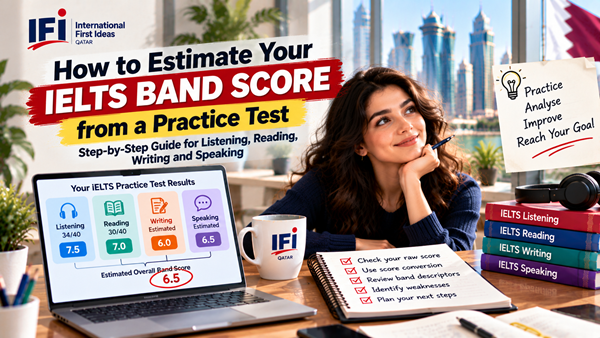
You have completed an IELTS practice test, checked your answers and calculated your score. But what does that result actually tell you? Are you close to Band 6.5, ready to aim for Band 7.0, or still some distance from your target?
Understanding your IELTS practice test band score can help you make better decisions about your preparation. Instead of relying on guesswork, you can use your practice results to identify weaknesses, track progress and decide whether you need more preparation before booking your official exam.
However, estimating your IELTS score requires more than counting correct answers. Listening and Reading can be estimated using raw scores, while Writing and Speaking require assessment against specific performance criteria. Your overall band score is then calculated from the four individual skill scores.
In this guide, you will learn how to estimate your IELTS band score, interpret your results for Academic and General Training, calculate a provisional overall score and use a mock test to prepare more effectively. If you are preparing for IELTS in Qatar, you will also learn when a structured mock test can provide a clearer picture of your readiness.
What Is an IELTS Practice Test Band Score?
An IELTS practice test band score is an estimate of your performance based on a practice assessment rather than an official IELTS examination.
IELTS uses a nine-band scale, from Band 1 to Band 9, to report English proficiency. Your official Test Report Form includes individual scores for Listening, Reading, Writing and Speaking, as well as an overall band score.
A practice test can help you estimate these scores, but its accuracy depends on the quality of the test, how closely you follow the official time limits and how your answers are assessed.
There are three important distinctions:
- Raw score: The number of correct answers in a section, usually out of 40 for Listening and Reading.
- Estimated band score: An approximate band inferred from your practice performance.
- Official IELTS band score: The result awarded after your official test is assessed under IELTS scoring procedures.
A practice result is useful for planning your preparation, but it is not an official IELTS score and cannot guarantee your result on exam day.
How to Estimate Your IELTS Listening Band Score
The IELTS Listening test contains 40 questions. Each correct answer receives one mark, giving you a raw score out of 40.
That raw score is converted to the IELTS nine-band scale. The exact number of correct answers required for a particular band can vary slightly between test versions, so any conversion table should be treated as an approximate guide.
IELTS Listening Raw Score Conversion
The following figures are based on the average marks published in official IELTS scoring guidance.
| Correct answers out of 40 | Approximate IELTS Listening band |
|---|---|
| 16 | 5.0 |
| 23 | 6.0 |
| 30 | 7.0 |
| 35 | 8.0 |
These are reference points, not a complete conversion table. Scores between these points should be interpreted using an appropriate scoring guide for the practice test you completed.
Example: Estimating Your Listening Score
Suppose you complete a timed Listening practice test and answer 29 out of 40 questions correctly.
Your raw score is:
29 ÷ 40 × 100 = 72.5%
However, 72.5% is not your IELTS band score. IELTS uses a conversion from raw marks to its band scale, not a direct percentage-to-band calculation.
Because approximately 30 correct answers corresponds to Band 7 in the official average-mark guidance, 29 correct answers suggests performance around that general range. You should not assume that it guarantees Band 6.5 or Band 7.0 on every test version.
How to Improve Your Listening Estimate
After checking your answers, review your mistakes carefully.
Ask yourself:
- Did I miss an answer because the speaker used a synonym?
- Did I lose concentration during a longer recording?
- Did I make spelling or singular/plural errors?
- Did I misunderstand the instructions or word limit?
- Did I struggle to follow a particular accent?
Record these patterns alongside your raw score. This will help you understand not only your estimated band, but also what you need to practise next.
How to Estimate Your IELTS Reading Band Score
The IELTS Reading test also contains 40 questions, with one mark awarded for each correct answer. Your raw score is converted to the IELTS band scale.
However, you must use the correct conversion guidance for your test type.
IELTS Academic and IELTS General Training Reading use the same band scale, but General Training candidates typically need more correct answers to achieve a comparable band because the tests differ in their reading materials and difficulty.
IELTS Reading Score: Academic vs General Training
The following are approximate reference points commonly used for practice scoring. They are not guaranteed thresholds for every test version.
| Approximate band | Academic Reading: correct answers out of 40 | General Training Reading: correct answers out of 40 |
|---|---|---|
| Band 5.0 | Around 15 | Around 23 |
| Band 6.0 | Around 23 | Around 30 |
| Band 7.0 | Around 30 | Around 34 |
| Band 8.0 | Around 35 | Around 38 |
The exact raw-score boundaries can vary. Always use the scoring guidance supplied with a reliable practice test, and avoid treating these approximate figures as an official conversion chart.
Example: Estimating Your Reading Score
Imagine you take an IELTS Academic Reading practice test and score 28 out of 40.
Your raw score is:
28 ÷ 40 × 100 = 70%
This percentage shows how many questions you answered correctly, but it does not directly determine your band score.
Since approximately 30 correct answers is an average reference point for Band 7 in Academic Reading, a score of 28 suggests that you may be approaching that range. Your exact estimated band depends on the conversion guidance applicable to your practice test.
If you are preparing for General Training, do not use an Academic Reading conversion table to estimate your score.
How to Interpret Your Reading Mistakes
Your raw score is only part of the picture. Look at the types of questions you answered incorrectly.
For example:
- True / False / Not Given: You may be confusing information that is absent from the passage with information that contradicts it.
- Matching headings: You may be focusing on individual details instead of the main idea of each paragraph.
- Multiple choice: You may be choosing an answer based on a familiar word rather than the meaning of the passage.
- Sentence completion: You may be overlooking grammar, spelling or the word limit.
- Time management: You may be spending too long on difficult questions.
If the same mistake appears repeatedly, targeted practice may be more useful than immediately taking another full test.
How to Estimate Your IELTS Writing Band Score
Writing is more difficult to estimate from a practice test because there is no simple raw-score conversion.
Your performance is assessed using four criteria, and a credible estimate depends on how well your responses meet those criteria. Counting words, checking grammar mistakes or comparing your essay with a sample answer cannot reliably produce a band score on its own.
IELTS Writing Assessment Criteria
IELTS Writing is assessed using four main criteria:
1. Task Achievement or Task Response
For Academic Writing Task 1, Task Achievement considers how effectively you summarise and report the information. For General Training Task 1, it considers how well you fulfil the purpose of the letter. Task Response in Task 2 evaluates how fully you address the question and develop your position.
2. Coherence and Cohesion
This criterion looks at how logically your ideas are organised and how effectively you connect sentences and paragraphs.
3. Lexical Resource
This assesses the range, accuracy and appropriateness of your vocabulary.
4. Grammatical Range and Accuracy
This evaluates your use of different grammatical structures and how accurately you use them.
Task 2 carries more weight than Task 1 in the Writing score, so your estimated Writing band should account for both the quality of your responses and the relative weighting of the tasks.
A Practical Way to Review Your Writing
After completing both Writing tasks within the official 60-minute limit, review your work against the assessment criteria.
Use the following questions:
| Assessment criterion | Questions to ask |
|---|---|
| Task Achievement / Task Response | Did I answer every part of the question and develop the relevant ideas? |
| Coherence and Cohesion | Is the response logically organised, with clear relationships between ideas? |
| Lexical Resource | Did I use appropriate vocabulary accurately, without unnecessary repetition? |
| Grammatical Range and Accuracy | Did I use a range of structures and control errors effectively? |
This review can help you identify strengths and weaknesses, but it should not be treated as a formal band assessment.
If possible, ask a qualified IELTS teacher or an assessor familiar with the official band descriptors to review your responses. An experienced assessor can identify problems that automated grammar tools and self-marking may miss, such as insufficient task development or weak organisation.
How to Estimate Your IELTS Speaking Band Score
IELTS Speaking is assessed through an interview lasting approximately 11–14 minutes. Because the score depends on the quality of your spoken performance, simply counting mistakes or measuring how long you speak is not enough to estimate your band accurately.
A useful practice assessment should consider all four official Speaking criteria.
The Four IELTS Speaking Assessment Criteria
Fluency and Coherence: Can you maintain your speech, organise your ideas and develop your answers without excessive hesitation?
Lexical Resource: Can you use a suitable range of vocabulary to express ideas clearly and accurately?
Grammatical Range and Accuracy: Can you use different sentence structures with reasonable control?
Pronunciation: Can you communicate clearly, using stress, rhythm and intonation effectively?
Your accent does not have to match a particular native-speaker accent. The important consideration is how clearly and effectively you communicate.
How to Review a Speaking Practice Test
Record yourself answering practice questions under timed conditions. Then listen to the recording and evaluate your performance.
Ask yourself:
- Did I answer the question directly?
- Did I develop my answers with explanations or examples?
- Did I repeat the same vocabulary too often?
- Were my sentences clear and grammatically controlled?
- Could a listener understand my pronunciation without undue effort?
- In Part 2, could I speak at length while staying relevant to the topic?
You can use these observations to identify areas for improvement. However, a reliable estimated band requires careful assessment against the official descriptors, not simply a subjective impression of how fluent you sounded.
For a more useful estimate, consider having your Speaking performance reviewed by an experienced IELTS assessor.
How to Calculate Your Estimated Overall IELTS Band Score
Once you have estimates for Listening, Reading, Writing and Speaking, you can calculate a provisional overall band score.
The overall IELTS band score is based on the average of the four skill scores, rounded to the nearest whole or half band according to IELTS scoring rules.
The calculation is:
Estimated overall score = (Listening + Reading + Writing + Speaking) ÷ 4
Remember that the result is only as reliable as your four individual estimates. If your Writing and Speaking scores are based on guesswork, your overall estimate may be misleading.
Example: Calculating an Estimated Overall Band
Suppose your practice results suggest the following scores:
| Skill | Estimated band |
|---|---|
| Listening | 7.0 |
| Reading | 6.5 |
| Writing | 6.0 |
| Speaking | 6.5 |
| Total | 26.0 |
Calculate the average:
26.0 ÷ 4 = 6.5
Your estimated overall band is therefore 6.5.
This example assumes that all four individual estimates are reasonable. It does not mean that the same result is guaranteed in the official test.
How IELTS Rounding Works
IELTS reports overall band scores in whole and half bands. The average of the four components is rounded according to the official rules.
For example:
| Average of four skill scores | Overall band score |
|---|---|
| 6.125 | 6.0 |
| 6.25 | 6.5 |
| 6.50 | 6.5 |
| 6.75 | 7.0 |
An average ending in .25 is rounded up to the next half band, while an average ending in .75 is rounded up to the next whole band. Other averages are rounded to the nearest whole or half band.
The example also shows why improving a weaker skill can matter. If your overall target is 7.0 but Writing remains at 6.0, you may need a more focused plan than someone whose four skills are already consistently close to the target.
Why Your Practice Test Score May Differ from Your Official IELTS Result
Even a well-designed practice test cannot guarantee the same score in your official examination.
There are several reasons your results may differ.
The Practice Test May Not Match the Official Test’s Difficulty
Not all online practice tests are equally reliable. Some may use easier questions, incomplete sections or scoring conversions that do not reflect official IELTS guidance.
Choose practice material that matches your test type and follows the appropriate time limits.
Writing and Speaking May Be Inaccurately Self-Assessed
Listening and Reading have objectively marked answers, but Writing and Speaking require assessment against performance criteria.
A self-assessed essay may seem strong because it contains advanced vocabulary, even if it does not fully address the task. Similarly, a fluent Speaking response may still have weaknesses in vocabulary, grammar or coherence.
Test-Day Conditions Can Affect Performance
Stress, concentration, fatigue and time management can influence your performance. A practice session completed without time limits or distractions may not reflect the conditions you face during the official test.
Your Skills May Not Be Equally Strong
You may achieve a high Listening score while struggling with Writing. An overall average can hide these differences, so always examine each skill separately.
The most useful practice result is not simply a single number. It is a realistic picture of your strengths, weaknesses and readiness for your target score.
How to Use Your IELTS Practice Test Results to Improve
Once you have estimated your band score, use the result to decide what to do next.
Step 1: Compare Your Current Score with Your Target
Write down the score you need and the score suggested by your latest practice test.
For example, if your target is 7.0 and your estimated overall score is 6.0, you have a clear gap to address. You should also check whether your university, employer or other receiving organisation requires a minimum score in each skill.
Step 2: Identify Your Weakest Skill
Compare your individual Listening, Reading, Writing and Speaking results.
If Writing is noticeably lower than your other skills, spending most of your preparation time on Listening may not be the most effective strategy.
Step 3: Analyse the Reasons Behind Your Mistakes
Look beyond the score. Determine whether your errors result from vocabulary, grammar, question interpretation, time management or a lack of familiarity with the test format.
The more accurately you identify the cause, the more targeted your preparation can become.
Step 4: Practise the Skills That Need Improvement
Use focused exercises to address recurring problems. For example, practise identifying paraphrases in Reading, recognising distractors in Listening, developing essay arguments in Writing or extending Speaking answers with relevant examples.
Step 5: Take Another Mock Test at the Right Time
After you have worked on your weaknesses, take another full mock test under realistic conditions.
Comparing results across attempts can help you determine whether your performance is improving consistently. Avoid taking repeated tests without reviewing your mistakes, as this may produce more scores without meaningful progress.
Should You Book an IELTS Mock Test Before the Official Exam?
If you have been using online practice questions but are still uncertain about your readiness, a structured IELTS mock test can provide a more complete assessment.
A mock test can help you experience the four skills together, practise under timed conditions and identify the areas that deserve more attention before your official exam.
It is particularly useful if:
- Your practice scores vary significantly from one test to another.
- You are unsure whether your Writing or Speaking meets your target band.
- You want to understand your performance across all four skills.
- You need to improve time management.
- You want feedback to guide your next stage of preparation.
IFI Qatar offers IELTS mock-test options for candidates preparing for the official exam. Depending on the available option, you can use the experience to become familiar with the test format and assess your readiness before deciding on your next step.
A mock test does not guarantee a particular official band score. Its value lies in giving you a more structured assessment and helping you turn the results into a practical preparation plan.
Book Your IELTS Mock Test with IFI Qatar
Estimating your IELTS practice test band score is a useful starting point, but you do not have to rely on guesswork when deciding what to improve.
A structured mock test can help you evaluate your performance under exam-style conditions, identify weaknesses and plan your preparation around your target score.
If you are preparing for IELTS in Doha or elsewhere in Qatar, explore the mock-test options available through IFI Qatar.
Ready to assess your IELTS readiness? Book an IELTS mock test and use your results to understand where you stand, what needs improvement and how to prepare more effectively for the official exam.
Your next step is not simply to take another test. It is to understand your performance and use that information to prepare with purpose.
Frequently Asked Questions About IELTS Practice Test Band Scores
Can I calculate my IELTS band score from a practice test?
Yes, you can estimate your score. For Listening and Reading, convert your raw marks using an appropriate scoring guide. For Writing and Speaking, assess your performance against the official criteria or seek feedback from a qualified assessor. The overall score can then be estimated by averaging the four skill bands and applying the IELTS rounding rules.
Is an IELTS practice test score accurate?
Its accuracy depends on the quality of the practice test, the similarity to official test conditions and the reliability of the marking. A practice score is an estimate, not a guarantee of your official IELTS result.
How many correct answers do I need for IELTS Listening Band 7?
Official IELTS guidance gives approximately 30 correct answers out of 40 as an average reference point for Listening Band 7. The exact number can vary slightly between test versions.
How many correct answers do I need for IELTS Reading Band 7?
The approximate reference point is around 30 correct answers out of 40 for Academic Reading and around 34 for General Training Reading. Exact boundaries vary by test version, so use the relevant scoring guidance rather than relying on a single fixed threshold.
Can I estimate my Writing and Speaking scores myself?
You can review your performance against the official criteria, but self-assessment has limitations. A qualified assessor or experienced IELTS teacher can provide more reliable feedback on task fulfilment, organisation, vocabulary, grammar, fluency and pronunciation.
How is the overall IELTS band score calculated?
The overall band score is calculated by averaging the Listening, Reading, Writing and Speaking scores, then rounding the result to the nearest whole or half band under IELTS scoring rules.
Should I take a mock test before booking the real IELTS exam?
A mock test can be particularly helpful if you are unsure about your readiness or need feedback on weaker skills. It can help you make a more informed decision about your next preparation step, although it cannot guarantee a particular official result.
Where can I take an IELTS mock test in Qatar?
IFI Qatar offers IELTS mock-test options for candidates preparing for the official exam. Check the current booking information to confirm the available test type, format, schedule and any feedback options.