

Currently Empty: ر.ق 0,00


IELTS
English Word Stress Rules: How Stress Changes Meaning and Clarity
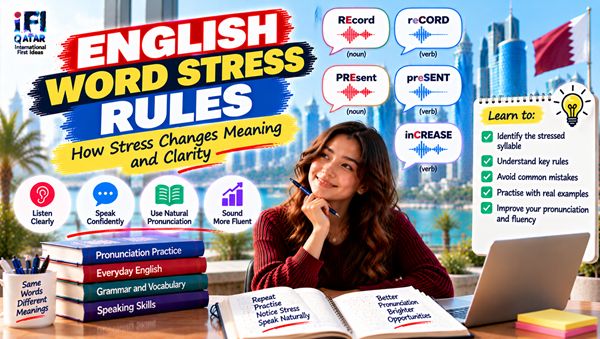
Have you ever known the meaning of an English word but struggled to make yourself understood when speaking? The problem may not be your vocabulary or grammar. It could be the way you pronounce the word.
In English, word stress is the emphasis placed on one syllable within a word. The stressed syllable is usually pronounced with greater prominence through a combination of loudness, length, pitch movement and vowel clarity. Using the correct stress pattern helps listeners recognise words more easily and makes your spoken English sound more natural.
For example, the words REcord and reCORD contain the same letters, but the stress pattern changes when the word is used as a noun or a verb. This is one reason why learning the pronunciation of a word is just as important as learning its meaning.
In this guide, you will learn the main English word stress rules, explore common examples, understand how stress can affect meaning and practise techniques to improve your pronunciation.
What Is English Word Stress?
English word stress is the emphasis placed on a particular syllable in a word. A stressed syllable typically stands out from the others because it is more prominent in speech.
Consider the word TAble. It has two syllables, but the first syllable carries the main stress.
Now consider aBOUT. The second syllable is stressed.
Word stress is commonly represented by capital letters in learning materials:
- TA-ble
- a-BOUT
- com-PU-ter
- im-POR-tant
Capital letters are a teaching convention used to show stress. They do not mean that the syllable should be shouted.
What Makes a Stressed Syllable Different?
A stressed syllable often has one or more of these characteristics:
- It may be louder than the surrounding syllables.
- Its vowel may be longer or more clearly pronounced.
- Its pitch may rise or fall in a noticeable way.
- Its vowel quality may be clearer than the reduced vowels in unstressed syllables.
Not every stressed syllable has all these features to the same degree. Stress depends on the word, the speaker and the surrounding sentence.
For learners, the most important point is to recognise which syllable carries the main emphasis and practise producing the word with that pattern.
Why Is Word Stress Important in English Pronunciation?
Correct word stress helps listeners identify words, follow your meaning and understand your speech with less effort.
1. Word Stress Can Change Meaning
Some English words have different meanings or grammatical functions depending on which syllable is stressed.
For example:
- REcord — a noun, such as a music record or an official document.
- reCORD — a verb meaning to capture or store information.
The spelling remains the same, but the stress pattern changes.
2. Word Stress Helps You Sound More Natural
English speakers do not give equal emphasis to every syllable. When learners pronounce every syllable with the same force, their speech may sound unnatural or become harder to understand.
Learning stress patterns helps you develop a more natural rhythm when speaking.
3. Word Stress Supports Listening Comprehension
Recognising stressed syllables can help you identify words in connected speech, especially when unstressed syllables contain reduced vowels.
For example, the unstressed vowel in many English words may sound like /ə/, known as the schwa. If you expect every written vowel to be pronounced clearly, you may find it harder to recognise familiar words when listening.
4. Word Stress Improves Communication Confidence
When you know how to pronounce unfamiliar words, you can use them more confidently in conversations, presentations and professional situations.
Correct stress does not require you to imitate a particular accent. The goal is to make your pronunciation clear and easy to understand.
English Word Stress Rules: The Main Patterns to Learn
English word stress has several useful patterns, but it also contains many exceptions. The following rules are practical guidelines rather than absolute laws. Always check the pronunciation of an unfamiliar word in a reliable dictionary.
Rule 1: Two-Syllable Nouns Often Have First-Syllable Stress
Many common two-syllable nouns are stressed on the first syllable.
Examples include:
| Word | Stress pattern |
|---|---|
| TAble | First syllable |
| DOCtor | First syllable |
| MOther | First syllable |
| WINdow | First syllable |
| PICture | First syllable |
| MONey | First syllable |
Practise each word by making the first syllable prominent without exaggerating it.
Say TA-ble, then use it in a sentence:
“The table is near the window.”
The goal is to maintain the correct word stress while speaking naturally.
Rule 2: Two-Syllable Verbs Often Have Second-Syllable Stress
Many common two-syllable verbs are stressed on the second syllable.
Examples include:
| Word | Stress pattern |
|---|---|
| reLAX | Second syllable |
| deCIDE | Second syllable |
| arRIVE | Second syllable |
| beGIN | Second syllable |
| forGET | Second syllable |
| exPLAIN | Second syllable |
Compare the following sentences:
- “We need to deCIDE today.”
- “Please exPLAIN your answer.”
These patterns are common, but they are not universal. Some two-syllable verbs have first-syllable stress, so learn the pronunciation of each word rather than applying the rule automatically.
Rule 3: Some Nouns and Verbs Change Stress
One particularly useful pattern involves words that can function as both nouns and verbs. In many familiar pairs, the noun is stressed on the first syllable, while the verb is stressed on the second.
| Noun | Verb | Example |
|---|---|---|
| REcord | reCORD | Keep a record / Record the meeting |
| PREsent | preSENT | A birthday present / Present an idea |
| PERmit | perMIT | A parking permit / Permit someone to enter |
| OBject | obJECT | An unusual object / Object to a decision |
| INcrease | inCREASE | An increase in prices / Increase the price |
| DEcrease | deCREASE | A decrease in demand / Decrease the amount |
These patterns can help you recognise differences in meaning and grammatical function.
However, not every noun–verb pair follows this pattern. Treat it as a useful tendency, not a rule that applies to every word.
Rule 4: Words Ending in -tion Often Have Stress Before the Suffix
Words ending in -tion commonly have the main stress on the syllable immediately before the suffix.
Examples:
- eduCAtion
- inforMAtion
- compeTItion
- communiCAtion
- proNUNciation
Notice that the stress falls before the final -tion syllable.
Practise saying each word slowly, then use it in a sentence. For example:
“Clear communication is important at work.”
Learning word families can make this pattern easier to recognise. If you know communicate, learning communication also helps you notice how stress may change when a suffix is added.
Rule 5: Words Ending in -ic Often Have Stress Before the Suffix
Many words ending in -ic have stress on the syllable immediately before -ic.
Examples include:
- geoGRAPHic
- ecoNOMic
- draMAtic
- scienTIfic
- athLETic
For instance, economic is commonly pronounced with stress on the syllable nom.
This pattern is useful when learning longer academic and professional vocabulary. Nevertheless, there are exceptions, so confirm unfamiliar words using audio pronunciation.
Rule 6: Some Suffixes Affect Stress Placement
Certain suffixes influence the stress pattern of the word they form. Others generally do not change the location of the main stress.
For example, words ending in -ity often have stress on the syllable immediately before the suffix:
- aBILity
- responSIBility
- posSIBility
- acTIVity
The exact pattern can depend on the word and its structure, so it is best to learn examples in groups rather than trying to memorise a complicated rule without practice.
Other suffixes, such as -ness and -less, often leave the original stress pattern unchanged:
- HAPPY → HAPPYness
- CARE → CAREless
These are useful tendencies, but pronunciation dictionaries remain the best way to confirm an unfamiliar word.
Rule 7: Compound Nouns Often Have First-Element Stress
A compound noun combines two or more words to form a single expression. Many common compound nouns place the main stress on the first element.
Examples:
- BLACKboard
- FOOTball
- TOOTHbrush
- GREENhouse
- BUS stop
Compound stress can help distinguish expressions that have different meanings depending on how their elements are emphasised.
However, compound stress varies by expression and context. Do not assume that every two-word noun phrase follows the same pattern.
How Word Stress Changes Meaning: Common Examples
Some words demonstrate particularly clearly why stress matters.
REcord vs reCORD
REcord is a noun.
Example: “The police checked his record.”
reCORD is a verb.
Example: “Please record the interview.”
PREsent vs preSENT
PREsent can be a noun meaning a gift.
Example: “I bought her a present.”
preSENT is a verb meaning to show, introduce or deliver something.
Example: “She will present her findings tomorrow.”
OBject vs obJECT
OBject is a noun meaning a thing.
Example: “The object was made of metal.”
obJECT is a verb meaning to express opposition.
Example: “Several residents object to the proposal.”
INcrease vs inCREASE
INcrease is a noun.
Example: “There was an increase in demand.”
inCREASE is a verb.
Example: “The company plans to increase production.”
These examples show why it is useful to learn pronunciation together with meaning, grammatical function and example sentences.
How to Find the Stressed Syllable in an English Word
When you encounter an unfamiliar word, use a repeatable process rather than guessing from its spelling.
Step 1: Divide the Word into Syllables
A syllable is a unit of pronunciation built around a vowel sound.
For example:
- TA-ble has two syllables.
- com-PU-ter has three syllables.
- in-for-MA-tion has four syllables.
Syllable division in writing does not always match how a word is divided in speech, so use audio when you are unsure.
Step 2: Listen to a Reliable Pronunciation Model
Look up the word in a reputable dictionary that provides audio. Listen to both British and American pronunciations if both are relevant to your learning goals.
Focus on which syllable stands out, rather than trying to imitate the entire accent.
Step 3: Mark the Main Stress
Write the word with a simple stress marker or capital letters.
For example:
- deCIDE
- imPORtant
- comPUter
- eduCAtion
Keep the notation consistent in your vocabulary notebook.
Step 4: Repeat the Word in a Sentence
Practise the word in isolation first, then use it in a complete sentence.
For example:
“Education can create new opportunities.”
This helps you maintain the correct word stress while speaking at a more natural pace.
Step 5: Review It Later
Return to the word after a day or two. Try to pronounce it without looking at your notes, then check your pronunciation against the dictionary audio.
Repeated retrieval helps you remember the pattern more effectively than simply reading the word several times.
Daily Exercises to Improve English Word Stress
You do not need a long practice session to begin improving your pronunciation. A short, focused routine can help you notice stress patterns and use them more confidently.
Exercise 1: Clap the Syllables
Choose a word and clap once for each syllable. Clap more prominently on the stressed syllable.
For example:
- TA-ble
- a-BOUT
- com-PU-ter
- edu-CA-tion
Do not make every clap equally strong. The purpose is to notice the difference between stressed and unstressed syllables.
Exercise 2: Compare Word Pairs
Practise noun–verb pairs such as:
- REcord / reCORD
- PREsent / preSENT
- INcrease / inCREASE
- OBject / obJECT
Say each word, identify its meaning and use it in a sentence. This connects pronunciation to the way the word functions in English.
Exercise 3: Use Shadowing
Shadowing involves listening to a short recording and repeating the speaker’s words while following the original pronunciation and rhythm.
Choose a short passage that you can understand. Listen once, then repeat the sentences, paying attention to prominent syllables and reduced vowels.
Record yourself if possible and compare your version with the original. Focus on one or two improvements at a time.
Exercise 4: Keep a Word Stress Notebook
Create a notebook with four columns:
| Word | Stress pattern | Meaning | Example sentence |
|---|---|---|---|
| deCIDE | Second syllable | Choose between options | We need to decide soon. |
| TAble | First syllable | A piece of furniture | The table is clean. |
| eduCAtion | Before -tion | The process of learning | Education opens opportunities. |
| reCORD | Second syllable | Capture information | Please record the lesson. |
Add new words from books, conversations, podcasts and lessons. Review the notebook regularly and practise saying the words aloud.
Common Word Stress Mistakes English Learners Make
Giving Every Syllable Equal Emphasis
Pronouncing every syllable with the same force can make a word sound unnatural and may make it harder for listeners to recognise.
How to improve: Listen to the word, identify its main stress and practise exaggerating the contrast slightly at first. Then reduce the exaggeration until the word sounds natural.
Guessing Stress from Spelling Alone
English spelling does not always reveal where the stress belongs. A familiar-looking word may have an unexpected pronunciation.
How to improve: Learn new words with audio, phonetic information when useful and an example sentence.
Applying One Rule to Every Word
Rules such as first-syllable stress in many two-syllable nouns are helpful, but exceptions are common.
How to improve: Use rules to make an initial prediction, then confirm the pronunciation in a reliable dictionary.
Ignoring Stress When Learning Vocabulary
Some learners record only the spelling and meaning of a word. They may remember the definition but use the wrong stress when speaking.
How to improve: Include pronunciation and stress information whenever you add an unfamiliar word to your vocabulary notebook.
Practising Words Only in Isolation
Pronouncing a word correctly on its own does not guarantee that you will use it naturally in a conversation.
How to improve: Practise each word in a sentence, then use it in a short explanation or conversation.
How English Word Stress Differs from Sentence Stress
Word stress and sentence stress are related, but they are not the same.
Word stress identifies the prominent syllable within an individual word.
Sentence stress identifies the words or parts of a sentence that receive emphasis because they carry important information or express a particular contrast.
For example:
“I wanted the BLUE shirt, not the black one.”
The word blue receives extra emphasis because the speaker is contrasting two colours.
In a longer sentence, the stress pattern of individual words remains important, but sentence stress helps communicate which information matters most.
Learning both can improve your spoken English. Start by practising word stress accurately, then work on sentence rhythm, emphasis and connected speech.
When Should You Consider Pronunciation Training?
Self-study can help you recognise stress patterns and improve your pronunciation. However, it can be difficult to identify your own mistakes, especially when you have repeated the same pattern for a long time.
Pronunciation training may be useful if you:
- Frequently receive requests to repeat what you said.
- Find it difficult to pronounce longer words naturally.
- Know vocabulary but struggle to use it clearly in conversation.
- Want feedback on stress, rhythm and connected speech.
- Need to communicate confidently in professional or academic settings.
A structured programme can help you practise systematically and receive feedback on the areas that need attention.
Improve Your English Pronunciation with IFI Qatar
If you want to improve your spoken English in Doha, consider discussing your learning goals with IFI Qatar. The centre offers English language learning options across levels from A1 to C1, with face-to-face and online options available.
When enquiring, ask whether the available programme can address your specific pronunciation needs, including word stress, clear speech and speaking practice.
Ready to improve your English pronunciation? Contact IFI Qatar to discuss your goals and explore suitable English learning options.
- Location: 16th Floor, Laffan Tower, West Bay, Doha, Qatar
- Phone: +974 4037 9708
- Email: info@ifi.qa
- Website: https://ifi.qa
Frequently Asked Questions About English Word Stress
What is word stress in English?
Word stress is the emphasis placed on one syllable within a word. The stressed syllable typically sounds more prominent than the others because of features such as length, loudness, pitch and vowel clarity.
Can word stress change the meaning of a word?
Yes. Some English words change meaning or grammatical function depending on stress placement. For example, REcord is commonly a noun, while reCORD is a verb.
What are the basic rules of English word stress?
Common patterns include first-syllable stress in many two-syllable nouns, second-syllable stress in many two-syllable verbs, stress before the suffixes -tion and -ic in many words, and first-element stress in many compound nouns. These are tendencies rather than universal rules.
How can I learn English word stress quickly?
Start with common words, listen to reliable pronunciation recordings, mark the stressed syllable and practise the word in a sentence. Review the same words over several days and record yourself occasionally to identify areas for improvement.
Does word stress affect my English accent?
Word stress is one feature of pronunciation that contributes to how natural and understandable your speech sounds. Your accent includes other features too, such as individual sounds, intonation and rhythm. You do not need to eliminate your accent to communicate clearly.
Should I learn word stress before learning advanced vocabulary?
It is helpful to learn pronunciation alongside vocabulary from the beginning. When you learn a new word, practise its meaning, spelling, stress pattern and use in a sentence together. This can prevent incorrect pronunciation habits from becoming established.
Is word stress the same in British and American English?
Many English words have the same stress pattern in British and American English, but some pronunciations differ. If you use a particular variety of English for study, work or an examination, practise the pronunciation relevant to your needs and be aware of common alternatives.
Final Thoughts
English word stress is an important part of clear pronunciation. It helps listeners recognise words, distinguishes the meaning or grammatical function of some word pairs and contributes to the natural rhythm of spoken English.
Start by learning the stress patterns of common words, checking unfamiliar pronunciations in a reliable dictionary and practising new vocabulary in complete sentences. Gradually combine word stress with sentence stress and connected speech.
With consistent practice and useful feedback, you can become more aware of how English words sound and communicate with greater clarity and confidence.