

Currently Empty: ر.ق 0,00


IELTS
English Prepositions of Time and Place: At, On, In and Beyond
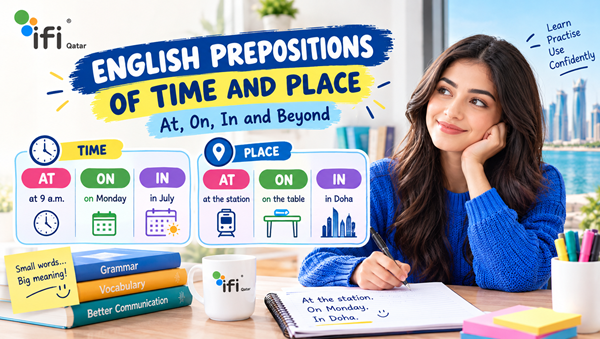
Prepositions are small words that help us explain when something happens, where something is located, and how people or objects relate to one another. In English, words such as at, on, in, by, under and between are essential for clear communication.
However, choosing the correct preposition can be confusing, especially when the same word has several meanings.
Consider these examples:
- My English class starts at 9 a.m.
- I have an exam on Monday.
- I was born in 2002.
- My keys are on the table.
- She lives in Doha.
- We are waiting at the entrance.
Why do we say at 9 a.m. but on Monday? Why is it in Doha but at the entrance?
The answer depends on how we understand the time, location or relationship being described. Although there are patterns to learn, English prepositions also have exceptions and fixed expressions that become easier with practice.
In this guide, you will learn how to use English prepositions of time and place, understand the differences between at, on and in, explore other common prepositions, and practise applying the rules in everyday situations.
What Are Prepositions in English?
A preposition is a word that expresses a relationship between a noun or pronoun and another part of a sentence. It can describe time, place, direction, movement or other relationships.
Examples include:
- Time: at noon, on Friday, in July
- Place: at the station, on the wall, in the room
- Direction: to school, into the building, towards the exit
- Movement: through the tunnel, across the road, along the path
- Position: under the desk, behind the door, between two buildings
A preposition is often followed by a noun, a pronoun or a noun phrase.
Examples:
- At night
- In the classroom
- On the first floor
- Behind the building
- Between you and me
Prepositions are important because they help make meaning precise.
Compare:
- The book is on the table.
- The book is under the table.
- The book is beside the table.
The noun table remains the same, but the preposition changes the location of the book.
Similarly, consider these time expressions:
- At 8 a.m.
- On Tuesday
- In September
Each expression identifies a different level of time specificity.
Prepositions of Time: At, On and In
The three most important prepositions of time for English learners are at, on and in. They are used with different types of time expressions.
A useful starting point is to think about the level of detail:
- At is commonly used for specific times and certain fixed expressions.
- On is used for days and dates.
- In is used for months, years, seasons and longer periods.
These are general patterns rather than rules without exceptions, but they cover many everyday situations.
When to Use At for Time
Use at with specific clock times and certain established expressions referring to parts of the day or particular moments.
| Expression | Example |
|---|---|
| Clock times | At 7 a.m. |
| Noon | At noon |
| Midnight | At midnight |
| Night | At night |
| The weekend in British English | At the weekend |
| The moment something happens | At the end of the meeting |
Examples:
- My English lesson begins at 10 a.m.
- We usually have lunch at noon.
- The city looks different at night.
- I prefer studying at the weekend.
- Please arrive at the start of the session.
Notice that at night is a common fixed expression. We generally say in the morning, in the afternoon and in the evening, but at night.
Compare:
- I study in the evening.
- I usually sleep at night.
In American English, on the weekend is also common. Both at the weekend and on the weekend are correct in their respective varieties of English.
When to Use On for Time
Use on with days of the week, calendar dates and many expressions that identify a particular day.
| Expression | Example |
|---|---|
| Days of the week | On Monday |
| Full dates | On 15 March |
| Specific dates | On 1 January |
| Day plus part of day | On Tuesday morning |
| Special days | On my birthday |
| Named days or occasions | On New Year’s Day |
Examples:
- I have an English test on Thursday.
- Her birthday is on 12 August.
- We are meeting on Monday morning.
- The office will be closed on New Year’s Day.
- I visited my family on my birthday.
When a day is mentioned together with a part of the day, on is normally used.
For example:
- In the morning
- On Friday morning
- In the afternoon
- On Saturday afternoon
The addition of a specific day changes the expression.
When to Use In for Time
Use in with months, years, seasons, centuries and longer periods. It is also used with parts of the day in many standard expressions.
| Expression | Example |
|---|---|
| Months | In October |
| Years | In 2026 |
| Seasons | In winter |
| Decades | In the 1990s |
| Centuries | In the 21st century |
| Parts of the day | In the morning |
| Longer periods | In the future |
Examples:
- I started learning English in September.
- She graduated from university in 2024.
- We usually travel in summer.
- Many changes happened in the 20th century.
- I feel more productive in the morning.
- Technology may develop significantly in the future.
Use in when referring to a period rather than a specific day or clock time.
Compare:
- At 8 p.m.
- On Friday
- In December
These expressions move from a specific time to a day and then to a broader period.
Quick Comparison: At, On and In for Time
| Preposition | Common Use | Examples |
|---|---|---|
| At | Specific clock times and fixed expressions | At 6:30, at noon, at night |
| On | Days and dates | On Sunday, on 5 May |
| In | Months, years, seasons and longer periods | In July, in 2025, in winter |
A useful way to remember the pattern is:
At = a specific time; on = a day or date; in = a longer period.
This is a starting point, not a substitute for learning fixed expressions. For example, English uses at night even though night is a period of time.
Prepositions of Place: At, On and In
The same three prepositions are also used to describe location. However, their meanings depend on the physical or conceptual relationship between the place and the person or object.
A helpful general distinction is:
- At: a point, destination or place viewed as a location.
- On: a surface or something attached to or positioned along a surface.
- In: an enclosed space, area or larger location.
When to Use At for Place
Use at when referring to a location as a point, destination or place where an activity happens.
Examples:
- At the bus stop
- At the entrance
- At the airport
- At work
- At school
- At home
- At the reception desk
Example sentences:
- I will meet you at the entrance.
- She is waiting at the bus stop.
- He works at a language centre.
- We arrived at the airport early.
- My brother is at home today.
In these examples, at identifies a location without necessarily describing its interior or boundaries.
Compare:
- She is at the school. (The school is the relevant location.)
- She is in the school. (She is inside the school building.)
Both can be correct, but they emphasise different aspects of the location.
When to Use On for Place
Use on when something is positioned on a surface or when describing certain locations along a route, floor or line.
Examples:
- On the table
- On the wall
- On the floor
- On the ceiling
- On the second floor
- On the left
- On the right
Example sentences:
- Your phone is on the desk.
- There is a painting on the wall.
- The children are playing on the floor.
- Our classroom is on the second floor.
- The pharmacy is on the left.
Use on for streets in many common expressions, especially when identifying an address or location along a street.
Examples:
- The café is on Al Corniche Street.
- She lives on a quiet street.
- The office is on the main road.
However, usage can vary with the type of location and the intended meaning. It is helpful to learn common location expressions as complete phrases.
When to Use In for Place
Use in when referring to something inside an enclosed space or within a larger area.
Examples:
- In the room
- In the kitchen
- In a building
- In a car
- In Doha
- In Qatar
- In the garden
- In the city centre
Example sentences:
- The students are in the classroom.
- There is some milk in the fridge.
- She lives in Doha.
- We stayed in Qatar for two weeks.
- My wallet is in my bag.
- The children are playing in the garden.
Use in with cities, countries, regions and many geographical areas.
For example:
- In Doha
- In Qatar
- In the Middle East
- In Europe
At, On and In for Place: Comparison Table
| Preposition | Main Idea | Examples |
|---|---|---|
| At | A location or point | At the entrance, at the station |
| On | A surface or position along something | On the table, on the wall |
| In | Inside an area or enclosed space | In the room, in Qatar |
Consider these three sentences:
- I am at the library.
- I am in the library.
- My bag is on the table.
The first sentence identifies the library as the speaker’s location. The second emphasises that the speaker is inside the building. The third describes the bag’s position relative to a surface.
Context determines which preposition communicates the intended meaning most accurately.
Other Important Prepositions of Time
Although at, on and in cover many common expressions, several other prepositions are essential for discussing schedules, deadlines and duration.
Before
Use before to describe something that happens earlier than a particular time or event.
Examples:
- Please arrive before 9 a.m.
- I usually have breakfast before work.
- She finished the assignment before the deadline.
- Wash your hands before eating.
After
Use after to describe something that happens later than a time or event.
Examples:
- We can meet after lunch.
- I usually exercise after work.
- She called me after the lesson.
- Please review your notes after class.
Compare:
- Finish your homework before dinner.
- You can watch television after dinner.
The prepositions establish the order of the activities.
During
Use during with a noun phrase referring to a period or event.
Examples:
- Please remain quiet during the exam.
- I took notes during the lecture.
- We travelled during the summer holidays.
- She received a phone call during the meeting.
Do not normally use during directly before a clause with a subject and verb.
Incorrect: During I was studying, my phone rang.
Correct: While I was studying, my phone rang.
Correct: During my study session, my phone rang.
Use during with a noun phrase and while with a clause.
For
Use for to describe the duration of an activity or situation.
Examples:
- I studied for two hours.
- She has lived in Doha for five years.
- We waited for thirty minutes.
- He worked there for a long time.
The phrase after for tells us how long something lasts.
Since
Use since to identify the starting point of an activity or situation that continues to a later time.
Examples:
- I have studied English since 2022.
- She has worked here since January.
- We have known each other since childhood.
- He has lived in Qatar since last year.
Since often appears with the present perfect when a situation began in the past and continues into the present.
Compare:
- I have studied English for three years. (Duration)
- I have studied English since 2023. (Starting point)
The choice depends on whether you want to express a length of time or the point when the period began.
By
Use by to indicate a deadline: the latest time something should happen.
Examples:
- Please submit your assignment by Friday.
- I need to finish the report by 5 p.m.
- You should arrive by noon.
- We hope to complete the project by the end of the month.
The meaning of by Friday is that the task should be completed no later than Friday.
Compare:
- I will work until Friday. (The activity continues up to Friday.)
- I will finish the report by Friday. (The report will be completed no later than Friday.)
Until and Till
Use until or till to describe how long an activity or situation continues.
Examples:
- The library is open until 8 p.m.
- I will wait here until you arrive.
- She worked until midnight.
- The shop is closed till Monday.
Until and till generally have the same meaning, although until is often preferred in formal writing.
From … To
Use from … to to describe the beginning and end of a period.
Examples:
- The course runs from Monday to Friday.
- I work from 9 a.m. to 5 p.m.
- The office is open from June to August.
- The event takes place from 10 to 12 October.
You can also use from … until.
Example:
“The museum is open from 9 a.m. until 6 p.m.”
Other Important Prepositions of Place and Movement
Prepositions of place help describe position. Prepositions of movement explain how someone or something travels from one location to another.
Under and Below
Use under when something is beneath another object, often with the sense that it is covered by or directly below it.
Examples:
- The cat is under the table.
- My shoes are under the bed.
- The children hid under the blanket.
Use below when referring to a lower position or level.
Examples:
- The temperature fell below zero.
- Please read the instructions below.
- The village is below the mountain.
Under and below can overlap, but they are not interchangeable in every expression.
Above and Over
Use above when something is at a higher level than another object.
Examples:
- The picture is above the sofa.
- The temperature is above 30 degrees.
- The apartment is above the shop.
Use over when something is positioned higher than another thing, often directly above it, or when describing movement across something.
Examples:
- A lamp hangs over the table.
- The plane flew over the city.
- She put a blanket over the child.
In some situations, both words are possible, but over can emphasise coverage or movement, while above often focuses on relative height.
Between and Among
Use between when describing a position or relationship involving two clearly identified people or things. It can also be used for more than two distinct entities when the individual relationships are important.
Examples:
- The café is between the bank and the pharmacy.
- She sat between her two friends.
- The agreement was reached between the three organisations.
Use among when something is surrounded by, included within or distributed through a group considered collectively.
Examples:
- He felt comfortable among his classmates.
- The teacher distributed the books among the students.
- The house is hidden among the trees.
The choice depends on whether the entities are being considered individually or as a group.
In Front of and Behind
Use in front of to describe a position ahead of something.
Examples:
- The car is parked in front of the building.
- She stood in front of the class.
- There is a garden in front of our house.
Use behind to describe a position at the back of something.
Examples:
- The parking area is behind the office.
- The cat is hiding behind the sofa.
- He stood behind me in the queue.
These expressions are especially useful when giving directions.
Next to, Beside and Near
Use next to or beside to describe a position immediately adjacent to something.
Examples:
- The pharmacy is next to the supermarket.
- She sat beside her friend.
- The hotel is beside the main entrance.
Use near when something is close to another place but not necessarily directly beside it.
Examples:
- The school is near my house.
- There is a café near the station.
- We live near the city centre.
Across From and Opposite
Use across from or opposite when something is on the other side of a space, street or area.
Examples:
- The bank is across from the supermarket.
- Our office is opposite the hotel.
- The bus stop is across from the shopping centre.
Across from is especially common in American English, while opposite is widely used in British English and many international contexts.
To, Into and Onto
These prepositions describe movement or direction.
Use to when indicating a destination.
Examples:
- I am going to school.
- She travelled to Doha.
- We walked to the station.
Use into when movement takes place from outside to inside an enclosed space.
Examples:
- He walked into the room.
- She put the books into her bag.
- The cat jumped into the box.
Use onto when movement takes place towards and onto a surface.
Examples:
- The child climbed onto the chair.
- She put the bag onto the table.
- The cat jumped onto the bed.
Compare:
- The cat is in the box. (Position)
- The cat jumped into the box. (Movement)
- The book is on the table. (Position)
- She placed the book onto the table. (Movement)
The difference between location and movement is important when choosing a preposition.
Common Differences That Confuse English Learners
Some prepositions are especially challenging because two expressions may seem similar but communicate different meanings.
In Time vs On Time
These expressions are not interchangeable.
On time means at the scheduled or expected time.
Examples:
- The lesson started on time.
- Please arrive on time for your interview.
- The train was on time.
In time means early enough to do something or before it is too late.
Examples:
- We arrived in time to catch the train.
- She submitted her application in time.
- I reached the airport just in time for my flight.
Compare:
“The class started on time.”
The class started at its scheduled time.
“I arrived in time for the class.”
I arrived early enough to attend it.
At the End vs In the End
These expressions have different meanings.
At the end refers to the final part or point of something.
Examples:
- There is a summary at the end of the book.
- We took a photograph at the end of the course.
- Please ask your questions at the end of the presentation.
In the end means finally or after considering what happened.
Examples:
- In the end, we decided to stay at home.
- She tried several methods and, in the end, found one that worked.
- In the end, the team completed the project.
By vs Until
Use by for a deadline and until for the continuation of an activity or state.
Examples:
- Finish the assignment by Friday.
- I will remain in the office until Friday.
In the first sentence, Friday is the deadline. In the second, the speaker will remain in the office up to Friday.
In the Car vs On the Bus
English often uses in with cars and taxis, but on with buses, trains, planes and ships.
Examples:
- She is in the car.
- We travelled in a taxi.
- He is on the bus.
- They are on the train.
- I left my bag on the plane.
These are common usage patterns, not a simple rule based only on the size of a vehicle. Learn the expressions as common combinations.
At School vs In the School
These expressions can have different meanings.
At school often describes someone attending school or being at that location for its usual purpose.
Example:
“My daughter is at school.”
In the school emphasises being inside the school building.
Example:
“I left my notebook in the school.”
The correct choice depends on what you want to communicate.
Common Preposition Mistakes and How to Correct Them
English learners sometimes translate prepositions directly from their first language. This can lead to sentences that are understandable but grammatically incorrect or unnatural.
| Incorrect Sentence | Correct Sentence | Explanation |
|---|---|---|
| I wake up in 7 a.m. | I wake up at 7 a.m. | Use at with clock times. |
| My birthday is in Monday. | My birthday is on Monday. | Use on with days. |
| She was born on 2001. | She was born in 2001. | Use in with years. |
| I live at Qatar. | I live in Qatar. | Use in with countries. |
| The book is in the table. | The book is on the table. | Use on for a surface. |
| I will finish it until Friday. | I will finish it by Friday. | Use by for a deadline. |
| I have lived here since five years. | I have lived here for five years. | Use for with a duration. |
| I have lived here for 2022. | I have lived here since 2022. | Use since with a starting point. |
| We arrived to the airport. | We arrived at the airport. | Arrive at is common with specific locations. |
| She is married with a doctor. | She is married to a doctor. | The standard expression is married to. |
Not every preposition mistake can be corrected by memorising a single rule. Some verbs, adjectives and nouns are normally followed by particular prepositions.
For example:
- Interested in
- Good at
- Afraid of
- Depend on
- Listen to
- Arrive at the airport
- Arrive in Doha
Learning these combinations in context can help you use them naturally.
How to Learn English Prepositions More Effectively
Understanding the rules is important, but using prepositions accurately requires regular practice. The following methods can help you remember the correct expressions and apply them in real conversations.
1. Learn Prepositions in Complete Phrases
Avoid memorising prepositions as isolated words. Instead, learn them as part of a useful expression.
For example, practise:
- At the weekend
- On Monday morning
- In the afternoon
- Interested in music
- Good at English
- Arrive at the airport
- Arrive in Qatar
Learning complete phrases helps you recognise common patterns when speaking and writing.
2. Group Examples by Meaning
Create separate lists for time, place and movement.
Time
- At 8 a.m.
- On Friday
- In December
- Before lunch
- After work
- During the meeting
Place
- At the station
- On the wall
- In the kitchen
- Under the table
- Beside the door
- Between two buildings
Movement
- Go to school
- Walk into the room
- Climb onto the chair
- Drive through the tunnel
- Walk across the street
Grouping examples by meaning makes it easier to compare similar expressions.
3. Describe Your Daily Routine
Write five to ten sentences about your day and include as many time expressions as possible.
For example:
“I wake up at 7 a.m. I usually have breakfast in the morning. On weekdays, I go to work at 8:30. I study English in the evening and go to bed at 11 p.m.”
Then write another paragraph describing the places you visit.
For example:
“My office is in Doha. My desk is near the window, and my laptop is on the table. I usually meet my colleagues at the entrance before we go into the meeting room.”
This exercise connects grammar rules to your daily life.
4. Read and Notice Prepositions
When reading English articles, stories or short dialogues, pay attention to prepositions.
Ask yourself:
- Why does the writer use at instead of in?
- Is the sentence describing a location or movement?
- Does the expression refer to a specific time or a longer period?
- Is this a fixed expression that I should learn as a phrase?
Keep a notebook of useful examples and review it regularly.
5. Practise Speaking Aloud
Use prepositions when describing objects around you, explaining your schedule or giving directions.
For example:
“The keys are on the desk. My bag is under the chair. The notebook is in my bag. The clock is above the door.”
For time practice, describe your schedule:
“My class starts at 9 a.m. on Tuesday. I usually study in the evening and review my notes before bed.”
Speaking aloud helps connect grammar knowledge with real communication.
6. Review Your Mistakes
Keep a list of errors you frequently make. For each mistake, record the incorrect sentence, the correction and a short explanation.
For example:
- Incorrect: I have studied English since three years.
- Correct: I have studied English for three years.
- Reason: Use for with a period of time and since with a starting point.
Reviewing these patterns helps you identify the areas that need more practice.
Practice Exercises: English Prepositions of Time and Place
Complete the following exercises to check your understanding. Try answering the questions before looking at the answer key.
Exercise 1: Choose At, On or In
Complete each sentence with at, on or in.
- My English class starts _____ 9 a.m.
- I usually visit my grandparents _____ Sunday.
- She was born _____ 2003.
- We go swimming _____ summer.
- The meeting is _____ Monday morning.
- I often read _____ the evening.
- The train arrives _____ midnight.
- His birthday is _____ 14 February.
- We moved to Doha _____ September.
- I usually sleep _____ night.
Exercise 2: Choose the Correct Preposition of Place
Choose the most appropriate preposition.
- The keys are (in / on / at) the table.
- She lives (at / in / on) Qatar.
- We are waiting (at / on / in) the bus stop.
- The students are (in / on / at) the classroom.
- There is a picture (in / on / at) the wall.
- The pharmacy is (between / under / into) the bank and the supermarket.
- The cat is hiding (under / across / onto) the bed.
- My office is (in / on / into) the second floor.
- The café is (next to / through / into) the hotel.
- She walked (into / at / on) the room.
Exercise 3: Choose the Correct Preposition of Time
- Please submit the assignment (by / until) Friday.
- I have lived in Doha (for / since) 2022.
- We waited (during / for) thirty minutes.
- She worked (until / by) midnight.
- I took notes (during / while) the lecture.
- We arrived just (in / on) time to catch the train.
- The class started (in / on) time.
- Please finish your work (before / during) lunch.
- I have studied English (for / since) three years.
- We stayed in Qatar (during / while) the summer holidays.
Exercise 4: Correct the Mistakes
Rewrite each sentence correctly.
- I wake up in 6:30 a.m.
- She was born on 1998.
- The book is in the desk.
- We will finish the project until Friday.
- I have worked here since five years.
- My friend lives at Doha.
- I will meet you in Monday morning.
- He walked on the room.
- The train arrived in time according to its schedule.
- She is very good in English.
Answers and Explanations
Exercise 1
- At — Use at with clock times.
- On — Use on with days of the week.
- In — Use in with years.
- In — Use in with seasons.
- On — Use on with a specific day and part of the day.
- In — In the evening is a common expression.
- At — Use at with midnight.
- On — Use on with calendar dates.
- In — Use in with months.
- At — At night is a fixed expression.
Exercise 2
- On — The keys are on a surface.
- In — Use in with countries.
- At — The bus stop is treated as a location.
- In — The students are inside the classroom.
- On — The picture is attached to the wall.
- Between — The pharmacy is positioned between two places.
- Under — The cat is below the bed.
- On — Use on with floors in a building.
- Next to — The café is beside the hotel.
- Into — The sentence describes movement from outside to inside.
Exercise 3
- By — Friday is the deadline.
- Since — 2022 is the starting point.
- For — Thirty minutes expresses duration.
- Until — The activity continued up to midnight.
- During — Use during with the noun phrase the lecture.
- In — In time means early enough.
- On — On time means at the scheduled time.
- Before — The work should be finished earlier than lunch.
- For — Three years expresses duration.
- During — Use during with the noun phrase the summer holidays.
Exercise 4
- I wake up at 6:30 a.m.
- She was born in 1998.
- The book is on the desk.
- We will finish the project by Friday.
- I have worked here for five years.
- My friend lives in Doha.
- I will meet you on Monday morning.
- He walked into the room.
- The train arrived on time according to its schedule.
- She is very good at English.
Frequently Asked Questions About English Prepositions
What are the most common prepositions of time in English?
The most common prepositions of time include at, on, in, before, after, during, for, since, by and until. They help explain when an event happens, how long it lasts and when it should be completed.
What is the difference between at, on and in for time?
Use at for specific times, such as at 8 a.m.; on for days and dates, such as on Friday; and in for months, years and longer periods, such as in July or in 2026.
What is the difference between at, on and in for place?
Use at to identify a location or point, such as at the station; on for surfaces or positions, such as on the table; and in for enclosed spaces or larger areas, such as in the room or in Qatar.
Should I say “in time” or “on time”?
Both are correct but have different meanings. On time means at the scheduled time. In time means early enough to do something or before it is too late.
What is the difference between for and since?
Use for to express duration, as in for three years. Use since to identify a starting point, as in since 2022. The present perfect is commonly used with both when a situation continues into the present.
Should I use in or on with days?
Use on with days and dates. For example, say on Monday, on Friday morning and on 15 May. Use in with months, years, seasons and many general parts of the day, such as in June and in the morning.
Which prepositions are used with countries and cities?
Use in with most countries, cities and regions. Examples include in Qatar, in Doha, in Europe and in the Middle East. Some expressions may use different prepositions depending on the intended meaning.
How can I learn English prepositions faster?
Learn prepositions in complete phrases, read and listen to English regularly, describe your daily routine and practise using prepositions in speaking and writing. Reviewing mistakes and receiving feedback can also help you apply the rules more accurately.
Improve Your English Grammar With IFI Qatar
Using prepositions correctly can make your English clearer and more natural. From describing your daily schedule to explaining where something is located, these small words help you communicate precise information in conversations, emails, academic writing and professional situations.
At IFI Qatar, you can explore English courses that help you strengthen your grammar, vocabulary and communication skills. Structured lessons and regular practice can help you understand essential grammar patterns and apply them more confidently in real-life situations.
Whether you are learning English from the beginning or improving skills you already have, choosing a course that matches your current level can help you build a stronger foundation.
Ready to improve your English grammar? Contact IFI Qatar to explore available English courses and find a suitable starting point for your learning goals.