

Currently Empty: ر.ق 0,00


IELTS
A, An and The: A Practical Guide to English Articles
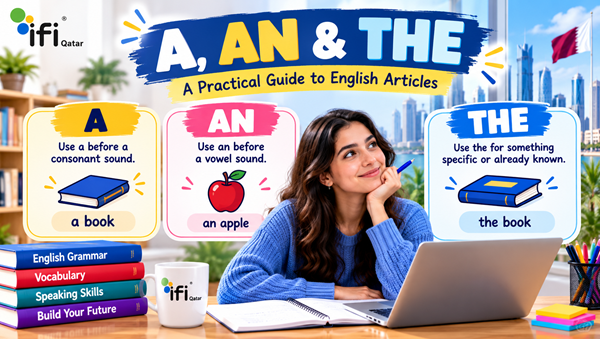
Learning when to use a, an and the is one of the first important steps toward speaking and writing English accurately. These small words appear in everyday conversations, emails, stories, academic texts and professional communication. Although they are short, using them incorrectly can make a sentence sound unnatural or change its meaning.
Consider these examples:
- I saw a dog in the park.
- The dog was playing with a ball.
- She ate an apple after lunch.
Each article has a specific purpose. We often use a or an when introducing a singular countable noun for the first time. We use the when the listener or reader can identify which person or thing we mean.
However, the rules are not always as simple as they first appear. The choice between a and an depends on pronunciation rather than spelling, and the is used in several situations that learners need to recognise.
In this practical guide, you will learn the main rules for English articles, understand the difference between definite and indefinite articles, explore common exceptions, and practise using a, an and the in everyday English.
What Are Articles in English Grammar?
Articles are words that come before nouns to help show whether we are referring to something general or something specific.
English has three articles:
- A
- An
- The
They belong to two main categories.
| Article Type | Articles | Main Purpose |
|---|---|---|
| Indefinite articles | A, an | Refer to a non-specific person, place, thing or idea |
| Definite article | The | Refer to a specific or identifiable person, place, thing or idea |
For example:
I need a pen.
The speaker needs one pen, but the listener does not know which particular pen is meant.
I need the pen on your desk.
The phrase the pen on your desk identifies a particular pen. The listener can understand which one the speaker means.
Articles usually appear before nouns, but other words may come between an article and its noun.
Examples:
- A beautiful house
- An interesting book
- The old building
- A very useful tool
- An extremely difficult question
In these examples, the article introduces the noun phrase. The adjective or other descriptive word does not change the basic purpose of the article.
When to Use A in English
Use a before a singular countable noun when you are referring to one non-specific person or thing.
The noun does not need to begin with a particular letter. What matters is the sound at the beginning of the following word.
1. Before a Consonant Sound
Use a before a word that begins with a consonant sound.
Examples:
- A book
- A car
- A teacher
- A university
- A European country
- A useful idea
- A one-hour lesson
Notice that university, European and useful begin with vowel letters, but their initial sounds are consonant sounds: /j/ as in yes.
Similarly, one begins with the /w/ sound. That is why we say a one-hour lesson, not an one-hour lesson.
2. When Mentioning Something for the First Time
Use a when introducing a singular countable noun that has not yet been identified in the conversation.
Example:
“I bought a book yesterday. The book is about learning English.”
The first sentence introduces the book. The second sentence refers to that same book, so the is used.
More examples:
- I met a new colleague this morning.
- She adopted a cat last week.
- We visited a small village during our holiday.
- He found a wallet near the entrance.
In each case, the noun is introduced as one person or thing without identifying a specific one that the listener already knows.
3. To Mean One Member of a Group
Use a when referring to one member of a larger category.
Examples:
- A doctor treats patients.
- A good teacher encourages students.
- A smartphone is a useful communication tool.
- A healthy breakfast can help you start the day.
These sentences describe a general member of a category rather than one particular person or object.
4. With Jobs and Professions
Use a or an before a singular countable noun describing someone’s job or profession.
Examples:
- She is a doctor.
- He is a teacher.
- My sister is an engineer.
- Ali wants to become a pilot.
- Her father is an architect.
The article is normally required before a singular countable profession when it follows become, be or similar expressions.
Compare:
Incorrect: She is teacher.
Correct: She is a teacher.
The noun teacher is singular and countable, so it needs an appropriate determiner in this sentence.
When to Use An in English
Use an before a word that begins with a vowel sound.
The five vowel letters in English are a, e, i, o, and u. However, the choice between a and an depends on the sound you hear, not simply the first written letter.
1. Before a Vowel Sound
Examples:
- An apple
- An egg
- An idea
- An orange
- An umbrella
- An interesting story
- An expensive watch
In each example, the word following an begins with a vowel sound.
2. Before Words With a Silent H
Some English words begin with the letter h, but the h is not pronounced. When the first spoken sound is a vowel, use an.
Examples:
- An hour
- An honest person
- An honour
- An heir
For example:
“We waited for an hour.”
The word hour begins with a vowel sound because its initial h is silent.
However, when the h is pronounced, use a.
Examples:
- A house
- A hotel
- A happy child
- A helpful teacher
The key is pronunciation. Do not choose the article based only on the spelling of the first letter.
3. Before Abbreviations That Begin With a Vowel Sound
Some abbreviations are pronounced letter by letter. In these cases, the first spoken sound determines the article.
Examples:
- An MBA student
- An FBI agent
- An X-ray
- An MP
For example, FBI begins with the spoken letter name /ef/, which starts with a vowel sound. Therefore, we say an FBI agent.
By contrast, we say a URL when the abbreviation is pronounced /juː ɑːr el/, beginning with the consonant sound /j/.
4. Before Adjectives Beginning With Vowel Sounds
When an adjective comes between the article and the noun, choose the article according to the adjective’s initial sound.
Examples:
- An excellent student
- An old house
- An unusual experience
- A difficult examination
- A useful application
- A beautiful painting
Compare:
- A book
- An interesting book
The noun is the same, but the article changes because the second phrase begins with the adjective interesting.
A vs An: What Is the Difference?
The difference between a and an is pronunciation.
| Use A | Use An |
|---|---|
| Before a consonant sound | Before a vowel sound |
| A car | An apple |
| A teacher | An engineer |
| A university | An umbrella |
| A European city | An interesting city |
| A one-way street | An hour |
| A useful tool | An honest answer |
| A URL | An FBI agent |
Why Is It “A University” but “An Umbrella”?
The word university begins with the /j/ sound, as in yes. This is a consonant sound, so we use a.
The word umbrella begins with the vowel sound /ʌ/, so we use an.
Compare:
- A university
- An umbrella
- A European country
- An English lesson
- A uniform
- An unusual uniform
The spelling alone cannot tell you which article to choose. Listening to the beginning of the word is the most reliable approach.
Quick Rule to Remember
Ask yourself:
What sound do I hear at the beginning of the next word?
- If it is a consonant sound, use a.
- If it is a vowel sound, use an.
This rule also applies when an adjective or abbreviation comes after the article.
When to Use The in English
Use the when referring to a specific person, place, object or idea that the listener or reader can identify.
Unlike a and an, the can be used with singular countable nouns, plural countable nouns and uncountable nouns.
1. When the Noun Has Already Been Mentioned
Use the when referring to something that has already been introduced.
Example:
“I saw a dog near my house. The dog was wearing a red collar.”
The first sentence introduces a dog. The second sentence refers to the same dog.
More examples:
- She bought a dress yesterday. The dress was expensive.
- We entered a restaurant. The restaurant was very busy.
- He found a key. The key opened the front door.
This is one of the most common uses of the in everyday English.
2. When the Listener Knows Which One You Mean
Sometimes a noun has not been mentioned before, but the context makes it clear which person or thing is meant.
Examples:
- Please close the door.
- Could you turn off the light?
- The manager is waiting for you.
- Where is the bathroom?
In an ordinary conversation, the speaker and listener may both know which door, light, manager or bathroom is being discussed.
The article helps identify the intended noun.
3. With Superlative Adjectives
Use the before superlative adjectives in standard constructions.
Examples:
- The tallest building
- The most interesting book
- The best student
- The fastest runner
- The most important lesson
For example:
“This is the most useful grammar guide I have read.”
The phrase the most useful identifies one item as having the highest degree of a particular quality within the relevant comparison.
4. With Ordinal Numbers
Use the with ordinal numbers when identifying a particular position or sequence.
Examples:
- The first chapter
- The second question
- The third floor
- The last page
- The next step
For example:
“Please read the first paragraph carefully.”
The phrase identifies a particular paragraph in a sequence.
There are exceptions depending on the surrounding structure. For example, we can say my first job without the because the possessive determiner my already introduces the noun phrase.
5. With Unique or Contextually Unique Things
Use the when the context identifies something as unique or as the relevant one.
Examples:
- The sun
- The moon
- The internet
- The environment
- The principal of our school
For example:
“The sun rises in the east.”
In ordinary contexts, the sun refers to the specific star around which Earth orbits.
Some nouns can take different articles depending on the intended meaning. For example, a moon can refer to a natural satellite of another planet, while the moon commonly refers to Earth’s moon.
6. With Certain Geographical Names
Use the with certain geographical names, including many rivers, seas, oceans, mountain ranges and groups of islands.
Examples:
- The Nile
- The Amazon
- The Pacific Ocean
- The Mediterranean Sea
- The Alps
- The Philippines
- The United States
- The United Arab Emirates
However, not all geographical names use the.
Examples:
- Qatar
- France
- Japan
- Mount Everest
- Lake Victoria
For example:
“Qatar is in the Middle East.”
We do not normally say the Qatar when referring to the country. However, the Middle East takes the.
Geographical naming conventions have exceptions, so it is useful to learn the article together with the place name.
7. With Musical Instruments
When talking generally about the ability to play a musical instrument, English commonly uses the.
Examples:
- She plays the piano.
- He is learning to play the guitar.
- My brother plays the violin.
In modern English, you may also encounter play piano or play guitar in certain informal contexts, but play the piano and play the guitar are standard and widely used constructions.
8. With Specific Plural and Uncountable Nouns
Use the when a plural or uncountable noun refers to a specific group or quantity.
Examples:
- The students in my class are friendly.
- The water in this bottle is cold.
- The information you provided was helpful.
- The books on the table belong to me.
Compare:
“Students need practice.”
This is a general statement about students.
“The students in my class need practice.”
This refers to a specific group of students.
The same principle applies to uncountable nouns.
“Water is essential for life.”
“The water in this glass is warm.”
The first sentence refers to water in general. The second identifies a particular quantity of water.
When Not to Use A, An or The
Sometimes English nouns appear without an article. This is called the zero article.
Understanding when to leave an article out is just as important as knowing when to use one.
1. With Plural Nouns Used Generally
Do not normally use a or an before plural nouns. Also, do not use the when making a general statement about a category.
Examples:
- Teachers help students learn.
- Dogs need exercise.
- Books can improve vocabulary.
- Computers are useful tools.
These sentences refer to teachers, dogs, books and computers in general.
However, use the when you mean a specific group.
- The teachers at my school are experienced.
- The dogs in the garden are barking.
- The books on the shelf are new.
2. With Uncountable Nouns Used Generally
Uncountable nouns do not normally take a or an when used in their general meaning.
Examples:
- Information is important.
- Advice can be helpful.
- Water is necessary for life.
- Education creates opportunities.
- Music helps some people relax.
Incorrect: I need an information.
Correct: I need some information.
You can use the when the noun refers to a specific quantity or instance.
Examples:
- The information in this report is useful.
- The water in the glass is cold.
- The advice you gave me was helpful.
Remember that some nouns can be countable or uncountable depending on their meaning.
For example:
- I need some paper. (Paper as a material)
- I wrote a paper for university. (A specific written assignment or document)
3. With Most Personal Names
Do not normally use the before personal names.
Examples:
- Sarah is my friend.
- Ahmed lives in Doha.
- Maria works at a school.
Incorrect: The Sarah is my friend.
Correct: Sarah is my friend.
Some names and contexts have special conventions, but the general rule is not to use an article before a person’s name.
4. With Most Languages
Do not normally use articles before language names when referring to the languages themselves.
Examples:
- I speak English.
- She is learning Arabic.
- They study French at school.
- He understands Spanish.
However, an article may be used when the language name is part of a larger noun phrase.
Examples:
- The English spoken in this region is different from the English I learned at school.
- She enjoys the French used in classic literature.
The article is used because the sentence refers to a particular variety or form of the language.
5. With Many Meals
When talking about meals in general, articles are usually omitted.
Examples:
- We had breakfast at seven.
- Lunch is ready.
- Dinner starts at eight.
- I usually eat breakfast before work.
However, use an article when the meal is described as a particular event or instance.
Examples:
- We had a delicious breakfast.
- The dinner we attended was excellent.
- It was an unusual lunch.
The descriptive context changes the structure of the noun phrase.
6. With Certain Institutions and Activities
Some expressions involving school, work, home, bed and similar places commonly omit articles when referring to their usual purpose or activity.
Examples:
- Children go to school.
- My father is at work.
- She went to bed early.
- We stayed at home yesterday.
Compare:
- The children went to school. (A particular group of children)
- The parents went to the school to meet the teacher. (The school building is the destination)
In the second sentence, the school refers to a particular place rather than the usual activity of being a pupil.
These expressions can be challenging because the article depends on the intended meaning and the conventional use of the phrase.
A, An and The With Countable and Uncountable Nouns
The type of noun affects which articles you can use.
Singular Countable Nouns
A singular countable noun usually needs a determiner when used in an ordinary noun phrase.
Examples:
- A chair
- An apple
- The teacher
- My phone
Compare:
Incorrect: I bought book.
Correct: I bought a book.
Correct: I bought the book you recommended.
The article depends on whether the book is being introduced generally or identified specifically.
Plural Countable Nouns
Plural nouns can appear with the or without an article.
Examples:
- Students learn new skills. (Students in general)
- The students are in the classroom. (Specific students)
- I bought some apples. (An unspecified quantity)
- I bought the apples you asked for. (Specific apples)
Do not use a or an directly before a plural noun.
Incorrect: A students need books.
Correct: Students need books.
Correct: A student needs a book.
Uncountable Nouns
Uncountable nouns usually do not take a or an directly.
Examples:
- Advice
- Information
- Furniture
- Equipment
- Homework
- Research
- Traffic
Incorrect: She gave me an advice.
Correct: She gave me some advice.
Correct: She gave me a piece of advice.
Use the when the uncountable noun is specific.
Examples:
- The furniture in this room is new.
- The research published last month attracted attention.
- The traffic near the airport was heavy.
Quick Reference Table
| Noun Type | General Meaning | Specific Meaning |
|---|---|---|
| Singular countable | A book / An apple | The book / The apple |
| Plural countable | Books / Apples | The books / The apples |
| Uncountable | Information / Water | The information / The water |
This table provides a useful starting point, but remember that article choice also depends on the context and whether the listener can identify the noun.
Common Mistakes With A, An and The
English learners often make similar mistakes when using articles. The following examples show how to correct them.
| Incorrect | Correct | Why? |
|---|---|---|
| She is teacher. | She is a teacher. | Singular countable professions usually need an article. |
| I ate a apple. | I ate an apple. | Apple begins with a vowel sound. |
| He studies at an university. | He studies at a university. | University begins with a consonant sound. |
| I need an information. | I need some information. | Information is normally uncountable. |
| The life is difficult. | Life is difficult. | Life is used generally without an article in this sentence. |
| I like the music. (when meaning music in general) | I like music. | General references to music do not normally take the. |
| She bought book. | She bought a book. | A singular countable noun normally needs a determiner. |
| The Mount Everest is high. | Mount Everest is high. | The name normally appears without an article. |
| I go to the bed early. | I go to bed early. | Go to bed is a common expression without an article. |
| He is an honest man. | He is an honest man. | This sentence is already correct: the h in honest is silent. |
A useful habit is to review the noun whenever you use an article. Ask yourself whether it is singular or plural, countable or uncountable, general or specific.
Then check the first sound of the next word if you are choosing between a and an.
Practical Tips for Learning English Articles
Articles become easier to use when you practise them in meaningful sentences rather than memorising isolated rules.
1. Learn Nouns With Their Articles
When learning new vocabulary, record example phrases instead of memorising nouns alone.
For example:
- A decision
- An opportunity
- The environment
- A useful suggestion
- An interesting question
This helps you remember common article patterns alongside vocabulary.
2. Read Short English Texts
Reading exposes you to natural article use.
Choose short stories, graded readers, news articles or other texts appropriate for your level. When you encounter a, an or the, ask why the writer selected that article.
For example, notice how a writer introduces a person with a teacher and then refers to the same person as the teacher in the following sentence.
3. Practise Describing Everyday Objects
Look around your room and describe what you see.
Examples:
- There is a desk near the window.
- The desk is brown.
- I have an umbrella beside the door.
- The umbrella is black.
- There are books on the shelf.
- The books belong to my sister.
This simple exercise helps you practise introducing objects and referring to them again.
4. Listen for Pronunciation
Remember that a and an depend on sound rather than spelling.
Practise saying phrases aloud:
- A university
- An umbrella
- A European country
- An English lesson
- A useful tool
- An hour
Listening and repeating these expressions can help you develop a more natural feel for article choice.
5. Keep a Personal Error List
When you make an article mistake, write down the incorrect sentence, its correction and the reason.
For example:
- Incorrect: She is engineer.
- Correct: She is an engineer.
- Reason: Engineer is a singular countable profession and begins with a vowel sound.
Reviewing your own errors helps you recognise patterns and avoid repeating the same mistakes.
6. Practise in Speaking and Writing
Do not limit article practice to grammar exercises. Use articles when describing your routine, telling a story, writing an email or explaining an idea.
For example:
“Yesterday, I visited a new café. The café was near my office, and I ordered an iced coffee.”
This short description shows how a introduces the café and the refers to the same café later.
Practice Exercises: A, An and The
Complete the following exercises to check your understanding. Try answering each question before reading the explanations.
Exercise 1: Choose A or An
Fill in each blank with a or an.
- She bought _____ orange.
- He is _____ university student.
- I waited for _____ hour.
- They adopted _____ small dog.
- My sister is _____ engineer.
- We saw _____ European tourist.
- He gave me _____ useful suggestion.
- She wants to buy _____ umbrella.
- My brother is _____ honest person.
- I need _____ new notebook.
Exercise 2: Choose A, An or The
Complete each sentence with the most appropriate article.
- I saw _____ cat outside my house. _____ cat was sitting near the gate.
- She is _____ excellent student.
- Please close _____ door.
- We visited _____ museum yesterday. _____ museum had an interesting exhibition.
- He wants to become _____ architect.
- _____ sun rises in the east.
- I bought _____ book you recommended.
- They live in _____ United Arab Emirates.
- I need _____ information about the course.
- We had _____ delicious breakfast at the hotel.
Exercise 3: Correct the Mistakes
Rewrite each sentence correctly.
- She is an teacher.
- I saw a elephant at the zoo.
- He is a honest man.
- I need an advice.
- The water is essential for life.
- We visited the Qatar last year.
- She bought umbrella yesterday.
- He goes to the bed at ten o’clock.
Exercise 4: Complete the Paragraph
Fill in the blanks with a, an, the or no article where appropriate.
“Last weekend, I visited _____ interesting place near my home. It was _____ small art gallery that I had never visited before. When I entered, I saw _____ artist explaining a painting to a group of visitors. _____ painting was colourful and detailed. After looking around, I bought _____ postcard and returned home. I usually enjoy visiting _____ art galleries when I have free time.”
Answers and Explanations
Exercise 1
- An — Orange begins with a vowel sound.
- A — University begins with the consonant sound /j/.
- An — The h in hour is silent.
- A — Small begins with a consonant sound.
- An — Engineer begins with a vowel sound.
- A — European begins with the consonant sound /j/.
- A — Useful begins with the consonant sound /j/.
- An — Umbrella begins with a vowel sound.
- An — The h in honest is silent.
- A — New begins with a consonant sound.
Exercise 2
- A, the — Introduce the cat with a, then refer to the same cat with the.
- An — Excellent begins with a vowel sound.
- The — The context identifies a particular door.
- A, the — Introduce the museum, then refer to the same museum.
- An — Architect begins with a vowel sound.
- The — The sun is the conventional expression.
- The — The phrase identifies a specific book.
- The — The conventional country name is the United Arab Emirates.
- No article — Information is uncountable in this sentence. Some information is also correct.
- A — A delicious breakfast describes one particular meal.
Exercise 3
- She is a teacher.
- I saw an elephant at the zoo.
- He is an honest man.
- I need some advice. / I need a piece of advice.
- Water is essential for life.
- We visited Qatar last year.
- She bought an umbrella yesterday.
- He goes to bed at ten o’clock.
Exercise 4
“Last weekend, I visited an interesting place near my home. It was a small art gallery that I had never visited before. When I entered, I saw an artist explaining a painting to a group of visitors. The painting was colourful and detailed. After looking around, I bought a postcard and returned home. I usually enjoy visiting — art galleries when I have free time.”
No article is needed before art galleries in the final sentence because the speaker is referring to art galleries generally.
Frequently Asked Questions About English Articles
What is the difference between A, An and The?
A and an are indefinite articles used mainly with singular countable nouns when the person or thing is not specifically identified. The is the definite article, used when the listener or reader can identify the person or thing being discussed.
When should I use A instead of An?
Use a before a consonant sound and an before a vowel sound. For example, say a university because university begins with /j/, but an umbrella because umbrella begins with a vowel sound.
Why do we say “an hour” but “a house”?
The h in hour is silent, so the word begins with a vowel sound. The h in house is pronounced, so the word begins with a consonant sound. Article choice depends on pronunciation rather than spelling.
Can I use A or An with plural nouns?
No. A and an are used with singular countable nouns, not plural nouns. Say a student or students, not a students. To refer to a specific group, you can say the students.
Can I use articles with uncountable nouns?
Uncountable nouns do not normally take a or an directly. For example, say some information or a piece of information, not an information. You can use the when the noun refers to something specific, as in the information in this report.
When should I use no article?
Use no article in many general statements about plural countable nouns, uncountable nouns, languages and most personal names. Examples include Dogs need exercise, Water is essential, I speak English and Sarah is my friend.
Is “the” always used before superlative adjectives?
In standard constructions, superlative adjectives usually take the, as in the tallest building or the most interesting book. Other determiners can be used when the noun phrase is structured differently, such as my best friend.
How can I improve my use of English articles?
Read and listen to English regularly, learn nouns in example phrases, practise describing everyday objects and review your mistakes. Structured grammar lessons and feedback can also help you understand why an article is required or omitted.
Build Strong English Foundations With IFI Qatar
Understanding a, an and the is an important step toward more accurate English. Once you can recognise whether a noun is specific or general, identify countable and uncountable nouns, and choose articles according to pronunciation, you can build clearer sentences in everyday conversations and writing.
At IFI Qatar, you can explore foundational English courses designed to help you develop essential grammar, vocabulary, speaking, listening, reading and writing skills. Learning through structured lessons and regular practice can help you build confidence and strengthen the language skills you need for further study, work and daily communication.
Whether you are starting from the basics or reviewing grammar you have already studied, choosing a course that matches your current level can help you make steady progress.
Ready to strengthen your English foundations? Contact IFI Qatar to explore available English courses and find a suitable starting point for your learning goals.