

Currently Empty: ر.ق 0,00


IELTS
How to Pronounce -ED Endings in English: /t/, /d/ and /ɪd/
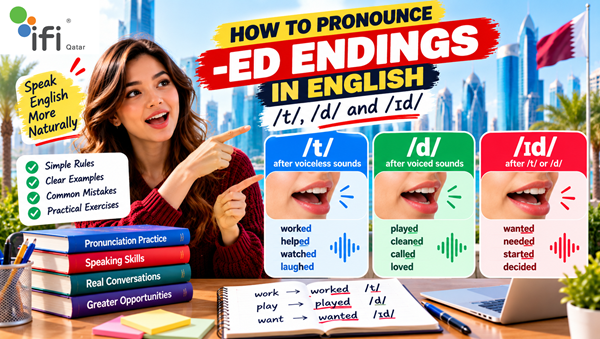
Have you ever wondered why the -ed ending in worked, played, and wanted sounds different in each word? Although these verbs all use the same written ending, their pronunciation is not the same.
Understanding the ED pronunciation rules will help you pronounce regular past-tense verbs more accurately, speak more naturally, and improve your listening comprehension. The good news is that you do not need to memorise the pronunciation of every verb individually. There are three main patterns to learn: /t/, /d/, and /ɪd/.
In this guide, you will discover when to use each sound, learn common examples, practise the rules with exercises, and identify mistakes that can affect your English pronunciation.
What Are the ED Pronunciation Rules in English?
The -ed ending is commonly used to form the past tense and past participle of regular English verbs. However, the letters -ed do not always represent the same sound.
There are three possible pronunciations:
- /t/ — as in worked, helped, and watched.
- /d/ — as in played, cleaned, and called.
- /ɪd/ — as in wanted, needed, and decided.
The most important rule is that the pronunciation of -ed depends on the final sound of the verb in its base form, not simply on its final letter.
For example, laugh ends with the /f/ sound, so laughed ends with /t/. By contrast, play ends with a vowel sound, so played ends with /d/.
Once you understand these patterns, you can usually predict the correct pronunciation without checking a dictionary.
Rule 1: When Is -ED Pronounced /t/?
The -ed ending is pronounced /t/ when a regular verb ends in a voiceless consonant sound, except /t/.
A voiceless sound is produced without vibration of the vocal cords. You can feel the difference by placing your fingers lightly against your throat while producing a sound.
Common voiceless sounds that trigger the /t/ pronunciation include /p/, /k/, /f/, /s/, /ʃ/ (as in she), and /tʃ/ (as in chair).
Examples of -ED Pronounced /t/
| Base verb | Past tense | Final sound in base verb | -ED pronunciation |
|---|---|---|---|
| Work | Worked | /k/ | /t/ |
| Help | Helped | /p/ | /t/ |
| Laugh | Laughed | /f/ | /t/ |
| Watch | Watched | /tʃ/ | /t/ |
| Wash | Washed | /ʃ/ | /t/ |
| Miss | Missed | /s/ | /t/ |
| Finish | Finished | /ʃ/ | /t/ |
| Look | Looked | /k/ | /t/ |
| Stop | Stopped | /p/ | /t/ |
| Dance | Danced | /s/ | /t/ |
Notice that the -ed ending adds no extra syllable in these examples. For instance, worked is normally pronounced as one syllable, /wɜːrkt/, rather than two.
How to Practise the /t/ Sound
Read these sentences aloud, paying attention to the final consonant:
- I worked late yesterday.
- She helped her friend.
- We watched a film last night.
- He finished his homework.
- They stopped near the entrance.
Try not to add an extra vowel after the final /t/. Saying worked as “work-id” or helped as “help-id” introduces an unnecessary syllable.
Rule 2: When Is -ED Pronounced /d/?
The -ed ending is pronounced /d/ when a regular verb ends in a voiced sound, except /d/.
Voiced sounds involve vibration of the vocal cords. These include vowel sounds and voiced consonants such as /b/, /g/, /v/, /z/, /m/, /n/, /l/, and /r/.
If the base verb ends in a vowel sound or a voiced consonant other than /d/, the -ed ending is normally pronounced /d/.
Examples of -ED Pronounced /d/
| Base verb | Past tense | Final sound in base verb | -ED pronunciation |
|---|---|---|---|
| Play | Played | Vowel sound | /d/ |
| Clean | Cleaned | /n/ | /d/ |
| Call | Called | /l/ | /d/ |
| Open | Opened | /n/ | /d/ |
| Love | Loved | /v/ | /d/ |
| Live | Lived | /v/ | /d/ |
| Learn | Learned | /n/ | /d/ |
| Arrive | Arrived | /v/ | /d/ |
| Change | Changed | /dʒ/ | /d/ |
| Rain | Rained | /n/ | /d/ |
As with the /t/ pronunciation, the /d/ ending does not create an extra syllable.
For example, played is normally one syllable, pronounced /pleɪd/. It is not pronounced “play-id.”
How to Practise the /d/ Sound
Practise these sentences at a comfortable speed:
- I played football yesterday.
- She cleaned her room.
- We called our teacher.
- They arrived early.
- He changed his plans.
Focus on connecting the final sound of the base verb to the /d/ ending without inserting an extra vowel.
Rule 3: When Is -ED Pronounced /ɪd/?
The -ed ending is pronounced /ɪd/ when a regular verb ends in the /t/ or /d/ sound.
Unlike the /t/ and /d/ patterns, this pronunciation creates an additional syllable.
For example:
- Want → wanted: /ˈwɒntɪd/
- Need → needed: /ˈniːdɪd/
- Start → started: /ˈstɑːrtɪd/
- Decide → decided: /dɪˈsaɪdɪd/
The extra vowel makes these past-tense forms longer than their base verbs.
Examples of -ED Pronounced /ɪd/
| Base verb | Past tense | Final sound in base verb | -ED pronunciation |
|---|---|---|---|
| Want | Wanted | /t/ | /ɪd/ |
| Need | Needed | /d/ | /ɪd/ |
| Start | Started | /t/ | /ɪd/ |
| Decide | Decided | /d/ | /ɪd/ |
| Visit | Visited | /t/ | /ɪd/ |
| Wait | Waited | /t/ | /ɪd/ |
| End | Ended | /d/ | /ɪd/ |
| Add | Added | /d/ | /ɪd/ |
| Invite | Invited | /t/ | /ɪd/ |
| Repeat | Repeated | /t/ | /ɪd/ |
How to Practise the /ɪd/ Sound
Read these sentences aloud:
- I wanted to learn English.
- She needed more time.
- We visited our friends.
- He decided to take a course.
- They waited for the bus.
Listen for the extra syllable in wanted, needed, visited, decided, and waited.
Avoid shortening these words by removing the /ɪ/ sound. At the same time, do not add an extra syllable to verbs such as worked or played.
The Complete -ED Pronunciation Rules Table
Use this table as a quick reference when learning or reviewing the three patterns.
| Final sound of the base verb | -ED pronunciation | Examples |
|---|---|---|
| Voiceless consonant other than /t/ | /t/ | Worked, helped, washed, laughed |
| Voiced sound other than /d/ | /d/ | Played, cleaned, called, loved |
| /t/ or /d/ | /ɪd/ | Wanted, started, needed, decided |
Here is an easy way to remember the rules:
- Does the verb end in /t/ or /d/? Pronounce -ed as /ɪd/.
- If not, is the final sound voiceless? Pronounce -ed as /t/.
- If the final sound is voiced, pronounce -ed as /d/.
Remember: Always identify the final sound of the base verb. The final written letter alone does not determine the pronunciation.
Common Mistakes When Pronouncing -ED Endings
Even learners with strong vocabulary and grammar skills can struggle with regular verb endings. The following mistakes are particularly common.
1. Pronouncing Every -ED Ending as /ɪd/
Some learners pronounce worked, played, and wanted as though all three have an extra syllable.
This is incorrect because only verbs ending in /t/ or /d/ in their base form use the /ɪd/ pronunciation.
How to improve: Group verbs according to their final sounds and practise them together.
- /t/: worked, helped, watched
- /d/: played, cleaned, called
- /ɪd/: wanted, needed, started
2. Confusing the /t/ and /d/ Sounds
The /t/ and /d/ sounds can be difficult to distinguish, especially when speaking quickly.
How to improve: Practise pairs such as worked and played, or helped and cleaned. Listen carefully to the final sound and compare your pronunciation with a reliable audio recording.
3. Ignoring the Final Sound of the Base Verb
The spelling of a word can be misleading. For example, laugh ends with the letters gh, but its final sound is /f/. Therefore, laughed ends with /t/.
How to improve: Learn the pronunciation of the base verb first. Then apply the -ed rule to its final sound.
4. Adding Extra Syllables
Words such as worked, watched, and played should not normally gain an extra syllable when you add -ed.
How to improve: Clap once for each syllable while practising. Clap once for worked, once for played, and twice for wanted.
5. Speaking Too Quickly During Practice
When you focus on speed before accuracy, it becomes easier to mix up the three endings.
How to improve: Start slowly, pronounce the final sound clearly, and then gradually increase your speed. Your goal is accurate, natural speech rather than exaggerated pronunciation.
Practice Exercises: Test Your -ED Pronunciation
Now that you know the three rules, test your understanding with the following exercises.
Exercise 1: Choose the Correct Pronunciation
Decide whether the -ed ending is pronounced /t/, /d/, or /ɪd/.
- Worked
- Played
- Wanted
- Helped
- Needed
- Cleaned
- Watched
- Decided
- Laughed
- Visited
- Opened
- Finished
Exercise 2: Complete the Sentences
Read each sentence aloud and pay attention to the past-tense verb.
- I ________ (finish) my homework before dinner.
- She ________ (visit) her family last weekend.
- We ________ (play) tennis yesterday.
- He ________ (need) help with the assignment.
- They ________ (watch) a documentary last night.
- I ________ (call) my friend after work.
- She ________ (decide) to study English.
- We ________ (stop) at the supermarket.
Exercise 3: Sort the Verbs Into Three Groups
Place each verb into the correct pronunciation category.
Verbs: asked, arrived, wanted, worked, enjoyed, started, missed, cleaned, needed, washed, learned, ended.
- Group A: /t/
- Group B: /d/
- Group C: /ɪd/
Try to complete the activity without looking at the rules table.
Exercise 4: Read a Short Paragraph Aloud
Read the following paragraph slowly, then repeat it at a natural speaking speed.
“Yesterday, I finished my work early and visited a friend. We watched a film, ordered dinner, and talked about our plans. Later, I decided to study English because I wanted to improve my speaking skills.”
As you read, identify every regular past-tense verb and classify its -ed ending as /t/, /d/, or /ɪd/.
Pay special attention to the contrast between finished, visited, watched, ordered, talked, decided, and wanted.
Answer Key
Exercise 1 Answers
| Word | Correct pronunciation |
|---|---|
| Worked | /t/ |
| Played | /d/ |
| Wanted | /ɪd/ |
| Helped | /t/ |
| Needed | /ɪd/ |
| Cleaned | /d/ |
| Watched | /t/ |
| Decided | /ɪd/ |
| Laughed | /t/ |
| Visited | /ɪd/ |
| Opened | /d/ |
| Finished | /t/ |
Exercise 2 Answers
- Finished — /t/
- Visited — /ɪd/
- Played — /d/
- Needed — /ɪd/
- Watched — /t/
- Called — /d/
- Decided — /ɪd/
- Stopped — /t/
Exercise 3 Answers
- /t/: asked, worked, missed, washed
- /d/: arrived, enjoyed, cleaned, learned
- /ɪd/: wanted, started, needed, ended
Exercise 4 Answers
- Finished — /t/
- Visited — /ɪd/
- Watched — /t/
- Ordered — /d/
- Talked — /t/
- Decided — /ɪd/
- Wanted — /ɪd/
How Long Does It Take to Learn the -ED Pronunciation Rules?
Many learners can understand the three basic rules in a single study session. However, using them consistently in spontaneous conversation takes practice.
Your progress will depend on your current pronunciation skills, how often you practise, and whether you receive useful feedback.
For steady improvement, try the following approach:
- Days 1–2: Learn the three rules and memorise a few examples of each.
- Days 3–4: Practise sorting regular verbs into the correct groups.
- Days 5–7: Read short passages aloud and record yourself.
- Week 2: Use regular past-tense verbs in conversations and short spoken stories.
Repeat difficult words until you can pronounce them accurately without pausing to remember the rule.
Improve Your English Pronunciation With Structured Practice
Learning the rules is an important first step, but pronunciation becomes more reliable when you apply it in real conversations. You need to hear the differences, practise producing the sounds, and recognise mistakes that may be difficult to notice on your own.
At IFI Qatar, you can explore English learning options designed to help you develop your speaking and pronunciation skills. Depending on your current level and goals, guided practice can help you work on individual sounds, word stress, sentence rhythm, and speaking fluency.
Whether you are improving your everyday communication or preparing for IELTS, start with a clear understanding of your current strengths and the areas that need attention.
Ready to improve your English pronunciation? Contact IFI Qatar to discuss available English courses and speaking practice options in Doha or online.
Frequently Asked Questions About ED Pronunciation Rules
What are the three ED pronunciation rules?
The -ed ending has three common pronunciations: /t/, /d/, and /ɪd/. The correct sound depends on the final sound of the base verb.
When is -ed pronounced /t/?
The -ed ending is pronounced /t/ after a voiceless consonant other than /t/. Examples include worked, helped, watched, and laughed.
When is -ed pronounced /d/?
The -ed ending is pronounced /d/ after a voiced sound other than /d/. Examples include played, cleaned, called, and loved.
When is -ed pronounced /ɪd/?
The -ed ending is pronounced /ɪd/ when the base verb ends in the /t/ or /d/ sound. Examples include wanted, needed, started, and decided.
How can I remember the ED pronunciation rules easily?
First, check whether the base verb ends in /t/ or /d/. If it does, use /ɪd/. If not, check whether the final sound is voiced or voiceless: voiceless sounds take /t/, while voiced sounds take /d/.
Is the -ed ending always pronounced as a separate syllable?
No. The -ed ending creates an additional syllable only when it is pronounced /ɪd/. In words such as worked and played, it does not create an extra syllable.
Why is correct -ed pronunciation important?
Correct pronunciation helps make past-tense verbs easier to understand and improves the natural rhythm of spoken English. It can also support clearer communication in everyday conversations and IELTS Speaking.
Can I improve my -ed pronunciation through self-study?
Yes. You can practise by grouping verbs according to their final sounds, listening to reliable pronunciation recordings, reading aloud, and recording yourself. Feedback from a teacher or speaking partner can help you identify persistent errors.
Final Thoughts
The three ED pronunciation rules are straightforward once you focus on sounds rather than spelling. Use /t/ after voiceless consonants other than /t/, /d/ after voiced sounds other than /d/, and /ɪd/ after /t/ and /d/.
Practise a few verbs every day, listen carefully to natural English, and use the endings in complete sentences. With regular practice, you can make your past-tense pronunciation clearer and more natural.
If you want personalised guidance, explore English pronunciation and speaking course options at IFI Qatar and take the next step toward more confident communication.