

Currently Empty: ر.ق 0,00


IELTS
اختبار IELTS تجريبي كامل Academic مع نتيجة تقديرية
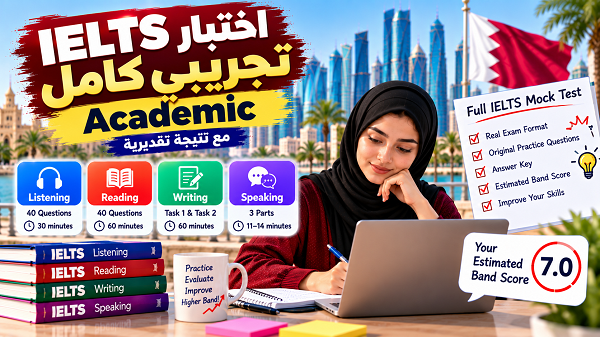
إذا كنت تستعد لاختبار IELTS Academic وتريد معرفة مستواك قبل حجز الامتحان، فهذا اختبار IELTS تجريبي Academic يمنحك فرصة لتجربة الأقسام الأربعة في اختبار واحد: Listening وReading وWriting وSpeaking.
صُمم هذا IELTS Academic Mock Test ليحاكي طبيعة الاختبار الحقيقي قدر الإمكان، مع أسئلة تدريبية أصلية، Answer Key، طريقة لحساب نتيجة Listening وReading، ومعايير تقديرية لمراجعة Writing وSpeaking.
مهم: هذا الاختبار التدريبي من IFI Qatar وليس اختبار IELTS رسميًا، ولا يمكن اعتبار النتيجة التقديرية نتيجة رسمية أو بديلًا عن الاختبار الحقيقي.
كيف تستخدم اختبار IELTS التجريبي Academic؟
للحصول على نتيجة أكثر واقعية، تعامل مع هذا الاختبار كأنك في يوم الامتحان.
قبل بدء IELTS Academic Mock Test
- اختر مكانًا هادئًا.
- أغلق الهاتف والإشعارات.
- استخدم مؤقتًا.
- لا تستخدم قاموسًا أو Google.
- لا تراجع الإجابات أثناء الحل.
- جهّز ورقة لتسجيل إجاباتك.
- حاول حل الأقسام في الوقت المحدد.
يتكون IELTS Academic من أربعة أقسام: Listening وReading وWriting وSpeaking. ويبلغ الوقت الإجمالي للاختبار الكتابي حوالي ساعتين و45 دقيقة، بينما يستغرق Speaking عادةً من 11 إلى 14 دقيقة.
ما الوقت المقترح لكل قسم؟
| القسم | الوقت التقريبي | عدد الأسئلة/المهام |
|---|---|---|
| Listening | حوالي 30 دقيقة | 40 سؤالًا |
| Reading | 60 دقيقة | 40 سؤالًا |
| Writing | 60 دقيقة | مهمتان |
| Speaking | 11–14 دقيقة | 3 أجزاء |
اختبار IELTS Listening تجريبي Academic
في اختبار Listening الرسمي توجد أربعة Parts و40 سؤالًا، ويتم الاستماع إلى التسجيلات مرة واحدة فقط. لذلك، للحصول على تجربة أقرب إلى الامتحان الحقيقي، يجب ألا تقرأ Transcript قبل الإجابة.
IELTS Listening Part 1: Conversation
Questions 1–10
اقرأ الأسئلة أولًا، ثم استخدم Transcript الموجود لاحقًا في هذه الصفحة لمحاكاة التسجيل. إذا كنت تدرس بمفردك، يمكنك استخدام خاصية القراءة الصوتية أو جعل شخص آخر يقرأ النص مرة واحدة فقط.
Complete the form below.
IELTS Study Centre Registration
- Student’s full name: ________
- Course: IELTS ________
- Preferred class: ________
- Course duration: ________ weeks
- Classes begin on: ________
- Class time: ________ p.m.
- Number of students in the class: ________
- Course fee: £________
- Students must bring a ________ to class.
- The centre is located near the ________.
IELTS Listening Part 2: Information Talk
Questions 11–15
Choose the correct answer, A, B or C.
- What is the main purpose of the talk?
A. To introduce a new university
B. To explain changes to a study centre
C. To advertise a language course
- Where can students find the new computer room?
A. On the first floor
B. On the second floor
C. In the library
- Students who want individual support should:
A. book online
B. visit the reception desk
C. contact their teacher
- The new study area is mainly designed for:
A. group discussions
B. private exams
C. teacher meetings
- The centre will close early on:
A. Friday
B. Saturday
C. Sunday
Questions 16–20
Match each facility with the correct location.
Locations
A. First floor
B. Second floor
C. Ground floor
D. Outside the main building
- Reception — ________
- Quiet study area — ________
- Speaking practice rooms — ________
- Café — ________
- Bicycle parking — ________
IELTS Listening Part 3: University Discussion
Questions 21–25
Choose the correct answer.
- Why did the students choose their research topic?
A. Their professor suggested it.
B. They both have personal experience with it.
C. They found it in a textbook.
- What is the biggest problem with their first idea?
A. It is too expensive.
B. It is too broad.
C. It is difficult to research.
- What does Sara suggest doing?
A. Interviewing university students
B. Sending an online questionnaire
C. Reading more academic books
- The students decide to focus mainly on:
A. study habits
B. social media use
C. online classes
- When will they meet their professor?
A. Monday morning
B. Tuesday afternoon
C. Wednesday afternoon
Questions 26–30
Complete the notes.
Research Project
- Main research group: university ________
- Number of participants: approximately ________
- Main research method: online ________
- Expected research period: ________ weeks
- Final presentation: ________ minutes
IELTS Listening Part 4: Academic Lecture
Questions 31–40
Complete the notes below.
Urban Green Spaces
- Green spaces can reduce urban ________.
- Trees provide shade and can lower local ________.
- Parks may encourage people to become more physically ________.
- Green areas can also improve people’s mental ________.
- Researchers found that access to nature may reduce ________.
- Urban gardens can provide fresh ________.
- Community gardens can strengthen social ________.
- One challenge is the cost of long-term ________.
- Another issue is unequal access between different ________.
- Successful green-space projects usually involve local ________.
Transcript لاختبار IELTS Listening التجريبي
لا تقرأ هذا القسم قبل إنهاء الأسئلة.
Transcript – Part 1
Receptionist: Good morning, IELTS Study Centre. How can I help you?
Student: I’d like to register for an IELTS course.
Receptionist: Certainly. Can I take your full name?
Student: Daniel Carter.
Receptionist: And which course are you interested in?
Student: IELTS Academic.
Receptionist: We have several options. Would you prefer the morning or afternoon class?
Student: Afternoon, please.
Receptionist: The course lasts eight weeks. The next course begins on the 14th of March.
Student: That sounds good.
Receptionist: Classes start at 5:30 p.m. There are currently twelve students in the class.
Student: How much is the course?
Receptionist: It’s £240.
Student: Is there anything I need to bring?
Receptionist: Please bring a notebook. We provide all other materials.
Student: And where are you located?
Receptionist: We’re on Green Street, just opposite the central station.
Transcript – Part 2
Welcome to the Riverside Study Centre.
We have recently made several changes to improve the facilities available to students.
The reception area remains on the ground floor, but the new computer room is now located on the second floor.
Students who want individual academic support should book an appointment online before visiting the support team.
Our new quiet study area is designed for students who need a place to work independently. Group discussions should take place in the designated discussion rooms.
The centre’s café is on the first floor, while bicycle parking is available outside the main building.
Please remember that the centre will close early on Saturday at 4 p.m.
Transcript – Part 3
Tom: Have you decided what we should research for our university project?
Sara: I was thinking about social media and students, but I think that’s too broad.
Tom: I agree. We need something more specific.
Sara: What about study habits among university students?
Tom: That could work. We could send an online questionnaire.
Sara: Good idea. We probably need around fifty participants.
Tom: How long should we collect the information?
Sara: Maybe three weeks?
Tom: That should be enough. We can then analyse the responses.
Sara: When should we see Professor Wilson?
Tom: She’s available on Wednesday afternoon.
Sara: Perfect. Let’s meet her then.
Transcript – Part 4
Urban green spaces play an important role in modern cities.
One benefit is temperature control. Trees provide shade and can reduce local temperatures during hot weather.
Green spaces may also encourage people to become more physically active because parks provide convenient places for walking and exercise.
Researchers have also studied the relationship between nature and mental health. Spending time in green environments may reduce stress and improve general psychological well-being.
Urban gardens have another potential benefit: they can provide fresh food for local communities.
Community gardens can also strengthen social connections by creating opportunities for residents to work together.
However, maintaining green spaces can be expensive. Long-term maintenance is an important consideration for city authorities.
Researchers have also identified unequal access as a challenge. Some neighbourhoods have much better access to parks than others.
Successful projects therefore often involve local communities in planning and decision-making.
إجابات IELTS Listening Mock Test
| السؤال | الإجابة |
|---|---|
| 1 | Carter |
| 2 | Academic |
| 3 | afternoon |
| 4 | 8 |
| 5 | 14 March |
| 6 | 5:30 |
| 7 | 12 |
| 8 | 240 |
| 9 | notebook |
| 10 | central station |
| 11 | B |
| 12 | B |
| 13 | A |
| 14 | A |
| 15 | B |
| 16 | C |
| 17 | B |
| 18 | B |
| 19 | A |
| 20 | D |
| 21 | C |
| 22 | B |
| 23 | B |
| 24 | A |
| 25 | C |
| 26 | students |
| 27 | 50 |
| 28 | questionnaire |
| 29 | 3 |
| 30 | 10 |
| 31 | temperatures |
| 32 | temperatures |
| 33 | active |
| 34 | health |
| 35 | stress |
| 36 | food |
| 37 | connections |
| 38 | maintenance |
| 39 | neighbourhoods |
| 40 | communities |
اختبار IELTS Reading Academic تجريبي كامل
اختبار Academic Reading يتكون من ثلاثة نصوص و40 سؤالًا خلال 60 دقيقة. وتشمل أنواع الأسئلة في IELTS Academic أنماطًا مثل Multiple Choice وTrue/False/Not Given وMatching Headings وSummary Completion وغيرها.
Reading Passage 1: The Future of Urban Farming
As cities continue to grow, producing food close to where people live has become an increasingly important issue. Urban farming refers to the cultivation of vegetables, herbs and other crops within cities. This may take place on rooftops, in community gardens, on balconies or in specially designed indoor facilities.
One reason urban farming has attracted attention is the distance that food often travels before reaching consumers. Producing some food locally may reduce the distance between farms and urban households. However, urban agriculture is not intended to replace traditional farming. Instead, it can complement existing food systems by supplying selected products locally.
Technology has also changed the possibilities for urban agriculture. Some indoor farms use artificial lighting, controlled temperatures and carefully managed water systems. These methods allow crops to be grown throughout the year, even in environments where traditional outdoor farming would be difficult.
Water efficiency is another important consideration. Traditional agriculture can require substantial amounts of water, while some modern indoor systems recycle much of the water used by plants. This can reduce waste, although the technology itself may require considerable investment.
Urban farms may also provide social benefits. Community gardens can create spaces where residents meet, share knowledge and work together. In some cities, schools use gardens as educational environments where students can learn about food production, biology and environmental responsibility.
Nevertheless, urban farming faces challenges. Land in cities can be expensive, and rooftop or indoor farms may require significant investment. Energy consumption can also be high in facilities that rely heavily on artificial lighting and climate control.
For this reason, researchers generally argue that urban farming should be evaluated according to local conditions rather than treated as a universal solution. In some cities, community gardens may provide the greatest benefits, while in others, advanced indoor farms may be more practical.
Questions 1–5: True / False / Not Given
- Urban farming can take place on rooftops.
- Urban farming is expected to replace traditional agriculture completely.
- Some indoor farms can produce crops throughout the year.
- All urban farms use recycled water.
- Schools sometimes use urban gardens for educational purposes.
Questions 6–9: Choose the correct answer
- One possible advantage of urban farming is:
A. eliminating traditional agriculture
B. reducing the distance food travels
C. increasing international food trade
D. reducing the cost of all food
- Some indoor farming systems control:
A. rainfall only
B. soil colour
C. temperature and lighting
D. transportation costs
- One problem associated with indoor farming is:
A. lack of technology
B. excessive rainfall
C. energy consumption
D. limited educational value
- The writer suggests that urban farming:
A. works equally well everywhere
B. should only be used in schools
C. should be evaluated according to local conditions
D. is less effective than traditional farming
Questions 10–13: Complete the sentences
Choose NO MORE THAN TWO WORDS from the passage.
- Some urban farms are built on ________.
- Indoor systems may recycle much of the ________ used by plants.
- Community gardens can create opportunities for residents to ________ together.
- Urban farms may require significant financial ________.
Reading Passage 2: Why Sleep Matters for Learning
Sleep is often treated as a period in which the brain becomes inactive. Modern research, however, suggests that sleep plays an important role in learning and memory.
When people learn something new, information initially needs to be processed and organised. Sleep appears to help the brain strengthen certain memories, making them easier to retrieve later. This process is particularly relevant for students who need to remember large amounts of information.
The relationship between sleep and learning is not simply about the total number of hours someone spends in bed. Sleep quality also matters. Frequent interruptions can make it difficult for the brain to complete the normal sequence of sleep stages.
Researchers have identified several stages of sleep, each associated with different patterns of brain activity. Some stages appear to be particularly important for memory consolidation, while others may support emotional processing and physical recovery.
For students, the practical implication is clear: studying late into the night may not always be the most effective strategy. A student who spends several extra hours studying but sleeps very little may perform worse the following day than a student who studies for a shorter period and gets adequate rest.
Sleep also affects attention. A tired student may find it more difficult to maintain concentration during a lecture or while reading a complex academic text. This can indirectly affect learning because understanding new information requires sustained attention.
Experts therefore recommend developing consistent sleep habits. Going to bed and waking up at similar times can help establish a stable routine. Reducing exposure to stimulating activities immediately before bedtime may also make it easier to fall asleep.
However, individual needs vary. There is no single sleep schedule that is ideal for every person. Students should therefore pay attention to how different routines affect their concentration, mood and academic performance.
Questions 14–18: Choose the correct heading
Choose the correct heading for paragraphs A–E.
Headings
i. The importance of a regular routine
ii. Sleep and academic performance
iii. Different stages of sleep
iv. Sleep is not simply inactivity
v. Individual differences
vi. The relationship between sleep and memory
- Paragraph A — ________
- Paragraph B — ________
- Paragraph C — ________
- Paragraph D — ________
- Paragraph E — ________
Questions 19–22: True / False / Not Given
- Sleep helps strengthen some memories.
- The number of hours in bed is the only factor affecting sleep quality.
- Studying all night is always the best way to prepare for an exam.
- Lack of sleep can affect concentration.
Questions 23–26: Complete the summary
Choose NO MORE THAN TWO WORDS.
Sleep can support the process of memory ________.
Students who sleep poorly may experience problems with ________.
A consistent sleep ________ may help students develop better habits.
However, people may have different individual ________.
Reading Passage 3: The Changing Role of Public Libraries
Public libraries have traditionally been associated with books and printed information. However, the role of the modern library has expanded considerably as technology has changed how people access knowledge.
The arrival of the internet initially created uncertainty about the future of libraries. If information could be accessed from a computer at home, some observers questioned whether physical library buildings would remain necessary.
In practice, many libraries have adapted rather than disappeared. They now provide access to computers, digital resources, training programmes and community events. In some areas, libraries also provide internet access for people who do not have reliable connections at home.
This change is particularly important because access to technology is not evenly distributed. Although smartphones and computers are widespread, differences remain in the quality of internet connections, access to suitable devices and people’s ability to use digital services effectively.
Libraries can therefore contribute to digital inclusion. Staff may help visitors search for reliable information, complete online forms or develop basic digital skills. Some libraries also provide workshops covering topics such as online safety, job applications and digital communication.
Another important development is the library’s role as a community space. Modern libraries may host lectures, language classes, children’s activities and discussion groups. These activities can create opportunities for people from different backgrounds to meet.
However, the transformation of libraries requires investment. Digital services need updated equipment, reliable internet connections and staff training. Libraries also need to understand changing community needs rather than simply adding technology for its own sake.
The future of libraries is therefore unlikely to depend on choosing between books and technology. Instead, successful libraries may combine traditional resources with digital services and community programmes.
Questions 27–31: Choose the correct answer
- What initially caused uncertainty about libraries?
A. The rising cost of books
B. The growth of internet access
C. A shortage of library staff
D. Changes in school systems
- Libraries can support digital inclusion by:
A. selling computers
B. providing digital assistance
C. replacing universities
D. limiting internet access
- Some libraries offer workshops about:
A. professional sports
B. online safety
C. international travel
D. architecture
- Why do libraries need investment?
A. To reduce the number of visitors
B. To replace all printed books
C. To maintain digital services and train staff
D. To stop community events
- The writer believes successful libraries will probably:
A. focus only on books
B. abandon physical buildings
C. combine traditional and digital services
D. stop offering educational programmes
Questions 32–35: Complete the sentences
Choose NO MORE THAN TWO WORDS.
- Some people do not have reliable internet ________ at home.
- Library staff can help visitors find ________ information.
- Libraries may organise language ________.
- Digital services require updated ________.
Questions 36–40: True / False / Not Given
- Every modern library provides the same digital services.
- Digital access is equally available to all members of society.
- Libraries can help people develop digital skills.
- Community events can bring different groups together.
- The writer believes printed books will completely disappear.
إجابات IELTS Reading Mock Test
Reading Passage 1
| السؤال | الإجابة |
|---|---|
| 1 | True |
| 2 | False |
| 3 | True |
| 4 | Not Given |
| 5 | True |
| 6 | B |
| 7 | C |
| 8 | C |
| 9 | C |
| 10 | rooftops |
| 11 | water |
| 12 | work |
| 13 | investment |
Reading Passage 2
| السؤال | الإجابة |
|---|---|
| 14 | iv |
| 15 | vi |
| 16 | iii |
| 17 | ii |
| 18 | i |
| 19 | True |
| 20 | False |
| 21 | False |
| 22 | True |
| 23 | consolidation |
| 24 | concentration |
| 25 | routine |
| 26 | needs |
Reading Passage 3
| السؤال | الإجابة |
|---|---|
| 27 | B |
| 28 | B |
| 29 | B |
| 30 | C |
| 31 | C |
| 32 | connections |
| 33 | reliable |
| 34 | classes |
| 35 | equipment |
| 36 | Not Given |
| 37 | False |
| 38 | True |
| 39 | True |
| 40 | False |
كيف تحسب نتيجة IELTS Reading التجريبي Academic؟
احسب عدد الإجابات الصحيحة من أصل 40.
وفق جداول IELTS الإرشادية، قد تعادل بعض الدرجات الخام في Academic Reading تقريبًا:
| الإجابات الصحيحة | Band تقريبي |
|---|---|
| 35 | 8.0 |
| 30 | 7.0 |
| 23 | 6.0 |
| 15 | 5.0 |
هذه التحويلات إرشادية، وقد تختلف الدرجة المطلوبة قليلًا من نسخة اختبار إلى أخرى.
اختبار IELTS Writing Academic تجريبي
يحتوي IELTS Academic Writing على مهمتين خلال 60 دقيقة. في Task 1 تكتب عادةً وصفًا أو ملخصًا لمعلومات مرئية مثل Graph أو Chart أو Table أو Diagram، بينما Task 2 يتطلب كتابة Essay حول رأي أو مشكلة أو حجة. ويكون Task 2 ذا وزن أكبر في حساب درجة Writing.
IELTS Academic Writing Task 1
Time: 20 minutes
The table below shows the percentage of university students in three different age groups who used public transport regularly in 2015 and 2025.
| Age group | 2015 | 2025 |
|---|---|---|
| 18–24 | 62% | 78% |
| 25–34 | 48% | 69% |
| 35–49 | 31% | 52% |
Write at least 150 words.
Summarise the information by selecting and reporting the main features, and make comparisons where relevant.
IELTS Academic Writing Task 2
Time: 40 minutes
Some people believe that universities should focus mainly on subjects that prepare students for employment. Others believe that universities should provide a broader education, including subjects that may not have a direct connection with future jobs.
Discuss both views and give your own opinion.
Write at least 250 words.
كيف تراجع Writing بعد الانتهاء؟
قيّم إجابتك وفق أربعة معايير رئيسية:
- Task Achievement / Task Response
- Coherence and Cohesion
- Lexical Resource
- Grammatical Range and Accuracy
ويتم تقييم Task 1 وTask 2 وفق هذه المعايير، مع إعطاء Task 2 وزنًا أكبر في نتيجة Writing.
اختبار IELTS Speaking Academic تجريبي
اختبار Speaking في IELTS Academic يتكون من ثلاثة Parts ويستغرق عادةً 11–14 دقيقة. Speaking هو نفسه في IELTS Academic وGeneral Training.
IELTS Speaking Part 1
أجب عن الأسئلة التالية بشكل طبيعي ودون حفظ إجابات جاهزة.
Topic: Studies
- What do you study?
- Why did you choose this subject?
- What do you enjoy most about your studies?
- Is there anything you find difficult about your studies?
Topic: Free Time
- What do you usually do in your free time?
- Do you prefer spending time alone or with other people?
- Have your hobbies changed over the years?
- What new activity would you like to try?
IELTS Speaking Part 2
You have one minute to prepare.
Describe a skill you would like to learn.
You should say:
- what the skill is
- why you want to learn it
- how you would learn it
- and explain how this skill could help you in the future.
تحدث لمدة تصل إلى دقيقتين.
IELTS Speaking Part 3
ناقش الأسئلة التالية بمزيد من التفصيل:
- Why do people need to continue learning new skills?
- Do you think universities should teach more practical skills?
- What skills will be important for future workers?
- Has technology changed the way people learn?
- Do you think online learning can replace traditional classrooms?
- Why do some adults stop learning new things?
كيف تحسب نتيجة IELTS التجريبي Academic؟
هناك فرق مهم بين نتيجة Listening وReading وبين التقييم في Writing وSpeaking.
نتيجة Listening
يمكنك مقارنة نتيجتك من أصل 40 بالتحويلات الإرشادية التالية:
| Correct Answers | Approximate Band |
|---|---|
| 35 | 8.0 |
| 30 | 7.0 |
| 23 | 6.0 |
| 16 | 5.0 |
التحويلات الرسمية نفسها توضح أن الدرجة المطلوبة لكل Band قد تختلف قليلًا حسب نسخة الاختبار.
نتيجة Reading
بالنسبة إلى Academic Reading، يمكن استخدام التقدير التالي كنقطة مرجعية:
| Correct Answers | Approximate Band |
|---|---|
| 35 | 8.0 |
| 30 | 7.0 |
| 23 | 6.0 |
| 15 | 5.0 |
مرة أخرى، هذه ليست معادلة ثابتة لكل نسخة IELTS، وإنما تحويل إرشادي.
كيف تقيّم Writing؟
لا تعتمد فقط على عدد الكلمات أو القواعد.
اسأل نفسك:
- هل أجبت عن السؤال بالكامل؟
- هل وضعت Introduction واضحة؟
- هل الأفكار مرتبة منطقيًا؟
- هل استخدمت أمثلة مناسبة؟
- هل استخدمت Vocabulary بشكل طبيعي؟
- هل توجد أخطاء Grammar متكررة؟
- هل تستطيع استخدام Simple وComplex Structures بشكل مناسب؟
كيف تقيّم Speaking؟
راجع أداءك في:
- Fluency and Coherence
- Lexical Resource
- Grammatical Range and Accuracy
- Pronunciation
هذه هي المعايير الأربعة التي يستخدمها IELTS لتقييم Speaking.
كيف تحسب Overall IELTS Band Score؟
بعد الحصول على تقدير لكل مهارة، اجمع درجات:
Listening + Reading + Writing + Speaking
ثم اقسم الناتج على 4.
مثال:
| Skill | Estimated Band |
|---|---|
| Listening | 7.0 |
| Reading | 7.0 |
| Writing | 6.5 |
| Speaking | 7.0 |
المتوسط:
7.0 + 7.0 + 6.5 + 7.0 = 27.5
27.5 ÷ 4 = 6.875
والنتيجة النهائية ستكون تقريبًا Band 7.0 وفق قواعد التقريب الخاصة بـ IELTS.
ماذا تعني نتيجة IELTS التجريبي؟
إذا حصلت على Band 7 أو أعلى
هذا مؤشر جيد على أن مستواك قد يكون قريبًا من بعض متطلبات القبول التي تطلب Band 7، لكن يجب مقارنة نتيجتك بالمتطلبات المحددة للجامعة أو المؤسسة التي تتقدم إليها.
إذا حصلت على Band 6–6.5
لديك أساس جيد، لكن قد تحتاج إلى تحسين مهارة أو أكثر، خصوصًا إذا كان هدفك Academic Band 7 أو أعلى.
إذا حصلت على Band 5–5.5
من الأفضل عدم الانتقال مباشرة إلى حل Mock Tests بشكل متكرر. ركز أولًا على أساسيات اللغة، Vocabulary، Grammar والمهارات الأربع.
إذا كانت النتيجة أقل من Band 5
ابدأ بتقييم مستوى اللغة الإنجليزية بشكل أوسع، ثم ضع خطة IELTS Preparation تتناسب مع مستواك الحالي بدل محاولة حفظ إجابات الاختبار.
كيف تعرف أي مهارة تخفض نتيجتك؟
لا تنظر إلى Overall Band فقط.
قد تحصل مثلًا على:
- Listening: 7.5
- Reading: 7.0
- Writing: 5.5
- Speaking: 6.5
في هذه الحالة، المشكلة الأساسية ليست في Listening أو Reading؛ بل في Writing.
لذلك، أهم فائدة من IELTS Academic Mock Test ليست معرفة رقم واحد فقط، وإنما اكتشاف المهارة التي تمنعك من الوصول إلى الدرجة المطلوبة.
ما الفرق بين IELTS Academic Mock Test والدراسة العادية؟
حل الأسئلة بشكل عشوائي لا يعطيك صورة كاملة عن مستواك.
الـ Mock Test الجيد يجب أن يساعدك على:
- قياس مستواك الحالي.
- اكتشاف نقاط الضعف.
- معرفة مدى قدرتك على إدارة الوقت.
- التعرف على أنواع الأسئلة التي تسبب لك مشاكل.
- اختبار قدرتك على التركيز لفترة طويلة.
- معرفة ما إذا كنت قريبًا من Target Band.
لذلك، من الأفضل استخدام الاختبار ضمن دورة:
Test → Review → Error Analysis → Targeted Practice → Retest
متى يجب أن تحل IELTS Academic Mock Test؟
في بداية التحضير
استخدم أول Mock Test كـ Diagnostic Test.
لا تهتم فقط بالنتيجة؛ سجل الأخطاء التي ارتكبتها.
في منتصف خطة IELTS Preparation
أعد الاختبار بعد عدة أسابيع لمعرفة ما إذا كانت نقاط الضعف تتحسن.
قبل امتحان IELTS
استخدم Mock Tests لمحاكاة ظروف الامتحان، خصوصًا إدارة الوقت والقدرة على التركيز.
لكن لا تجعل هدفك هو حل أكبر عدد ممكن من الاختبارات. تحليل الأخطاء بعد كل اختبار أهم من مجرد حل اختبار جديد.
ما الأخطاء الأكثر شيوعًا في IELTS Academic Mock Test؟
حل الاختبار بدون وقت
إذا لم تستخدم الوقت المحدد، قد تحصل على نتيجة أعلى من مستواك الحقيقي في الامتحان.
البحث عن معنى كل كلمة
في Reading، ليس من الضروري فهم كل كلمة في النص. ركز على السؤال، Keywords، Paraphrasing والسياق.
إعادة Listening عدة مرات
في الاختبار الحقيقي، التسجيلات تُسمع مرة واحدة فقط، لذلك يجب أن تحاول محاكاة هذا الشرط في التدريب.
كتابة Essay بدون مراجعة
اترك دقائق في نهاية Writing لمراجعة Grammar وSpelling وSentence Structure.
حفظ إجابات Speaking
حفظ إجابات كاملة قد يجعل كلامك غير طبيعي. الأفضل أن تتدرب على الأفكار واللغة وطريقة تطوير الإجابة.
الاعتماد على Overall Band فقط
قد يكون لديك فرق كبير بين المهارات الأربع. لذلك يجب تحليل كل Skill بشكل مستقل.
كيف ترفع نتيجتك بعد IELTS Academic Mock Test؟
بعد انتهاء الاختبار، أنشئ جدول Error Log.
| Skill | Question Type | My Error | Why? | Action |
|---|---|---|---|---|
| Listening | Form Completion | Wrong spelling | Spelling | Dictation |
| Reading | T/F/NG | Confused NG | Weak evidence analysis | Practice |
| Writing | Task 2 | Weak example | Idea development | Essay practice |
| Speaking | Part 3 | Short answers | Weak development | Speaking practice |
بعد ذلك، لا تعالج كل الأخطاء في الوقت نفسه.
ابدأ بالمهارة التي تمنعك من الوصول إلى Target Band.
هل هذا اختبار IELTS رسمي؟
لا.
هذا IELTS Academic Mock Test هو اختبار تدريبي أصلي من IFI Qatar، وتم تصميم أسئلته لأغراض التدريب ومحاكاة تجربة الاختبار.
لا تستخدم نتيجته كبديل عن IELTS Test Report Form، ولا تعتبر Band التقديري في Writing أو Speaking نتيجة رسمية.
للتدرب على الاختبار الرسمي، يمكنك أيضًا الرجوع إلى موارد IELTS الرسمية وأسئلة العينة المتاحة من IELTS.
الأسئلة الشائعة حول اختبار IELTS التجريبي Academic
ما هو اختبار IELTS التجريبي Academic؟
هو اختبار تدريبي يحاكي أقسام IELTS Academic الأربعة: Listening وReading وWriting وSpeaking، ويساعدك على معرفة مستواك والاستعداد للامتحان.
كم عدد أسئلة IELTS Academic؟
يحتوي Listening على 40 سؤالًا، ويحتوي Academic Reading أيضًا على 40 سؤالًا. Writing يتكون من مهمتين، بينما Speaking يتكون من ثلاثة Parts.
هل IELTS Academic Mock Test يعطي Band Score حقيقي؟
لا. يمكن استخدام Listening وReading للحصول على تقدير قريب من Band، بينما Writing وSpeaking يحتاجان إلى تقييم بشري وفق معايير IELTS للحصول على تقدير أكثر موثوقية.
هل يمكنني استخدام هذا الاختبار إذا كنت أستعد للدراسة في الخارج؟
نعم. IELTS Academic مخصص بشكل أساسي لمن يحتاج إلى إثبات مستوى اللغة للدراسة في مرحلة البكالوريوس أو الدراسات العليا، وكذلك لبعض أغراض التسجيل المهني.
هل Band 7 نتيجة جيدة في IELTS؟
نعم. يصنف IELTS Band 7 على أنه مستوى Good، ويشير إلى قدرة تشغيلية جيدة في استخدام اللغة مع بعض الأخطاء أو حالات سوء الفهم العرضية.
كم أحتاج في Reading للحصول على Band 7؟
في Academic Reading، تشير جداول IELTS الإرشادية إلى أن حوالي 30 إجابة صحيحة من أصل 40 قد تعادل Band 7، مع إمكانية اختلاف التحويل قليلًا بين نسخ الاختبار.
كم أحتاج في Listening للحصول على Band 7؟
تشير الجداول الإرشادية إلى أن حوالي 30 إجابة صحيحة من أصل 40 قد تعادل Band 7 في Listening، مع احتمال اختلاف التحويل بين نسخ الاختبار.
هل يجب أن أحل IELTS Mock Test قبل حجز الامتحان؟
نعم، من الأفضل أن تعرف مستواك قبل حجز موعد الامتحان، خصوصًا إذا كان لديك Target Band محدد أو موعد نهائي للدراسة أو التقديم.
كم مرة يجب أن أحل IELTS Mock Test؟
لا توجد حاجة إلى حل Mock Test كامل كل يوم. الأفضل أن تحل الاختبار في مراحل مختلفة من التحضير، ثم تحلل أخطاءك وتخصص وقتًا لتحسين نقاط الضعف.
هل IELTS Academic Reading وGeneral Reading متشابهان؟
كلاهما يتكون من 40 سؤالًا، لكن نصوص ومهام Reading تختلف بين Academic وGeneral Training. لذلك يجب اختيار نوع الاختبار الصحيح منذ بداية التحضير.
هل IELTS Speaking في Academic مختلف عن General Training؟
لا. Speaking هو نفسه في IELTS Academic وIELTS General Training، ويتكون من ثلاثة Parts ويستغرق عادةً 11–14 دقيقة.
احجز IELTS Mock Test في قطر مع IFI Qatar
إذا كنت تستعد لاختبار IELTS في قطر ولا تريد دخول الامتحان وأنت غير متأكد من مستواك، فإن إجراء IELTS Academic Mock Test تحت ظروف قريبة من الاختبار الحقيقي يمكن أن يساعدك على تحديد نقاط القوة والضعف قبل يوم الامتحان.
مع IFI Qatar، يمكنك الانتقال من مجرد حل أسئلة IELTS إلى تدريب أكثر تنظيمًا يركز على الأداء، إدارة الوقت، تحليل الأخطاء وتحسين المهارات التي تؤثر على Target Band الخاص بك.
هل تريد معرفة مستواك قبل IELTS Academic؟ ابدأ بـ IELTS Mock Test واحصل على صورة أوضح عن استعدادك للامتحان.