

Currently Empty: ر.ق 0,00


IELTS
IELTS Band 9 Essay: Sample Answer, Structure and Expert Analysis
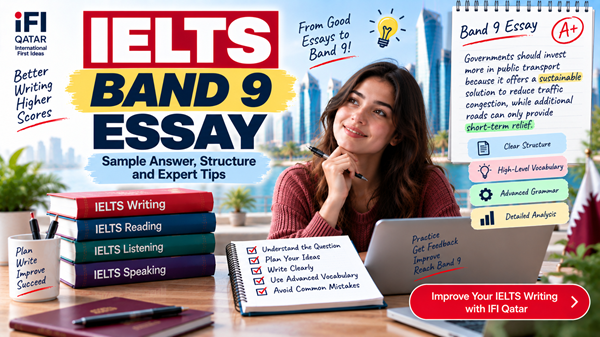
What Is an IELTS Band 9 Essay?
An IELTS Band 9 essay is not simply an essay containing difficult vocabulary and complicated grammar.
A high-level IELTS essay needs to answer the question directly, develop its ideas fully, organise information logically and use language accurately and appropriately.
According to the official IELTS Writing Task 2 Band 9 descriptors, a Band 9 response addresses and explores the prompt in depth, presents a clear and fully developed position, and supports relevant ideas thoroughly. It also demonstrates highly controlled coherence, vocabulary and grammar.
This means that a strong essay needs to succeed in four major areas:
- Task Response
- Coherence and Cohesion
- Lexical Resource
- Grammatical Range and Accuracy
The objective is not to make every sentence complicated.
The objective is to make every sentence clear, relevant, precise and purposeful.
What Does an IELTS Band 9 Essay Need?
Strong Task Response
A Band 9 essay must answer the actual question rather than simply discussing the general topic.
For example, if the question asks whether governments or individuals should be responsible for solving an environmental problem, your essay needs to address that specific responsibility.
A common mistake is to memorise a general environmental essay and adapt it poorly to the question.
A stronger approach is to:
- Identify the exact question.
- Decide your position.
- Select relevant arguments.
- Explain each argument.
- Support your ideas with appropriate examples.
Logical Coherence and Cohesion
A Band 9 essay should be easy to follow.
The examiner should be able to understand:
- What your main argument is
- Why each paragraph exists
- How your ideas relate to each other
- How your examples support your argument
- How your conclusion follows from your discussion
This does not mean using a linking word in every sentence.
In fact, excessive use of phrases such as:
Firstly, secondly, moreover, furthermore, on the other hand, therefore…
can make writing sound mechanical.
Instead, focus on the logical relationship between ideas.
Precise and Flexible Vocabulary
Band 9 vocabulary is not about filling your essay with rare words.
It is about choosing words that communicate your meaning accurately and naturally.
Compare:
Governments should do something about pollution.
with:
Governments should implement stricter measures to reduce industrial emissions.
The second sentence is more precise because implement, stricter measures, reduce and industrial emissions communicate specific meanings.
Flexible and Accurate Grammar
A strong IELTS essay should demonstrate a range of grammatical structures while maintaining control.
Useful structures can include:
- Complex sentences
- Relative clauses
- Conditional sentences
- Passive structures
- Concession clauses
- Participial clauses
- Modal structures
- Comparative structures
However, complexity should never come at the expense of accuracy.
A sophisticated sentence containing multiple errors is not automatically better than a clear sentence with accurate grammar.
How Long Should an IELTS Band 9 Essay Be?
For IELTS Writing Task 2, you must write at least 250 words. The official IELTS format recommends approximately 40 minutes for Task 2, and Task 2 contributes more to the Writing score than Task 1.
There is no need to chase an extremely high word count.
Instead, focus on:
- Fully answering the question
- Developing your ideas
- Supporting your arguments
- Maintaining clear organisation
- Leaving enough time to check your writing
A practical target is often around 270–320 words, although the quality and relevance of your response matter much more than hitting a particular word count.
IELTS Band 9 Essay Structure
A reliable structure can make it easier to organise your ideas under exam conditions.
Introduction
Your introduction should:
- Paraphrase the question
- Establish the topic
- Present a clear position or answer
Avoid spending too many words on background information.
Body Paragraph 1
The first body paragraph should introduce your strongest relevant argument.
A useful structure is:
Main idea → Explanation → Example → Link to the argument
Body Paragraph 2
The second body paragraph should develop another important argument or address the other side of the discussion when the question requires it.
Again:
Main idea → Explanation → Example → Implication
Conclusion
The conclusion should:
- Clearly answer the question
- Restate your position in different words
- Summarise the main reasoning
Do not introduce a completely new argument in the conclusion.
IELTS Band 9 Essay Sample
IELTS Writing Task 2 Question
Some people believe that governments should invest more money in public transport, while others think that building more roads is the best way to reduce traffic congestion. Discuss both views and give your own opinion.
Band 9 Model Essay
Traffic congestion has become a serious challenge in many rapidly growing cities. While some people argue that expanding road networks is the most effective way to address this problem, others believe that governments should prioritise investment in public transport. Although additional roads can provide short-term relief in certain areas, I believe that developing efficient and accessible public transportation is a more sustainable solution.
Those who support building more roads argue that existing infrastructure is often unable to cope with increasing numbers of private vehicles. When major roads become overcrowded, expanding them or constructing alternative routes can increase traffic capacity and reduce bottlenecks. This can be particularly effective in rapidly developing urban areas where infrastructure has failed to keep pace with population growth. For example, a new ring road may divert vehicles away from a congested city centre, allowing commuters and commercial traffic to reach their destinations more efficiently.
However, expanding roads does not necessarily address the underlying cause of congestion: excessive dependence on private cars. If additional road capacity encourages more people to drive, the initial reduction in congestion may be temporary. By contrast, reliable public transport can reduce the number of vehicles on the road by providing commuters with a practical alternative to driving. Investments in metro systems, dedicated bus lanes and integrated transport networks can therefore address congestion while also reducing fuel consumption and urban emissions. For instance, a well-connected metro system can transport thousands of passengers without requiring each individual to travel in a separate vehicle.
In my view, governments should therefore place greater emphasis on public transportation while continuing to improve road infrastructure where necessary. Roads remain essential for freight, emergency services and communities that cannot be effectively served by public transport, but they should form part of a broader transport strategy rather than being treated as the primary solution to congestion.
In conclusion, although building new roads can alleviate traffic problems in specific locations, investment in efficient public transport is more likely to provide a long-term solution. A balanced transport policy that reduces dependence on private vehicles while maintaining adequate road infrastructure would be more sustainable for growing cities.
Why This IELTS Band 9 Essay Works
The model answer above is useful because it does not rely on memorised phrases or unnecessarily complicated language.
Instead, it demonstrates several characteristics associated with high-level IELTS Writing.
The Position Is Clear
The writer’s position appears in the introduction:
“Although additional roads can provide short-term relief in certain areas, I believe that developing efficient and accessible public transportation is a more sustainable solution.”
The reader knows immediately what the writer believes.
The position is then maintained throughout the essay.
Each Main Idea Is Developed
The essay does not simply say:
Public transport is better.
It explains why.
The argument develops from:
More public transport → fewer private vehicles → less congestion → lower fuel consumption and emissions.
This creates a logical chain between the claim and its consequences.
Examples Support the Arguments
The essay uses examples such as:
“a new ring road may divert vehicles away from a congested city centre”
and:
“a well-connected metro system can transport thousands of passengers”
These examples illustrate the argument rather than replacing explanation.
The Essay Acknowledges the Other View
The writer does not ignore the argument for road construction.
Instead, the essay explains why additional roads can sometimes help before explaining why public transportation may offer a more sustainable long-term solution.
This creates a more balanced discussion.
Vocabulary Is Precise Rather Than Excessive
Notice the vocabulary used naturally:
- traffic congestion
- road networks
- infrastructure
- traffic capacity
- bottlenecks
- private vehicles
- public transportation
- practical alternative
- integrated transport networks
- urban emissions
- transport strategy
- sustainable solution
These words are relevant to the topic.
The essay does not use obscure vocabulary simply to appear advanced.
Band 9 Vocabulary You Can Learn From the Essay
Traffic and Transport Vocabulary
| Vocabulary | Meaning | Example |
|---|---|---|
| Traffic congestion | Heavy traffic and slow movement | Traffic congestion is a major problem in large cities. |
| Road network | A system of connected roads | The city needs to expand its road network. |
| Infrastructure | Basic systems and facilities needed by society | Transport infrastructure requires long-term investment. |
| Traffic capacity | The number of vehicles a road can handle | The new road increased traffic capacity. |
| Bottleneck | A point where movement becomes restricted | The bridge has become a major traffic bottleneck. |
| Private vehicles | Cars or other vehicles owned by individuals | Excessive use of private vehicles contributes to congestion. |
| Public transportation | Shared transport such as buses and trains | Reliable public transportation can reduce car use. |
| Integrated transport network | Transport systems that work together | An integrated transport network can make commuting easier. |
| Sustainable | Able to continue without causing unacceptable long-term harm | Cities need sustainable transport solutions. |
| Urban emissions | Pollution produced in cities | Public transport can help reduce urban emissions. |
Useful Argument Vocabulary
You can also use expressions that help you develop arguments:
- a serious challenge
- the underlying cause
- a practical alternative
- a long-term solution
- short-term relief
- a broader strategy
- play an important role
- reduce dependence on
- address the problem
- provide an effective solution
The key is to use these expressions only when they accurately fit your argument.
How to Write a Band 9 Introduction
A strong introduction does not need to be long.
A useful formula is:
Paraphrase + Position
For the sample question:
Traffic congestion has become a serious challenge in many rapidly growing cities.
This paraphrases the topic.
Then:
Although additional roads can provide short-term relief in certain areas, I believe that developing efficient and accessible public transportation is a more sustainable solution.
This establishes the writer’s position.
What to Avoid in an IELTS Introduction
Avoid:
This essay will discuss both views and give my opinion.
This sentence is not necessarily grammatically wrong, but it adds little value.
A stronger introduction uses the available words to establish the actual argument.
Also avoid:
Since the beginning of human civilisation, transportation has been important to people.
This type of broad background statement usually does not help answer the specific question.
How to Write Strong IELTS Body Paragraphs
A strong body paragraph should have a clear central idea.
One useful framework is:
Point → Explanation → Example → Result
For example:
Point
Reliable public transport can reduce dependence on private cars.
Explanation
When buses and rail systems are convenient, affordable and reliable, commuters have less reason to drive.
Example
A well-connected metro system can transport thousands of passengers without requiring each person to travel in a separate vehicle.
Result
This can reduce the number of vehicles on major roads and ease congestion.
This structure helps prevent paragraphs from becoming a list of disconnected ideas.
How to Write a Strong IELTS Conclusion
A good conclusion should answer the question without introducing a new argument.
For the sample essay:
In conclusion, although building new roads can alleviate traffic problems in specific locations, investment in efficient public transport is more likely to provide a long-term solution.
This works because it:
- Restates the central argument
- Acknowledges the alternative
- Maintains the writer’s position
Avoid Introducing New Ideas
Do not write:
In conclusion, governments should invest in public transport. They should also introduce higher fuel taxes and encourage cycling.
If fuel taxes and cycling were not discussed earlier, these ideas appear too late.
Introduce and develop your main arguments in the body paragraphs.
How to Improve Your Vocabulary for a Band 9 Essay
Vocabulary improvement should focus on precision, flexibility and collocation, not memorising long lists of unusual words.
Learn Topic-Based Vocabulary
Instead of memorising random words, create groups around common IELTS topics.
For example, for the environment:
- carbon emissions
- renewable energy
- fossil fuels
- environmental degradation
- climate policy
- sustainable development
For education:
- academic performance
- access to education
- higher education
- vocational training
- educational resources
- learning outcomes
Learn Collocations
Compare:
make a solution
with:
find a solution
Or:
strong traffic
with:
heavy traffic
Natural collocations can make your writing more precise and fluent.
Avoid Forced Advanced Vocabulary
Do not replace simple words with rare words unless the meaning is genuinely more precise.
For example:
Governments should ameliorate traffic congestion.
This is possible, but:
Governments should reduce traffic congestion.
may be more natural and direct.
Band 9 is not a vocabulary competition.
How to Improve Grammar for an IELTS Band 9 Essay
A high-level essay needs grammatical variety as well as accuracy.
Use Complex Sentences Naturally
For example:
Although additional roads can provide short-term relief, they may encourage greater dependence on private vehicles.
This combines a concession clause with a main clause.
Use Relative Clauses
Public transport systems that are reliable and affordable can encourage people to leave their cars at home.
Use Conditionals When Appropriate
If cities invest in efficient rail networks, fewer residents may depend on private vehicles.
Use Passive Structures When Useful
Significant investment should be directed towards public transport infrastructure.
But do not force advanced structures into every sentence.
The goal is controlled variety.
Common Mistakes That Prevent Students From Reaching Band 9
Memorising a Complete Essay
Memorised essays are risky because the actual question may be different.
Learn structures, argument development and useful language instead.
Using Unnatural Vocabulary
Using a dictionary to replace every common word with a rare synonym can make your essay sound unnatural.
Writing Extremely Long Sentences
Long sentences are not automatically sophisticated.
If a sentence contains multiple clauses that are difficult to control, split it.
Using Linking Words Too Frequently
A paragraph does not become coherent simply because it contains:
Firstly, moreover, furthermore, consequently, however, therefore…
Logical relationships should be clear from the ideas themselves.
Giving Examples Without Explaining Them
A weak paragraph may provide an example but never explain why it supports the argument.
Use:
Claim → Explanation → Example → Result
Ignoring the Exact Question
A well-written essay that does not fully answer the prompt cannot compensate for weak Task Response.
Always analyse the question before planning your answer.
How to Plan an IELTS Band 9 Essay in 5 Minutes
A short planning stage can make your writing more organised.
Step 1: Identify the Question Type
Determine whether the question asks you to:
- Agree or disagree
- Discuss both views
- Discuss advantages and disadvantages
- Discuss problems and solutions
- Answer two direct questions
Step 2: Decide Your Position
Write your position in one sentence.
For example:
Public transport should receive greater investment because it offers a more sustainable way to reduce congestion.
Step 3: Choose Two Main Arguments
Choose arguments that you can actually explain and support.
Step 4: Add One Example to Each Argument
The example does not need to be based on statistics.
A realistic example can be enough if it clearly supports the point.
Step 5: Plan the Conclusion
Restate your position in different words.
This five-minute process can prevent you from discovering halfway through the essay that your arguments do not answer the question.
IELTS Band 9 Essay Time Management
For Academic IELTS Writing, you have 60 minutes for two Writing tasks, with approximately 20 minutes recommended for Task 1 and 40 minutes for Task 2. Because Task 2 carries more weight, it deserves a larger share of your time.
A practical Task 2 plan could be:
| Stage | Time |
|---|---|
| Analyse the question | 2–3 minutes |
| Plan ideas | 3–5 minutes |
| Write | 25–28 minutes |
| Check and edit | 5 minutes |
During your final review, check:
- Subject-verb agreement
- Articles
- Verb tenses
- Spelling
- Punctuation
- Repeated vocabulary
- Missing words
- Sentence fragments
- Whether you answered every part of the question
Can You Get Band 9 With Simple Vocabulary?
Yes, provided that the vocabulary you use is sufficiently precise, appropriate and flexible for the task.
A Band 9 response is not defined by using the longest or rarest words available.
The official Band 9 descriptors emphasise full flexibility and precise use, with a wide range of vocabulary used accurately and appropriately and sophisticated control of lexical features.
Compare:
The government should do something about cars.
with:
Governments should introduce measures to reduce excessive dependence on private vehicles.
The second sentence is stronger not because the words are unusually difficult, but because the language is more specific.
Does a Band 9 Essay Need Complex Grammar in Every Sentence?
No.
A strong essay should demonstrate a range of structures with control.
For example, you might use:
Public transport is essential for large cities.
followed by:
Although expanding road networks can alleviate congestion temporarily, encouraging greater use of private vehicles may ultimately undermine this benefit.
The first sentence is simple.
The second is more complex.
Using both appropriately creates variation.
The official Band 9 descriptors focus on a wide range of structures used with full flexibility and control, rather than requiring every sentence to be complicated.
How to Practise IELTS Band 9 Essays
Writing one essay and reading a model answer is not enough.
Use a repeatable process.
Step 1: Write Your Own Essay
Give yourself approximately 40 minutes.
Step 2: Compare It With the Task Requirements
Ask:
- Did I answer every part?
- Is my position clear?
- Are my arguments relevant?
- Did I support my ideas?
Step 3: Check Your Organisation
Look at each paragraph.
Can you identify its central idea immediately?
Step 4: Analyse Your Language
Underline:
- Repeated words
- Grammar errors
- Weak collocations
- Informal expressions
- Unclear sentences
Step 5: Rewrite Weak Sentences
Do not simply correct the mistake.
Try to make the sentence clearer and more precise.
Step 6: Rewrite the Essay Later
After receiving feedback, write the essay again.
This is often more valuable than simply moving on to another topic.
How an IELTS Writing Course Can Help You Reach a Higher Band
Self-study can help you learn IELTS Writing strategies, but Writing is difficult to evaluate objectively without feedback.
A structured IELTS Writing course can help you:
- Understand the assessment criteria
- Improve essay structure
- Develop stronger arguments
- Expand topic-specific vocabulary
- Correct recurring grammar mistakes
- Improve coherence and cohesion
- Practise different Task 2 question types
- Receive feedback on your writing
- Track your progress over time
The most valuable feedback is not simply:
“Band 6.”
It is:
“Your position is clear, but your second main idea needs more development.”
That information gives you something specific to improve.
Frequently Asked Questions About IELTS Band 9 Essays
What is an IELTS Band 9 essay?
An IELTS Band 9 essay is a Task 2 response that fully addresses and explores the prompt, presents a clear and fully developed position, develops relevant ideas with appropriate support, and demonstrates very strong control of coherence, vocabulary and grammar.
How many words should a Band 9 IELTS essay have?
IELTS Writing Task 2 requires a minimum of 250 words. There is no official word count that automatically produces Band 9. The priority should be answering the question fully and developing relevant ideas clearly.
Can I memorise a Band 9 essay?
Memorising a complete essay is not a reliable strategy because IELTS questions can vary. It is better to learn essay structures, argument-development techniques, useful collocations and flexible language that you can adapt to the actual question.
What vocabulary should I use for an IELTS Band 9 essay?
Use precise, natural and context-appropriate vocabulary. Topic-specific collocations are usually more useful than memorising rare words simply because they sound advanced.
Do I need complex grammar for Band 9?
You need a wide range of grammatical structures used accurately and flexibly, but you do not need to make every sentence complex. Accuracy, control and appropriate variety are more important than sentence length.
What are the four IELTS Writing criteria?
IELTS Writing is assessed using Task Achievement/Task Response, Coherence and Cohesion, Lexical Resource, and Grammatical Range and Accuracy. For Task 2, Task Response is used rather than Task Achievement.
How can I improve from Band 6 to Band 7 or higher in Writing?
Start by identifying exactly why your current writing is receiving its score. Focus on Task Response, paragraph development, vocabulary precision, grammar accuracy and logical organisation rather than simply trying to add more advanced vocabulary.
Can one model essay prepare me for IELTS Writing?
No. A model essay can demonstrate structure, language and idea development, but you need to practise multiple question types and learn how to generate and develop your own arguments.
Final Thoughts on Writing an IELTS Band 9 Essay
Writing an IELTS Band 9 essay is not about making your essay sound complicated.
It is about demonstrating exceptional control over the fundamentals:
- Answer the exact question
- Present a clear position
- Develop your ideas fully
- Use relevant examples
- Organise paragraphs logically
- Choose precise vocabulary
- Use grammar flexibly and accurately
- Check your work carefully
The strongest IELTS writers do not try to impress the examiner with every sentence.
They make their argument clear, relevant, precise and easy to follow.
If your goal is to move towards a higher Writing band, regular practice combined with detailed feedback can help you identify the specific weaknesses holding your score back.
Ready to Improve Your IELTS Writing?
If you want structured IELTS Writing practice, expert feedback and guidance on Task 1 and Task 2, explore the IELTS Writing Course at IFI Qatar and develop a preparation plan around your target band.
Write with purpose. Get expert feedback. Prepare for your target IELTS score.